The issue of legalizing prostitution remains one of the most hotly debated topics in Ukrainian society to this day. Both its supporters and opponents present a host of compelling arguments. But what was the situation regarding this issue more than 100 years ago?
Until the mid-19th century, prostitution was cracked down on quite harshly in the Russian Empire: women were flogged, arrested, and exiled. During the reign of Nicholas I, given the ineffectiveness of punishment and other punitive measures, as well as the rise in sexually transmitted diseases, prostitution was legalized in the empire by a special decree.
In 1843, a special medical-police committee was established. It was tasked with monitoring the activities of sex workers. The police were required to track down women who had made prostitution their profession, register them, and subject them to medical examinations.
The passports of sex workers were confiscated, and they were issued a special certificate in exchange, which was called the “yellow ticket” because of its color. Thus, brothels and prostitutes operated quite legally and lawfully in our city until the arrival of Soviet power, which began to zealously combat the remnants of the “wicked bourgeoisie.”

On May 29, 1844, Count Lev Alekseevich Perovsky, Minister of the Interior, approved the document titled “Rules for Brothel Keepers.”
So, what regulations and requirements had to be met in order to open such an establishment in Kharkiv in the mid-19th century?
There were a total of 32 brothel rules.
The first condition stated:
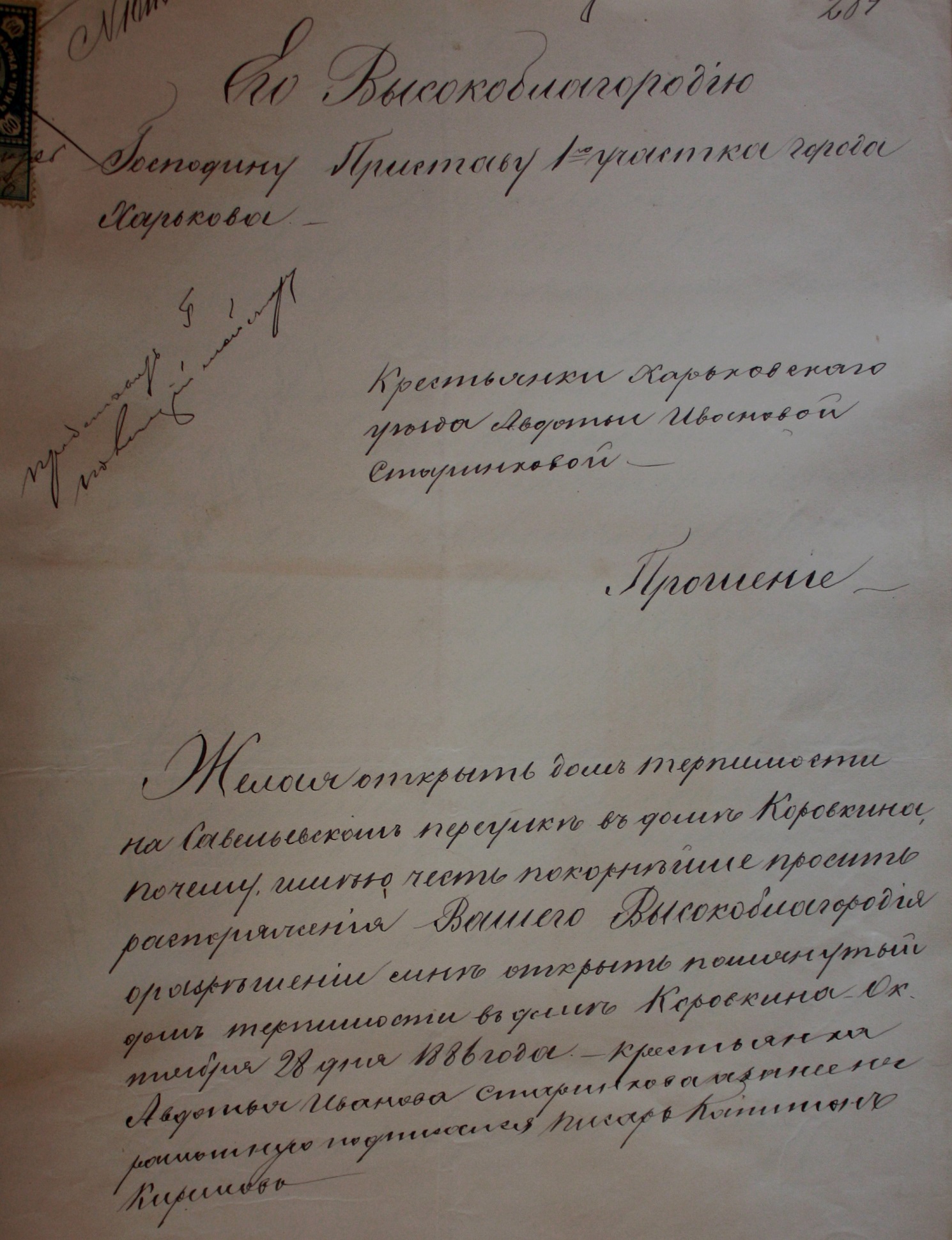
- Brothels can only open with police permission.
It is precisely for this reason that hundreds of petitions like these can be found in the collections of the State Archives of the Kharkiv Region:
2. Only a middle-aged woman, between the ages of 30 and 60, may obtain a license to open a brothel.
The third rule stipulated that if a brothel owner had children, she was not allowed to keep them with her (in the brothel). Nor was she allowed to rent rooms to ordinary tenants.
4. Upon receiving a license, the brothel owner was required to sign a pledge to comply with all health-related rules pertaining to “her women” as established by the Committee.
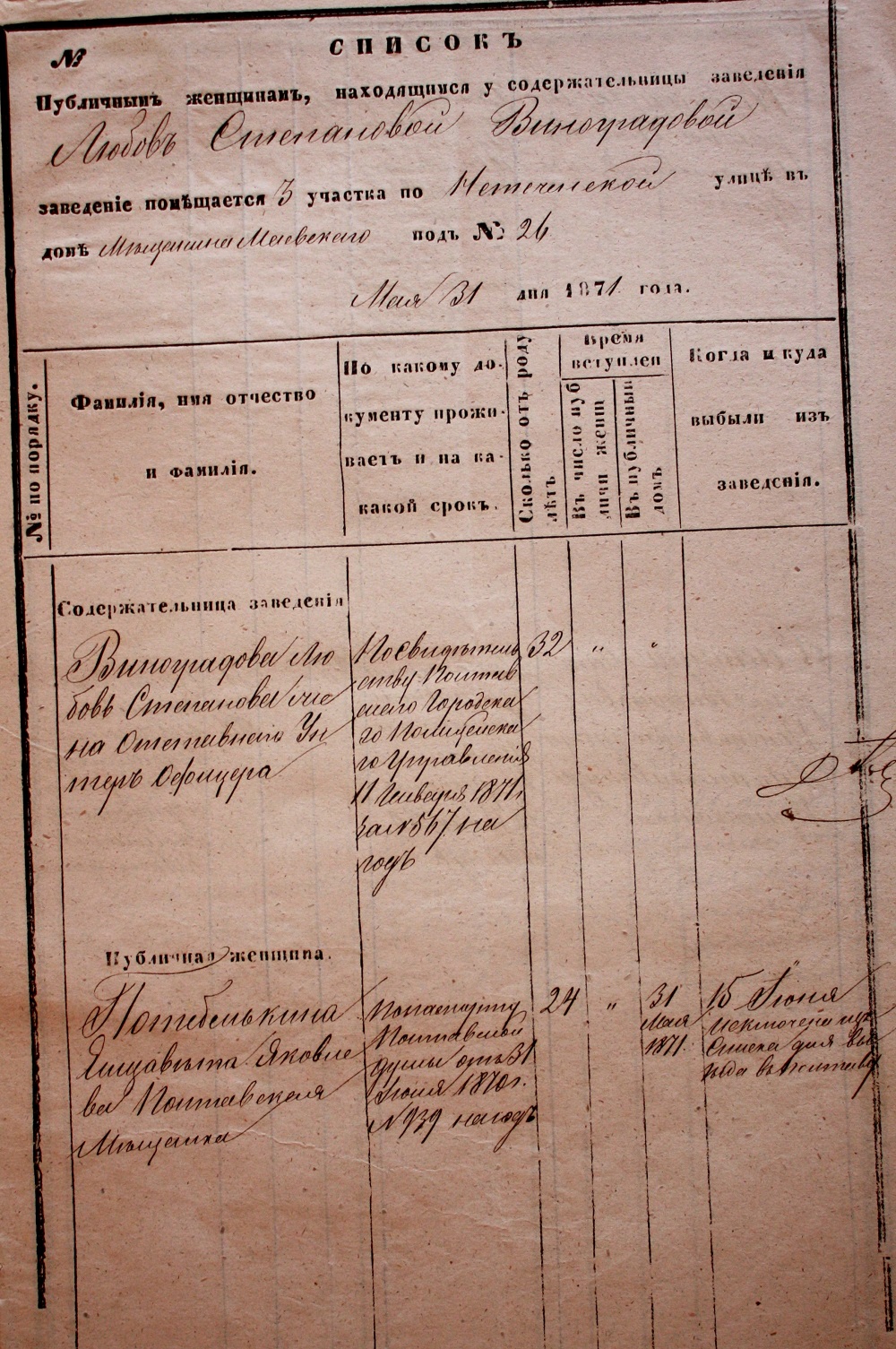
5. The brothel owner was required to maintain lists (prepared according to the attached form) of the women in her brothel.
6. She was required to keep these lists up to date and in good order.
7. To ensure that only the women listed on these records were permitted to work in the brothels; outsiders were not to be admitted under any circumstances.
Rule 8 clearly stated:
8. No women under the age of 16 may be admitted to brothels.
9. For women who have left the brothel, the proprietress is required to provide the doctor with a police certificate confirming the validity of their departure and the location to which they have gone.
Rule 10 is also quite interesting. It turns out that,
10. The debt claims of a brothel owner against the women working there should not be used as grounds for forcing the latter to leave the brothel.
Rules 11 through 13 addressed the situation in which a brothel owner decided, so to speak, to “step away from the business.”
11. The brothel owner has the right to close the brothel whenever she wishes, provided she notifies the police in advance.
12. She may transfer ownership of her establishment to another person, but only with the permission of the police.
13. A brothel owner who closed her brothel was not exempt from police supervision.
The following rules were covered by the sanitary and technical standards:
14. The brothel’s premises must be proportionate to the number of women working there.
15. The beds must be separated either by light partitions or, if circumstances do not permit this, by screens.
16. The air in the rooms must be refreshed frequently.
17. The proprietress must maintain the necessary cleanliness both in the apartment and in the bed linens, and likewise ensure that the women’s clothing is kept clean.18. She requires that the women in her establishment keep themselves neat and tidy, and to this end she strictly monitors:
a) That they wash certain parts of their bodies with cold water as often as possible, and especially that women who have been with a client do not immediately move on to other clients without washing first, and that they change their undergarments whenever possible.
b) That women who are menstruating be strictly prohibited from engaging in their trade.
c) That women of the night be required to go to the bathhouse twice a week.
d) That they use as little as possible white powder, rouge, strongly scented lipstick, ointments, and rubs.19. The owner is directly responsible for any failure to comply with these cleanliness rules.
20. The landlady is also held strictly liable for driving the maids living with her to the point of extreme exhaustion through excessive demands.
The legislation also provided for the protection of the sex workers themselves.
21. It is the madam’s responsibility to maintain quiet and, as far as possible, decorum in the brothel. She prevents the women in her care from excessive consumption of strong alcoholic beverages.
Because the Russian Empire was an Orthodox state, the rights and interests of believers—both those working in brothels and those visiting them—were also taken into account.
22. Brothel owners are prohibited from admitting visitors on Sundays and holidays until Mass has ended.
23. Underage males, as well as students at educational institutions, must not be admitted to brothels under any circumstances.
Rules 24 through 32 dealt with medical examinations—and this is not surprising, since sexually transmitted diseases were a major problem at that time (as they are today, for that matter).
24. On the day designated by the doctor for the visit, the brothel owner is required to present all the women in her brothel to him for examination. She must unconditionally comply with all his instructions regarding this matter.
Note. During each medical examination of the women of the trade, the doctor, in addition to noting their state of health on their medical records, shall schedule the date of their next visit.
25. Regardless of whether the women are examined by doctors, the brothel owner shall personally examine the women in her brothel every day and shall immediately send those who are ill to a special women’s hospital.
By the way, Rule 26 tells us that:
26. Those women of the night who are infected with a venereal disease and who voluntarily present themselves at a special women’s hospital are admitted for treatment free of charge, whereas, on the other hand, for those who are admitted there as a result of a medical examination, the brothel owners pay a certain sum.
27. Failure by any of the women to appear as a witness shall be deemed concealment. For concealment, the woman in charge shall be sent to a correctional facility. For this purpose, in accordance with the regulations of the Medical-Police Committee, she is handed over to the police, who then notify the Medical-Police Committee of the guilty party’s transfer and her release from the correctional facility.
28. The landlady shall keep the medical certificate regarding the women in good condition and in a conspicuous place, as proof of their state of health.
29. The medical examination also extends to the brothel owners themselves, their adult daughters, female relatives, and maids, if they are suspected of engaging in prostitution.
30. When a brothel owner transfers or takes on a new prostitute, she shall notify the police and inform the doctor so that the newcomer may be examined without delay, and shall not allow her to engage in prostitution until then.
31. Likewise, she shall notify the physician of any women found to have other types of illnesses or to be pregnant, and, upon the physician’s instructions, shall prevent such women from engaging in the trade.

Here’s some very interesting information in Rule 32. It turns out that the courtesans of that time
32. It is strictly forbidden to resort to any means of terminating early pregnancy in prostitutes, or to treat sick young women with medicines or by persons who are not authorized to do so, or to use medicines reputed to be beneficial according to popular tradition.
Of course, a number of changes were later made to these rules and laws. And they were by no means a panacea for all of society’s ills. Abuses in brothels—both legal and illegal—continued. The problem of sexually transmitted diseases has not gone away either. However, when addressing today’s question of legalizing prostitution, I believe it would be worthwhile to take into account such significant legislative experience—not only from neighboring countries but also from our ancestors…

- About the military pilot school and the airfield in Kharkiv… - 04.11.2020
- Kharkiv Artisans and the 1887 Exhibition - 17.08.2020
- Nikanor Savich—A Political Career by Mistake - 13.07.2020