In the past century, the lands of Sloboda Ukraine were home to many politicians whose names became well-known and respected throughout the country. Many left behind memoirs in which they recounted their work in city, county, or state councils, as well as their views and assessments of various events and political intrigues.
Reading memoirs is always interesting, and as I looked at all this historical legacy that has come down to us, I thought for a very long time about whose memoirs I should recommend reading first. A renowned idealistic scholar, considered one of the leading Freemasons of the past, who entered the world of high politics with the desire to change the world? Or, perhaps, a brilliant socialite who came from a titled and extremely wealthy family in our region and who describes in his memoirs all the details and intricacies of behind-the-scenes negotiations between parties and ministerial appointments? In the end, after much deliberation, I chose Nikanor Savich, who served as a deputy from the Kharkiv Governorate in the Third and Fourth State Dumas from 1907 to 1917, and later held important positions under Denikin and Wrangel. I have already written about the Savich family, a family of senior military officers, and its well-known members in our region.
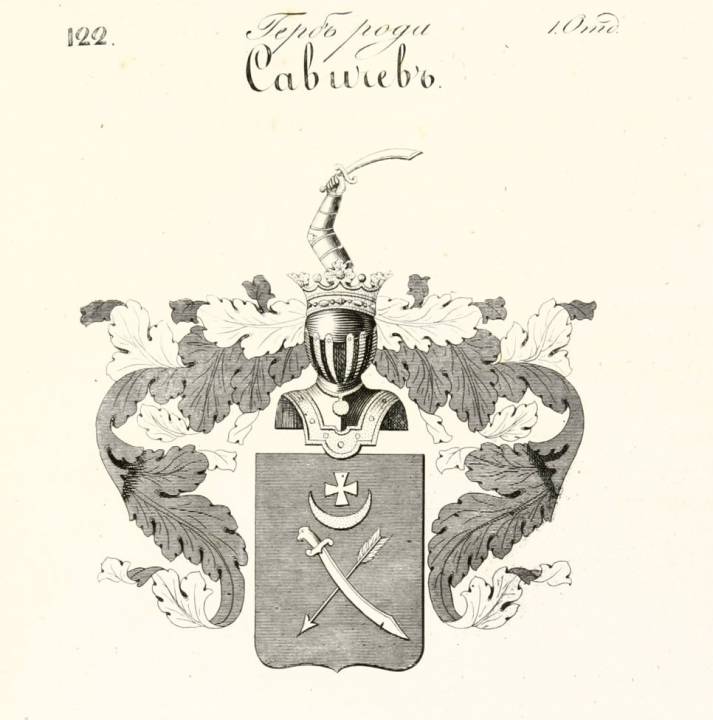
Nikanor Vasilyevich himself was born on December 22, 1869, at the family estate of Belovody in the Sumy Uyezd. He studied at the Faculty of Physics and Mathematics at St. Petersburg University. Despite his success in the sciences, Nikanor was never able to continue his studies and earn a degree. After his father’s death in 1895, he inherited a large but neglected estate of 679 desiatinas, along with family debts and the responsibility of caring for his younger brothers, who were still in school. Nikanor Savich moved to Belovody, where he devoted himself entirely to agriculture and lived as a recluse for some time. He describes his entry into big-time politics quite honestly, calling it a “career by mistake.”
…So I was greatly surprised when I once learned from the local news section of the newspaper *Yuzhny Krai* that I had been elected a delegate to the Sumy County Zemstvo. In the fall, I received a summons calling me to the next session of the zemstvo assembly. I went. The other council members were complete strangers to me; I had never even seen I. D. Traskin, our leader of the nobility, before. I began fulfilling my new duty by paying him a visit. He turned out to be a very kind, pleasant man, already elderly; he had known my father well in the past and welcomed me warmly, but he seemed to have a certain hint of—I’m not sure whether it was distrust or wariness—regarding my future activities in the Zemstvo. Only later, at the end of the session, did he tell me that this was because the “liberals”—as he called the party of our district council chairman—had nominated me as a candidate for the council in the election…
…The chairman of the local council, I. M. Lintvarev, was an energetic man who loved the limelight and, of course, belonged to the left wing of society. A small landowner himself, he managed to establish close ties with a group of peasant council members, with whose help he successfully fought against the “right-wing” faction, whose entire agenda could be summed up in one word: economy. In this clash of interests, the assembly split almost into two equal factions; every vote counted, so it seemed certain that the liberals had put forward my candidacy because they were confident in my “liberalism”—that is, in my willingness to vote for as much new spending as possible. Traskin was very surprised when I mentioned in passing that “I don’t know any of the council members and ask him, our leader, to introduce me to my colleagues on the council, and first and foremost to the chairman of the council”…
…When the session ended, the council members of the “left-wing” group invited me to join them for a friendly dinner. At that point, I couldn’t help but ask them why they had nominated me for the council—even though they didn’t know me at all. The brother of the council chairman, G. M. Lintvarev—who later became a member of the First Duma—admitted that “a mistake had been made.” A vacancy had opened up following the departure of one of the council members, and their group did not have a suitable candidate. They feared that someone from among the supporters of the “Conservative Party”—that is, those who intended to obstruct the expansion of the zemstvo’s economic activities—would be elected. They knew that in the remote village of Belovody, deep in the county, lived one of the Savich brothers—a young man who had recently appeared in the local court on some matter. They did not know him personally, but had heard that he was an assistant to a barrister at the St. Petersburg Bar Association. And since he was young and, moreover, belonged to the legal profession, he must be a “progressive.” That is why they put forward this candidate. But no one knew this Savich’s first name, and there were several members of that family on the Sumy County voter list. They began to make inquiries, and one of the administrators said that the Savich from Belovodsk was named Nikanor—so they put him forward as a candidate. It later turned out that they had meant my brother—Nikolai, who was indeed an assistant to a barrister. But there was nothing to be done; the election had taken place, and I had already been elected—as it turned out—by mistake. That is how my career in the zemstvo began ‘by mistake’…
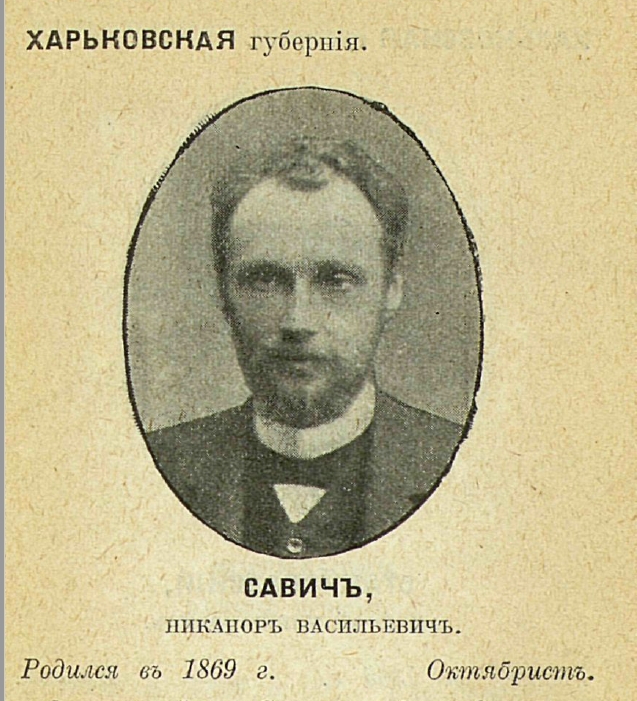
After some time, thanks to his energy and brilliant oratory skills, Nikanor Vasilyevich became familiar with local zemstvo affairs; he actively supported all initiatives aimed at advancing the core objectives of the zemstvo and fought against anything he considered unnecessary. However, in 1905–1907, though he was already a well-known public and political figure in the Kharkiv Governorate, he did not participate in the elections or the work of the 1st and 2nd State Dumas of the Russian Empire, nor did he explain his reasons for doing so. Instead, he provided an excellent and balanced account of everything that was happening at that time, both in the country and in Kharkiv. Savich also remains steadfastly silent about his participation and victory in the elections to the Third State Duma, merely noting:
…Several weeks passed, and the Second State Duma was dissolved. This was followed by a decree on a new electoral law, which came to be known as the Law of June 3. The law was issued by decree; it was, in essence, a coup d’état. But it preserved the very essence of the new constitutional system, the ‘representative system,’ as Stolypin himself called it. In the circles to which I belonged, this law was met with undisguised jubilation. For us, this was a sign that, despite the absurd behavior of the first two State Dumas, the “crowning achievement” that the zemtsy had been striving for so many decades had not been dealt a fatal blow, and that public representatives continued to participate in the governance of the state and in the oversight of the executive branch’s activities. At the same time, we believed that from then on the path of revolution would be abandoned, that society would become convinced that the future and prosperity of the state lay in peaceful evolution and in cooperation between representatives of society and the hereditary monarchy. We were aware that the new law, by granting us greater rights, thereby imposed upon us a greater responsibility for the country’s future. But at that time, we believed in our own strength—or rather, in our good intentions. We were convinced that, by embarking on a path of constructive work together with Stolypin, we would succeed in firmly establishing relations between the government and the people, as represented by the newly created legislative body…
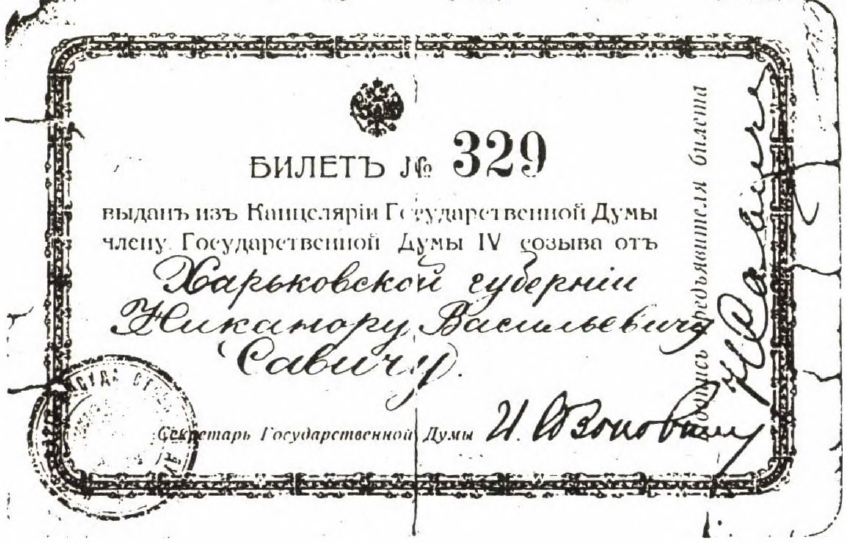
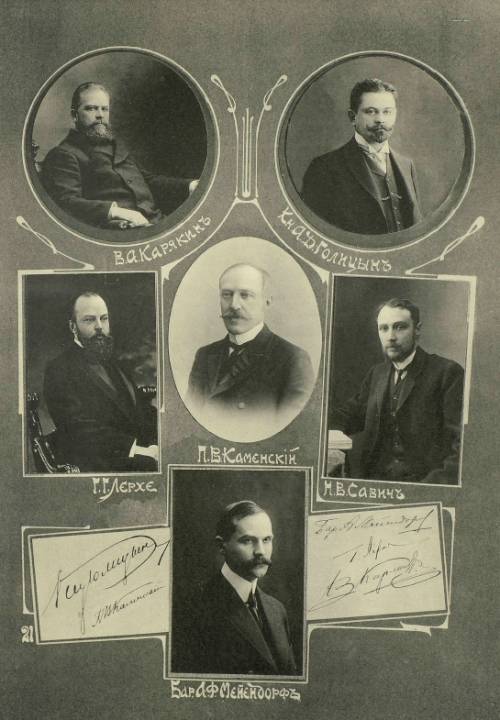
As a deputy in the State Duma during its third and fourth sessions, Nikanor Savich was actively involved in many committees at various times and chaired some of them. For example, he served on the Budget Committee, the Committee on National Defense, the Land Committee, and the Committee on the Expenditures of the Ministry of War, where he participated in the review and drafting of legislation. Thus, in the Duma, Nikanor Savich eventually became the closest associate of the well-known politician and statesman Alexander Ivanovich Guchkov and the secretary of the Octobrist faction. Possessing exceptional work ethic and enjoying a reputation as a deputy of impeccable integrity who knew how to keep secrets, he eventually headed the Subcommittee on Naval Affairs. And his expertise in financial matters was soon recognized by prominent figures in the Admiralty, ranging from Admiral Grigorovich—who became minister in part thanks to the support of the Duma commission—to the young and talented rapporteur from the Naval General Staff, then Captain 1st Rank Alexander Vasilyevich Kolchak. By 1917, Nikanor Savich’s authority in naval affairs was so great that immediately after the February Revolution, the Provisional Government offered him the post of Minister of the Navy and a seat at the Admiralty, in the building “Under the Spire.” However, our fellow townsman, fully aware of the Provisional Government’s dependence on the Petrograd Soviet of Workers’ and Soldiers’ Deputies, declined to accept this position.
Savich writes quite candidly about the reasons for his return to Ukraine:
…One day in May, an unfamiliar gentleman in civilian clothes came to see me, but his entire demeanor indicated that he was a military man from the good old days of the Tsarist era. He introduced himself as Colonel Nikolaev of the Hetman’s service, who had arrived in Petrograd as the commandant of a special train that had just arrived from Kyiv. This train had been sent to transport to the south those Ukrainian citizens stranded in the north whom the new government needed to organize the administrative apparatus of the Ukrainian state. An agreement had previously been reached with the Bolsheviks regarding the unimpeded release of these individuals, among whom my name was listed. At the same time, Nikolaev informed me that many of my good acquaintances and friends from the State Duma and the Kharkiv Provincial Council had played an active role in organizing the new government. It was thanks to them that I had been included on the list of individuals to be evacuated first. I had to give an immediate answer as to whether I agreed to be evacuated to an independent Ukraine. Although I felt not the slightest sympathy for the Hetman’s aspirations for independence, I had no reason to hesitate, for in essence I had to choose between the Hetman and Lenin…
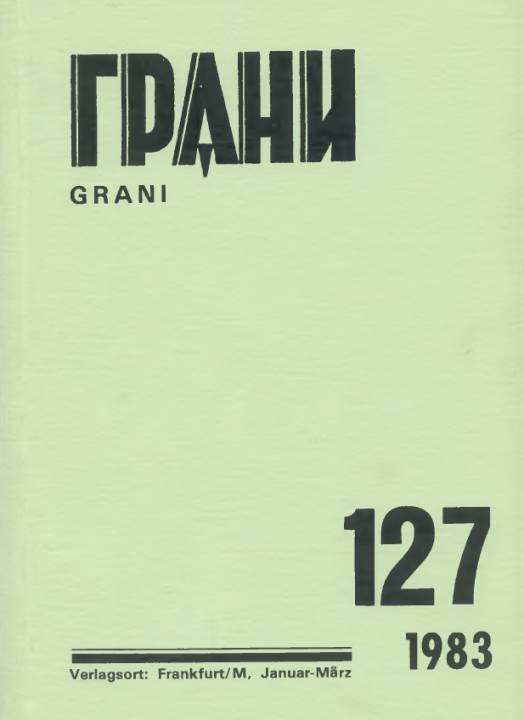
In December 1918, Nikanor took part in a well-known meeting of political figures with representatives of the Allies in Iași. The subsequent sections of his memoirs are devoted to his flight to the south, the decline of the White movement, and his emigration to Istanbul. From 1921 onward, Nikanor Savich lived in Paris, where, in 1927, having withdrawn from political and public life, he began working on his memoirs. However, the war that began in September 1939 and the subsequent occupation of France brought publishing activities by many émigrés to a halt. Ultimately, having lost all hope of seeing his memoirs published, Nikanor Vasilyevich Savich died in Aulnay-sous-Bois (a suburb of Paris) on March 14, 1942, and was buried in the Sainte-Geneviève-des-Bois Cemetery. It was not until 1983 that his memoirs were published in installments across several issues of the journal *Grani*, and in 1993 as a separate book. And although they were written by a monarchist and opponent of the Hetmanate, the text will be of great value to anyone interested in the political life of our region in the first half of the 20th century and its most prominent figures.

- About the military pilot school and the airfield in Kharkiv… - 04.11.2020
- Nikanor Savich—A Political Career by Mistake - 13.07.2020
- And once again, about the Cavalry Guards… - 21.01.2020