Travel notes by foreigners about Kharkiv have always been valuable because they allowed us to view familiar things and phenomena from an unusual perspective. But particularly interesting are the notes of people who were able to rise from the particular to the general, revealing a picture of large-scale social processes. One such intellectual traveler was the German linguist and Orientalist Julius von Klaproth. Among his achievements is the popularization of the ideas of the Indo-European and Tibeto-Burman language families. But we are interested specifically in his observations about Kharkiv, Sloboda Ukraine, and Ukraine as a whole, which he recorded in his book “Travels in Caucasus and Georgia, Performed in 1807–1808”.

His journey took him, among other places, through Sloboda Ukraine. Von Klaproth’s notes on our region are so fascinating that we will reproduce them in full.

“Kharkiv is just like Bordeaux”. Unfortunately, this had nothing to do with beauty but rather with the mud, which was so thick you couldn’t even walk through it on stilts.
Kharkiv, where we arrived towards evening on the 8th of October 8, is seated in an extensive plain, partly on an eminence between the rivers Chakowa and Lopan. It would be one of the best and most agreeable of the medium-sized towns in Russia were it not almost as filthy as Orel, and the mud frequently so deep as to prevent the pedestrians from going abroad, while droschkes (cabs) drawn by two strong horses stick fast in many places. Nay it is my opinion that it would not be possible here as it is at Bordeaux, to walk through the dirt upon stilts. Fortunately for us, the weather during the first part of our stay was serene and dry, and then the mud on the streets, like the sand in Brandenburg, becomes compact, so that you may traverse it without sinking. I was therefore enabled to pay my first visits on foot, but was not always so lucky and as to pick my way without accident.

However, von Klaproth created a device for walking through mud—long shoe covers fastened with straps. For the most part, they worked, but on one occasion, the mud in Kharkiv sucked a traveler’s boot off his foot along with the cover, snapping the straps.
As it difficult at Charkow to procure a hired droschke at a short notice, I contrived another method of conquering the dirt. Very wide fur-boots, which as the cold increased and the weather became more in inclement might be borne, where provided in the top with straps and buckles, and thus fastened above the knee when we went abroad. This invention stood the test; for thus equipped we could go almost any where, and at the place of our destination could with little trouble throw off these leg-covers at the foot of the stairs; and I recollect only one single occasion, when the top-boot stuck so fast in the mud that the strap at the knee broke and the whole was left behind. At present this inconvenience is said to be less felt; for the principal streets have been covered with fascines, so that carriages at least may now proceed without obstruction.
A significant portion of the notes on Kharkiv is devoted to the young university. The faculty, consisting of elderly Germans, had absolutely no desire to learn the local language and held an extremely condescending view of their students:
Charkow has become better known abroad in consequence of the university founded there by the present emperor; but this measure does not seem to have rendered the place more flourishing: for, excepting some public buildings which have been repaired for the use of the university, no change of consequence has taken place here, and the number of inhabitants, amounting to 6,000 has not increased in any considerable degree.

Among the professors of Charkow, I found some Germans well known for their works, but who seemed to me not to be exactly in their element here. This observation applies to most of the Germans who, when no longer young emigrate to Russia and enter into the service of the crown, if they are not appointed government service if they are not appointed to situations in Petersburg and Moskwa. It is however in some measure their own fault. Many of them, for instance, neglect to learn the Russian language, under the idea that they have no occasion for it, and expect the natives to converse with them in a foreign idiom. This is unreasonable; for, when a man resides in a country to take the trouble to learn its language.-Again, the Germans would have every thing to proceed in Russia just it does in their own country, and most of them insist on this point with such obstinacy as to excite the hatred of the Russians. They also in general think themselves wiser and better than their new countrymen, and in betraying these sentiments to the latter they prove that they are neither the one not the other. This conduct occasions circumstances extremely unpleasant to themselves; but in the Russians, who are accustomed to take things more easily, it creates contempt and aversion for these strangers. I have often wondered in silence at the blindness of self-conceited foreigners, who fancied themselves esteemed by all, and perceived not that whenever they appeared they were the objects of universal derision.-In my opinion, therefore, only such young Germans should go to Russia, as are yet capable of adapting themselves to the way of thinking and acting in that country.

On the other hand, the researcher emphasized that the local population’s motivation to attend university was also weak, since the state lacks a middle class (there are only “masters and slaves”), the merchant class sees no particular need for higher education (which, moreover, following the German model, does not provide in-depth knowledge but merely covers broad topics), and the children of the nobility are satisfied with their home education. After all, the main thing for them is to secure a position in the civil service through connections, not through skills acquired at the university.
The building appropriated to the university is spacious, and according to report is about to be still further enlarged; but the number of the students would be very small had it not been augmented by a recent ordinance of the emperor, according to each no person shall be appointed to any civil employment unless he has studied at some Russian university, nor any individual without a previous examination in the sciences be promoted to a staff officer, or from a collegiate counsellor to a counsellor of state.

The idea of founded University at Charkow was not of itself a bad one comma because many opulent gentry whose seems might have benefited by it resided in that vicinity. But in Russia there is yet too little taste for learning and the old French mode of education is still too fashionable; on which account people of rank and fortune very seldom avail themselves of the advantages offered by universities and other seminaries. It was likewise an exceedingly injudicious step to attempt to introduce knowledge into Russia by means of foreigners, and to raise a fabric which requires the labor of ages, and expeditiously as a triumphal arch may be patched up. The only method of effectually promoting the diffusion of science in Russia would have been to have sent young Russians who had distinguished themselves in the ordinary schools to some good seminary in Germany, and thence to an university where they might have prepared themselves for their this destined career. Such persons as these, at their return, which certainly have furnished the best teachers for the institutions for the promotion of learning.

At present, on the contrary, the whole course of instruction from the normal schools upwards is radically faulty, because encyclopedian method of teaching so prevalent in Germany has been introduced; by which method the pupil learns a little of every thing but nothing thoroughly, and the most acquires an historical notion of each science, which in the end proves of no further use to him, and which he very soon forgets. As long as the sciences have been cultivated in Russia, the mathematical have been considered as best adapted to the diffusion of knowledge in the country; but it was long since justly remarked by Schlözer, that no nation in the world was ever yet rescued from barbarism by the mathematics. Nature changes not the course; and it is by the arts and sciences, by the belles-lettres and poetry, that the Greeks and Romans, the Italians, French, English, and Germans attained to so high a degree of civilization.

Another almost insurmountable obstacle which will long prevent Russia from making any progress in the sciences, lies in the political constitution. As there is no middle class in the country the whole nation is divided into two parts, masters and slaves; and at present in another way, into persons who are in the service of the state and such are not. To the latter belong the vassals and tradesmen, who have neither inclination nor opportunity to cultivate their minds. The others are much to anxious to obtain honours and titles, which the service alone confers, to devote much time to the sciences. Every one strives at as early an age as possible to procure an appointment under the crown, for each he needs nothing but a good recommendation, and an acquaintance with the Russian style of business and the laws of the country. He has no encouragement to study the sciences, of which he knows nothing and for which he he thinks that he has no occasion. Till, then, a middle class of citizens shall rise in Russia no real diffusion of knowledge can be reasonably expected.
Julius von Klaproth was forced to stay in Kharkiv because his apartment had been burgled and he had no money left to continue his journey. The irony of the situation was that a guard had been stationed at his house at the time of the burglary, which particularly outraged the explorer.
Unfortunately for me, I was detained considerable time in at Charkow by various circumstances; for one evening when I had been invited by the civil governor to tea, and by Mr. von Stoikowitz, who was then rector of the university, to supper, some thieves, getting in at the window of my apartment from the court-yard, robbed me not only on my linen and clothes, but also of a large sum of money which was locked up in the same room. This happened about 10 in the evening, while Bobrintsow the student and the police soldier assigned me by the burgomaster is a guard were in the house. The affair made considerable noise in the town; and in a wood near Charkow was found one of my uniforms, which was returned to me quite torn in pieces: but none of the thieves has yet been brought to punishment; a circumstance that reflects the highest honour on the police of the town, by which the sentry had been appointed to attend me! I have since heard that one of the robbers was actually taken, but that he either escaped or was set at liberty.

Even after von Klaproth had managed to pack some of his belongings for the rest of the journey, Kharkiv would not let him go—his carriage got stuck in the mud on the way out of town. Nevertheless, he managed to reach Izyum, which left him with a more favorable impression.
Having in some measure replaced the necessaries which I had lost, I left Charkow on the 30th of October; but before we reached the gate our carriage stuck so fast in the mud that it could not be drawn out of this slough of the Muses without some additional horses. By pleasant and level road we soon reached the circular town of Isjum, 111 wersts from Charkow founded in 1687 by a colonel named Donez, on both sides of the river Ssevernoi Donez, and rivulet Mokraja Isjumza. It was formerly the principal defence against the incursions of the Tartars into this government, and has still an earth-work on a hill, but which is now very ruinous. In the town are three churches built of wood, and one of stone erected by command of Peter the Great.
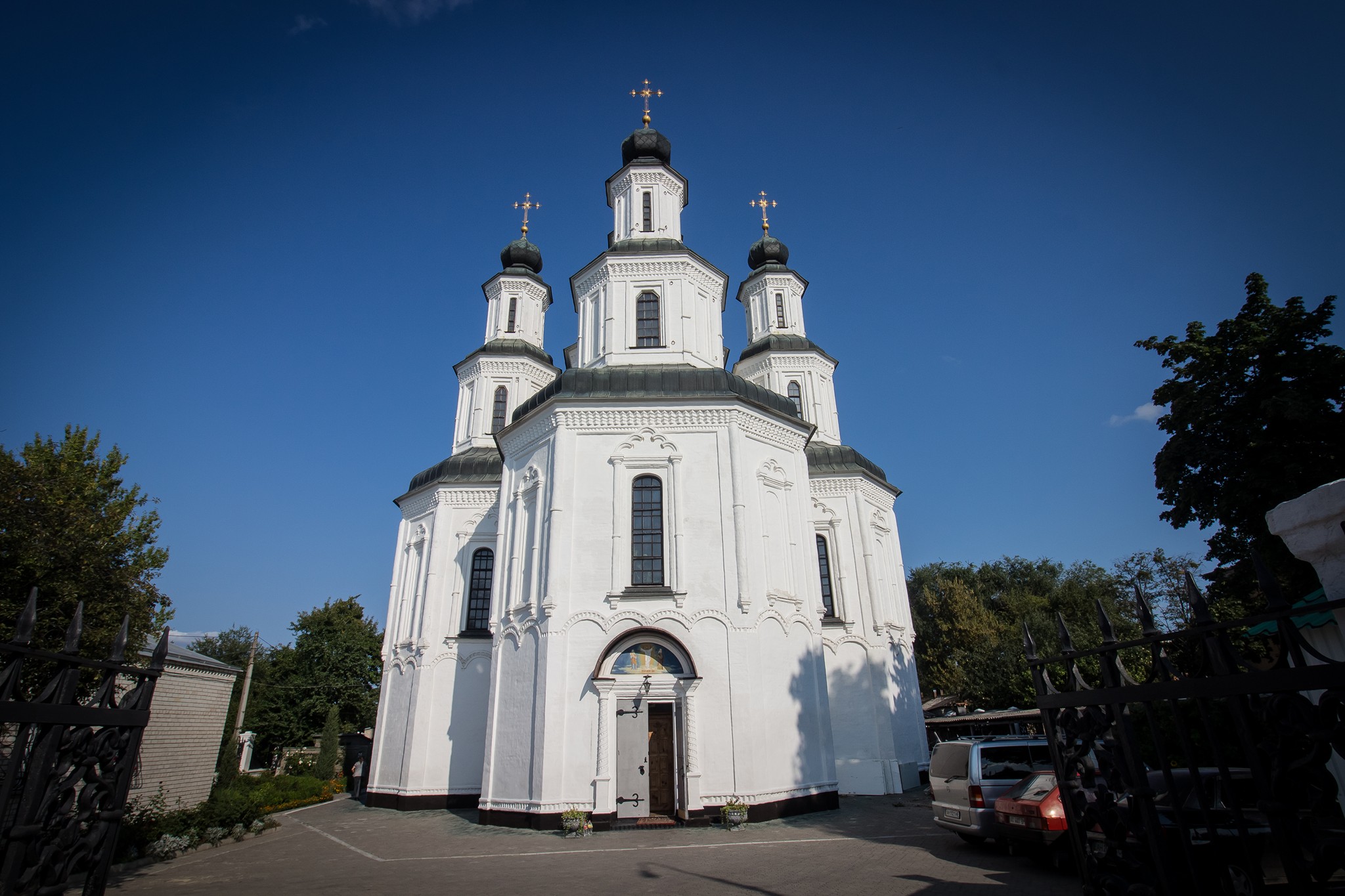
The number of inhabitants amounts to 5,000, so that this place must be deemed tolerably lively. Isjum is better and more regularly built than the other towns of the governments of Charkow, and was once the most populous of them all. One couse of the decrease of its inhabitants was the plague introduced by the Tartars; but the other circumstances have likewise occasioned frequent emmigrations. From this place there was formerly a convenient passage from the Donez to the sea of Asow; and during the war with Porte, from 1736 to 1739, troops, provisions, and other necessaries, were conveyed in beidars from Isjum to the mouth of the Don; for above that town vessels found a good depth of water from the village of Smiewan, which is only 44 wersts from Charkow, and indeed it was navigable as high as Bielgorod: but now the mill-dams, constructed above and below Isjum on the Donez, have raised and filled up the bed of the river and covered its banks with water, so that it is no longer passable for vessels.

Isjum (in the Russian and Tartar Raisins) has it arms three vines with bunches of grapes hanging from them in a field or, in allusion to the name of the town, and to denote that its district is favourable to the growth of that fruit. The principal support of the inhabitants, and the peasants who rove about in its neighborhood, is agriculture and the breeding of cattle, namely, horses, oxen and particularly sheep, for which this town and its circle are remarkable, since even Silesian sheep are kept there. The place has likewise a considerable traffic in Greek and Turkish commodities, and in the great market-house are several shops belonging to resident Greek tradesmen.
The explorer’s journey through Sloboda Ukraine then took him through Bakhmut, which von Klaproth also found very appealing.
As it was yet early in the day we pursued our journey, and, having proceeded 65 wersts further, passed the night at Bachmut on the river of the same name. This town was anciently a fortress of some importance against the Tartars; but of its works nothing is left except a spacious quadrangular area surrounded by a high rampart pf earth. The place however is thriving and populous, and carries on a considerable trade with the adjacent country.

Between the ancient fortifications and the left bank of the river Bachmut are the two salt-springs of Kirikowskoi and Chaikowskoi, from the water of which is boiled a great quantity of salt that is exported to other governments. The name Bachmut is probably a corruption of Mahhmud, or perhaps even of Mohhammed, as the Russians and Tartars frequently change M into B: thus. the latter frequently say Busurman for Moslemim, etc. This town belongs tp the government of Jekaterinoslaw, and is now the capital of a circle; it is situated in a pleasant and fertile country. in a plain that gently slopes to the banks of the river.
It is worth mentioning von Klaproth’s profound reflections on the history of the peoples he observed and studied—he provided a rich context for his travel notes. Von Klaproth noted that it is now hardly possible to consider the Ukrainian and Russian languages as having common roots, given how much they have changed over centuries of independent development.
The Rusinians rendered important service to the Polish state above three centuries, from 1340 to 1650, protecting it from incursions of the Tartars, and guarding the Turkish frontiers. This accidental separation of southern from northern or Great Russia, produced such a change in the inhabitants of the former, that they would scarcely be supposed to proceed from the same stock. The same cause gave rise to the Little Russian Ukraine dialect, which is in like manner a distinct language of Slavonian origin.
The form of government has a great influence on the mode of life of conquered nations, and the transformation of a whole people. The changes of domestic economy, of sentiments, language, and character, or the distinguishing trait in the manners of a nation, flow from this source. Upon this principle the alterations which have taken place in the south of Russia may easily be accounted for. During a period of 80 years it was subject to the Tartars, 20 to the Lithuanians, 300 to the Poles, till 1650, and for some time to the Hungarians.
Nevertheless, all the inhabitants of the Ukrainian lands, from Lodomeria to the Don, remembered their former metropolis—the city of Kyiv—and this was particularly evident during religious holidays, when Kyiv was flooded with pilgrims.

The inhabitants of southern Russia, separated from one another by distance of habitation, differences of sovereignty, form of government, civil customs, language, and some also by religion, attract the serious attention of the observer who views them with a philosophical eye. When they assemble on religious occasions at Kiew, from the Don and Wolga on the east, from Galicia and Lodomiria in the west, and other less remote parts, they consider one another not as people speaking different languages, but as descendants from one common stock, who differ only in their mode of expression and customs, which cause them to appear foreign to one another: but upon the whole, all these people, though so widely dispersed, still retain a child-like veneration for the metropolis of their ancient country—the city of Kiew.


- Danylevs’koho Street, 19 - 13.10.2026
- Debunking the myth about one of the most famous Kharkiv photos - 12.10.2026
- The Architectural Evolution of the Kharkiv Theater - 26.09.2026