As we all know, our beloved city is home to people of many nationalities and religious backgrounds.
The history of Kharkiv’s Islamic community has been little studied to date: it is full of mysteries, gaps, and interesting facts.
In the book by D. I. Bahalii and D. P. Miller, *The History of the City of Kharkiv Over Its 250 Years of Existence*, it is mentioned that the city’s Muslim community numbered 38 in 1866, and by 1897, it had grown to 760 Tatars. This growth was attributed to the stationing in Kharkiv of a Tatar-Bashkir cavalry detachment during the Russo-Turkish War.

According to the *Kharkiv Calendar* for 1897, there were 1,067 Muslims in the province (959 men and 108 women), of whom 220 men and 30 women lived in Kharkiv. In the county seat of Sumy, however, there were 500 Muslims, all of whom were men.
It’s no secret that Kharkiv, both then and now, is a college town. However, even today, Muslim students here are often viewed as negative and alien figures. In the student rosters of the Kharkiv Imperial University for 1868–1869, listed as number 80 in the third year of the law school, one can find one of the first Muslim students. He was Gatsyr Shanaev, a former student of the 2nd Kharkiv Gymnasium.
At the beginning of the 20th century, there were quite a few Muslim students. The rosters for 1907–1908 include one of the first foreign students who practiced Islam. Jafarov Mamed Jafarov, a Persian subject, studied at the Faculty of Medicine.
On June 20, 1893, the following news item appeared in the Kharkiv newspaper *Yuzhny Krai*:
June 20. A prayer service was held at the Moskalevsky Barracks in connection with the Bayram holiday. About 400 worshippers gathered. Mullah Kurban Galleev led the service. The issue of building a mosque was raised.
One of the distinctive features of our beloved city is that it welcomes and embraces everyone into its heart, regardless of nationality or religion. Whatever anyone may say, unlike other cities, there were no pogroms against Jews or Germans in Kharkiv prior to 1917.
In 1904, a significant event took place in the lives of Kharkiv’s Muslims. In the *Kharkiv Calendar*, which regularly published the calendars of all the religious communities in our city (Orthodox, Catholic, Lutheran, Jewish, Karaite, Armenian-Gregorian), the “Muslim Calendar for 1904—1321–1322 Hijri” was published for the first time.
From this point on, the Muslim calendar will be published annually until the publication ceases.

The first official Muslim organization was established by decree of Catherine II in 1788. The purpose of establishing the Orenburg Muslim Spiritual Assembly (OMDS) was to ensure state control over the Muslim clergy. Subsequently, the OMDs came under the jurisdiction of the Department of Religious Affairs of Foreign Faiths within the Ministry of Internal Affairs.
Some of the earliest documents detailing contacts between the Orenburg Muslim Spiritual Assembly and the Kharkiv Muslim community—related to the maintenance of our city’s civil registry records—date back to 1893. If you wish, you can consult them at the State Archives of the Kharkiv Region.


However, the most interesting material is, alas, accessible only to a few. The most valuable information about the Muslims of Kharkiv, including the parish registers, can be found in the following collections:
1) RGIA — Form 821 of the Department of Religious Affairs of Foreign Denominations of the Ministry of Internal Affairs.
2) Central State Historical Archive of the Republic of Bashkortostan, Ufa I-295, Orenburg Muslim Religious Assembly.
On February 24, 1906, the Construction Department of the Kharkiv Provincial Administration received a request from the Kharkiv Muslim community to approve plans for the construction of a mosque.
As a result, on August 21, 1906, the mosque was fully completed on a lot belonging to the Muslims Muhammad Gane and Khabibula Terberdeev at Yaroslavskaya Street, 33.

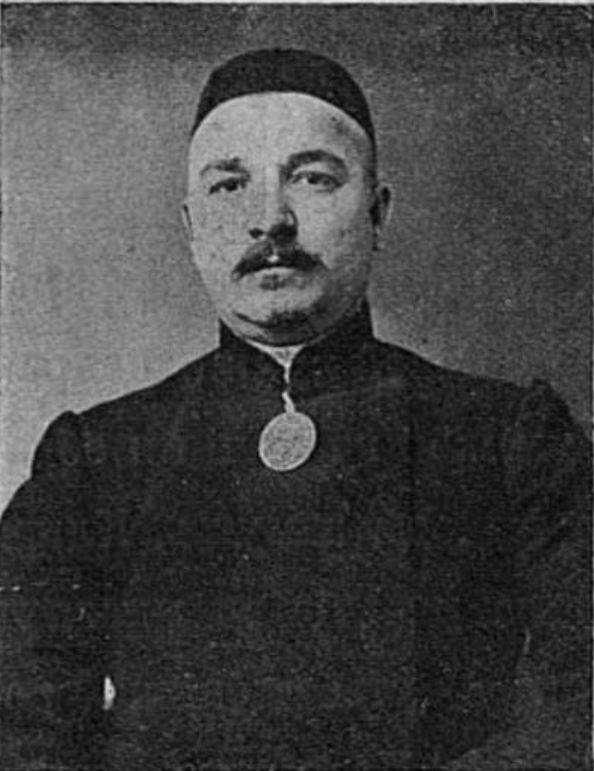
For many years, the spiritual leader of the Muslims in our city was Muhammad Rakhim Alimovich Uzbyakov, the Kharkiv provincial ahun and the official military mullah of the Kyiv Military District. His contribution to the life of the Islamic community and to the history of pre-revolutionary Kharkiv was immense. Unfortunately, his biography was previously unknown, and it was also unclear what he looked like.
However, while working with the wonderful 1913 book *Jubilee Historical and Artistic Edition in Commemoration of the 300th Anniversary of the Reign of the Romanov Dynasty*, which contained numerous biographies of famous people of that time, I was fortunate enough to find both. So the photo below is being published for the first time.
It turns out that Uzbyakov was born in 1871 in the village of Kiryushkino in the Saratov Governorate. He received his elementary education at a local school and his specialized theological education in Kasimov, in the Ryazan Governorate, at the Kastrovsky madrasah, where, upon completing the course on September 1, 1895, he was awarded the title of muderiss (teacher) and Doctor of Muslim Theology. Subsequently, upon the recommendation of the Kiryushkino community, on October 28, 1895, the Saratov Provincial Administration appointed him mullah of the Third Cathedral Mosque.
On April 3, 1900, at the request of our city’s Muslim community, Muhammad Rakhim Alimovich Uzbyakov was appointed mullah of the Kharkiv Central Mosque by the provincial government. For distinguished service, he was elevated to the honorary title of ahun in 1906, and on January 1, 1909, he was awarded a large silver medal on the Vladimir ribbon.
Pursuant to a request from the General Staff, on October 3, 1909, Uzbekov was appointed to the position of staff military mullah of the Kyiv Military District.
Mulla was married to the daughter of Ayup A. Baishchev-Ayshi, a hereditary honorary citizen, and had four children.
At the very end of the text, it was specifically noted: “The name of Muhammad Rahim Uzbekov, as the spiritual leader of the Muslims, is well known and highly respected both among fellow believers and in public circles.”
At the beginning of the 20th century, there was a Muslim Charitable Society in our city. Little is known about its activities, but while working with documents in the archives, I accidentally discovered several of the society’s reports from 1910 and 1912. Thanks to this, we can learn new and interesting details about the life of the community.
It turns out that, according to the budget adopted on January 6, 1912, the community’s revenue in 1911 amounted to 950 rubles, including:
Membership dues—200;
income from the mosque—500;
income from the movie theater—250 rubles.
Expenses included: payments for heating and lighting, the mosque caretaker’s salary, cemetery maintenance, aid to the poor, and debt repayment. As of January 1, 1912, the outstanding debt for the construction of the mosque and cemetery still amounted to 1,576 rubles and 89 kopecks.
In addition, the Muslim Charitable Society’s general meeting decided to offer Russian language classes at the mosque, provided there is sufficient interest.

Speaking of movies, articles from Kharkiv newspapers dating back to 1913 reveal that the Muslim community organized charity screenings at the Bommer Brothers’ movie theater on Yekaterinoslavskaya Street to help fellow Muslims in need.
In March 1915, World War I, raging across Europe, was taking a terrible toll everywhere. At that time, all ethnic and religious communities were helping the military in any way they could.
In issue No. 11 of *Ogonyok*, a magazine popular throughout the Russian Empire, we find an interesting photo and accompanying text:
In Kharkiv. A group of members of the Kharkiv Women’s Muslim Committee for Aid to Wounded Soldiers at work making linens.
Committee Chairs: 1) H. Bashkirova 2) H. Tuteeva 3) A. Uzbyakova

Here’s a short note and some new insights about our amazing city, where no one will ever feel like a stranger if they open their heart to it.

- About the military pilot school and the airfield in Kharkiv… - 04.11.2020
- Kharkiv Artisans and the 1887 Exhibition - 17.08.2020
- Nikanor Savich—A Political Career by Mistake - 13.07.2020