In 1838–1839, Mikhail Pavlovich Zhdanov, an official with the Ministry of the Interior, undertook a working trip through 20 provinces of the empire. The purpose of this journey was to gather information on the state of agriculture. As he set out on this long journey, Mikhail Pavlovich naturally wanted to purchase a guidebook to the cities and provinces he was about to visit. However, alas, no such guidebook was available.
Here is what the author himself has to say about this:
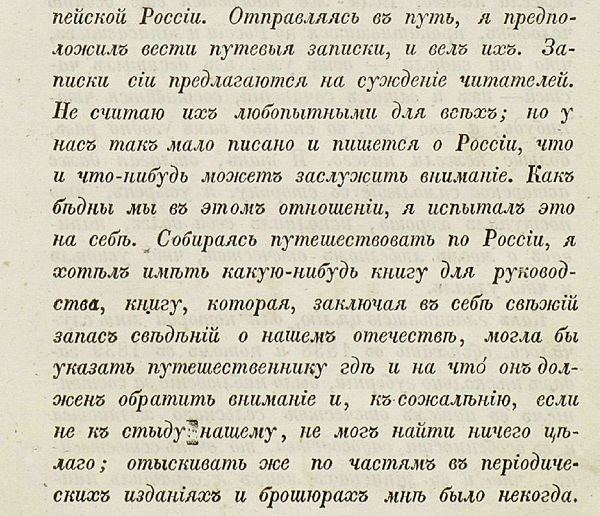
As he himself points out, this was precisely what served as the impetus for writing the book *Travel Notes*.
Although this book was subjected to scathing and merciless attacks by the renowned literary critic Vissarion Grigoryevich Belinsky after its publication in 1843, these entries offer many interesting insights into our beloved city.
Not long ago, we saw Kharkiv in the 1820s and 1830s through the eyes of Felix Osipovich von Reinhardt, who lived during that time. Now, let’s take a look at it through the eyes of a passing government official, traveler, and author of one of the empire’s first travel guides…
Zhdanov begins writing about Kharkiv long before his arrival:
A striking contrast in opinions sometimes arises from a change in location. In St. Petersburg, people discuss and strive to increase and improve grain harvests, while in the southern provinces—such as Tambov, Voronezh, and Kharkiv, in Little Russia—it is not uncommon to hear: “It wouldn’t hurt to have a ‘costly year’ come along”—that is, a year with a poor grain harvest but a bountiful one for money. Here, landowners often laugh when you start discussing the theory of crop rotation to increase yields. “Give us a break,” they say, “We have nowhere to sell even this much grain: no one buys it.” What can one say in response to such an objection?
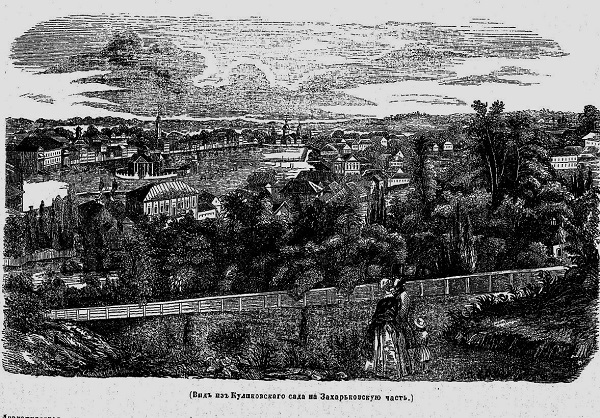
Kharkiv, viewed from the north as you enter through the Moscow checkpoint, does not look very appealing.
In contrast, from the Poltava road—from the so-called Kholodna Hora—the city opens up before one’s eyes and presents a picturesque scene. The city is quite well laid out, situated on the banks of the Kharkiv and Lopan Rivers; large stone buildings line Moskovskaya and Zalopanskaya Streets, as well as parts of Sumskaya Street and the city square.
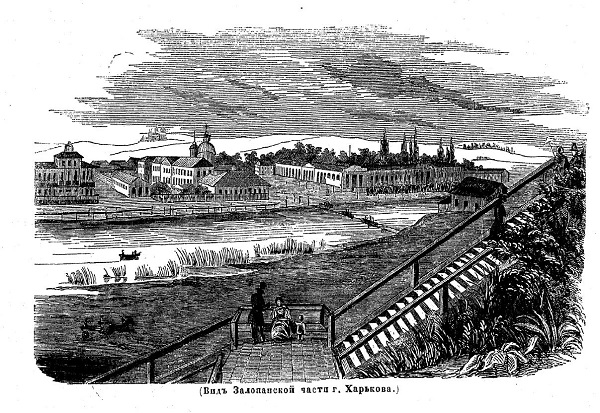
If the benches were arranged in one place and in a square, they could serve as a decoration for the city; but as they are now, scattered in various locations, they do not look particularly good. The buildings of the University, the Institute, and the government offices are very fine. Kharkiv is renowned as the center of learning in southern Russia. Landowners bring their sons here to enroll them in boarding schools, the Gymnasium, and the University; their young daughters to boarding schools and the Institute; and their adult daughters to the fairs: Epiphany, Assumption, and Trinity. At the fairs, wool is sold, while dresses, hats, bonnets, perfume, and lipstick are bought. Young men buy horses from the fathers, and often pledge their hearts to the daughters as a token of their affection. During the fairs (especially the Epiphany Fair), young people party at Motozka’s hotel; champagne flows, gold is scattered across the green tables, and then passes from hand to hand in heaps. Anglers come here to fish in the murky water and take advantage of the simplicity of the steppe folk; but this has become very rare in recent times. The hotel offers a wonderful view of the city: nearby is Moskovskaya Street, then a vast square, and beyond the Kharkov River, lined with beautiful houses and two churches; outside the city, you can see the mental hospital and, beyond it, green fields.

Thanks to Mikhail Pavlovich’s writings, we learn that for the residents of Kharkiv at that time, the University Garden (now Shevchenko Park) was “very far away.” We also learn that there was a “Chinese-style gazebo” there. It’s a real shame that the park isn’t being restored to its original form, because this beautiful gazebo could have been its crowning glory.
The Institute for Young Ladies is highly praised; and now, under its new director, many improvements are being made there. The University Garden serves as a place of recreation for city residents; it is a pity that it is very far from the city center. (At the end of Sumskaya Street, near the checkpoint.) The garden’s main avenue (up to 500 sazhens long), lined with elms and poplars, is very beautiful; at its end stands a Chinese-style gazebo, from which one can see the lower garden and the university greenhouses. Here, in the botanical garden—which is well-designed and thoughtfully laid out—students walk around with their notebooks, examining and studying plants noted for their healing powers or other properties.
No doubt many readers will be surprised to learn that Zhdanov goes on to describe in detail how the landowners in Kharkiv are paying close attention to the development of… sheep farming.

After describing the sugar industry and horticulture, Mikhail Pavlovich delivers a sort of verdict on our beloved city:
Life in Kharkiv can be pleasant; at any rate, everything points to that: the Governor-General’s residence, good society, scholars, intellectuals, artists, the theater, the nearby Chuguev military settlements that supply gatherings with officers, and especially the low cost of housing and daily necessities. I knew one student who rented three rooms and a stable, lived with two other people, and paid a total of forty rubles a month, including food.
It should also be noted that Mikhail Pavlovich Zhdanov’s visit to our city at that time was not his last. From 1854 to 1856, he served as vice-governor of Kharkiv.
Every record of this kind about Kharkiv from past centuries is priceless, because, like a time machine, they transport us to another era and give us the chance to see our beloved hometown, which was just getting started back then…


- About the military pilot school and the airfield in Kharkiv… - 04.11.2020
- Nikanor Savich—A Political Career by Mistake - 13.07.2020
- And once again, about the Cavalry Guards… - 21.01.2020