In the first half of the 19th century, there was no radio, no television, and no Internet in Kharkiv. Even newspapers were not the same as they were at the beginning of the 20th century.
For these reasons, memoirs from that period remain an extremely important source for us to this day, allowing us—much like a time machine—to be transported back to a time when all the most interesting things about our beloved city were just beginning.
In 1887, the memoir “Kharkiv in the 1920s and 1930s” was published in the first volume of the *Kharkiv Collection*.
The author of the memoirs was Felix Osipovich von Reingardt.
At the very beginning of the text, a brief biography of him was included:
The author of this note on Kharkiv, Felix Osipovich von Reingardt, a native of Tavasthus, Finland, was educated at the Reval Gymnasium and Kharkiv University (at the latter from 1827, having arrived in Kharkiv in 1826). In Kharkiv, he attended lectures on medicine and took the master’s exam in pharmacy at Moscow University; he subsequently ran his own pharmacies in Belgorod and Korotich. After leaving the pharmacy business, he passed exams at St. Petersburg University to become a German teacher and at Kharkiv University to become a history and geography teacher. After that, he served for 25 years as a teacher in Kharkiv at the 2nd and 3rd boys’ gymnasiums, at the 1st Girls’ Gymnasium from the time of its founding until his retirement; furthermore, he taught at all girls’ boarding schools and educational institutions in Kharkiv, with the exception of the Institute for Noble Young Ladies. Currently, as a landowner, he resides on his estate in the village of Sennoye, Bogodukhovsky District.
F. 0., despite his advanced age (75 years old, born in 1812), has a sharp memory, so he did not use any notes or reference materials when compiling his memoirs. As a veteran educator, he has organized and systematized his memoirs. The content of these memoirs pertains to the 1920s and 1930s; however, some material from later periods has also been included. We would be very pleased if this note were to inspire other long-time residents of Kharkiv to put their memories of their hometown down on paper or, at the very least, to write their own additions and corrections to this article. Of particular interest would be notes from professors—veterans of Kharkiv University—about their time there
Written in vivid and lively prose, these memoirs are filled with numerous fascinating details about both the city itself and its inhabitants, and can certainly be considered an encyclopedia of life in Kharkiv during the first half of the 19th century.
Since the topic of alcohol has been in the news a lot lately, that’s what we’ll focus on. Let’s start, perhaps, at the lower end of the alcohol content scale and gradually increase it as the story progresses…
For example, Reinhard writes the following about beer in Kharkiv:
The Iskra Brewery, located outside Kharkiv, near the outpost on Iskrinskaya Street and close to its windmill, supplied Kharkiv and the surrounding area with excellent Little Russian beer, the quality of which was almost on par with Kochubeevskoye from Dikanka. Its beer was thick, slightly sweet, and effervescent. The so-called Bavarian beer—white, thin, and bitter—was not yet known in Kharkiv at that time. In the 1820s, Danilson and Kron’s white beer was imported from Moscow; the beer improved during transport and was of higher quality than the same product I had had the opportunity to drink in Moscow and St. Petersburg themselves; but this beer was sold at a high price. At Sherykin’s tavern, they charged nearly a ruble in banknotes per bottle.
Of course, Felix Osipovich, like today’s researchers in Kharkiv, did not lead tours along Kontorskaya Street. However, he does mention this street in his notes. It is precisely thanks to his unique insights that the city’s residents have every right to propose opening a vodka museum on this street, for that is exactly where it belongs.
There was only one distillery—used for purifying grain wine and producing various specialty vodkas, sweet vodkas, and liqueurs—located at the office of the concessionaire Kozma Nikitich Kuzin on Kontorskaya Street.
Here’s what the author writes about what we now call “nalivaykas”—the places associated with so many tragic stories these days. Judging by their locations, the situation hasn’t changed much since then, and they still stand in the same familiar spots as they did over 100 years ago.
At that time, Little Russia still enjoyed the privilege of unrestricted distillation; only in certain cities, which had been leased out, was vodka sold at a higher price; on all sides—on the outskirts of the city and along the main roads beyond the city gates—checkpoints had been set up, and a guard would approach anyone entering or passing through the city to verify whether they were carrying or transporting illicit wine. He would thrust long, one-sazhen-long, pointed iron probes into carts loaded with hay, straw, or other goods, and rigorously inspect the interiors of passing carriages—a task no one could prevent him from performing. But despite all this strictness, illicit distilling often took place—and woe to those caught in the act! Caught red-handed, they were escorted by the border guards straight to the prison, where they remained until the criminal court reached a verdict. Working-class people and, in general, those who enjoyed vodka—especially cheap vodka—didn’t drink much in the city; instead, in their free time, especially on Sundays and holidays, they flocked out of town to enjoy their freedom: to the village of Filippovo, to Osnova, beyond Kholodnaya Gora to the Kamenny Inn—two versts from Kharkiv—to Danilovka, or just outside the city to the inn on the Zmiiv Road. There, where prices were 8 or 10 times cheaper than in the city, they would drink until they were drunk to the gills and, staggering and singing, would walk back into the city past the police officers who eyed them askance. But, alas, this pleasure did not last long: by the late 1830s, a concession tax had been imposed on the district, and the number of taverns had greatly diminished.
I imagine today’s young people would find it interesting to learn what life was like among the nobility in the 1920s and 1930s.
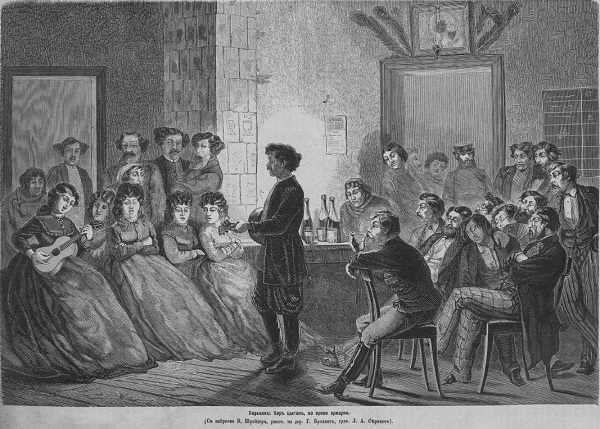
Vodka wasn’t considered appropriate for young people, and until the age of 20 or 25—at least in polite society—they never touched it; it was considered shameful.

- About the military pilot school and the airfield in Kharkiv… - 04.11.2020
- Nikanor Savich—A Political Career by Mistake - 13.07.2020
- And once again, about the Cavalry Guards… - 21.01.2020