In an effort to stabilize the political situation amid widespread unrest and revolutionary protests, on October 17, 1905, Russian Emperor Nicholas II issued a supreme manifesto on the improvement of the state order (the so-called October Manifesto), drafted primarily by Minister of the Interior A. G. Bulygin. The historical significance of this manifesto lay in the fact that, together with the manifesto of August 6, 1905, “On the Establishment of the State Duma,” it made it possible to enact the corresponding law on December 11, 1905. A total of 135 electoral districts were established, in which elections were held in February and March. The First State Duma lasted 72 days (April 27–July 9, 1906) and held only one session.
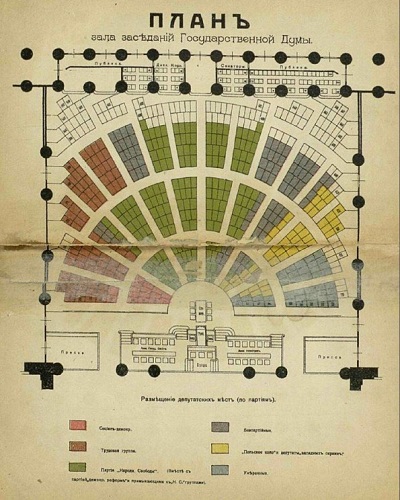
On July 8, 1906, Emperor Nicholas II issued a manifesto dissolving the State Duma.
Elected by the people, instead of carrying out their legislative duties, they have strayed into a realm that does not belong to them and have turned to investigating the actions of local authorities appointed by Us, to pointing out to Us the imperfections in the Fundamental Laws—amendments to which can be undertaken only by Our Royal Will—and to actions that are clearly unlawful, such as the Duma’s appeal to the people on its own behalf. The peasantry, unsettled by such disorder, without waiting for a lawful improvement in their situation, resorted in a number of provinces to open looting, the theft of others’ property, and disobedience to the law and lawful authorities. But let Our subjects remember that a lasting improvement in the people’s way of life is possible only through complete order and tranquility. Let it be known, then, that We will not tolerate any arbitrariness or lawlessness, and with the full force of state power We will bring those who disobey the law into submission to Our Imperial will. We call upon all right-thinking Russian people to unite in support of lawful authority and the restoration of peace in Our beloved Fatherland.
The manifesto also announced that new elections would be held under the same rules as those for the First State Duma. So on July 9, when the deputies arrived for the session, they found the doors to the Tauride Palace locked, and nearby—nailed to a post—the manifesto announcing the dissolution of the legislative body.
New elections began, resulting in the Second State Duma, which existed from February 20 to June 3, 1907. It differed little from the previous one—the sharp confrontation with the Council of Ministers continued. The deputies of the Second Duma held only one session and worked for a total of 102 days.
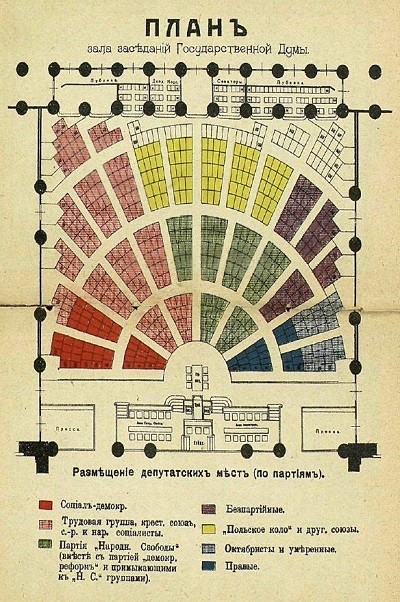
On June 3, 1907, the Second Duma was dissolved ahead of schedule. This led to the so-called “June 3 Coup.” One of its key outcomes was the reform of the electoral system itself. Not all residents of the empire had the right to vote at that time. To be eligible to vote, one had to meet specific criteria at least one year before the election. The result of this convoluted legislation was an extremely disproportionate representation of various segments of society in the Duma. Complex rules haphazardly divided the population along property, religious, and ethnic lines in various regions.
However, one indisputable merit of the Third Duma is that it served its full term as prescribed by law—five years (from November 1, 1907, to June 9, 1912).
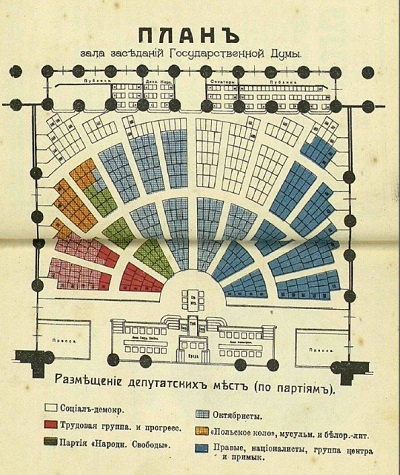
The Fourth State Duma began its work on November 15, 1912, and on October 6, 1917, it was officially dissolved by decree of the Provisional Government in connection with the scheduling of elections to the All-Russian Constituent Assembly.
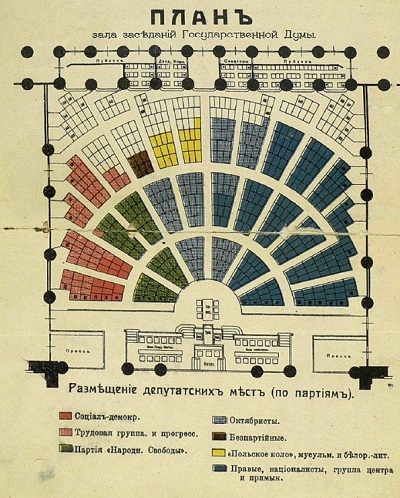
So, as we can see, the situation of “endless elections” was not unique to the present; it existed back then as well.
It goes without saying that the private lives and activities of elected officials sparked great interest in the media of that time. Since there was no television or internet at the beginning of the 20th century, this curiosity was satisfied through various periodicals.
Let’s take the magazine *Ogonek*, which was very popular at the time, as an example.
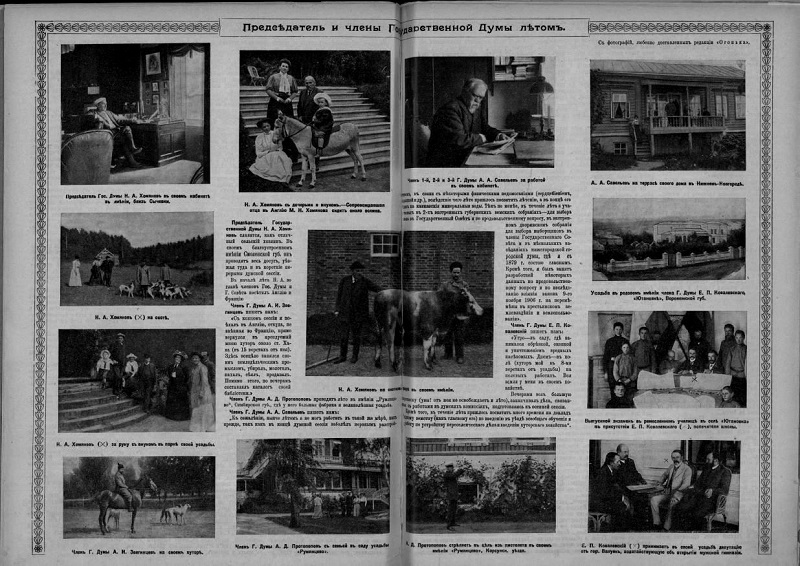
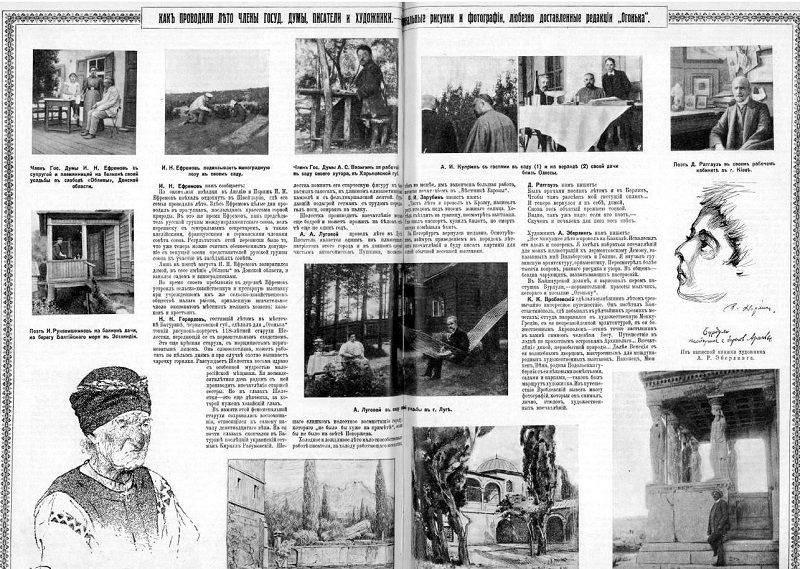
The column “How They Spent Their Summer…” not only covered the vacations of popular writers, actors, and singers, but also those of State Duma deputies. In addition to stories about their leisure activities, the column also featured unique photographs.
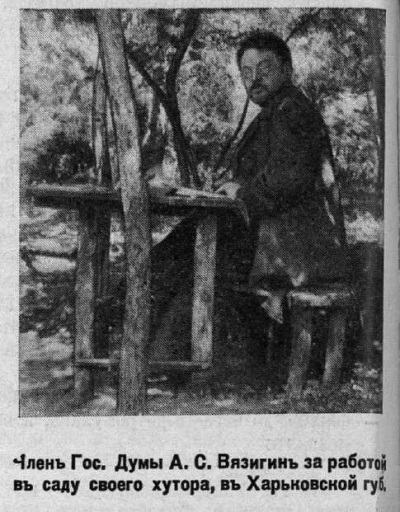
Thanks to this, in 1909, for example, curious citizens were able to confirm that Andrei Sergeyevich Vyazigin, a deputy from the Kharkiv Governorate (and a member of the Right-Wing Party), had spent the summer at his farmstead working on new texts.
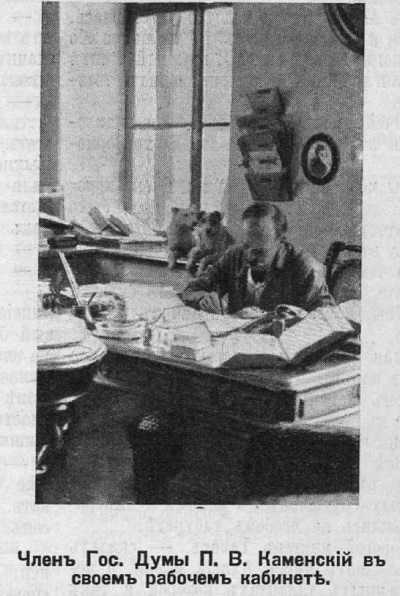
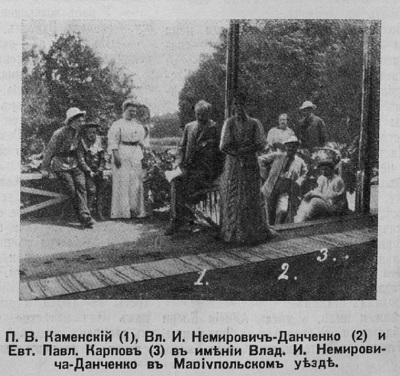
Meanwhile, Pyotr Valeryevich Kamensky—a former student of the Kharkiv Gymnasium and Kharkiv University, a deputy from the Yekaterinoslav Governorate, and a member of the Octobrist Party—spent the summer of 1909 quite productively: he worked in his study, personally bandaged a worker’s hand (not forgetting to take a photograph of the event), and hosted the renowned Vladimir Ivanovich Nemirovich-Danchenko at his estate.

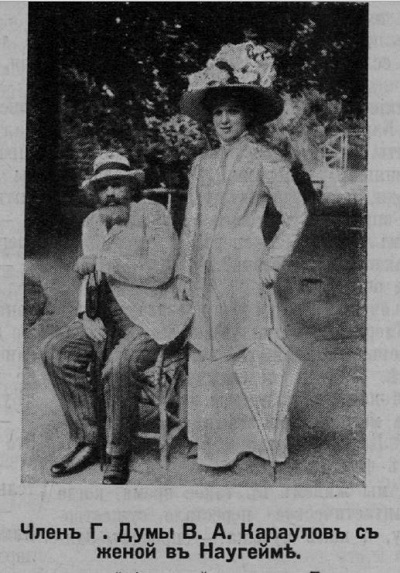
For Vasily Andreevich Karaulov, a deputy from the Yenisei Governorate, the summer of 1909 proved to be a difficult one. He sadly reported this to the readers of *Ogonyok*:
My heart was giving me a lot of trouble, and I had to spend the entire summer undergoing treatment. I lived in Nauheim (Germany) with my wife in complete seclusion, trying as much as possible not even to get to know the people around us. I recovered only slightly, and on the way back I traveled through Switzerland and Italy. After returning to Russia, I fell ill in Częstochowa and had to stay in bed for about a week in Warsaw…
As further proof of his extremely sorrowful summer, Representative Karaulov even managed to provide journalists with a photo.
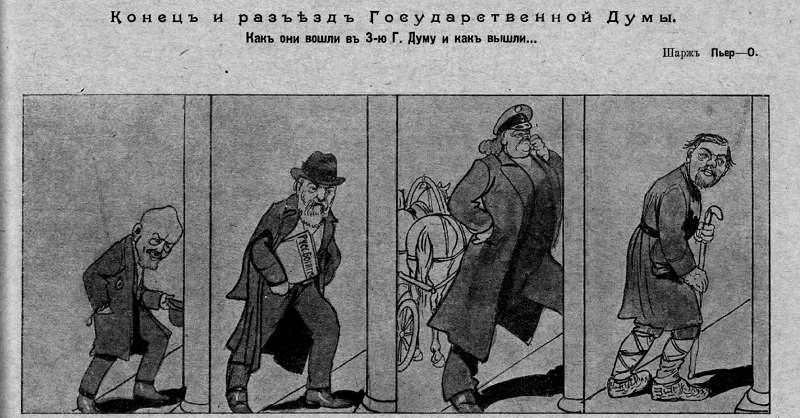
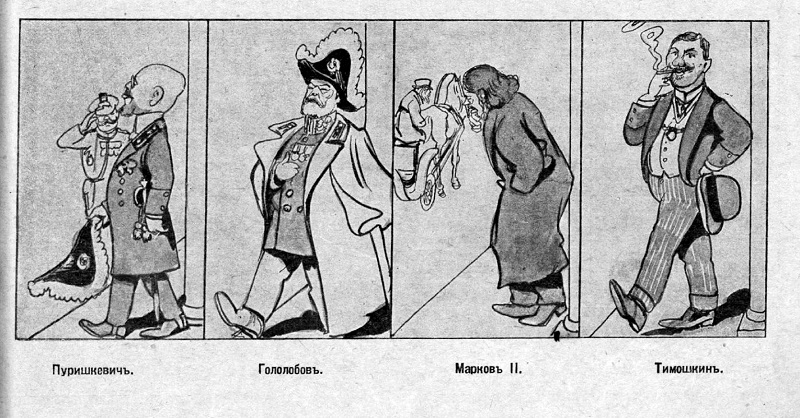
Political satire also existed at that time. A caricature published in issue No. 24 of *Ogonyok* on June 9, 1912, remains relevant to this day.
The column “How … Lives and Works…” was just as popular.
Thanks to it, readers could not only learn about the lives of government officials (governors, ministers) or figures in culture and the arts (such as Chaliapin or Repin), but also see it all with their own eyes, since the articles included quite a few photographs.
Journalists were allowed into the homes of those in power, which is why this column flourished.
In late November 1912, for example, readers could learn “How Sergei Ivanovich Timashev, Minister of Trade and Industry and Privy Councilor, Lives and Works.”
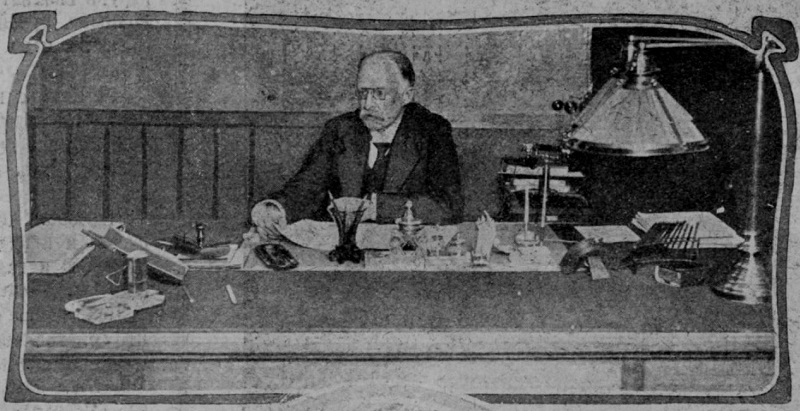
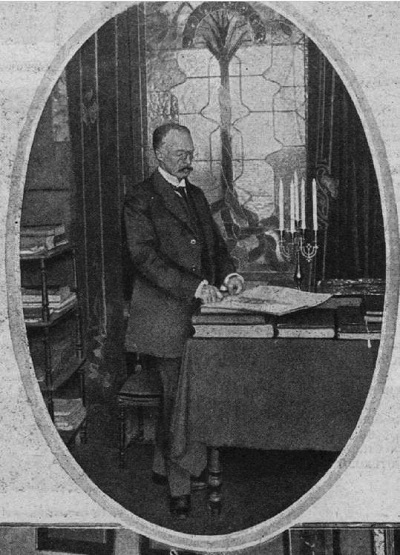
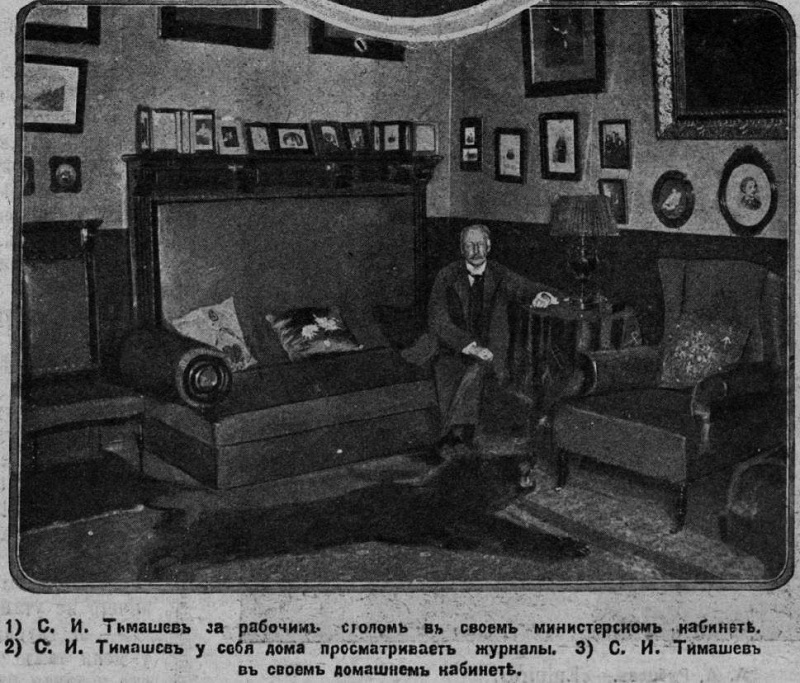
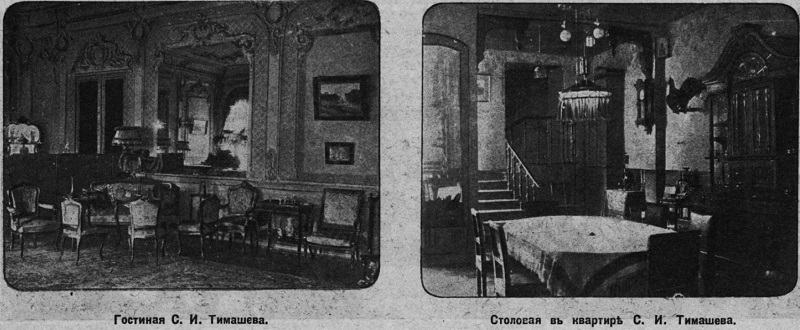
We also find the articles in the June 1913 issues of *Ogonyok* quite interesting.
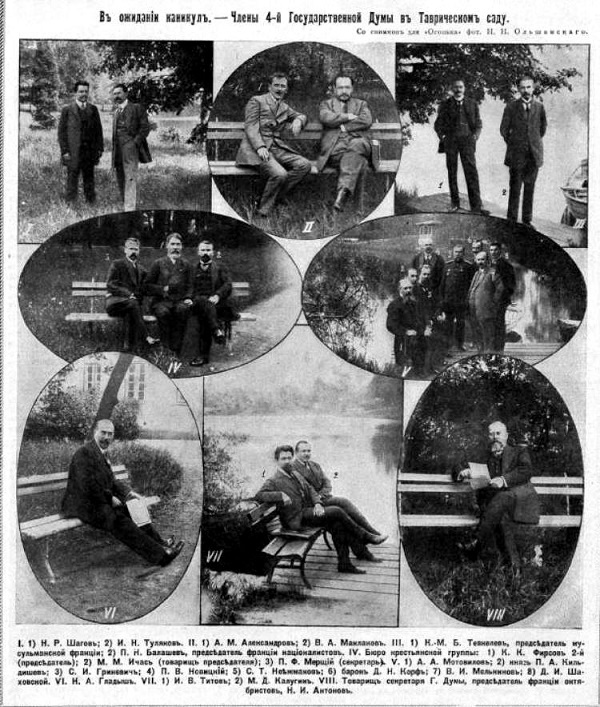
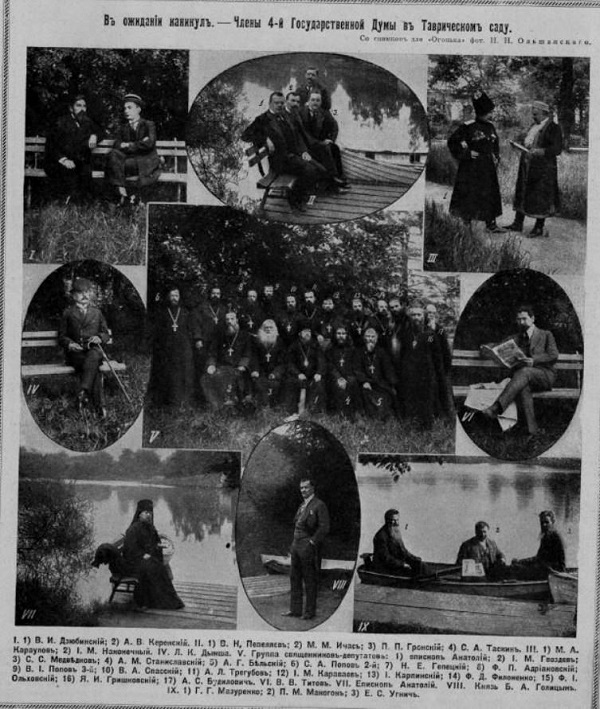
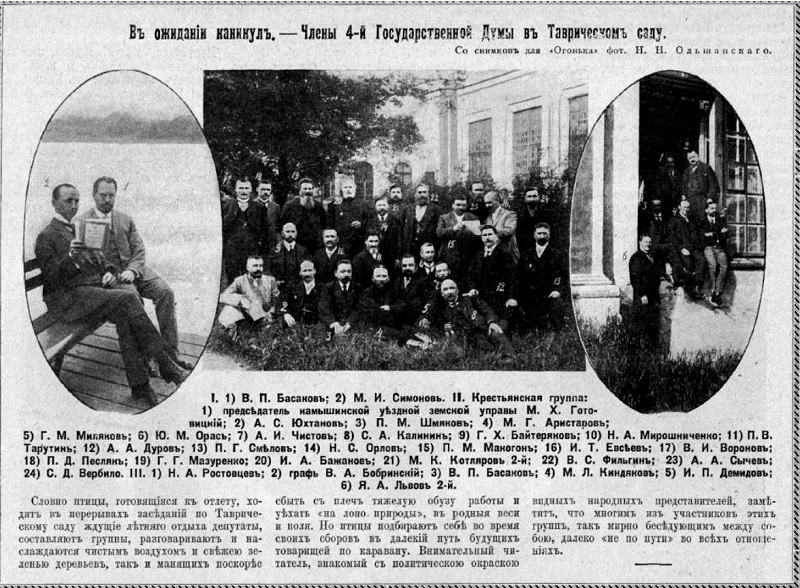
At that time, the ever-watchful eye of the reporters captured the elected officials relaxing in Tavrichesky Garden as they awaited their vacation. The journalist did not fail to add a rather scathing comment:
Like birds preparing to take flight, the deputies—who are awaiting their summer vacation—stroll through Tavrichesky Garden during breaks in the sessions, forming groups, chatting and enjoying the clean air and the fresh greenery of the trees, which seem to beckon them to quickly cast off the heavy burden of work and head “into the bosom of nature,” to their native villages and fields. But as they prepare for their long journey, the birds are choosing their future traveling companions. An attentive reader, familiar with the political leanings of prominent elected officials, will notice that many of the members of these groups, chatting so peacefully among themselves, are far from being “on the same page” in every respect.
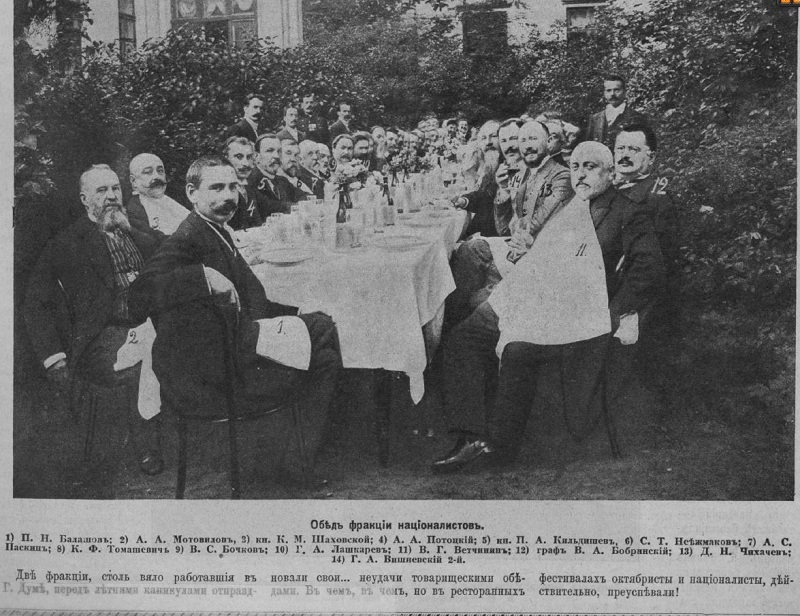
The very next issue featured an equally sarcastic follow-up:
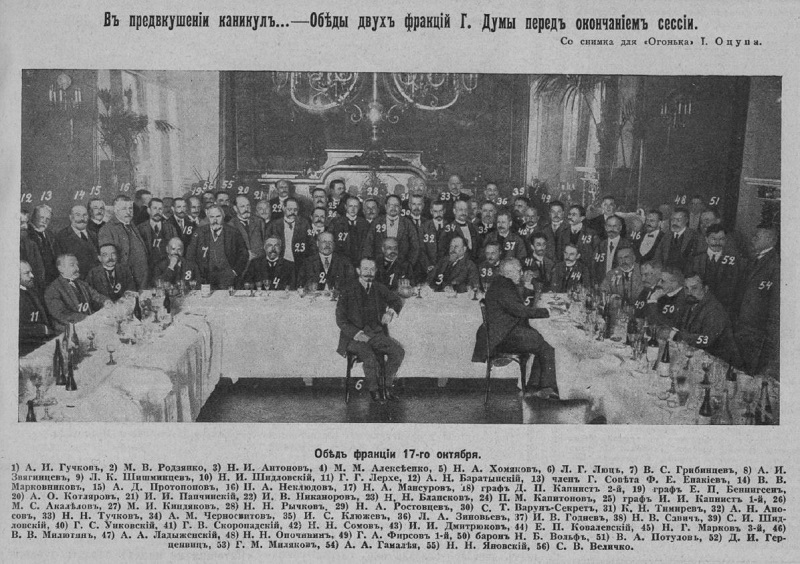
The two factions, which had been so lackluster in their work in the State Duma, celebrated their… failures with friendly dinners before the summer recess. Whatever else may be said, the Octobrists and nationalists certainly excelled at restaurant festivals!
So, as we can see, there was interest in and criticism of elected officials even a hundred years ago. And some of these topics are still relevant today.

- About the military pilot school and the airfield in Kharkiv… - 04.11.2020
- Nikanor Savich—A Political Career by Mistake - 13.07.2020
- And once again, about the Cavalry Guards… - 21.01.2020