On June 3, 1907, the Second Duma was dissolved ahead of schedule. This led to the so-called “June 3 Coup.” One of its consequences was the reform of the electoral system itself. Under the new “Regulations on Elections to the State Duma,” elections were:
- indirect;
- that did not provide for equal representation;
- had to be conducted according to the curial system. The main curiae were:
a) the volost curia (i.e., the peasant curia);
b) the landowning curia;
c) the 1st urban curia (highest property qualification);
d) the 2nd urban curia (lowest property qualification);
e) the workers’ curia.
In addition, Cossack curiae were established in some districts, and the curiae of Russian and non-Russian voters were separated. Within the curiae, there were also no rules governing representation (a standard number of voters per deputy), and the number of deputies from localities and curiae was determined solely by the schedule attached to the Regulations. Not all residents of the empire had the right to vote. To be eligible to vote, one had to meet specific criteria at least one year prior to the election.
The result of this convoluted legislation was extremely disproportionate representation. The complex election rules, meanwhile, haphazardly divided the population along property, religious, and ethnic lines in various localities.
So who represented Kharkiv and the Kharkiv Governorate in the Duma?
Despite the reform of the electoral system, the number of representatives remained at 11. However, there are some truly significant figures among them, so let me introduce them to you…
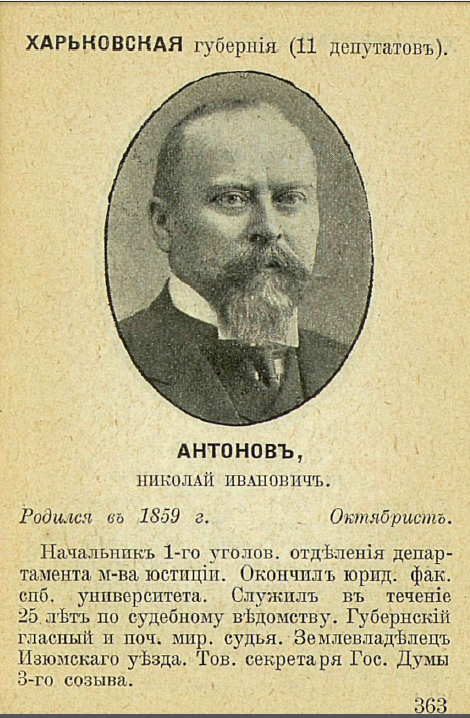
Nikolai Ivanovich Antonov.
Born in 1859. A member of the Octobrists.
Head of the 1st Criminal Division of the Ministry of Justice. Graduated from the Law School of St. Petersburg University. Served for 25 years in the judicial system. Provincial Councilor and Honorary Justice of the Peace. Landowner in the Izyum District. Assistant to the Secretary of the State Duma of the 3rd Convocation.
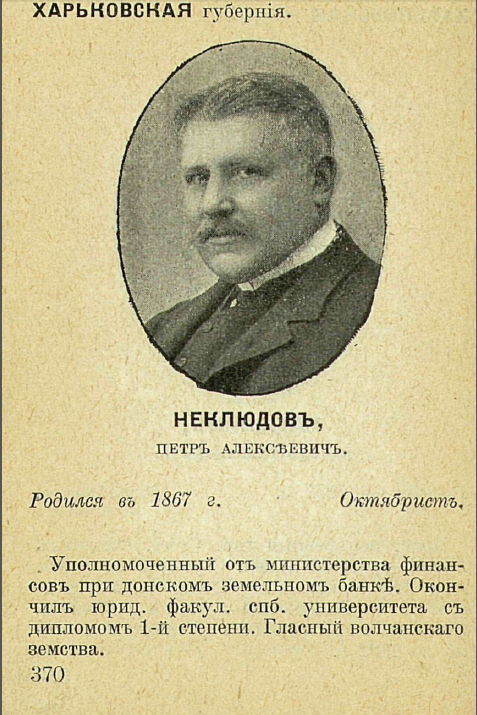
Petr Alekseevich Neklyudov.
Born in 1867. A member of the Octobrists.
Representative of the Ministry of Finance at the Don Land Bank. He graduated from the Law School of St. Petersburg University with a first-class degree. Council member of the Vovhansk District Council.
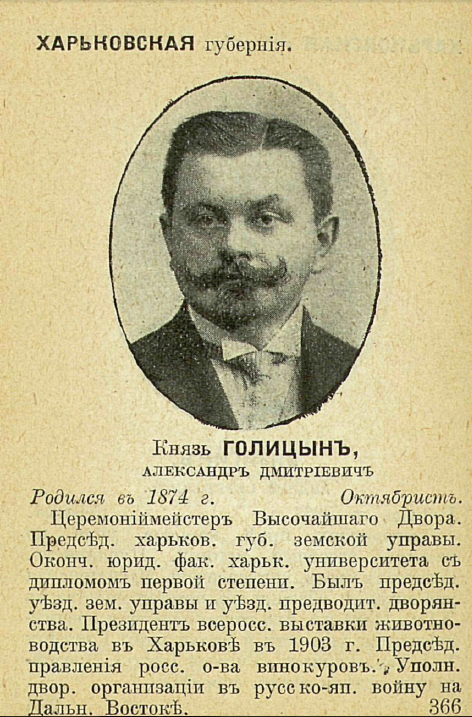
Prince Alexander Dmitrievich Golitsyn.
Born in 1874. A member of the Octobrists.
Master of Ceremonies of the Imperial Court. Chairman of the Kharkiv Provincial Zemstvo Council. He graduated from the Law Faculty of Kharkiv University with a first-class degree. He served as chairman of the district Zemstvo Council and as district leader of the nobility. President of the All-Russian Livestock Exhibition in Kharkiv in 1903. Chairman of the Board of the Russian Society of Distillers; Representative of a noblemen’s organization during the Russo-Japanese War in the Far East.
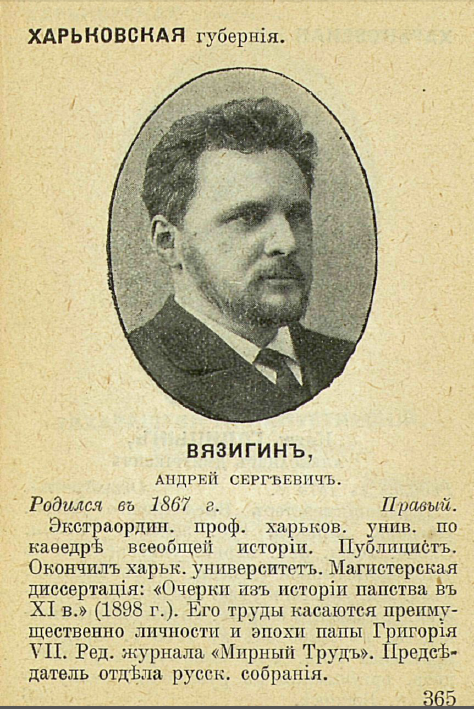
Andrey Sergeyevich Vyazigin.
Born in 1867. Right-wing.
Adjunct Professor in the Department of General History at Kharkiv University. Publicist. Graduated from Kharkiv University. Master’s thesis: “Essays on the History of the Papacy in the 11th Century” (1898). His works focus primarily on the figure and era of Pope Gregory VII. Editor of the journal *Mirny Trud*. Chairman of the Russian Collection Department.
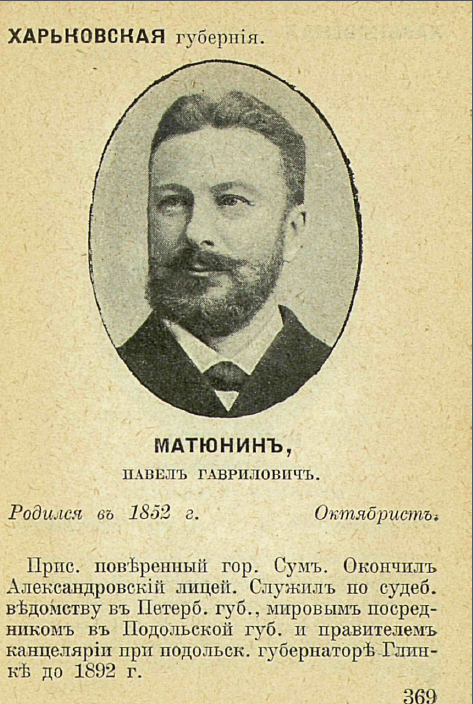
Pavel Gavrilovich Matyunin.
Born in 1852. A member of the Octobrists.
Attorney-at-law in Sumy. He graduated from the Alexandrovsky Lyceum. He served in the judicial department of the St. Petersburg Governorate, as a justice of the peace in the Podolsk Governorate, and as chief of staff to the Podolsk Governor Glinka until 1892.
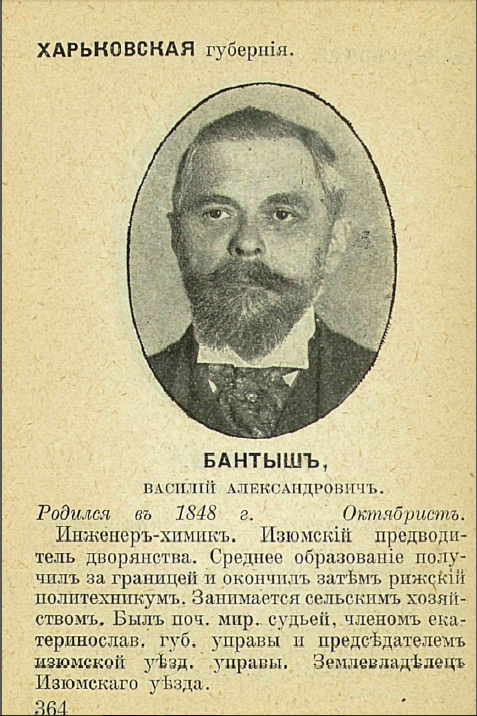
Vasily Alexandrovich Bantysh.
Born in 1848. A member of the Octobrists.
Chemical engineer. Leader of the nobility in Izyum. He received his secondary education abroad and subsequently graduated from the Riga Polytechnic Institute. He is involved in agriculture. He served as an honorary justice of the peace, a member of the Yekaterinoslav Provincial Council, and chairman of the Izyum District Council. Landowner in Izyum District.
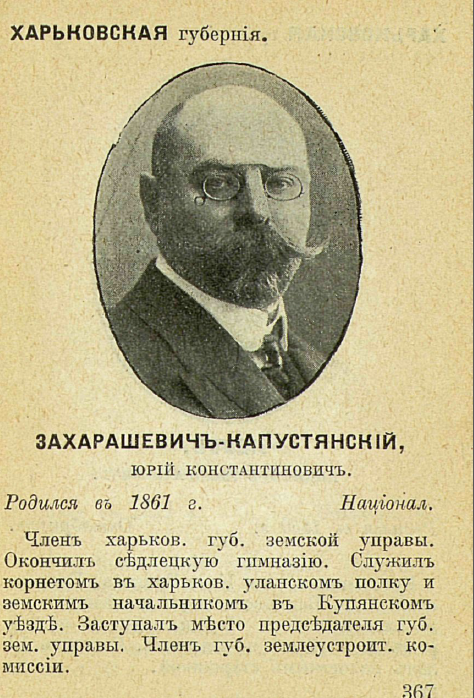
Yuri Konstantinovich Zakharševič-Kapustiansky.
Born in 1861. Nationalist.
Member of the Kharkiv Provincial Zemstvo Council. He graduated from the Sedlets Gymnasium. He served as a cornet in the Kharkiv Uhlan Regiment and as a zemstvo official in the Kup’yans’k District. He served as acting chairman of the Provincial Zemstvo Council. Member of the provincial land-reorganization commission.
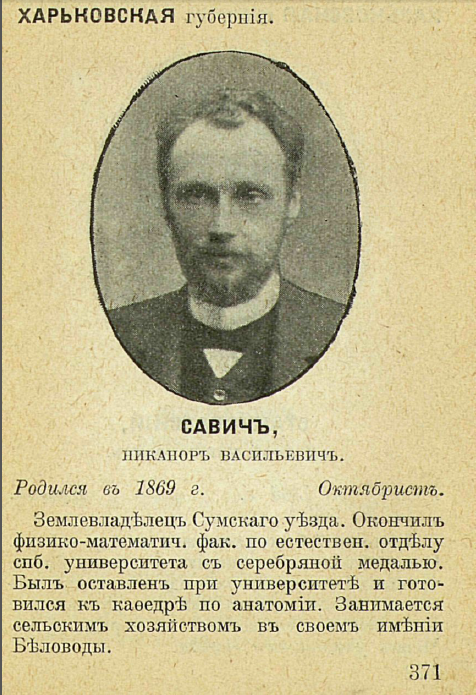
Born in 1869. A member of the Octoberist movement.
A landowner in the Sumy Uyezd. He graduated from the Faculty of Physics and Mathematics (Natural Sciences Department) at St. Petersburg University with a silver medal. He remained at the university and was preparing to take up a position in the Department of Anatomy. He is engaged in agriculture on his estate in Belovody.
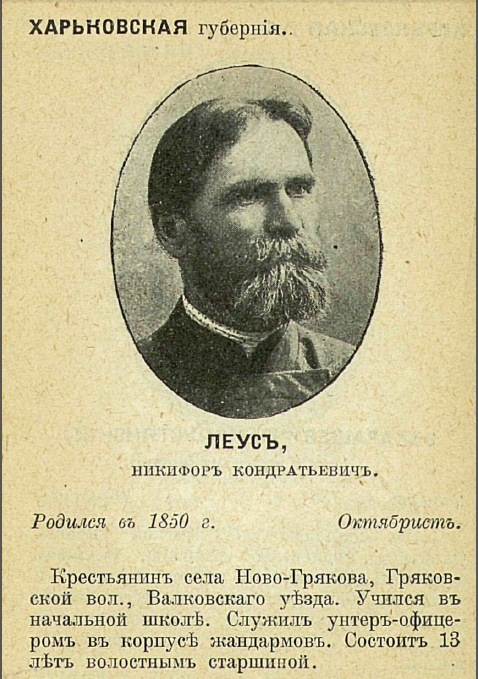
Leus Nikifor Kondratyevich.
Born in 1850. Member of the Octobrists.
A peasant from the village of Novo-Gryakova, Gryakovsky Volost, Valkovsky Uyezd. He attended elementary school. He served as a noncommissioned officer in the gendarmerie. He has been the volost foreman for 13 years.
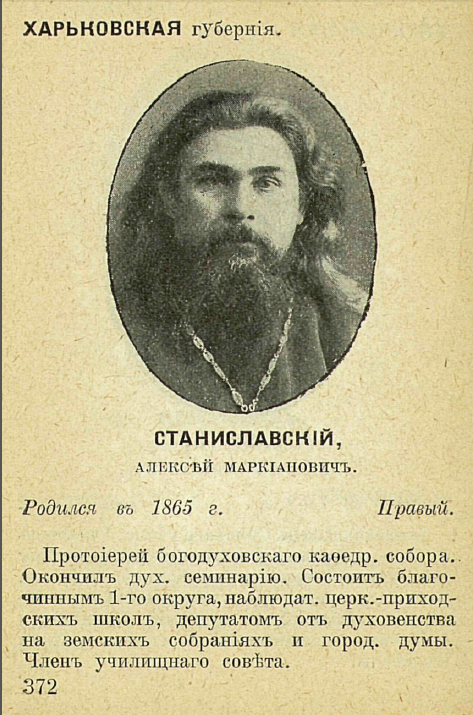
Alexei Markianovich Stanislavsky.
Born in 1865. Right-handed.
Archpriest of the Bohodukhiv Cathedral. He graduated from a theological seminary. He serves as dean of the 1st district, as an observer for parish schools, and as a clergy representative at county assemblies and the city council. Member of the school board.

Vasily Yegorovich Shurkanov.
Born in 1876. Social Democrat.
Laborer. Completed elementary school. Has worked in factories since the age of 15. Most recently, he worked at the Kharkiv Locomotive Plant.
However, one indisputable merit of the Third Duma is that it served its full term—five years—as prescribed by law. Although it consisted mainly of “right-wing forces,” the new Duma was never able to overcome interparty disagreements, which had a negative impact on the results of its work; it was succeeded by the Fourth Duma.

- About the military pilot school and the airfield in Kharkiv… - 04.11.2020
- Nikanor Savich—A Political Career by Mistake - 13.07.2020
- And once again, about the Cavalry Guards… - 21.01.2020