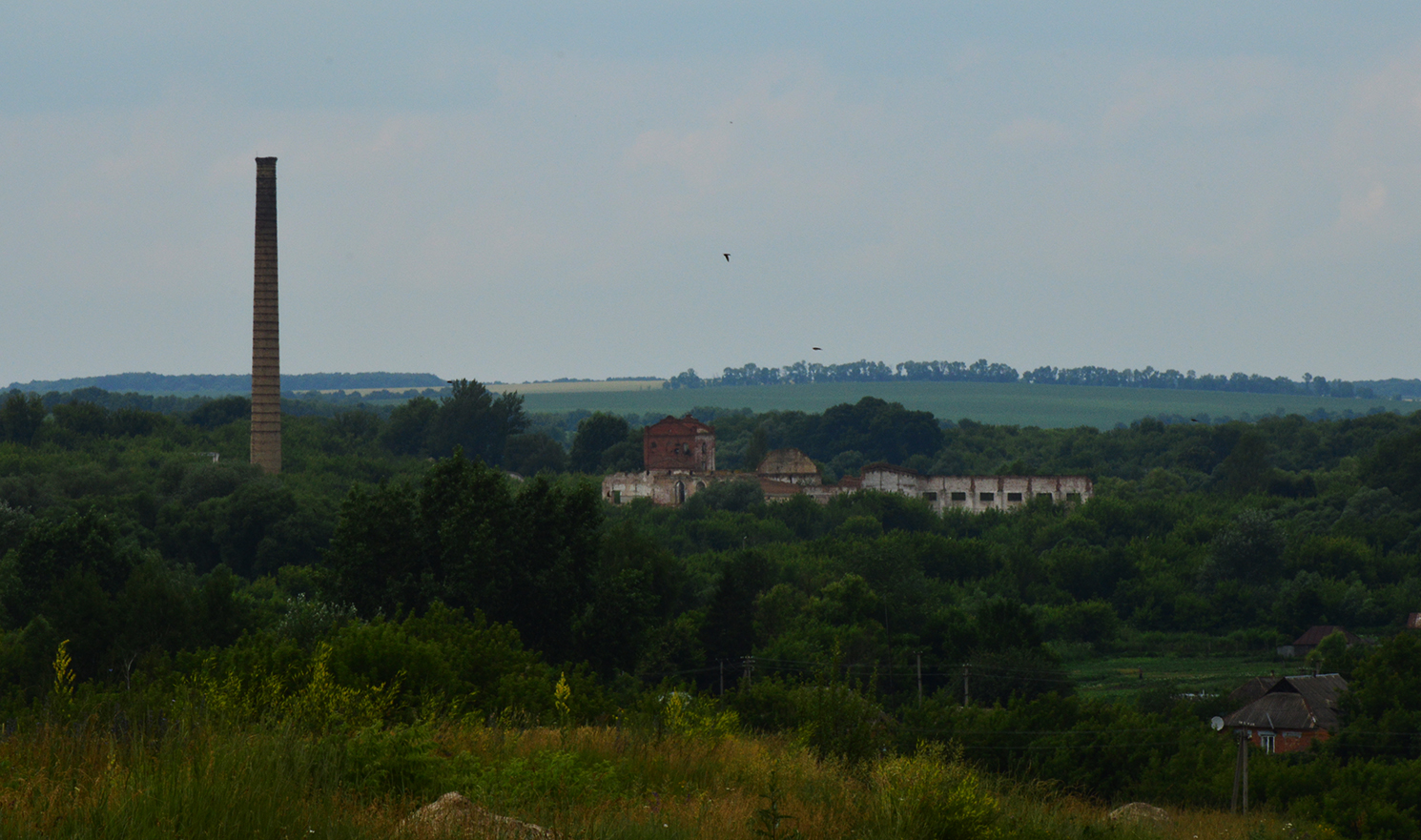
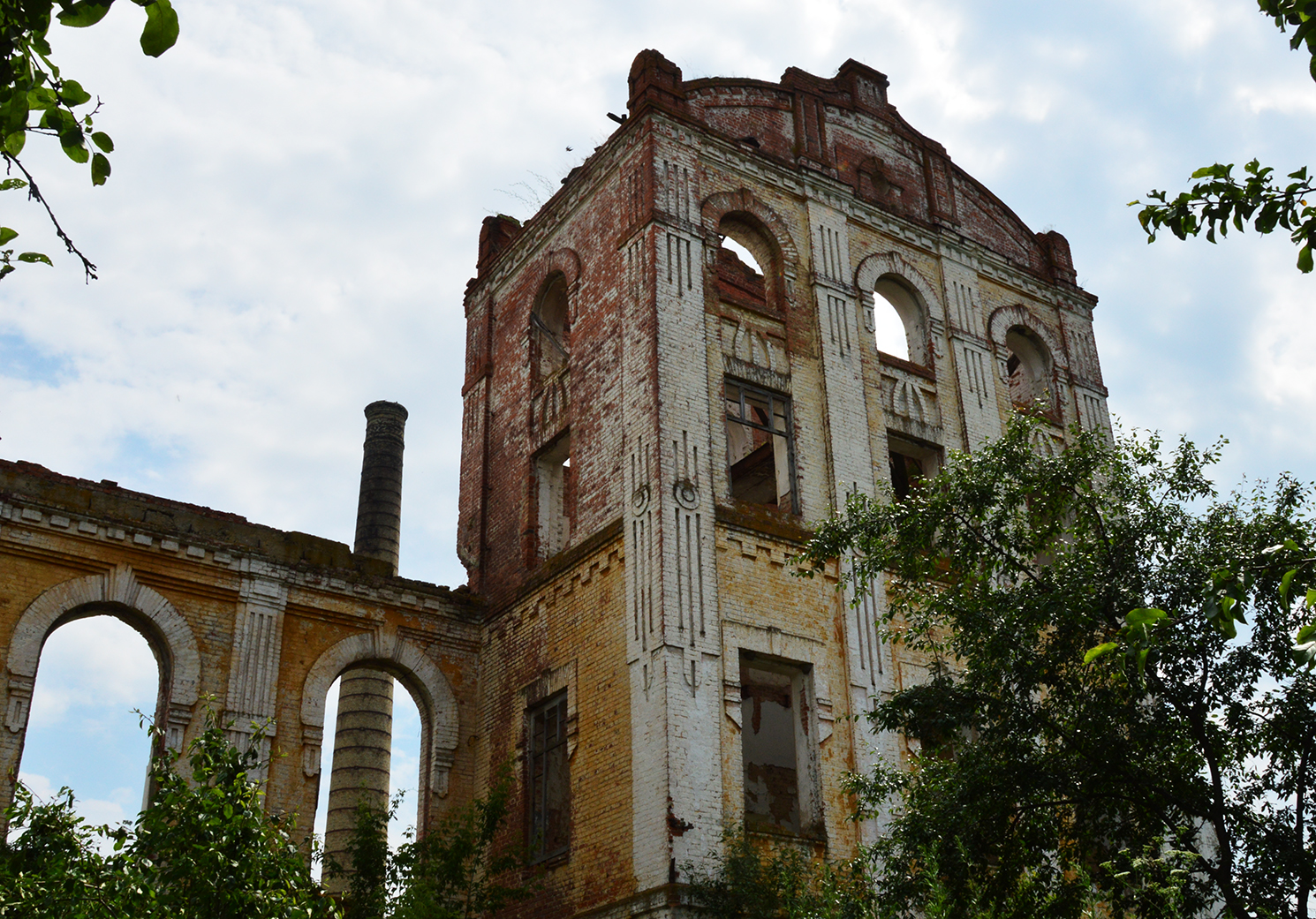
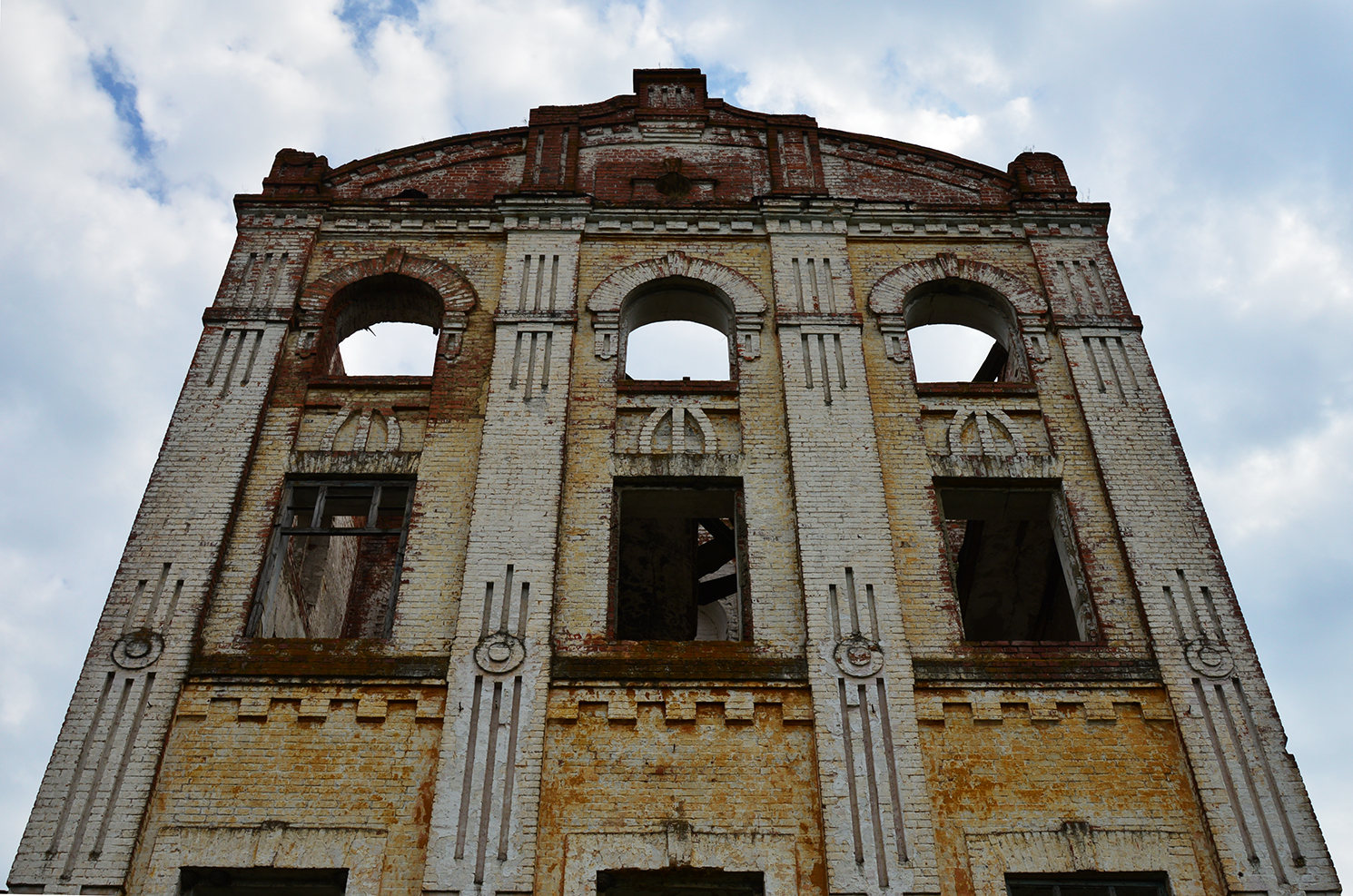
From Slavgorod, we set off for the nearby village of Mezenivka. The massive ruins of the old factory, which somewhat resemble an old castle (probably because of the tower), are clearly visible from a distance.
The exact date of the village’s founding is unknown. It is believed that this settlement near the Korova and Pozhnya rivers already existed in the mid-17th century.
Until the mid-18th century, Mezenivka was part of the Volnovsky Uyezd in the Belgorod Governorate. It was not until 1779 that it became part of the Bohodukhiv Commissariat. At that time, the village belonged to Brigadier Khitrovo and the widow Mezentseva. The Mezentsev family traced its origins to Afanasy Mezentsev, who served as a provincial mayor in Kursk in 1623.

In 1800, a stone, single-altar Trinity Church was built in Mezenivka with funds provided by the landowner Apollinariy Tagarov.
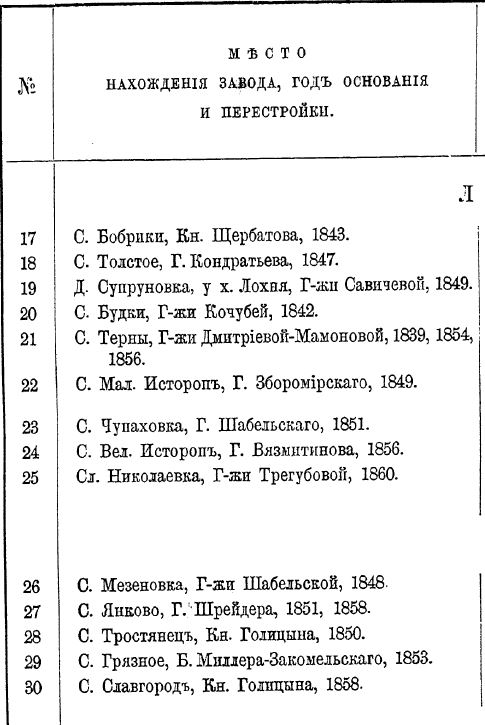
And in 1848, the Shabelsky family built a sugar factory there, which became the first such enterprise in the Okhtyrsky District. It was this factory that was destined to play a crucial role in the history and life of this town for many years to come.
It should be noted that in the early to mid-19th century, the noble Shabelsky family was considered quite wealthy in Sloboda Ukraine. They owned land not only in the Okhtyrsky District, but also in the Kup’yansky, Izyumsky, Lebedynsky, and Starobil’s’ky districts of the Kharkiv Governorate.
By 1861, Mezenivka was owned by Sofia Apollonovna Ellinskaya. The population consisted
of 120 households (407 men and 452 women), and the town had a church, a sugar factory, and a saltpeter factory.
In the 1880s, the “Mezenivka Beet Sugar Factory Partnership” was established to maintain and expand the factory’s operations.
The factory itself was owned by Nikolai Nikolaevich Skvortsov, a Privy Councilor; the board of directors included Lev Izrailevich Brodsky, Aron Iosifovich Brodsky, and Alexander Iosifovich Brodsky (managing director).
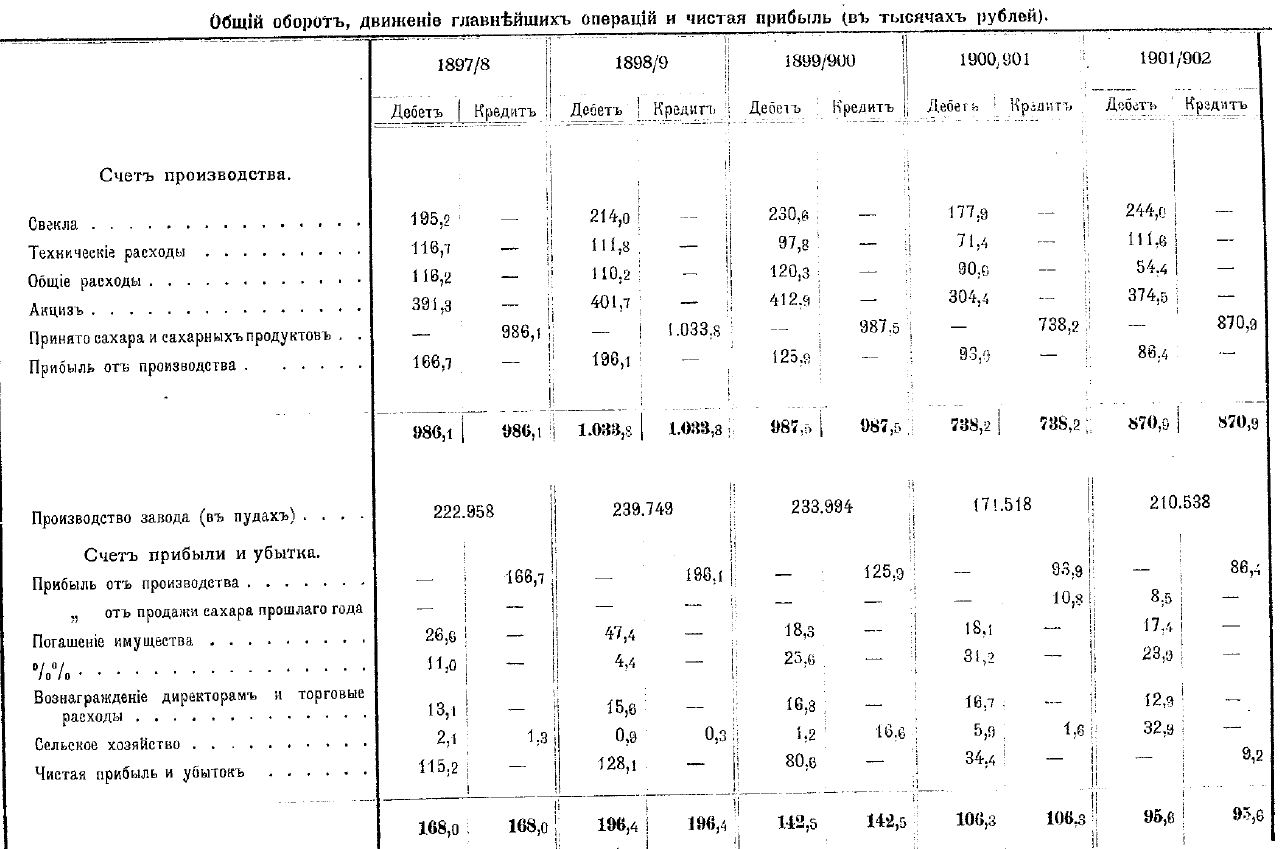
In the early 20th century, descriptions of the factory also mention a 6-bed infirmary for workers. The village also had a free library and reading room. The population of Mezenivka in the early 20th century can be estimated based on the fact that, as of 1904, there were 1,144 male parishioners and 1,111 female parishioners at the church.
However, it appears that life was not particularly easy for the workers and peasants of Mezenovo during those times. During the revolutionary events of 1905–1907, they were active participants in the unrest in the Okhtyrsky District.
“In the Okhtyrsky District, a major rampage took place on Khrushchev’s estate. At the end of November, peasants from the villages of Ryasnoe, Oleksandrivka, Novodmitrovka, Pushkarnoe, and Mezenivka destroyed the outbuildings on the estate and carried off grain, lard, harnesses, carts, and sleds from the estate.” (Source: N. H. Onatsky, “The Peasant Revolutionary Movement in the Sumy Region in 1905”; N. Kh. Onatsky, “1905 in the Sumy Region: A Collection of Scholarly Articles”—Sumy: Plow and Hammer, 1930.)
In a report from the assistant chief of the Kharkiv Provincial Gendarmerie Administration to the director of the Police Department regarding the strike by workers at the Mezenivsky Sugar Factory in Okhtyrsky Uyezd, we read:
September 27, 1905.
At 2:00 a.m. on the night of September 19–20, 400 workers at the Mezenivsky beet sugar factory of the Brodsky Partnership, in Okhtyrsky Uyezd—numbering 400 people—stopped work and demanded the establishment of a third shift, threatening to cause disturbances. Factory director Yanchinsky, having appeared before the workers, offered them additional pay in lieu of the third shift, after which the workers resumed work.
Order was not disrupted.
However, it seems that the owners’ concessions still failed to satisfy the workers. As early as January 1906, the Mezenivskaya estate was ravaged and looted by them. Following these events, the composition of the factory’s board of directors also changed. The 1911 charter of the “Mezhenivskaya Sugar Beet Factory Partnership” states:
The founders of the Partnership were: Nikolai Nikolaevich Skvortsov, a full State Councilor; Albert Gilen, a Belgian national and civil engineer; and Heinrich Mistral, a French citizen.

On July 30, 1917, a local resident named Martynenko, who had escaped from the Graivoronovskaya prison, was caught by his fellow villagers stealing bread. The vigilante justice meted out to the thief by the peasants and workers of Mezenovo was cruel and merciless. They began driving nails into the criminal’s heels, which ultimately led to his death.
In late September 1918, the Mezenivsky Plant—which by that time was already owned by the Putyatins—was sold. The new era and the new regime brought changes to both the plant and the lives of its workers. Not a trace of the stone church remains. New buildings were added to the old factory complex. Now, however, desolation reigns everywhere…
On the way to Mezenivka, we were stopped by soldiers (it is, after all, a border area). After checking our documents, they asked us where we were going. Upon hearing our chorus of cries, “To the ruins of the old factory!” the soldier smiled and said, “Ahhh… Stalekry… Good luck to you there.”
Well, it turned out he was right after all. The overgrown, crumbling, and impassable ruins will likely be of greater interest to those seeking adventure. However, the most interesting part of our trip was just beginning. After all, an ancient monastery in Riasne awaited us ahead.

- About the military pilot school and the airfield in Kharkiv… - 04.11.2020
- Nikanor Savich—A Political Career by Mistake - 13.07.2020
- And once again, about the Cavalry Guards… - 21.01.2020