So, dear readers, let’s continue our exploration of Kharkiv’s legendary yet little-known underground passages! You can read the previous part here.
We are publishing a short report for you, taken from the 1914 issue No. 7 of *News of the Kharkiv City Duma*.
On July 2, 1914, a regular meeting of the Commission on the Investigation of Underground Passages in the City of Kharkiv was held.
In attendance: the chairperson and board member Z.Yu. Kharmanksy; Members: V.I. Savva and E.M. Ivanov, representatives of the Historical and Philological Society at Kharkiv University; B.A. Kustersky, city engineer; and A.I. Linnik, city architect.

In opening the meeting, the chair, Z.Yu. Kharmanksy, a member of the Board, briefly outlined the data available to the commission for its research, based on the work already conducted last year. At the same time, the chair noted that the commission has a very modest budget of 700 rubles for this year’s research work.
Prof. Savva proposed that the practical work be entrusted to the University’s philology students, who had already expressed a desire to take an active part in the project, and that the technical supervision of the work, specifically in terms of implementing safety measures for workers, residents, and nearby structures, to B.A. Kustersky. The commission unanimously accepted the proposal.
Turning then to the question of selecting a starting point for the work, the Commission, at the suggestion of Prof. Savva, decided to begin research on Cathedral Square, across from Shchekleev’s store. With regard to financial matters, it was decided that workers would be paid based on timesheets recording the number of days worked, certified by one of the Commission members supervising the work.
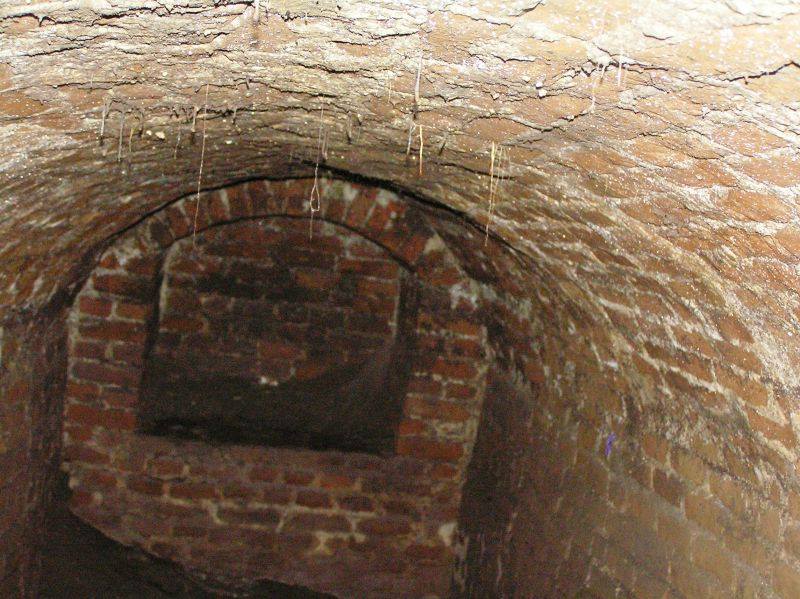
Next, Z.Yu. Kharmansky and E.M. Ivanov reported on a drainage gallery discovered during sewer construction work currently underway on Yaroslavskaya Street. The gallery runs from Ekaterinoslavskaya Street to the river along Yaroslavskaya Street; upon examination of the discovered traces of the passage, it was noted that it was constructed of brick and was approximately 7.5 vershoks long.
With a view to making the broadest possible use of all data uncovered during sewer and water supply system construction work, the Commission has resolved to request that the supervisors of underground infrastructure projects (sewer, water supply, etc.) immediately notify the members of the Commission for the Investigation of Underground Passages if they discover any signs of underground galleries. At the same time, we request that the City Council grant permission to review all archival material regarding the construction of sewer pipes on Yekaterinoslavskaya and Yaroslavskaya Streets.
But the story of the Kharkiv underground doesn’t end there—it’s only just beginning.
So, to be continued…
