These days, taxes don’t surprise anyone—they’re constantly popping up. The vivid imaginations of government officials keep creating new legal grounds for citizens to voluntarily hand over their money to the state. So if a tax on rain or air were to appear soon, I wouldn’t be the least bit surprised. However, not every tax has a history with specific dates marking its introduction, development, and repeal. Here’s a brief history of one tax in Kharkiv that took place between 1902 and 1905.
It all began on October 23, 1902, when, at the suggestion of City Police Chief K. I. Bezsonov, a regular meeting of the commission was held to discuss medical and police oversight of prostitution in Kharkiv.
Those in attendance included:
— Assistant Police Chief A. N. Ryabchenko
— Constable at the 1st Police Precinct, Baron N. E. von Brinken
— Constable at the 2nd Police Precinct, N. I. Anishchenko
— V. V. von Lange, Chief of the Criminal Investigation Division and Constable of the 6th Police Precinct
— A. M. Mironov, Senior City Medical Officer of Kharkiv— V. I. Krzhivinsky, Junior City Medical Officer
At this meeting, Mironov read an essay titled “On the Current State of Prostitution Oversight,” as well as a proposal outlining measures to improve it.
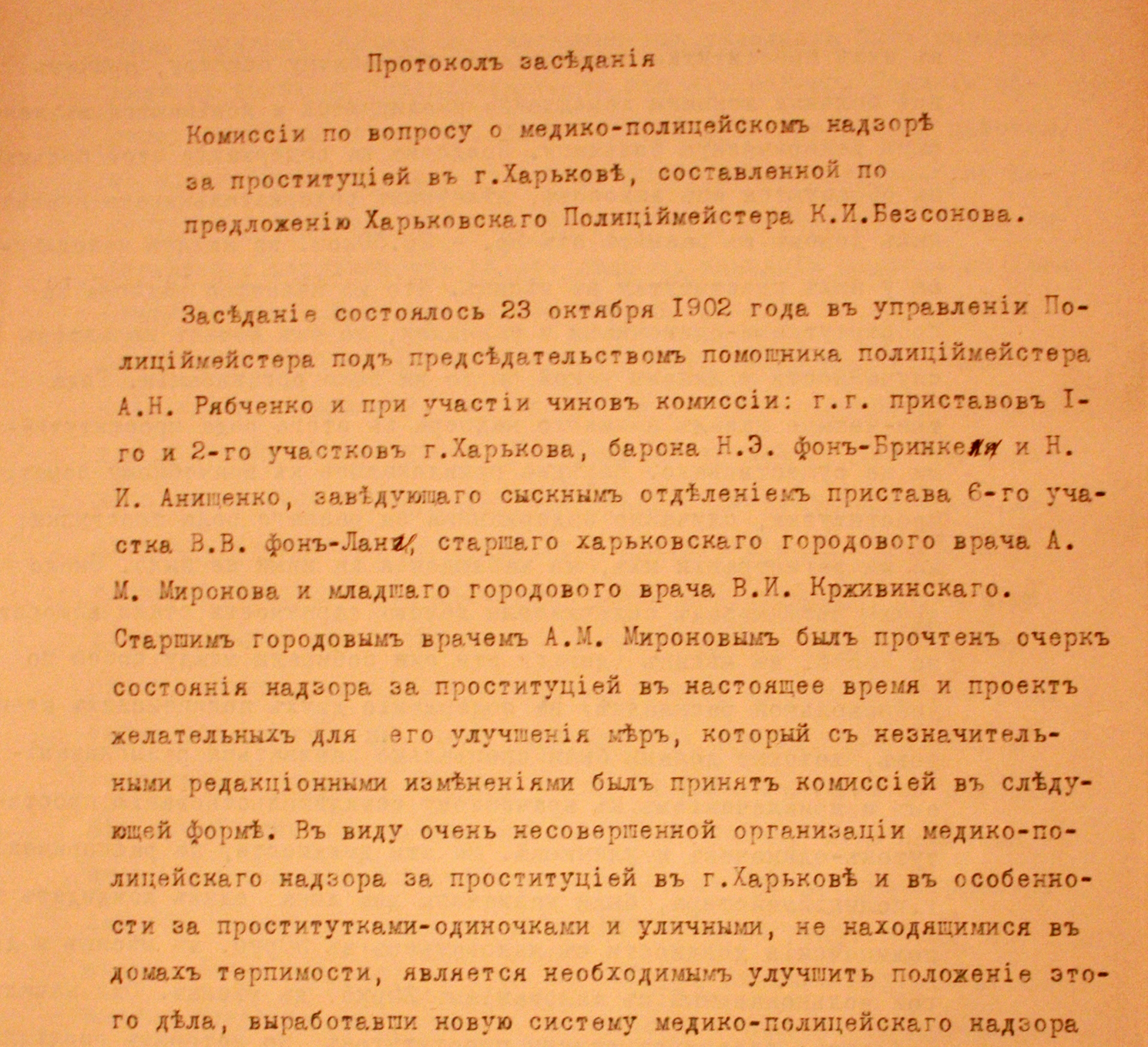
All of our city’s brothels were located within the jurisdictions of the 1st and 2nd police precincts and were strictly monitored by the police. These establishments were visited weekly by the senior city medical officer to conduct medical examinations of the workers. Any women who were found to be ill were immediately isolated and admitted to the women’s venereal disease hospital. Funds for its operation were collected from contributions made by the brothel owners, ranging from 2 rubles to 2 rubles 50 kopecks per month for each prostitute in their employ.
The system of medical and police supervision of independent street prostitutes (that is, those who did not work in brothels) was far from perfect; it was haphazard and lacked any kind of organization. “Prostitutes” working outside brothels lived in private apartments or hotels, and many of them were not registered anywhere. Street prostitutes were subjected to medical examinations only of their own volition, or if they were accidentally detained by the police for some offense. It goes without saying that women with sexually transmitted diseases did not want to stop working and be hospitalized, so they did not come in for examinations.
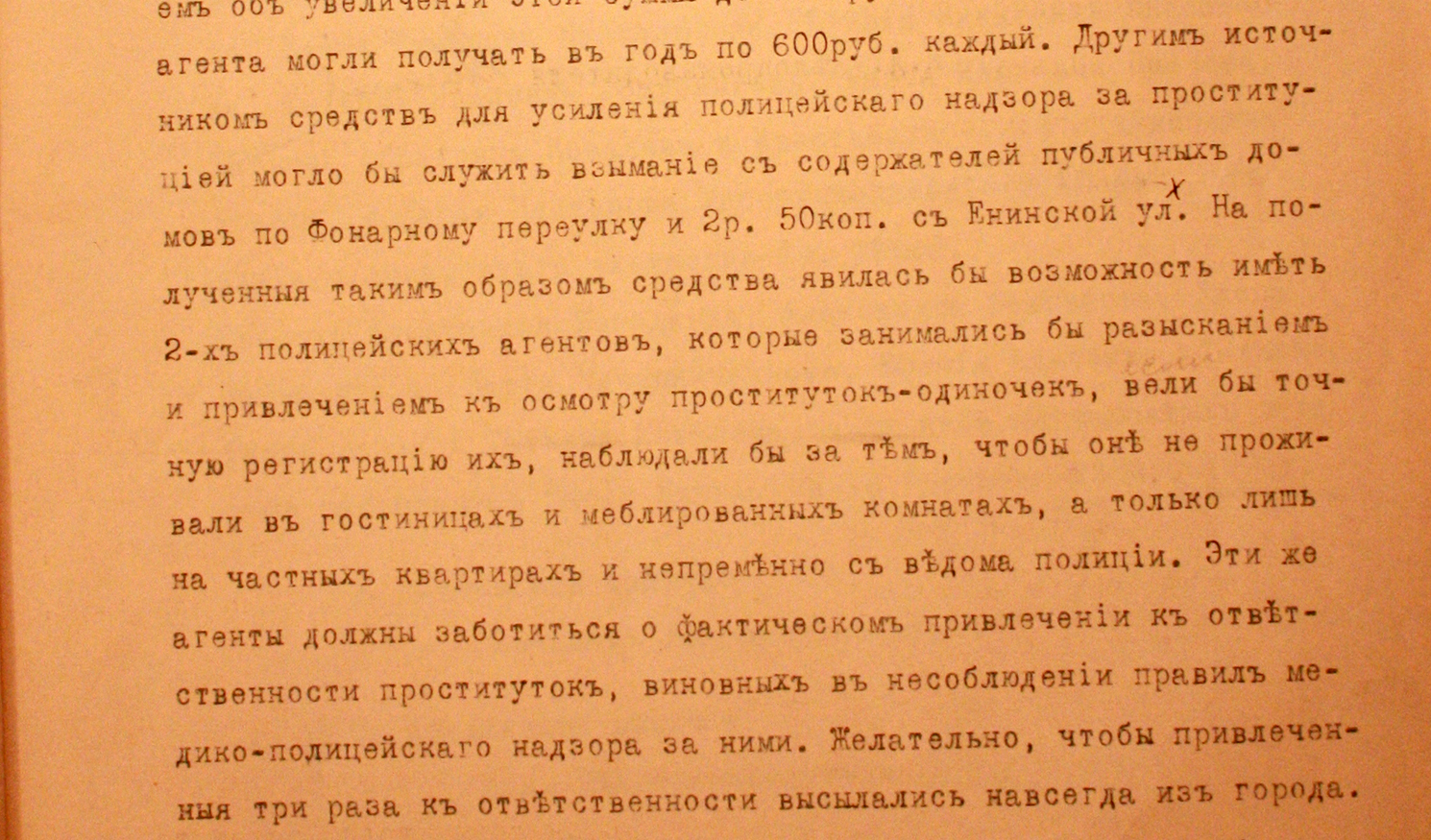
In 1900, the owners of brothels voluntarily agreed to contribute 75 rubles each month toward the upkeep of two police agents who were specifically tasked with tracking down streetwalkers and solo workers and subsequently bringing them in for medical examinations. At first, the initiative went well. However, over time, the agents’ zeal began to wane, and they grew negligent in their duties, as there was no oversight of their activities as such. This was despite the fact that they received a salary: one earned 50 rubles a month, and the other 25. By 1902, this type of police surveillance had been abolished.
So there was certainly room for improvement in this area. The police, overburdened with work and strapped for funds, were unable to assign new special agents. Meanwhile, the number of sexually transmitted diseases in our city—due to street prostitution and individuals working alone—continued to rise steadily. The city’s public administration allocated 850 rubles a year for the operation and maintenance of the venereal disease hospital. Taking into account the fact that this hospital, as we recall, was also supported by the owners of brothels, the meeting participants proposed… that’s right, to raise the tax on the latter. And to use the 850 rubles collected to pay for two new agents! It was decided to petition the City Administration to increase the allocated amount from 850 to 1,200 rubles—so that the agents monitoring unregistered night butterflies would each receive a salary of 600 rubles per year. As an additional source of funding, it was proposed to collect, on a voluntary basis, 5 rubles and 2 rubles 50 kopecks per night, respectively, from the owners of brothels on Fonarny Lane and Eninskaya Street for the police patrols dispatched there. Also at this meeting, a decision was made to permanently expel from Kharkiv any individuals caught for the third time for failing to undergo a medical examination.
In his report to the Kharkiv governor on October 31, the Kharkiv police chief requested the governor’s permission to implement the commission’s decision.
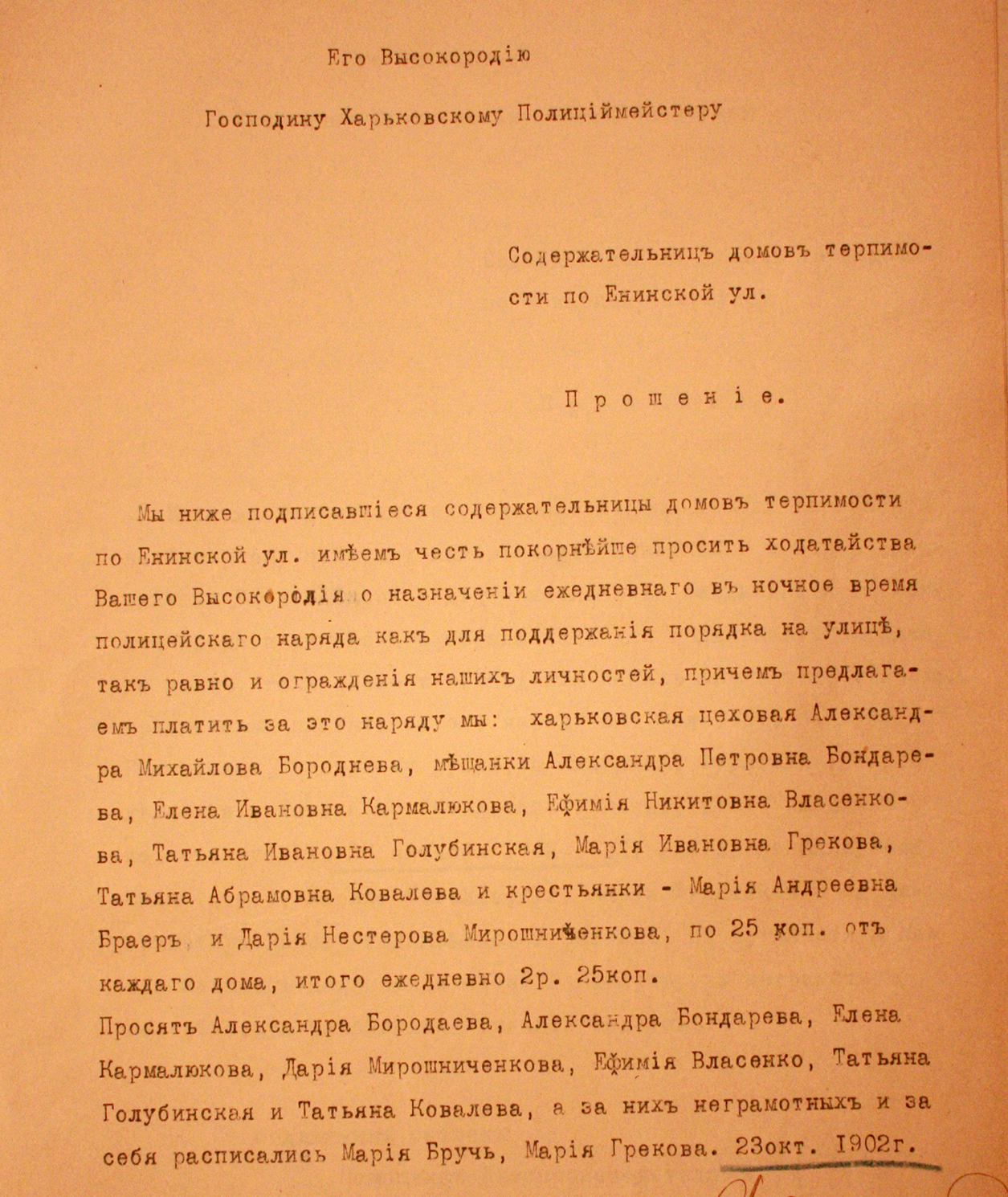
Petitions from the owners of 16 public buildings on Eninskaya Street and Fonarny Lane were also attached to the report.
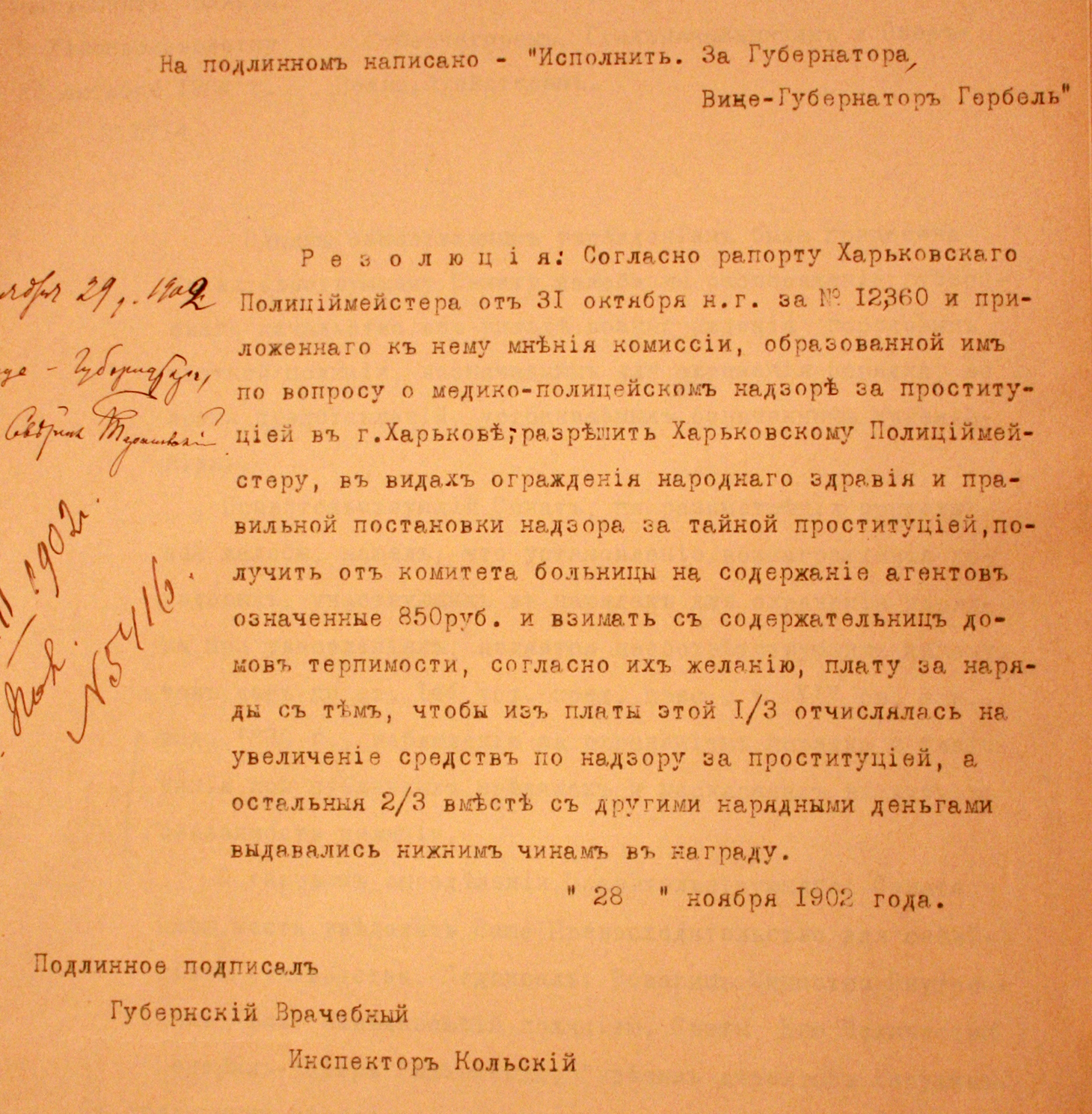
And on November 28, 1902, the long-awaited permission was granted. All in all, the measures taken to protect the health of our city’s residents were indeed necessary and important.
The end of this story is no less intriguing. A few years later, on October 26, 1904, a document was sent from the Police Department of the Ministry of Internal Affairs to the governor and the chief of police. It stated that, after reviewing a number of complaints, the Governing Senate had found that such payment of remuneration to the police for maintaining public order was not in accordance with the law.
In his report dated December 1, 1904, the Kharkiv police chief noted that the Committee of the Venereal Disease Hospital had stopped transferring funds for the agents’ upkeep, and that their salaries were being paid exclusively from funds collected from brothel owners for the patrols dispatched to their establishments. However, since the Provincial Government had decided on November 19 to stop collecting this fee as of November 23, there were no funds left to pay the agents who monitored illegal prostitution.
And at the end of 1905, the governor of Kharkiv received a “collective” complaint from the owner of one of the brothels. In it, he pointed out that three years earlier, police officers—under the threat of closing the brothels—had forcibly compelled all owners to sign a petition agreeing to pay additional fees for police supervision. Yet by law, brothels were already required to be protected by the police! The document also contained an insistent demand that the money illegally collected from the brothel owners over that entire period be returned to them. It should be noted that no refund was issued, as the petition was not accompanied by powers of attorney from all interested parties.
Let everyone decide for themselves whose side the truth is on in this story. However, all of this is part of the past of our beloved and beautiful city, a city we could talk about endlessly.

- About the military pilot school and the airfield in Kharkiv… - 04.11.2020
- Kharkiv Artisans and the 1887 Exhibition - 17.08.2020
- Nikanor Savich—A Political Career by Mistake - 13.07.2020