Back in 1856, an unknown publisher released a unique set.
It consisted of 80 beautifully illustrated double-sided postcards, each dedicated to a single province (gubernia) of the Russian Empire as it existed in 1856.
Each postcard provided an overview of the country’s culture, history, economy, and geography. The front side highlighted the main distinguishing features: rivers, mountains, major cities, and key industries. The back side featured a map and the coat of arms, information about the population, and traditional clothing worn by local residents.
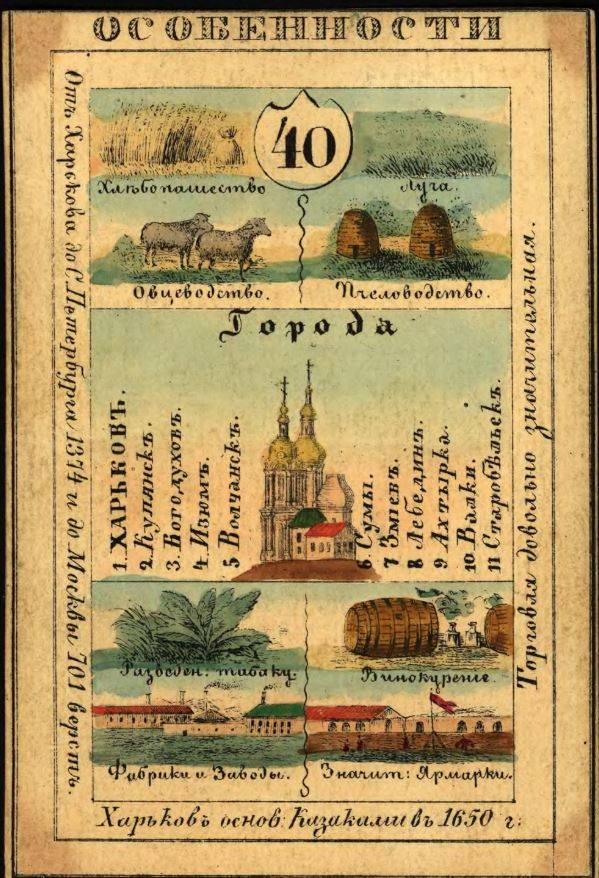
The publishers didn’t overlook our beloved city either. Here’s what we learn about the Kharkiv Governorate in 1856.
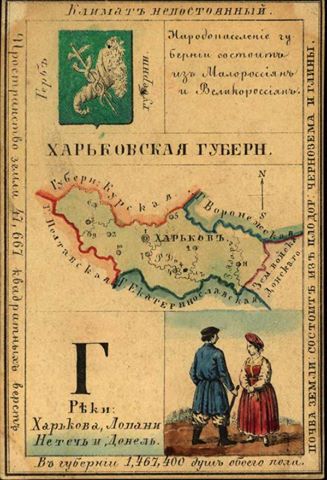
- The climate is variable;
- The province’s population consists of Little Russians and Great Russians;
- Land area—47,667 square versts;
- The soil consists of fertile chernozem and clay;
- Rivers—the Kharkiv, the Lopan, the Netech, and the Donets;
- The province has a population of 1,467,400 people of both sexes.
The “Features” section is particularly interesting to us. It specifically mentions:
- crop farming;
- meadows;
- sheep farming;
- beekeeping;
- tobacco cultivation;
- factories and plants;
- wine distillation;
- major fairs;
- Trade is quite substantial.
The towns in the province were apparently listed in order of importance
- Kharkiv;
- Kup’yans’k;
- Bohodukhiv;
- Izyum;
- Vovchans’k;
- Sumy;
- Zmiyiv;
- Lebedyn;
- Okhtyrka
- Valky;
- Starobil’s’k.
The publishers also noted that the city of Kharkiv was founded by the Cossacks in 1650.
What’s most interesting is that on these postcards, literally every centimeter is used as efficiently as possible. As a result, despite its relatively small size, the set provides a considerable amount of information about each province.
It’s scary to even think about how much such a printed luxury might have cost back then.

- About the military pilot school and the airfield in Kharkiv… - 04.11.2020
- Nikanor Savich—A Political Career by Mistake - 13.07.2020
- And once again, about the Cavalry Guards… - 21.01.2020