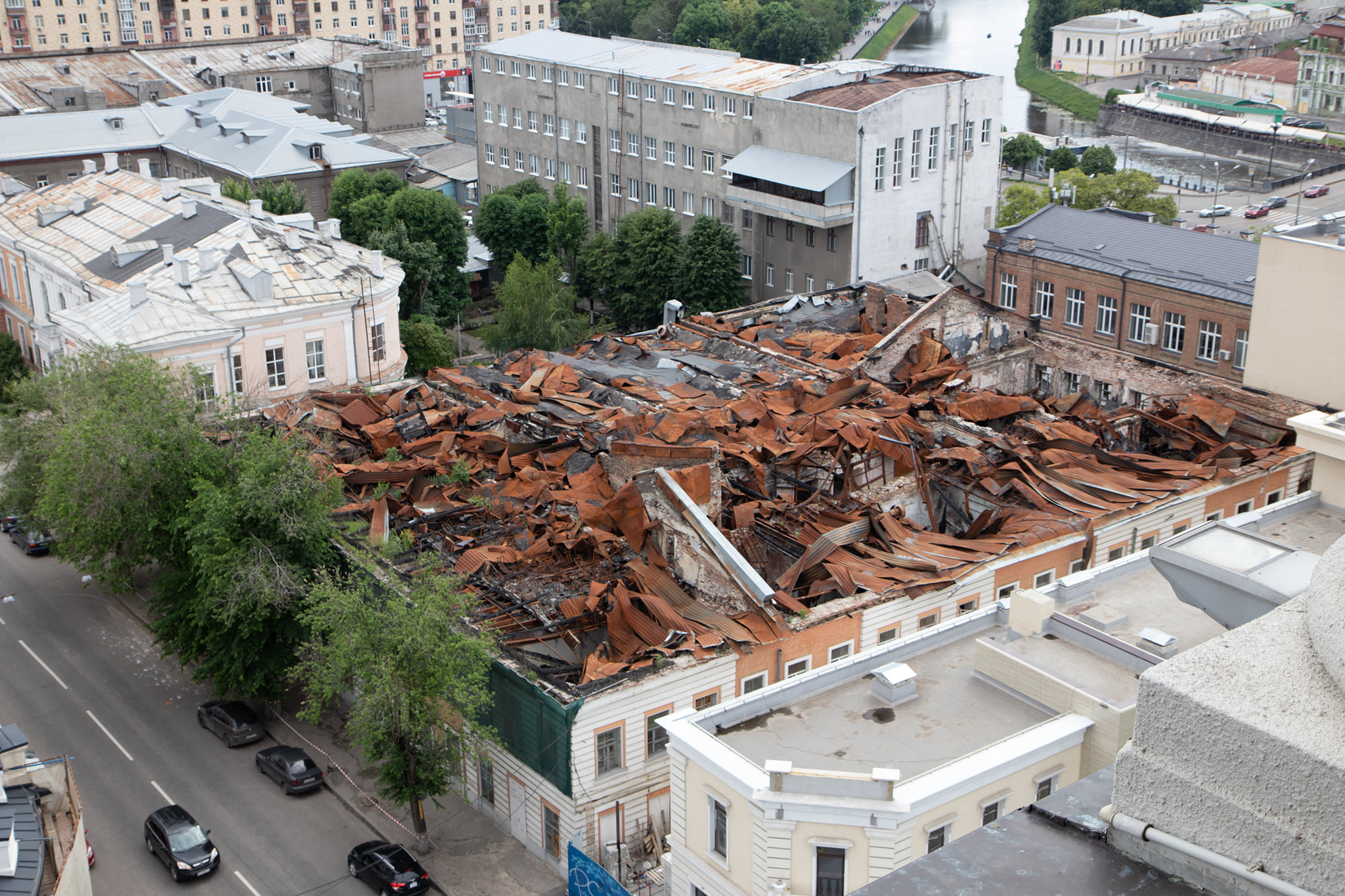
On August 2, a fire broke out in part of the Ukrainian Engineering and Pedagogical Academy building in our city—specifically, the former chemistry building. As is well known, this building, located at 16 Universytets’ka Street, is an architectural and historical landmark of national significance.
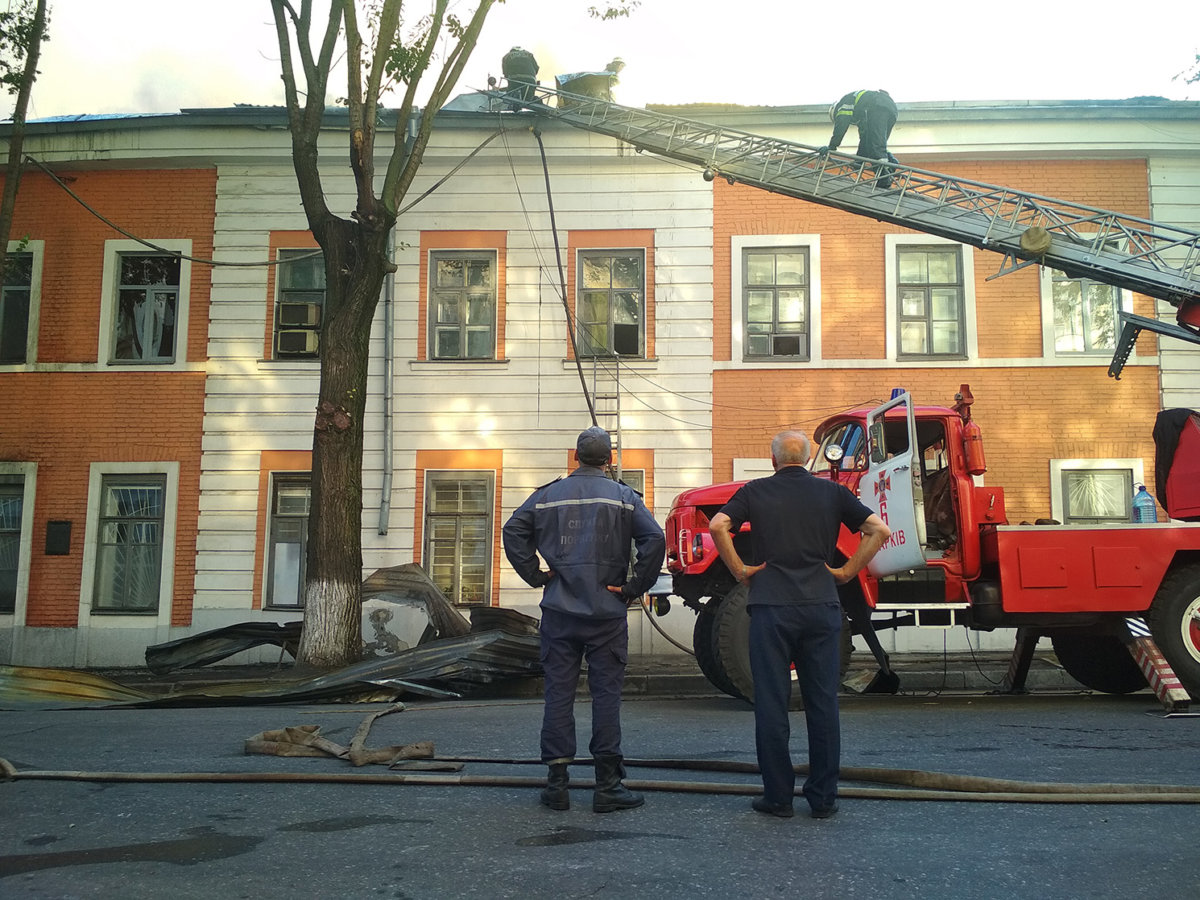
This building, constructed in the second half of the 18th century, initially served as the residence of the governor of Kharkiv and later as the Kharkiv Imperial University (now V. N. Karazin Kharkiv National University). I’m sure many articles will be written in the future about the history of this beautiful building until 1917. Today, however, I’d like to discuss in more detail what happened to the former governor’s residence in the mid-20th century.
As we recall from the article “Architectural Landmarks of Kharkiv in 1944,” architectural landmarks in downtown Kharkiv were surveyed during the summer and fall of 1944. The condition of the university’s main building was deemed satisfactory, as the structure had suffered virtually no damage during the hostilities. Unfortunately, the university church, located directly across the street, was far less fortunate.
However, on October 30, 1946, Orekhov, the head of the regional department of architectural affairs, wrote the following to the rector of Kharkiv State University:
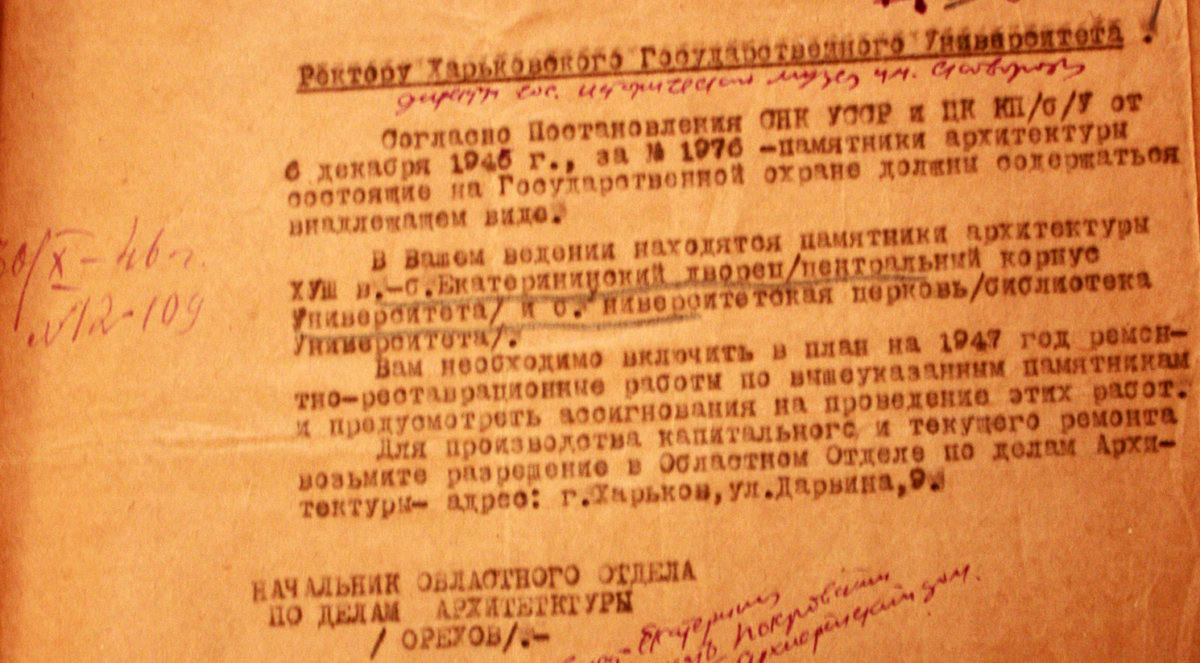
Consequently, renovations were carried out on the building in 1947–1948. The end of March 1951 was marked by an architectural dispute between the owners of the complex of buildings that had once housed the Imperial University and the authorities in power. The leadership of the Kharkiv Regional Department of Architecture sent a letter not to just anyone, but to the head of the Department of Architecture under the Council of Ministers of the Ukrainian SSR himself. The letter stated:
1) The building of the former university church, an architectural monument, is in a state of disrepair.
2) Kharkiv State University:
a) is not taking any measures to protect the monument from further deterioration;
b) uses the premises as a coal storage facility; a breach has been made in the wall to allow trucks to enter;
c) refused to respond to a proposal from the regional department of architectural affairs to issue a preservation commitment. They justified this by citing a lack of funding for the restoration of the former church.
The regional department requested that the building be removed from Kharkiv University’s balance sheet and transferred to the balance sheet of the Department of Architectural Affairs, so that it could then be transferred to an organization that would be able to undertake the building’s renovation on a lease basis. The response from the Department of Architectural Affairs, which arrived shortly thereafter, was quite unequivocal. Although, on the other hand, where would Kharkiv University have found the money for restoration during the postwar devastation?

However, despite this decision, something went wrong with the transfer of the building. This is because even in the summer of 1953, the USSR Ministry of Culture informed the leadership of the Kharkiv Regional Department of Architecture that they were expecting a preservation pledge from the university’s rector in the near future.
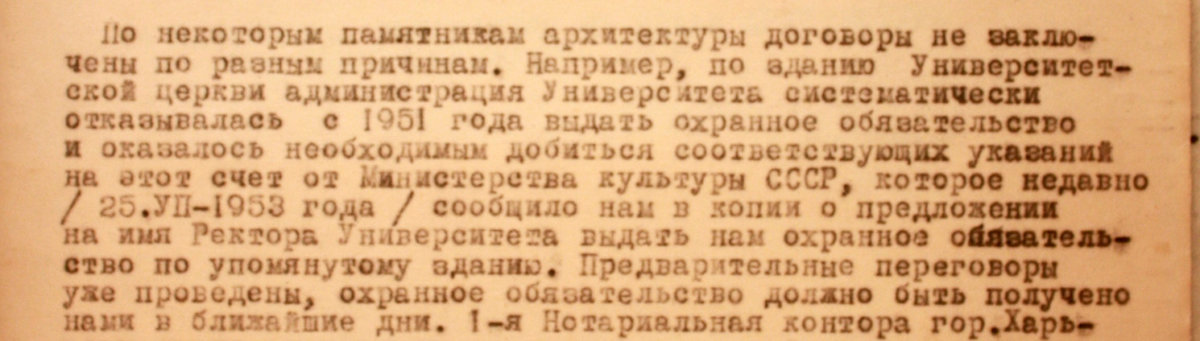
But, as the saying goes, “A promise is not a marriage vow.” A new scandal involving the former university chapel erupted in 1955. The building had been renovated in time for the university’s 150th anniversary. During an inspection, it turned out that the architectural features had been compromised. The plasterwork, for example, was carried out without blueprints or technical guidelines. No thorough measurements were taken of the cornices and column bases; as a result, they were severely damaged, and the proportions were distorted. Consequently, on May 12, the Kharkiv Regional Municipal Bank notified the head of the regional inspection:
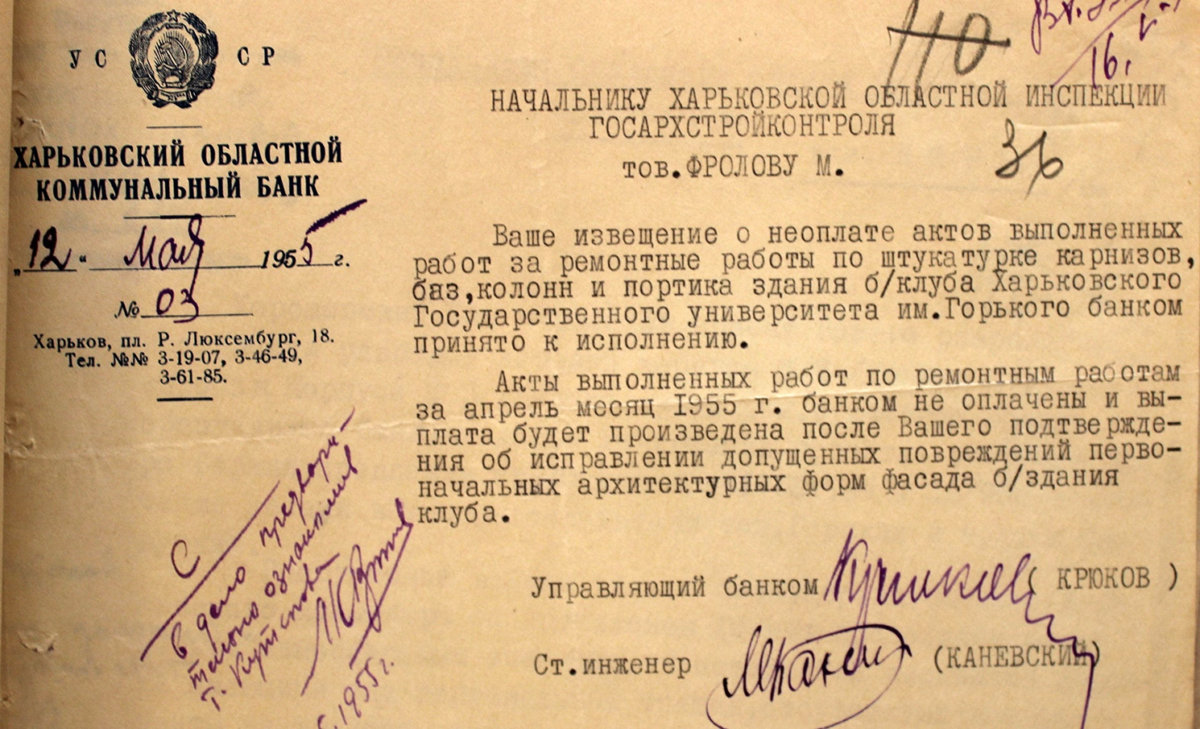
The Kharkiv City Executive Committee raised the issue with the USSR Ministry of Higher Education regarding the transfer of a building to its jurisdiction for restoration and reconstruction, with the aim of subsequently opening a ten-year school there. That said, credit must be given to Kharkiv University—according to reports, the condition of the other buildings (the main building, the chemistry building, and the physics building) was satisfactory. In 1957, the university moved from the old building to the new one. The UIPI became the owner of the building.
A year later, the Ministry of Construction of the Ukrainian SSR received revisions to the list of monuments from the Kharkiv Department of Construction and Architecture. Two items on the list are related to buildings of the old university. The inclusion of the “Catherine Palace”—so beloved by many—is particularly welcome.
Under No. 3, delete the additional name “Katerininsky Palace” in parentheses, as this name is not used either in practice or in the literature. Archival records and literature sometimes refer to it as the “Governor-General’s Palace,” but this name is unsuitable for the official list.
The name “University Church” is inaccurate, since this complex housed not only a church but also the university library and auditorium. It would be more appropriate to name it: “University Library, Auditorium, and Church.”

And in 1958, the building of the former university church was finally transferred to the Film Department’s jurisdiction. In 1962, it was decided to install a protective plaque on the old university building. On September 20 of that same year, the regional Department of Construction and Architecture submitted a proposal to include these buildings on the list of architectural monuments of republican significance. Repair and restoration work was carried out throughout the complex.

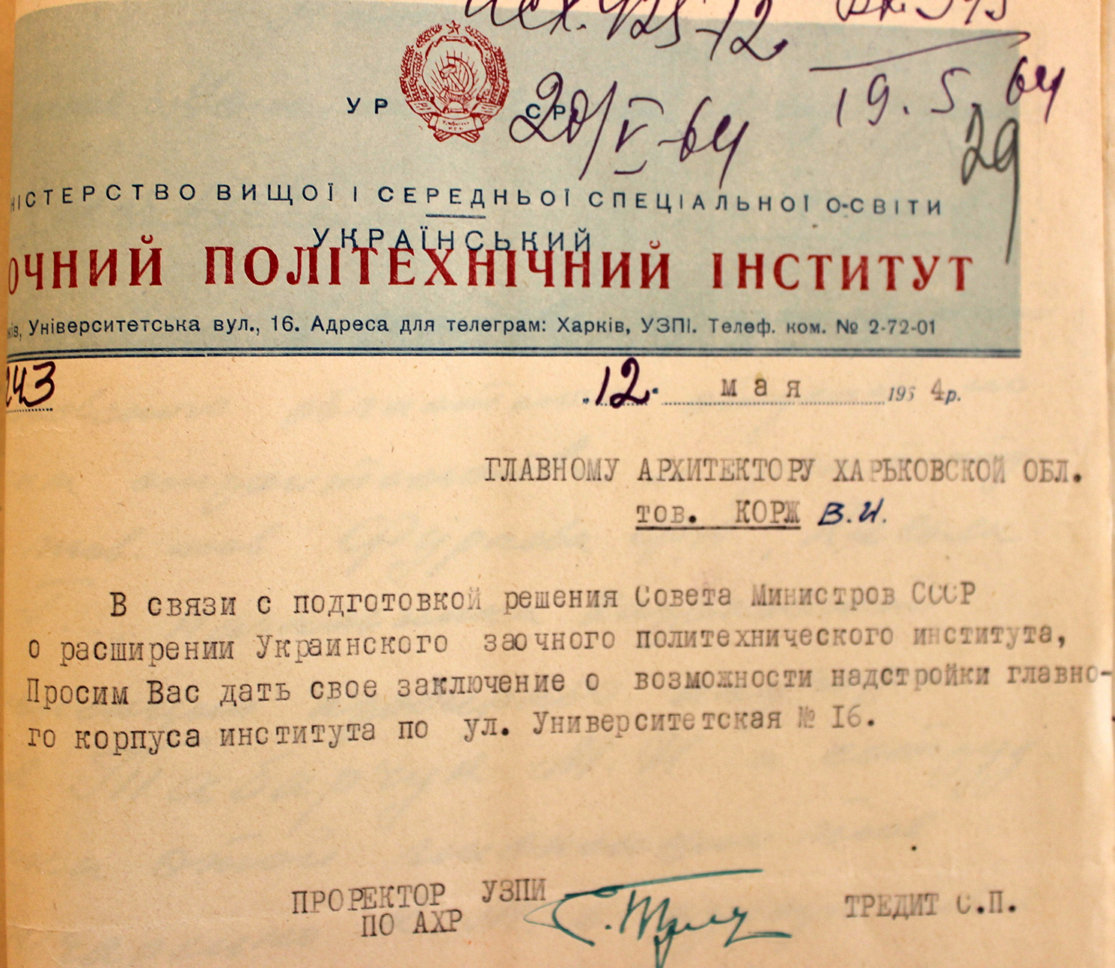
On May 12, 1964, the chief architect of the Kharkiv Oblast received a letter from the vice president of the UIPI:
In connection with the preparation of a resolution by the Council of Ministers of the USSR regarding the expansion of the Ukrainian Correspondence Polytechnic Institute, we request that you provide your opinion on the feasibility of adding an upper story to the institute’s main building at Universitetskaya Street, 16.
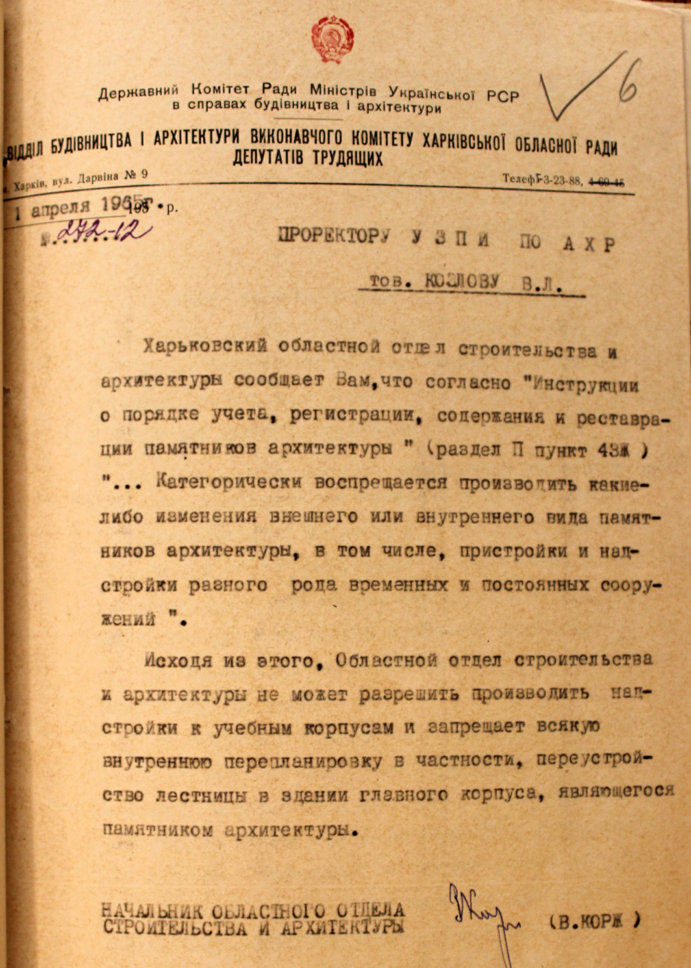
The response received by the vice president on April 1, 1965, contained not only a categorical refusal but also a ban on any internal remodeling at the university and any alterations to the staircase.
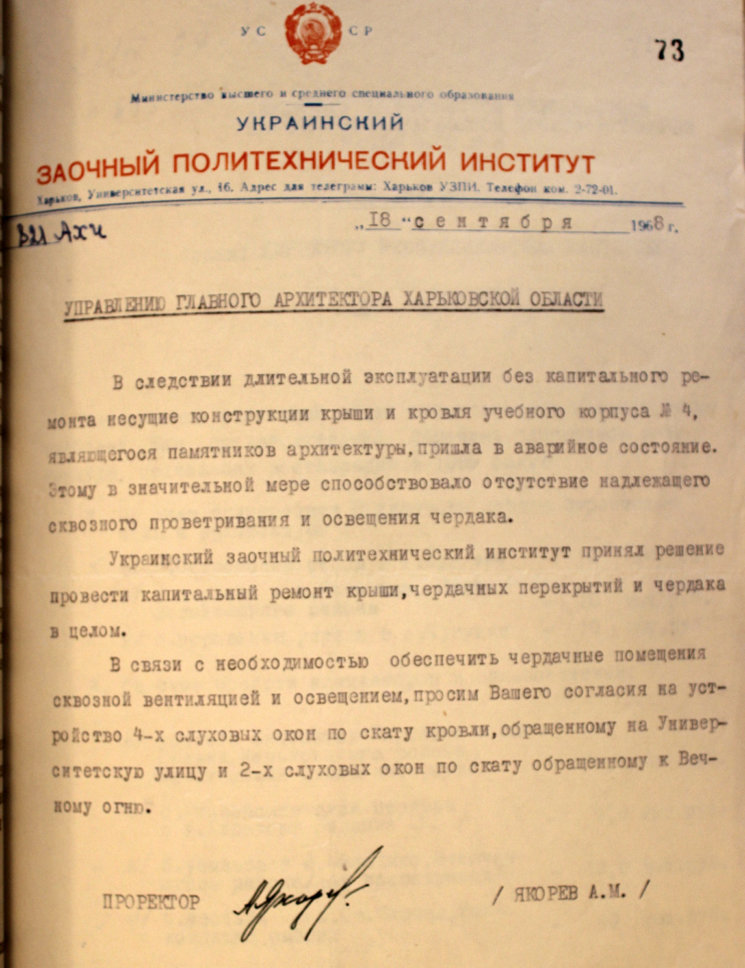
In the summer of 1967, the building underwent major renovations, during which the electrical wiring and fire safety equipment were replaced. A site for burning trash was also set up. The report also states the following: “Previous violations of fire safety requirements have been rectified.” However, it appears that the major renovation did not help—in 1968, the Office of the Chief Architect of the Kharkiv Region reported that the roof and roofing of Academic Building No. 4 were in a state of disrepair.
Well, a year later, yet another massive scandal erupted. In violation of the regulations governing the use of architectural monuments in effect at the time, and without any approval from the Regional Department of Construction and Architecture, the university built an addition to one of the side buildings without authorization. The metal frame installed for the addition significantly distorted the original appearance of the former university. Despite an order to immediately halt the work, the institute’s administration stubbornly continued construction. Not even the design documentation had been developed or approved.
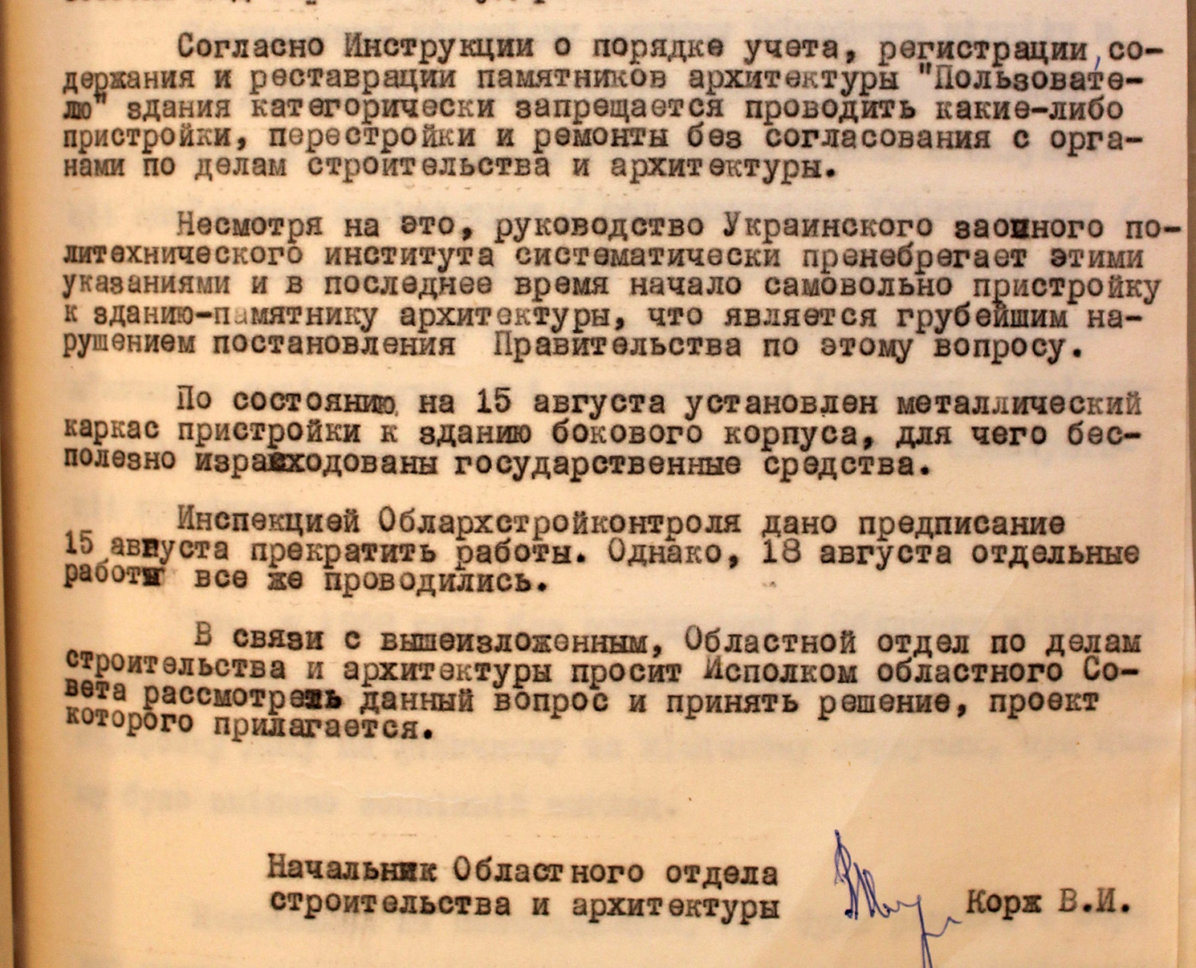
It is particularly interesting that, among other things, the document “On the Violation by the UIPI of the Rules for the Operation of an Architectural Monument” stated that during the 1968 renovation, the roof on the physics and chemistry buildings was remodeled without approval from the regional department of construction and architecture. As a result, the appearance of the buildings changed. Without wishing to delve further into the details of this extremely complex case, I will simply say that on October 14, 1969, the State Construction Committee of the Ukrainian SSR reached a compromise decision. On the one hand, the university rector was warned against engaging in such unauthorized actions in the future. On the other hand, the complex conditions under which the institute operated were taken into account, as well as the fact that a significant amount of construction work had already been completed and that the unauthorized addition was located in the courtyard. Therefore, as an exception, permission was granted to complete the construction on the condition that it be completely dismantled when new institute facilities were built.
Well, to conclude, a few words about a dream and a decision that were never meant to come true. Thanks to archival documents, I learned that, as it turns out, there were plans in 1969 to relocate the UIPI to another building within the next five years. And to create an architectural preserve in what had previously been the governor’s residence and later the Kharkiv Imperial University. I am sincerely convinced that bringing this wonderful idea to life would undoubtedly have further beautified our city and also prevented what happened on August 2, 2018. After all, by looking at the intense architectural passions of the past, one can understand the roots and causes of the present.

- About the military pilot school and the airfield in Kharkiv… - 04.11.2020
- Nikanor Savich—A Political Career by Mistake - 13.07.2020
- And once again, about the Cavalry Guards… - 21.01.2020