In early January 1951, a highly scandalous incident occurred in the Sloboda Ukraine region, sending shockwaves through the ranks of officials in our city and region.
The Department of Architecture under the Council of Ministers of the Ukrainian SSR sent a request to the Kharkiv Regional Department of Architecture, in which the Kyiv authorities asked for detailed materials (photographs, historical background, a technical condition report) describing the St. Nicholas Church in the village of Khotimlia, Starosaltovsky District, Kharkiv Oblast. The reason for this interest was a letter attached to the request. Here is its full text:
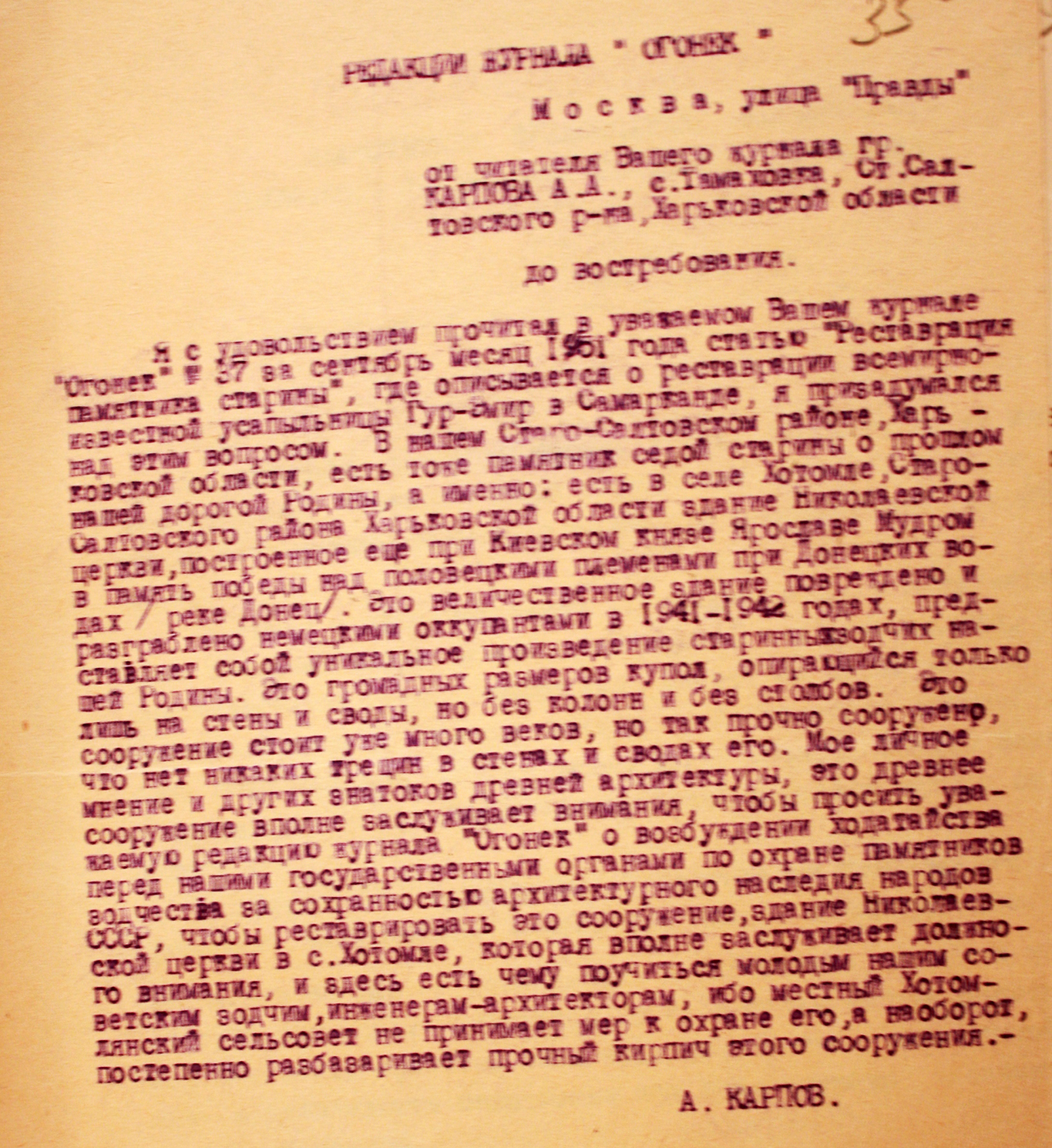
To the Editorial Office of *Ogonek*
magazine, Moscow, Pravdy
Street, from a reader of your magazine,
A. A. Karpova, Tomakhovka village, Saltovsky
District, Kharkiv Oblast
. To be claimed.
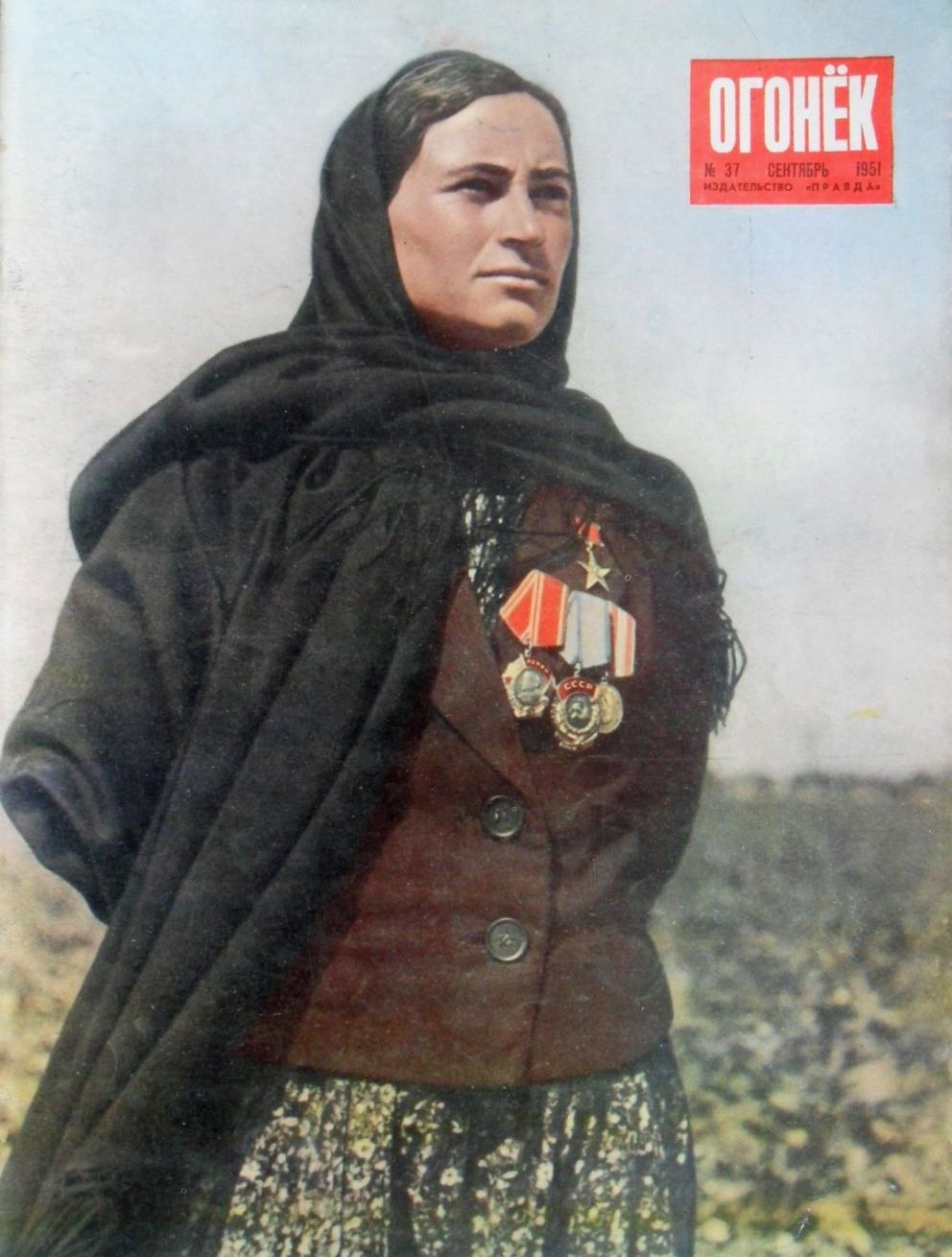
I was delighted to read in your esteemed magazine *Ogonek* No. 37, September 1951, the article “Restoration of Historical Monuments,” which describes the restoration of the world-famous Gur-Emir Mausoleum in Samarkand, and it gave me pause for thought.
In our Starosaltovsky District, Kharkiv Oblast, there is also a monument from time immemorial that commemorates the past of our beloved homeland, namely: in the village of Khotimlia, Starosaltovsky District, Kharkiv Oblast, stands the St. Nicholas Church, built during the reign of Prince Yaroslav the Wise of Kyiv to commemorate the victory over the Polovtsian tribes at the Donets River. This majestic building, destroyed and looted by the German occupiers in 1941–1942, is a unique masterpiece of our homeland’s ancient architects. It features a massive dome supported solely by the walls and vaults, without any columns or pillars. This structure has stood for many centuries, yet it is so solidly built that there are no cracks in its walls or vaults. In my personal opinion—and that of other experts in ancient architecture—this ancient structure fully deserves attention, and I would like to ask the esteemed editorial board of the magazine “Ogonyok” to file a petition with our state authorities responsible for the protection of architectural monuments to preserve the architectural heritage of the peoples of the USSR, with the aim of restoring this structure, the Nikolayevskaya Church in the village of Khotimlia, which fully deserves due attention, and there is much here for our young Soviet architects, engineers, and architects, for the local Khotimlia Village Council is not taking measures to protect it; on the contrary, it is gradually squandering the sturdy brickwork of this structure.
A. KARPOV.
Of course, the news that a structure dating back to the time of Prince Yaroslav the Wise existed in the Kharkiv region sent everyone into a complete uproar. And in February 1952, a reply finally arrived in Kyiv from Kharkiv…
“In response to a letter to the editor of *Ogonyok* magazine from Mr. Karpov regarding the church building in the village of Khotimlia, Starosaltovsky District, Kharkiv Oblast, we would like to state the following:
There is no basis for dating the aforementioned church building in the village of Khotimlia to the 11th century, during the reign of Yaroslav the Wise, since the settlement of Khotimlia dates to the second half of the 17th century (ca. 1668; see “Historical Chronology of the Kharkiv Governorate” by K. P. Shchelkova, 1882, p. 34). The St. Nicholas Church building mentioned by the author of the letter was built in 1756 but burned down in 1765; in its place, a new stone Church of the Intercession was built in 1774 (see Filaret, “Historical and Statistical Description of the Kharkiv Diocese,” vol. IV, p. 304, as well as K. Shchelkova, pp. 114 and 127 of the aforementioned work).
Thus, the historical data do not corroborate the information provided by Mr. A. Karpov in his letter to the editor of *Ogonyok*.
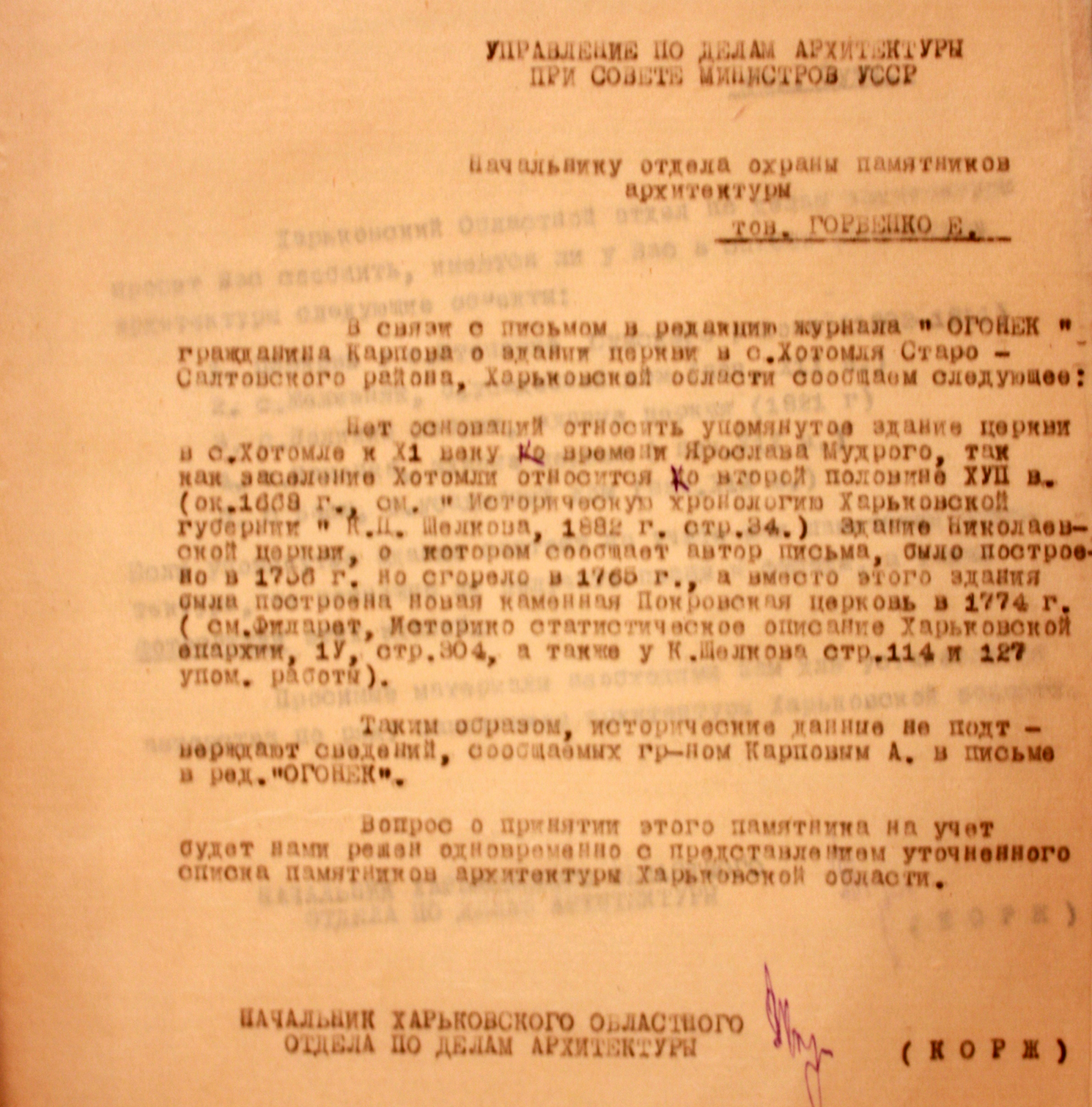
“We will decide on the registration of this monument at the same time as we submit the updated list of architectural monuments in the Kharkiv region.”
This response (especially the last part) is quite understandable. After all, the registers of architectural monuments were compiled as far back as the 1930s. Given that there were significantly more sites back then than there are now, it took considerable resources to verify and cross-check the data (some of the sites had been destroyed during the war). But the goal was achieved: the letter drew attention to the church (even if it did not date back to the time of Prince Yaroslav the Wise). Among the four architectural monuments in the Kharkiv region scheduled for inspection in 1953, the first on the list is the building of the old church in the village of Khotimlia, Staro-Saltovsky District.
And even though the church has not survived to this day, I believe that the attempt to save it—albeit in such an unusual way—deserves our attention and our collective remembrance.

- About the military pilot school and the airfield in Kharkiv… - 04.11.2020
- Nikanor Savich—A Political Career by Mistake - 13.07.2020
- And once again, about the Cavalry Guards… - 21.01.2020