Few people know this, but in the early 20th century, residents of Kharkiv could purchase firearms with virtually no restrictions and at quite affordable prices. Of course, certain conditions and requirements did exist, although there was no formal licensing and control system as such. Article 114, published in Volume 146 of the “Code of Laws of the Russian Empire” (1845), stated, for example: “It is forbidden for anyone and everyone to carry weapons, except for those whom the law permits or requires to do so.”
However, weapons were still being sold. This was because the law permitted their carrying and possession provided that:
- It is part of the uniform;
- It is necessary for self-defense in the event of an immediate threat to life and health;
- Mandatory by virtue of an established custom;
- For hunting and sports.
- Restrictions on the sale of weapons were imposed only if “there were disturbances (uprisings) in that area.”
The sale of weapons was prohibited to minors, the mentally ill, and hostile tribes, as well as in cases where the person seeking to purchase a weapon had a history of careless or malicious use of weapons.
There were almost no restrictions on the purchase of hunting weapons (particularly rifled firearms). However, the following were denied hunting rights at that time: clergy; individuals under police supervision; and those punished for damaging private forests or for violating hunting regulations.
The 1885 law also stated: “It is prohibited to fire weapons in houses, courtyards, public squares, and streets. The penalty is confiscation of the weapon and a fine of up to 25 rubles. Carrying a weapon where it is prohibited is punishable by a fine of up to 10 rubles.”
On May 29, 1903, Emperor Nicholas II issued a decree “On the Sale and Storage of Firearms and Explosives, and on the Establishment of Shooting Ranges.” It stated, in particular:
- It is prohibited to possess rifled rapid-fire (magazine-fed, etc.) firearms, as well as ammunition for them, without a special permit from the governor.
- Persons who trade in weapons and supplies are required to maintain special ledgers in which they record all weapons in their inventory or in their store; they must also note which items were sold, when, and to whom; These ledgers are issued free of charge by the provincial administration, properly bound, sealed, and stamped.
- Among firearms and ammunition, rifled rapid-fire (magazine-fed) rifles and the cartridges for them… may be sold only to persons who present a personalized certificate from the governor authorizing the purchase of these items.
- The aforementioned books and records are kept in the warehouse and in the store and are presented to police officers or other officials dispatched by the governor, upon their request, for inspection and verification of the available weapons and supplies.
- The rules set forth herein do not apply to military personnel and officials who, pursuant to special legislation, are required to possess such weapons and ammunition.
- Shooting ranges may be established only with the governor’s permission.
In 1905, in light of the difficult situation in the country, the Council of Ministers deemed it necessary to:
- To authorize governors-general, governors, and mayors in areas not declared to be under a state of emergency, in the event of extraordinary circumstances threatening public order and tranquility, the authority to issue binding regulations, valid for no more than three months, regarding the storage and sale of firearms, except for hunting firearms, as well as ammunition and explosives.
- To impose, on its own authority, administrative penalties for violations of the aforementioned regulations, not exceeding three months of detention or a fine of 500 rubles.
Consequently, only a person who presented a personalized certificate (the equivalent of a modern license) issued by the local police chief (or another authority) was entitled to purchase a pistol. However, the bans did not apply to smoothbore firearms, low-powered “ladies’” firearms intended for self-defense, or non-automatic hunting firearms owned by law-abiding citizens.
In conclusion, we can say that the legislation at that time, while granting nearly everyone the right to own firearms, strictly regulated the process itself and controlled the circulation of weapons and ammunition, thereby maintaining order in the country. In some regions, there were strict rules governing the purchase of firearms, requiring the submission of a special application addressed to the head of the local administration. In others, the rules were more lenient, and the sale of firearms was virtually unrestricted.
The arms trade itself at that time constituted a fairly well-developed retail network. In Kharkiv, for example, weapons could be purchased at the following stores:
- K. O. Shulz — Moskovskaya St., 14
- A. A. Edelberg — Nikolaevskaya Square
- Merchandise from A. V. Tarnopolsky’s gun shop—located on Yekaterinoslavskaya Street in the Rufa building.
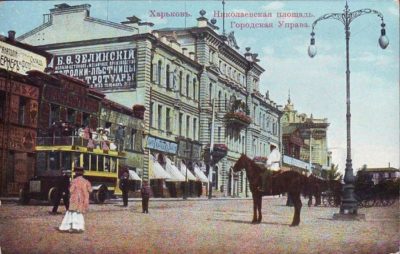
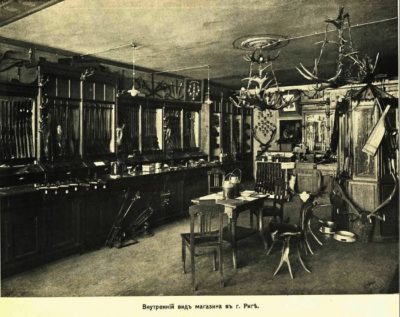
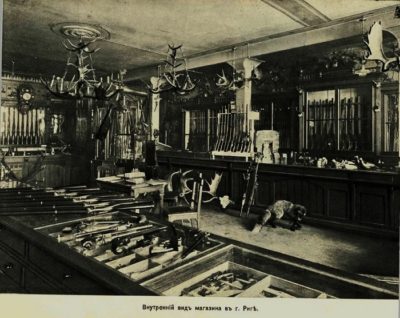
Unfortunately, no images of the stores’ interiors have been found yet.
However, thanks to early 20th-century photographs from the “Riga Price List of Master I. Niklas’s Specialty Arms Shop,” we can—albeit only vaguely—imagine the interiors of the Kharkiv premises.
But from April 21 to 25, 1911, a very important and significant event took place in our beloved city. The fact is that the Kharkiv branch of the Imperial Society for Proper Hunting organized the “First Hunting Exhibition.”
For Kharkiv, this was truly a major event. After all, it was expected that the following would be presented there:
Dogs of all breeds—hunting, sporting, and companion dogs—hunting horses, live birds and animals, firearms, equipment, hunting footwear, clothing, camping gear, saddles, carriages, boats, bicycles, automobiles, etc.; fishing and fish farming; works of art: paintings, photographs, taxidermy specimens, furs, antlers, etc.; hunting literature: statistical maps, diagrams, etc.; veterinary and optical sections.
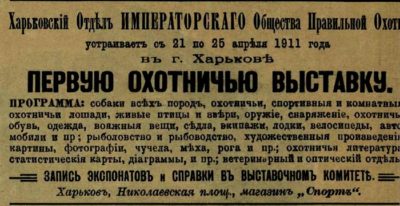
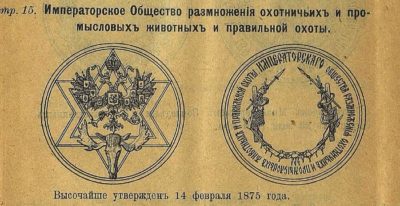
Gun dealers took pride in the awards they received at the Kharkiv hunting shows and were happy to include information about their achievements in their store catalogs.

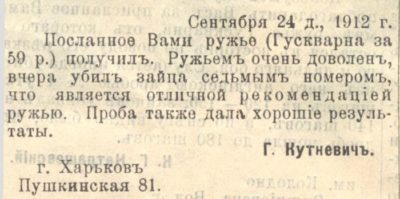
Speaking of gun advertisements: Price lists (catalogs) from gun shops in the late 19th and early 20th centuries were quite common. They serve as a sort of encyclopedia of life during that era. Some owners printed glowing reviews of their products in these catalogs to attract customers. For example, in the catalog “Warsaw Hunting Society, Wholesale Arms Trade, 1913–1914,” we find:
September 24, 1912
I received the shotgun you sent (a Husqvarna for 59 rubles). I’m very happy with it; yesterday I shot a hare with No. 7 shot, which is a great testament to the gun’s quality. The test shot also yielded good results.
G. Kutnevich, Kharkiv, 81 Pushkinskaya St.
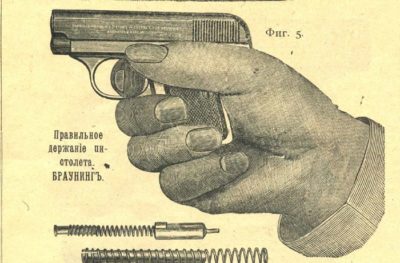
In stores, you could buy all kinds of “Mausers,” “Brownings,” “Colts,” “revolvers,” “Nagants,” and other handguns necessary for self-defense.
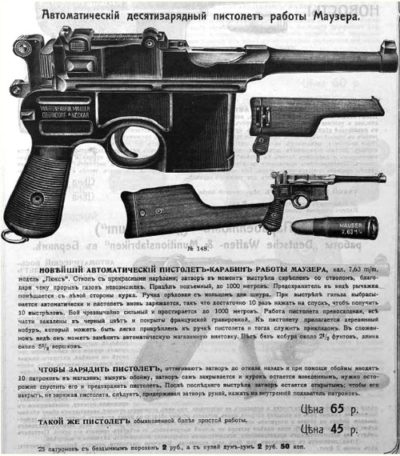
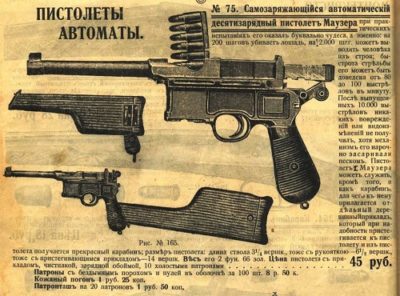
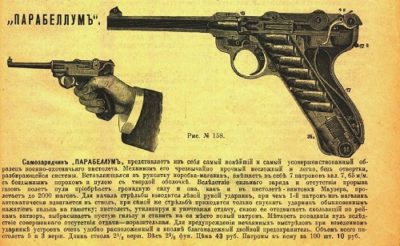
In addition, sellers could include the following information in their catalogs:
“Weapons sold on installment plans are available only to officers.” Or: “Due to constantly fluctuating prices for automatic pistols, I am unable to list a fixed price in the price list, but at the request of customers, I will immediately notify them of any price decreases or increases for the aforementioned pistols.”
Or, alternatively:
Guns without permits!
All of the pistols listed below are shipped without any permits, as they are smoothbore ramrod-loaded pistols suitable for watchmen, guards, and the like. The Monte Cristo target pistols, large and small, are designed for target practice, as well as for carrying in one’s pocket as a revolver for self-defense; Flobert—although the cartridge is weak, the shot is very powerful, and the flash from the pistol can send an attacker fleeing. We recommend these to anyone who does not own a revolver.

In 1909, gun shop owners reminded their customers:
When ordering revolvers and pistols, you must submit an original certificate from the local police authority authorizing the purchase of a revolver.
They also clarified:
Weapons are currently relatively inexpensive, especially since highly aggressive advertising helps sell the most substandard products, which aren’t even worth the meager price charged for them. Good weapons cannot generally be obtained for next to nothing, and there is hardly any other product where the principle of “as cheap as possible” is punished as severely in its manufacture as it often is in the field of weapons technology.

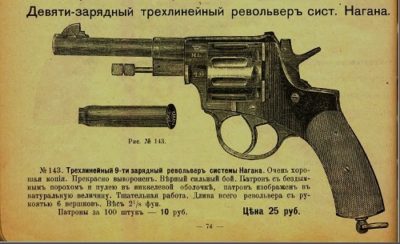
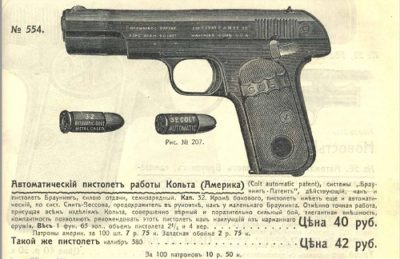
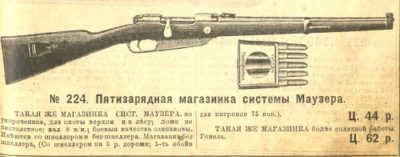
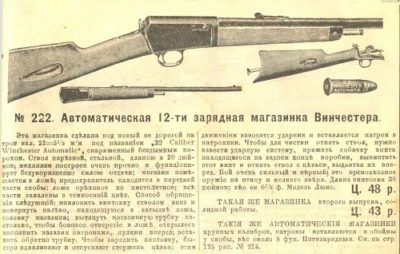
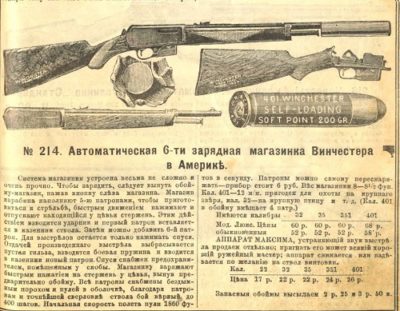
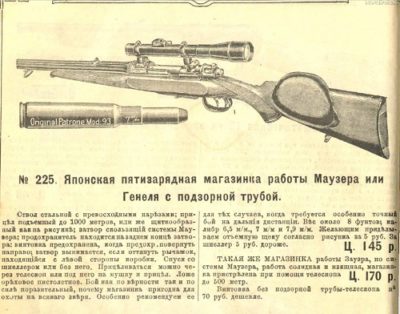
In addition to standard hunting rifles (muzzle-loaders, Berdan rifles, single-barrel, and double-barrel), customers could also purchase the latest technical innovations. For example—a five-shot Mauser-style magazine, a twelve-shot Winchester magazine, or a six-shot Winchester with a silencer. However, the Japanese five-shot Mauser-style magazine did not have a silencer; instead, it was equipped with… a spotting scope.
As with handguns, the owners explained to their customers:
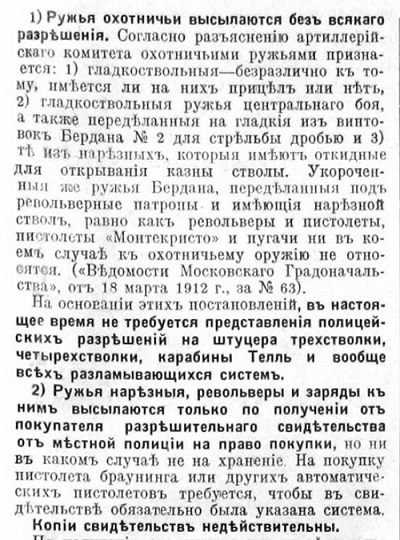
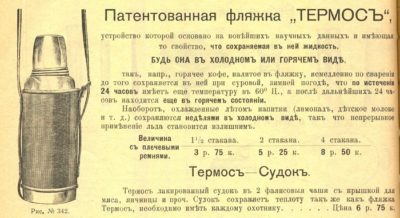
The most interesting thing is that in gun shops back then, just as today, in addition to ammunition, pistols, and rifles, a huge variety of other goods were sold: bladed weapons, roller skates, fireworks, hunting gear, accessories for motorists and aviators… But that’s a whole other story.

- About the military pilot school and the airfield in Kharkiv… - 04.11.2020
- Nikanor Savich—A Political Career by Mistake - 13.07.2020
- And once again, about the Cavalry Guards… - 21.01.2020