Right at the beginning of Poltavskyi Shliakh Street, you can see a magnificent mansion. The building at No. 1 catches the eye with its beauty—both for those strolling up University Hill and for those who’ve decided to simply take a walk through Kharkiv from the South Train Station. Many sightseeing tours begin right at this “charming little green corner house.” Personally, I’ve never been able to bring myself to call this building that. At least two interesting stories are connected to it.
To begin with, there were quite a few places in our city where one could buy books in the late 19th and early 20th centuries. Dmitry Nikitich Poluekhov’s bookstore, located at Moskovskaya Street, 18, a consignment agent for various educational institutions, attracted visitors with a wide selection of books covering all fields of science and literature, as well as by accepting books on consignment.

- The Morrisson store on Yekaterinoslavskaya Street sold only editions of the Holy Scriptures.
- Anyone who wished to do so could purchase German-language books from the merchant Friedrich Karlovich Miller.
- The bookstores owned by Yurokov, Kosov, and Antropov sold folk books and paintings.
- Used books could be purchased from the townsman Meretsky or the peasant Ivan Nestorovich Kadyk.
- Retired Major Fyodor Nikolaevich Konstantinov owned four newsstands in Kharkiv where he sold various newspapers and books.
- Fyodor Ivanovich Mikhailov, the owner of a bookstore on Shubny Row near Universitetskiy Hill, emphasized in his advertisements that he offered a wide selection of books in Ukrainian.

His competitor, I. I. Kukolevsky (Jr.), the owner of a bookstore on Ekaterinoslavskaya Street, was not far behind.

Starting in 1903, the building of the Meshchansky Society on Torgovaya Square housed the store of Ivan Dmitrievich Sytin, the largest book publisher in the Russian Empire. He produced mass-market, inexpensive editions of Russian and foreign classics, published numerous illustrated manuals, literature for educational institutions and extracurricular reading, as well as colorful children’s books, fairy tales, and children’s magazines. The exact number of publications released by Sytin remains unknown to this day.

N. I. Suchilin was the manager of Sytin’s store in Kharkiv. And A. I. Sizov was the provincial correspondent who wrote for Sytin’s newspapers.
As is well known, the first and second volumes of the seminal work *What Should the People Read? A Critical Guide to Books for Popular and Children’s Reading* were published by K. D. Alchevskaya at her own expense. By the time the third volume was compiled, Khristina Danilovna’s financial situation had deteriorated significantly. This was due to the fact that on May 7, 1901, her husband, the entrepreneur and industrialist Alexei Kirillovich Alchevsky, took his own life.
Although she was not, to use modern terminology, a “businesswoman,” Alchevskaya needed money to continue her projects. During this difficult time, Ivan Dmitrievich Sytin unexpectedly came to her aid. It was thanks to his funding that the third, very substantial volume of *What Should the People Read?* was published. Moreover, to make it more accessible to a wider audience, the price of the volume was set at 1 ruble and 75 kopecks.

In 1912, the Sytins published Alchevskaya’s memoirs, which are already well known to us: *Thoughts and Experiences: Diaries, Letters, and Memoirs*.
That is precisely why, in one of her letters, Khristina Danilovna writes:
We owe Ivan Dmitrievich a great deal for his support of our publications and for ensuring their wide distribution. All of this has helped us establish a Board of Trustees to address the needs of the Kharkiv Private Girls’ Sunday School. This secures the school’s future. Not only that, but several other Sunday schools have already established similar committees, thereby securing their own futures. All of this is of great importance to the cause and promises it a stable future!
Vasily Yakovlevich Danilevsky is credited with initiating and editing the multi-volume *People’s Encyclopedia of Scientific and Applied Knowledge*. However, publishing such a much-needed book required a considerable amount of money. When they approached Ivan Dmitrievich with a request for support, his reply was extremely brief: “I know, I know, it’s a good cause; write to them that I agree.”

The main rival of Sytin, the “book king,” was Alexei Sergeyevich Suvorin, a journalist, publisher, writer, theater critic, and playwright. He began his career in book publishing in St. Petersburg in 1872. He owned his own printing press, a newspaper, a chain of bookstores (including some abroad), as well as the exclusive right to sell published materials (newspapers, magazines, inexpensive books, and postcards) at railways, docks, and the mineral springs of the Caucasus and Starorussk.
It was Suvorin who was behind a number of interesting initiatives: for example, the establishment of the Russian Empire’s first agency for the distribution of printed works. It was even said that at that time there was no province, port, or railroad station that did not have an “A. S. Suvorin Agency” kiosk selling books and periodicals. It is hardly surprising that, over time, “A. S. Suvorin & Co. Agency” became Russia’s largest publisher of picture postcards.
After the opening in 1878 of bookstores operated by Suvorin’s publishing house “Novoye Vremya” in Moscow and St. Petersburg, on November 28, 1885, the “book king” opened his third store in Kharkiv. It was located in Ivanov’s house at Yekaterinoslavskaya Street, 1. For that time, Suvorin’s stores were a kind of book supermarket.

At Kharkiv’s largest bookstore, you could buy books on every subject, textbooks, maps, and globes. New books were added to the selection every week. A discount system was in place for booksellers, librarians, public institutions, and students.

This store was also the only place in our city in the early 20th century where one could purchase the exclusive and extremely expensive magazine *Capital and Estate. A Magazine of the Good Life.” Its 26th issue featured the first color photographic portrait ever published in the Empire.

But that is by no means the end of the story of the “charming little green house on the corner.” In early September 1910, the following report appeared in Kharkiv newspapers:
A major deal.
A deed of sale has been executed for the enormous house of Engineer Ivanov, covering more than 1,600 square sazhens, located at the corner of Yekaterinoslavskaya Street and Lopanskaya Embankment, which also opens onto Kontorskaya and Kuzinsky Lanes. This property is one of the largest in the city and is unique in that it forms a sort of square, as if set apart. Mr. Ivanov purchased these buildings twenty-five years ago at a bank auction—they were formerly the property of Burkevich—and they cost him approximately 200,000 thousand rubles. Mr. Ivanov subsequently carried out numerous additions and renovations. Currently, these buildings generate 62,000 rubles in annual income. The sale took place for 620,000 rubles. There is a debt on the properties (to the Poltava Land Bank) of 450,000 rubles, along with which the property was transferred. A deposit of 15,000 rubles was paid. This property was purchased by Messrs. Krymov and Münch, who, according to rumors, have been offered the opportunity to resell it at a profit of 50,000 rubles. Messrs. Munch and Krymov intend to build a huge shopping arcade here, with stores on the ground floor and various premises on the upper floors.
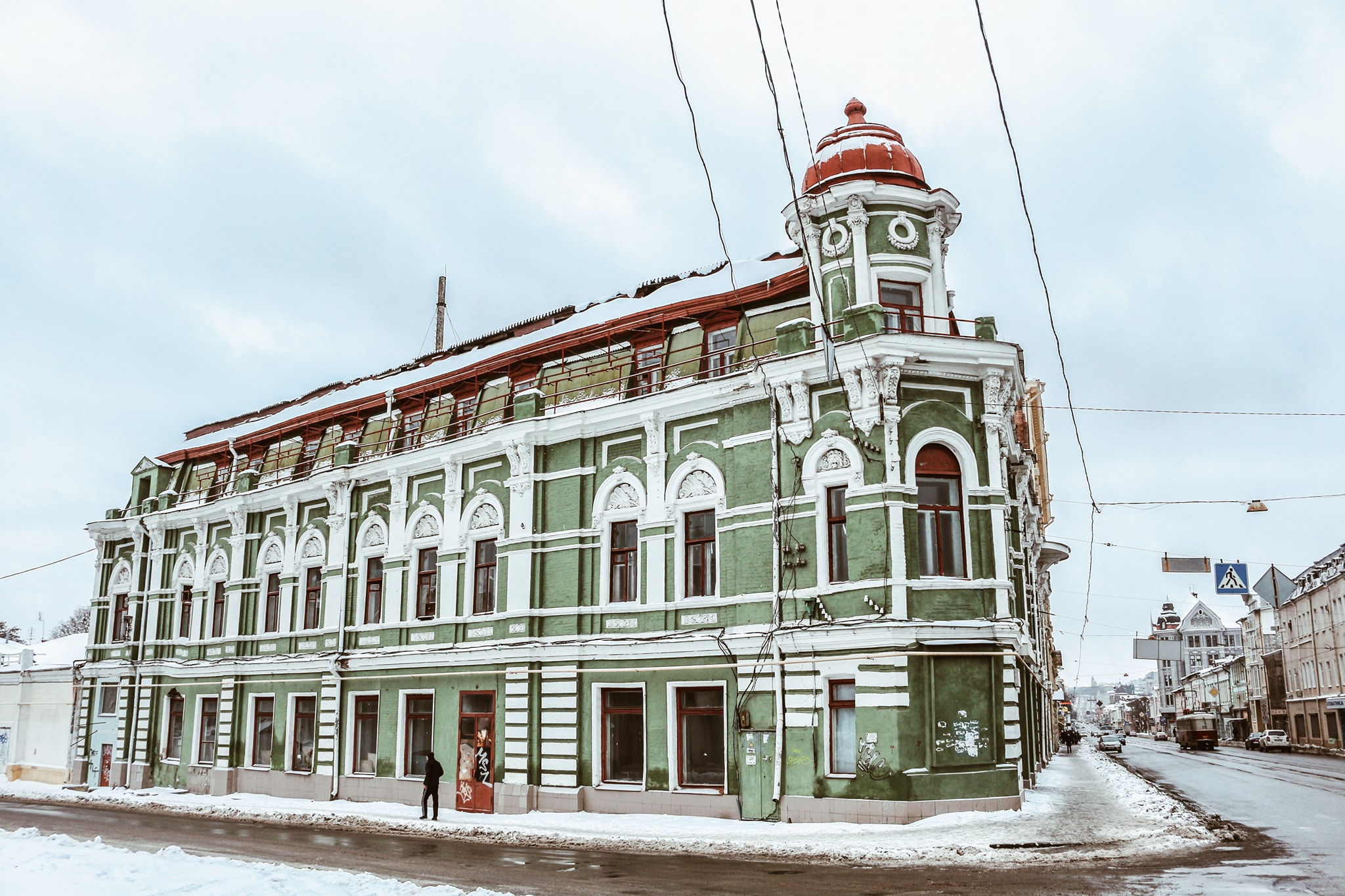
According to rumors, these individuals have allegedly secured the support of foreign capitalists looking to invest their money profitably. There is talk of construction costs amounting to two million rubles or even more. There is a tremendous need for commercial space and stores in the area around Yekaterinoslavskaya Street. It is currently very cramped here, as all the ground floors of the buildings are occupied by stores and warehouses. Kharkiv is growing very rapidly, not only in the elevated part of the city but in other areas as well. Not long ago, Yekaterinoslavskaya Street was considered to have lost its vitality due to the growth of Sumskaya and Moskovskaya Streets. The increase in rail traffic has had a huge impact on the commercial significance of our oldest street.
Archival documents reveal that the merchant Adolf-Gustav Albertovich Münch served as the Swedish consul in our city beginning in 1908. His apartment and office were located at Kostyurinsky Lane, 3. This mansion—albeit with a different number—still stands to this day.

This is the complex yet fascinating story behind the building at Poltavskyi Shliakh, 1, which was once the largest bookstore in old Kharkiv.
