The history of our beloved city is not just about grand mansions, fascinating facts, or famous figures.
Sometimes it’s worth pausing to take a closer look at seemingly insignificant details—
those small “pencil strokes” on the grand canvas of Kharkiv’s history that bring it closer and make it easier to understand.
In the June 1912 issue (No. 23) of the architectural journal *Zodchiy*, readers could find the following announcement:
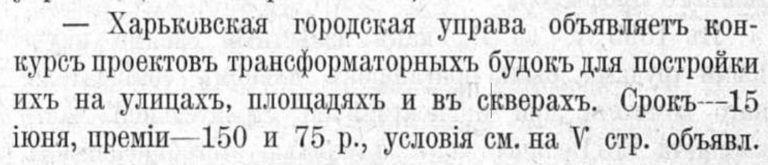
The Kharkiv City Administration is announcing a design contest for transformer stations to be built on streets, in squares, and in parks. The deadline is June 15; prizes are 150 and 75 rubles.
Further on, more detailed information was provided for anyone interested in participating:
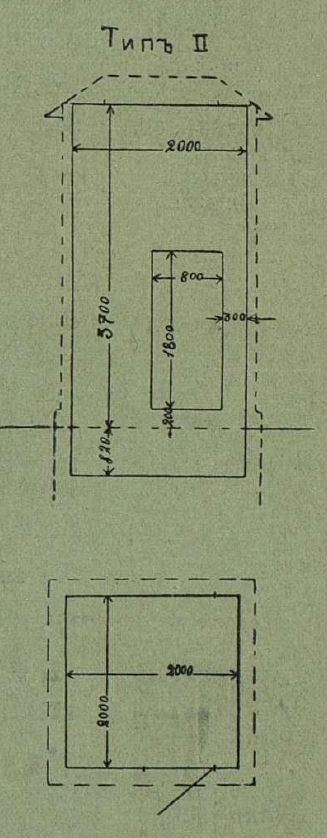
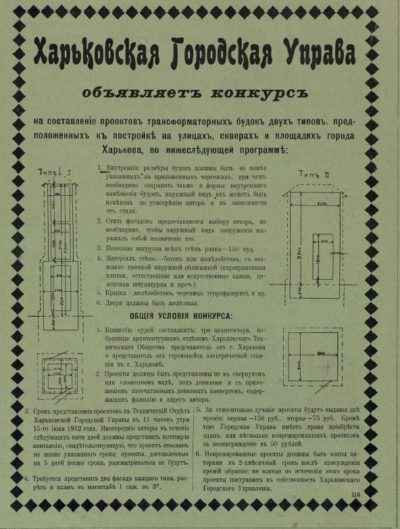
The Kharkiv City Administration is announcing a design competition for two types of transformer stations to be built on the streets, in parks, and in public squares throughout the city of Kharkiv, in accordance with the following guidelines:
1. The interior dimensions of the booths must be no less than those specified in the attached drawings, and the shape of the interior space must also be preserved; their exterior appearance may be modified at the architect’s discretion and depending on the style.
2. The style of the facades is left to the designer’s discretion, but the exterior appearance of the structure must reflect its purpose.
3. The live load on all walls is 150 poods.
4. Wall material: concrete or reinforced concrete, with the most durable exterior cladding possible (pyrogranite tiles, natural or artificial stone, cement plaster, etc.).
5. The roof may be made of reinforced concrete, roof tiles, terrofazite, or other materials.
6. Doors must be made of iron.

General Contest Rules:
1. The judging panel consists of: three architects selected by the Architecture Department of the Kharkiv Technical Society, a representative from the city of Kharkiv, and a representative from the power plant currently under construction in Kharkiv.
2. Designs must be submitted unrolled or unfolded, labeled with a motto, and accompanied by sealed envelopes bearing the motto and containing the designer’s last name and address.
3. The deadline for submitting designs to the Technical Department of the Kharkiv City Council is 11:00 a.m. on June 15, 1912. Authors from outside the city must submit, within the following five days, a postal receipt certifying that the design was mailed no later than the specified deadline; designs received more than five days after the deadline will not be considered.
4. Two elevations of each type, a section, and a floor plan on a scale of 1 sazhen to 3 must be submitted.
5. Two prizes will be awarded for the relatively best projects: the first is 150 rubles, and the second is 75 rubles. In addition, the city administration has the right to purchase one or more projects that did not receive a prize for a fee of 50 rubles.
6. Projects that did not receive a prize must be retrieved by their authors within two months after the prizes are awarded; projects not retrieved by the end of this period become the property of the Kharkiv City Administration.
From this text, we can see that, at that time, even a competition to build transformer stations in the city was put up for public review.
And now, finally, the results of the competition were officially published in issue No. 33 of *Zodchiy* magazine. First and second place went to architects from Kyiv.
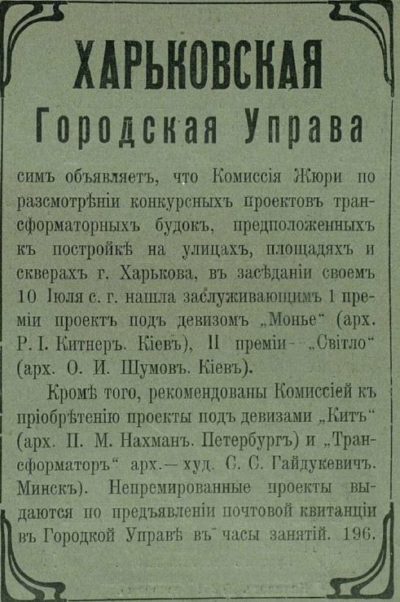
The Kharkiv City Council hereby announces that the jury responsible for reviewing competition entries for transformer stations to be built on the streets, squares, and parks of Kharkiv, in its meeting on July 10 of this year, has awarded the first prize to the design titled “Monier” (architect R. I. Kitner, Kyiv), the second prize to “Svitlo” (architect O. I. Shumov, Kyiv). In addition, the committee recommended for acquisition the designs titled “Kit” (architect P. M. Nakhmán, St. Petersburg) and “Transformer” (architect and artist S. S. Gaidukevich, Minsk). Projects that did not receive awards may be picked up upon presentation of a postal receipt at the city administration office during business hours.
In the summer of that same year, 1912, another advertisement appeared in the same magazine:
The Kharkiv Commercial Club is announcing a competition to design a reinforced-concrete, semi-open-air summer theater in the club’s garden
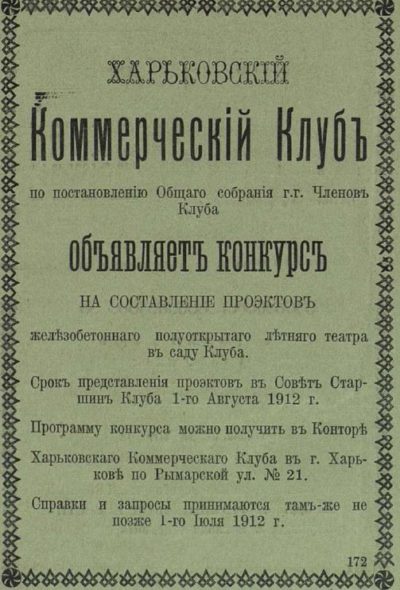
In principle, there was nothing particularly significant about these two open architectural competitions. The transformer station and the semi-open-air summer theater were not architectural masterpieces and, of course, have not survived to this day. However, both they and the story of their creation are small but important details in the portrait of our beloved old city…

- About the military pilot school and the airfield in Kharkiv… - 04.11.2020
- Nikanor Savich—A Political Career by Mistake - 13.07.2020
- And once again, about the Cavalry Guards… - 21.01.2020