The history of our city and its surroundings is incredibly trendy right now. The number of tourism projects is growing, and sections dedicated to the region’s history—a past that could be discussed endlessly—are popping up all over various websites. I wouldn’t be at all surprised if, in the near future, a hypothetical magazine like “Everything for Nursing Mothers” or “Amateur Gardener” were to feature sections on Kharkiv’s history.
Unfortunately, despite the increase in quantity, the quality rarely improves. Everywhere, you find practically the same topics with widely repeated errors—“the Koenig barons, the Shidlovsky counts, the Shapar family, Alchevsky’s suicide”… And, of course, one of the most popular topics is all sorts of “Top 10 Mystical Mansions” and other mysterious, unbelievable stories—preferably involving buried treasure and ghosts. There is one significant “but.” In most cases, none of these stories have any documentary evidence and are based on the trite notion that “well, since the house is old, dilapidated, and gloomy—that means something mysterious must have happened there, and it’s surely haunted…” But there’s not a word about what is perhaps the most mystical place in Sloboda Ukraine—even though everything that happened there over 100 years ago has been documented.
So, the village of Liptsi is located a little over 30 km from Kharkiv. Most people know this village for its cave quarries, which have a highly complex structure. All of them are described in researcher Andrei Kovalev’s work “Caves of the Kharkiv Region,” which was published in the book “Materials for the 10th Anniversary of the Kharkiv Regional Charitable Foundation for the Promotion of Historical and Cultural Research ‘Children of the Underground.’”

However, Andrei Kovalev was not the only one interested in the Liptsi. In 1895, a book titled “The Harbingers of Spiritualism Over the Last 250 Years: Notable Cases of Spontaneous Mediumistic Phenomena Since 1661 and the Transition to Experimental Methods in 1848” was published in St. Petersburg. It was the first book in Russian entirely devoted to the phenomenon of poltergeists. Its author was the well-known publisher, journalist, and translator Alexander Nikolaevich Aksakov. Alexander Nikolaevich became interested in spiritualism as a phenomenon as early as 1855, and he attended his first spiritualist séance in 1870. From then on, until the end of his days, he devoted his life to the study of mediumship and the poltergeist phenomenon. In his book, Aksakov describes several dozen cases of poltergeist activity both within the Russian Empire and beyond its borders. The importance of this work is more than eloquently demonstrated by the fact that it is still actively cited today by contemporary foreign researchers of poltergeist phenomena. In the section where cases of spontaneous mediumistic phenomena are described in chronological order, Aksakov mentions our region three times:
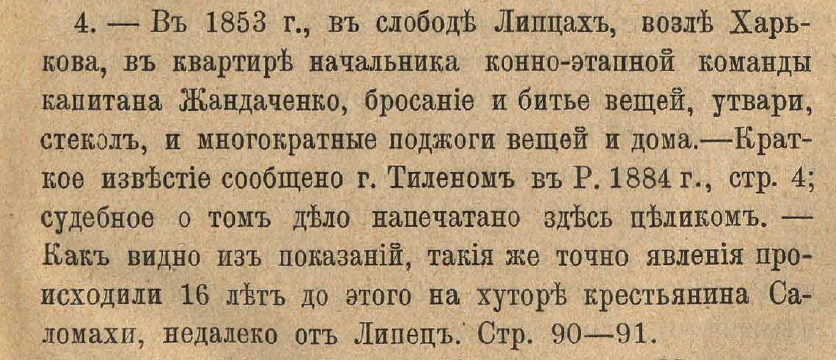
In 1853, in the settlement of Liptsi, near Kharkiv, in the apartment of Captain Zhandachenko, the commander of the cavalry escort unit, there was throwing and smashing of objects, household items, and glassware, as well as repeated arson attacks on belongings and the house. A brief report was published by Mr. Tilen in R. 1884, p. 4; the court record of that case is printed here in its entirety. As can be seen from the testimony, exactly the same events had occurred 16 years earlier at the farmstead of the peasant Salomakha, not far from Lipetsk.
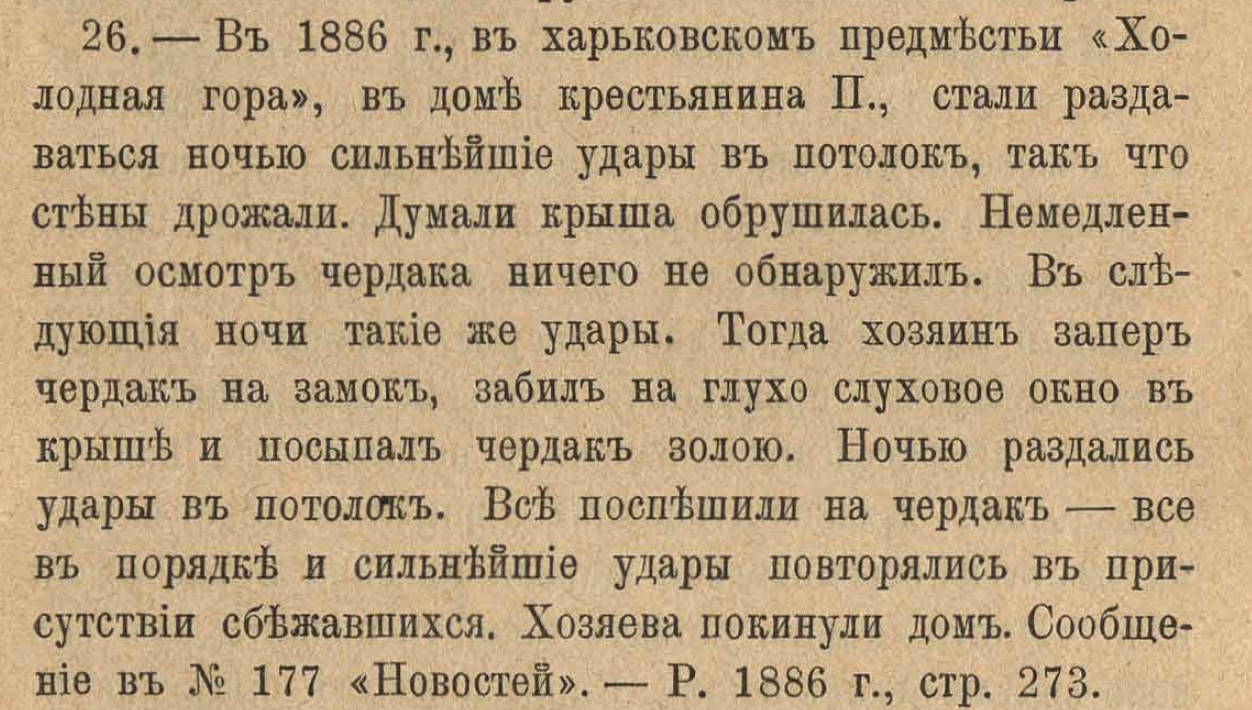
In 1886, in the Kharkiv suburb of “Kholodnaya Gora,” in the home of a peasant named P., loud thuds began to echo through the ceiling at night, so loud that the walls shook. They thought the roof had collapsed. An immediate inspection of the attic revealed nothing. The same bangs occurred on subsequent nights. Then the owner locked the attic, sealed the skylight in the roof shut, and scattered ash throughout the attic. That night, loud thuds rang out against the ceiling. Everyone rushed up to the attic—everything seemed fine—but the loud thuds resumed right before their eyes. The owners left the house. Report in No. 177 of *Novosti*. — St. Petersburg, 1886, p. 273.
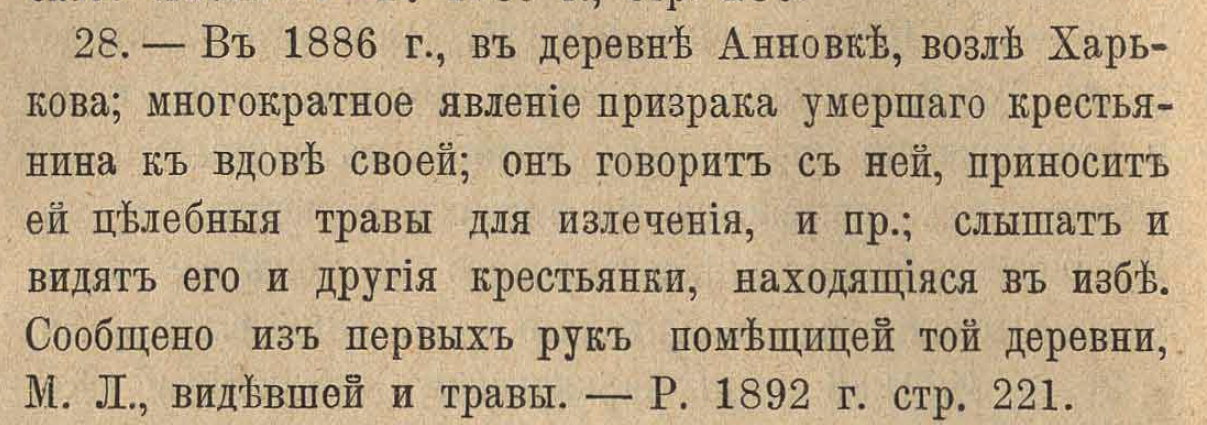
28. In 1886, in the village of Annovka, near Kharkiv; repeated apparitions of the ghost of a deceased peasant to his widow; he speaks with her, brings her medicinal herbs for healing, etc.; other peasant women in the huts could also hear and see him. This was reported firsthand by the landowner of that village, M. L., who had also seen the herbs. — R., 1892, p. 221.
However, for our region, this book is invaluable not only because of these references. The fact is that the author has included in it the complete documents of an extensive court case titled “On the events that took place in the apartment of Captain Zhandanchenko, commander of the Lipetsk horse-drawn convoy, and on the fire that resulted from them.”
The case involving strange phenomena in Liptsi (unexplained sounds, spontaneous movements, and the throwing of household objects, spontaneous combustion) was heard in the district and zemstvo courts of the Kharkiv Governorate from 1853 to 1856 and was dismissed “due to the failure to identify the causes of the unusual phenomena.” In other words, the existence of the Lipetsk poltergeist was, so to speak, officially recognized by the authorities. Aksakov himself writes about this in the preface:
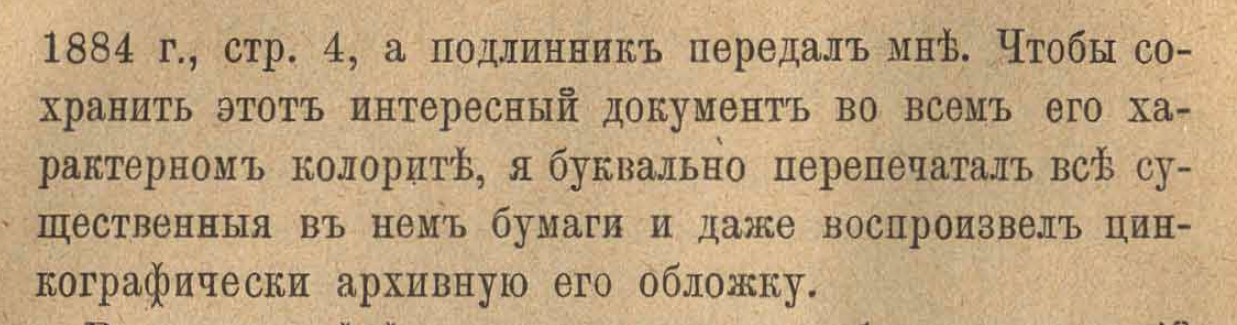
This book came together little by little, so to speak, quite unexpectedly. At first, I wanted to publish only “The Lipetsk Case,” as the only court case in our country that arose from mysterious phenomena, the cause of which—as in hundreds of similar cases— remained unsolved, though their reality was confirmed by the testimony of numerous witnesses. This case file, following the destruction of old case files from the archives of the disbanded Kharkiv Internal Garrison Battalion, was accidentally acquired by an acquaintance of mine, Mr. Tilen, who reported detailed information about it in *Rebus* in 1884, p. 4, and gave me the original. To preserve this interesting document in all its distinctive character, I have literally reprinted all the essential papers it contains and even reproduced its archival cover using zincography.
In total, Aksakov included 65 documents in the book, among which were reports to the provincial governor, the Kharkiv district magistrate, the commander of the Kharkiv Internal Battalion, and other officials; detailed descriptions of the scene and witness interviews; statements from priests who came to bless the haunted house; and court rulings. Captain Zhandachenko, the commander of the Lipetsk Cavalry Escort Unit and a participant in those events himself, wrote to the Kharkiv District Magistrate that from January 4 to 5, extraordinary events took place in his apartment.
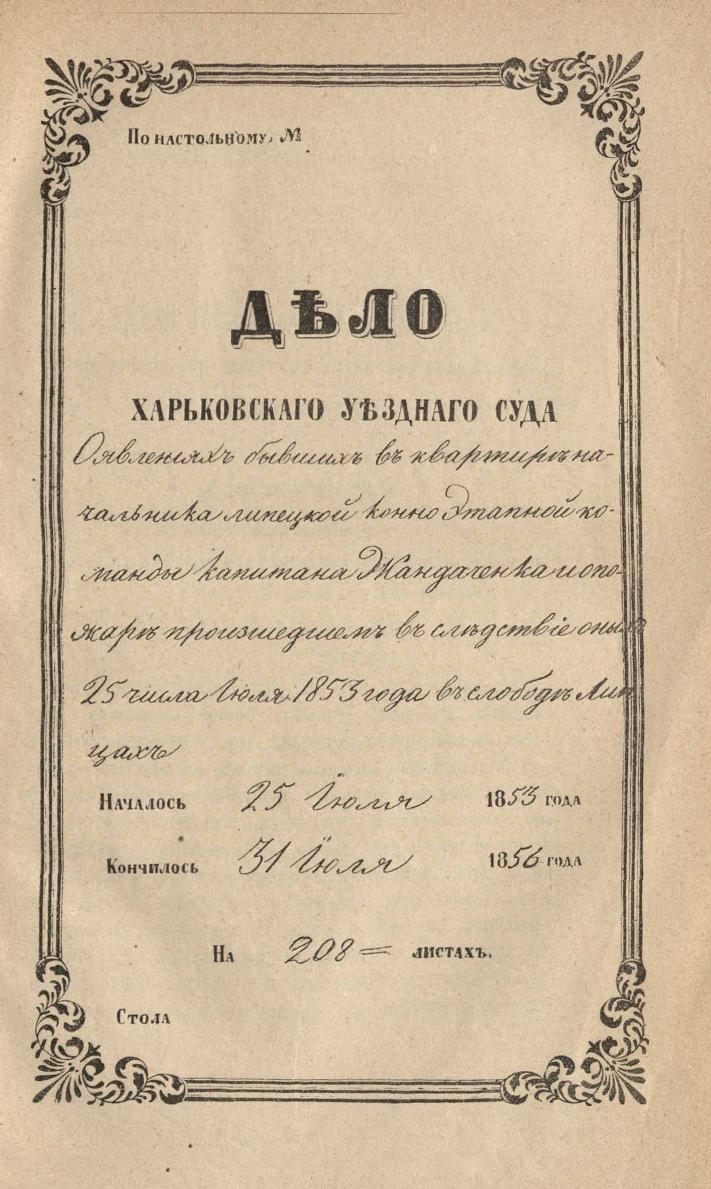
Some invisible force began throwing various items—dishes, bricks, knives, cast-iron pots, axes, and other objects—from atop the stove onto the floor and against the walls. Believing that this was the work of an evil force, he turned to the prayers of the church and, that very day, reported the matter to the priest, who, after blessing the water, arrived at his apartment with church ministers to sprinkle the house with holy water; whereupon an invisible force hurled an axe from the attic into the entranceway near the door with extraordinary speed and a loud noise…
The next day, the priest came to the house again. As soon as he crossed the threshold, various objects flew at him, glass began to shatter, and in the barn, all the dishes were also broken, with the flour and millet spilling out onto the floor. The barrels of cucumbers, apples, cabbage, and other provisions stored in the cellar were smashed to pieces. No amount of prayer or sprinkling with holy water helped. Three more priests were summoned; upon arriving at the house, they began a prayer service in front of a large crowd. However, judging by eyewitness accounts, the evil spirit did not subside. Bricks and planks flew at those who had come, and finally, a water-filled cast-iron pot standing on the stove flew into the crowd. Then, at two o’clock in the afternoon of the same day, for reasons unknown, the bed caught fire in three places in the room. Since Zhandachenko was in the room with his wife at the time, the fire was immediately extinguished. However, no more than 10 minutes later, the bed caught fire again in a different spot… Wishing to avoid losses and fearing for his life, Zhandachenko and his family moved to another apartment. For eight days, nothing happened in the empty house, according to the guards left there. Believing there was no danger, Zhandachenko returned to his former residence. The first two days were relatively calm. Except, according to the servants, that a “mournful and dreary human moan” could be heard periodically in the kitchen. But on the third day, it all started again with even greater ferocity. Just as before, objects began flying through the air. Vasily Korablev, an orderly who had entered the house, was wounded in the head near his ear by a knife that had flown toward him. The next day at three o’clock in the afternoon, the roof above the kitchen caught fire. They were unable to extinguish the fire, as an unknown force began hurling flames and bricks at the people who had rushed to the scene. As a result, the roof of the house and its wooden parts burned down.
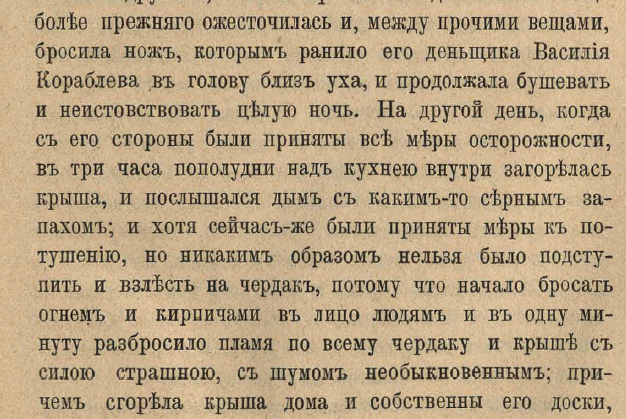
In July, objects suddenly began flying through the air again, and the fires broke out once more. The house and other buildings burned to the ground.
Let me repeat: you are not reading a Stephen King novel or a horror movie script, but excerpts from archival documents from the mid-19th century, published in a book from 1895.
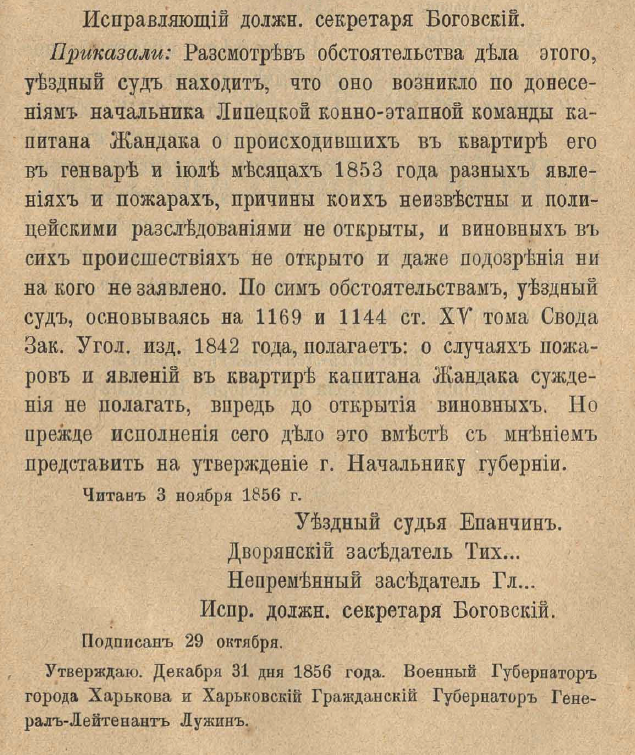
And here is the court’s ruling:
Having considered the circumstances of this case, the district court finds that the case arose from reports by Captain Zhandaq, commander of the Lipetsk Cavalry Escort Unit, regarding various phenomena and fires that occurred in his apartment in January and July 1853, the causes of which are unknown and have not been determined by police investigations; furthermore, those responsible for these incidents have not been identified, and no one has even been named as a suspect. Under these circumstances, the district court, relying on Articles 1169 and 1144 of Volume XV of the Code of Laws (Corner Edition, 1842), has determined that no judgment shall be rendered regarding the fires and phenomena in Captain Zhanda’s residence until the perpetrators are identified. However, before this decision is carried out, this case, together with the opinion, is to be submitted to the provincial governor for approval.
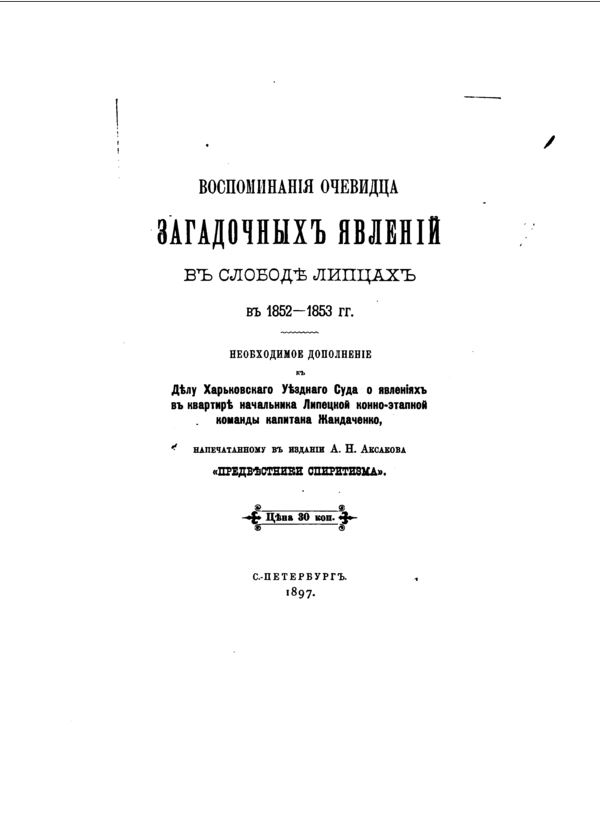
After the book was published in May 1896, thanks to the magazine *Rebus* Aksakov was fortunate enough to find a firsthand witness to the events in Liptsi—Fyodor Karpovich Zaretsky, an Actual State Councilor who lived in Yekaterinodar. As it turned out, as a child he had attended one of the gymnasiums in Kharkiv, where he was in the same class as Kostya Zhandanchenko, the son of Captain Zhandanchenko. During his summer vacation, he traveled to Liptsi with his schoolmate and thus witnessed the conclusion of the “Liptsy Affair.”
Aksakov persuaded Zaretsky to write about events that had taken place forty years earlier. And as early as 1897, a short (41-page) book titled “Memoirs of an Eyewitness to Mysterious Phenomena in the Village of Liptsi in 1852–1853” was published in St. Petersburg.
Several thousand people currently live in Liptsi. It’s truly a shame that, despite having such a wonderful and fascinating history—a truly mystical place in Sloboda Ukraine—it remains completely unremarkable from a tourism perspective to this day. And yet, thanks to the “Liptsi Poltergeist,” there could be tourists there…

- About the military pilot school and the airfield in Kharkiv… - 04.11.2020
- Nikanor Savich—A Political Career by Mistake - 13.07.2020
- And once again, about the Cavalry Guards… - 21.01.2020