From 1914 to 1916, World War I was raging across the globe. Naturally, it had a significant impact on both the country as a whole and our city.
Since “the enemy never slept,” the heroic struggle against enemy spies and their equally heroic capture played an extremely important role in society, sometimes giving rise to amusing incidents despite the seriousness of the situation.
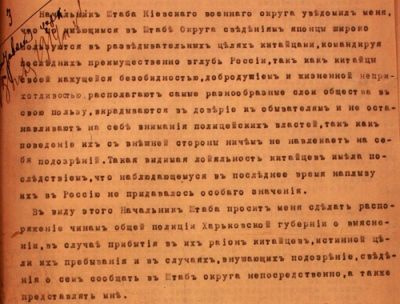
On June 30, 1914, Kharkiv Vice Governor Pavel Nikolaevich Mosalsky-Koshuro sent a directive marked “top secret” to the Kharkiv police chief and the district magistrates stating that the Japanese were actively using… no, not drones, but Chinese nationals for intelligence purposes. That makes perfect sense, after all—the Japanese were by no means a foolish people, and they figured that “the Chinese, with their apparent harmlessness, good nature, and unpretentious way of life, win people over…”
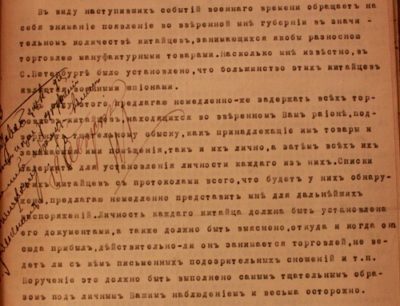
As early as August 12, 1914, the governor of Kharkiv, Mitrofan Kirillovich Katerinich, himself instructed the Kharkiv police chief to immediately detain and search all Chinese merchants.
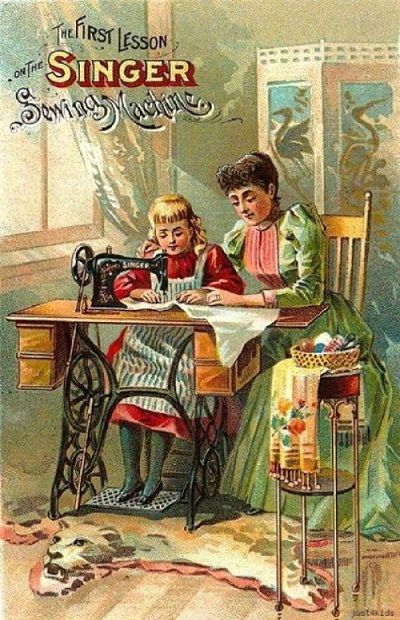
Even “Singer,” the sewing machine company so beloved by many, turned out to be the enemy.
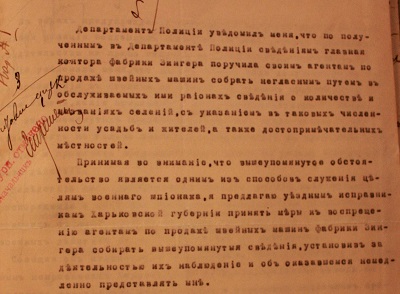
After all, on December 3, 1914, the district magistrates of the Kharkiv Governorate learned that the factory’s headquarters had instructed its sewing machine sales agents to covertly gather all kinds of information. Clearly, it had been decided in Kharkiv to monitor everything related to “Singer” and to take action if necessary.
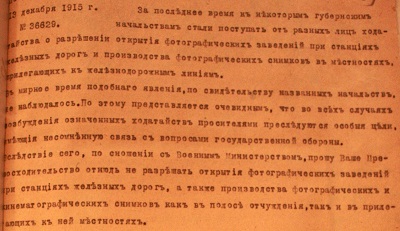
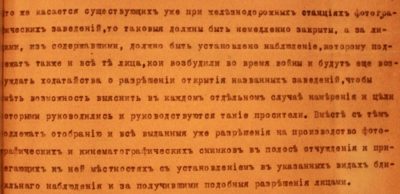
Incidentally, the authorities made a perfectly sensible decision regarding photographers at that time. On December 13, 1916, the Ministry of the Interior issued a strictly confidential directive to governors and mayors:
Recently, some provincial governors have begun receiving petitions from various individuals requesting permission to open photography studios at railroad stations and to take photographs in areas adjacent to railroad lines.
According to the aforementioned authorities, no such phenomenon has been observed in peacetime.
It therefore seems evident that in all cases where the petitioners have filed these petitions, they are pursuing specific objectives that are undoubtedly linked to matters of national defense.Consequently, following consultations with the Ministry of War, I respectfully request that Your Excellency under no circumstances authorize the opening of photographic establishments at railroad stations, nor the production of photographic or cinematographic images, either within the right-of-way or in the adjacent areas.
As for the photographic establishments already operating at railroad stations, they must be closed immediately, and the individuals operating them must be placed under surveillance, as well as all persons who, during the war, have filed or will file applications for permission to open such establishments, in order to ascertain, in each individual case, the intentions and objectives that have guided and continue to guide such applicants. At the same time, all permits already issued for the production of photographic and cinematographic images within the exclusion zone and adjacent areas shall be revoked, and vigilant surveillance shall be established over such activities and over the persons who have received such permits.
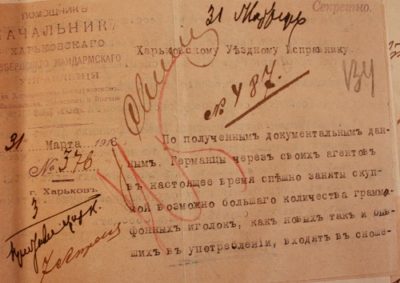
But on March 31, 1916, the Kharkiv District Police Chief received an extremely curious report:
March 31, 1916. Confidential.
To the Kharkiv District Police Chief.
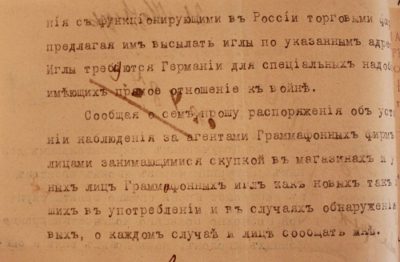
According to the documentary evidence received, the Germans, through their agents, are currently urgently engaged in buying up as many gramophone needles as possible, both new and used; they are contacting trading firms operating in Russia, offering to have the needles shipped to specified addresses. The needles are needed in Germany for special purposes directly related to the war.In light of this, I request that surveillance be ordered on agents of record companies and on individuals engaged in purchasing record needles—both new and used—from stores and private individuals, and that I be notified of each such instance as it is discovered.
The question of what kind of sinister “top-secret” German weapon required the purchase of gramophone needles in the Russian Empire at that time remains a mystery to this day.
To ensure that government officials knew their enemies by sight, in that same year of 1916—classified, of course, as “top secret”— the Police Department began publishing the “Album of Persons Registered by the Gendarmerie, Criminal Investigation, and General Police on Suspicion of Espionage.”
In the introduction, the authors stated the following:
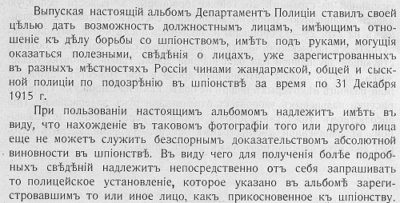
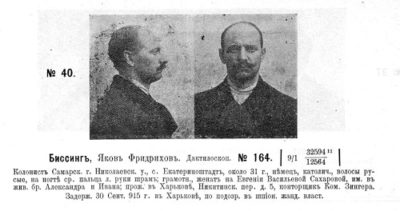
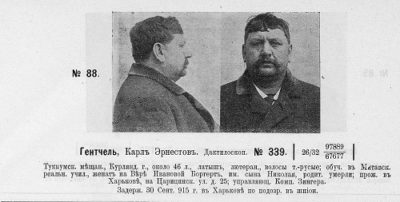
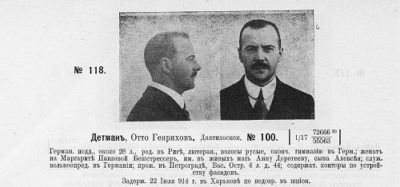
It contained detailed information, including photographs and fingerprints, on 427 men and 38 women who were detained on suspicion of espionage between 1910 and November 1915. It should be noted that, despite the fact that the state was at war with Germany, Jews who were Russian subjects accounted for the largest number of detentions—85 people (20% of the total). For those times, this was quite logical—“we are at war with Germany—Jews are the enemy.” Of particular interest to us, however, are the seven spies detained in Kharkiv. Thanks to the information about them, we can, so to speak, see firsthand the results of the aforementioned orders, as well as learn who the spies were, where they lived, and what they looked like.
So, let me introduce you.
No. 40. Yakov Friedrichovich Bissing. Nationality: German. Religion: Catholic. Clerk at the Singer Company. Address: 5 Nikitinsky Lane, Kharkiv. Arrested on September 30, 1915.
No. 88. Gentchel, Karl Ernestovich. Nationality: Latvian. Religion: Lutheran. Manager of the Singer Company. Place of residence: Kharkiv, Tsaritsynskaya Street, No. 25. Arrested on September 30, 1915.
No. 118. Detman, Otto Genrikhovich. German citizen. Residence: Petrograd. Operated a business specializing in facade construction. Arrested on July 22, 1914, in Kharkiv on suspicion of espionage.
No. 208. Kruglyansky, Shmay Leizer-Berkov. Religion: Jewish. Address: 43 Petenskaya Street, Kharkiv. Arrested on June 15, 1915.

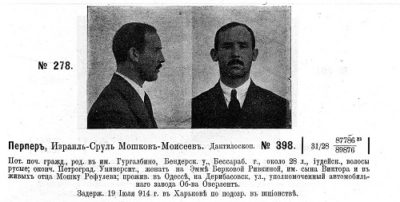
No. 278. Perper Israel-Srul Moshkov-Moiseev. Religion: Jewish. Place of residence: the city of Odessa. Authorized representative of the Overland Automobile Plant.
He was arrested on July 19, 1914, in Kharkiv on suspicion of espionage.
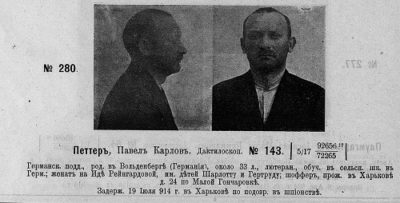
No. 280. Petter Pavel Karlovich, driver. German subject. Religion: Lutheran. Residence: Kharkiv, Malaya Goncharovka, Building 24. Arrested on July 19, 1914, in Kharkiv on suspicion of espionage.
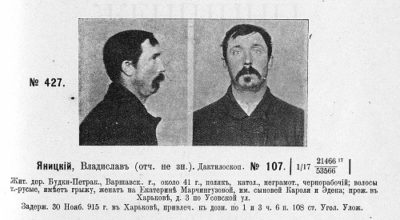
No. 427. Vladislav Yanitsky. Polish, manual laborer, religion: Catholic. Residence: Kharkiv, Usovskaya Street, Building 3. Arrested on November 30, 1915, in Kharkiv.
Of course, that’s not all. So the funny and sad stories about spy mania in Kharkiv during World War I don’t end here—they’re just getting started.

- About the military pilot school and the airfield in Kharkiv… - 04.11.2020
- Nikanor Savich—A Political Career by Mistake - 13.07.2020
- And once again, about the Cavalry Guards… - 21.01.2020