After the 1917 Revolution, the name of Nikolai Karazin—a great native of Kharkiv and the creator of the first artistic postcards in the Russian Empire—was consigned to oblivion.
On top of everything else, in the early 1920s, the Soviet authorities published a book about him titled “N. N. Karazin—An Artist Who Glorified Russia’s Barbarism and Aggressive Actions Before the Revolution.”
Thus, the most popular figure of his time—a distinctive, inimitable artist and one of the finest draftsmen in the Russian Empire—might as well never have existed.
It was not until 1975–1976 that V. Shumkov revived his name by publishing extensive articles about Nikolai Karazin in the magazines *Zvezda Vostoka* and *Knizhnoe Obozrenie*.
In his first study dedicated to our great native of Kharkiv, “The Life, Works, and Travels of Nikolai Karazin: Writer, Artist, and Traveler,” published in the journal *Zvezda Vostoka* in 1975, No. 6, Shumkov mentions a rather interesting incident.
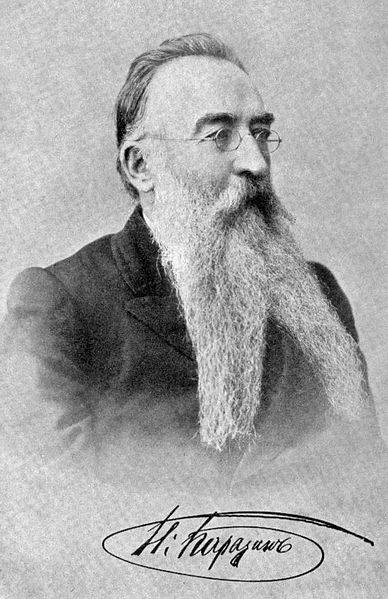
Thanks to this, one of the most talented and brilliant artists comes to life and feels closer to us.
But a military career did not appeal to N. N. Karazin. In 1865, he retired with the rank of staff captain and submitted a petition to be admitted to the Imperial Academy of Arts in St. Petersburg. On October 6, 1865, he was admitted as an independent student at the Academy.
After studying for just one year under the guidance of the renowned battle painter B. P. Villevalde, N. N. Karazin was expelled from the academy following a conflict with the administration. He later often spoke about this episode. It has come down to us through the memoirs of Alexandra Petrovna Schneider—an artist with whom Karazin shared a long-standing friendship. This account is quite interesting, and it is worth quoting it in its entirety.
The course assigned a theme from the Bible: “The Three Angels’ Visit to Abraham.” Karazin interpreted it realistically: he drew a tent, three travelers sitting at a table, Sarah serving them, and Abraham conversing with them. For this interpretation of the theme, he received the following comment from the jury, written directly on the drawing itself (he had already spotted the inscription from a distance as he walked through the exhibition toward his drawing): “Why did you deprive the angels of their proper adornment—their wings?” Karazin immediately grabbed a pencil and wrote: “Because I considered Abraham to be more perceptive than the academicians, and that if he had seen angels with wings, he would have immediately guessed who they were.” For this, he was immediately expelled from the Academy within 24 hours.”
That’s Kharkiv wit for you. After being expelled from the Academy of Arts, Nikolai Karazin still had many great achievements ahead of him in the world of art.
So, to be continued.

- About the military pilot school and the airfield in Kharkiv… - 04.11.2020
- Nikanor Savich—A Political Career by Mistake - 13.07.2020
- And once again, about the Cavalry Guards… - 21.01.2020