Kharkiv—a land and a place that has given birth to geniuses and great events. Kharkiv—a city whose very breath and heartbeat have inspired even those who were part of it for just a moment to create masterpieces. Kharkiv is the birthplace of marvelous paintings, unique architecture, and music of exquisite taste…
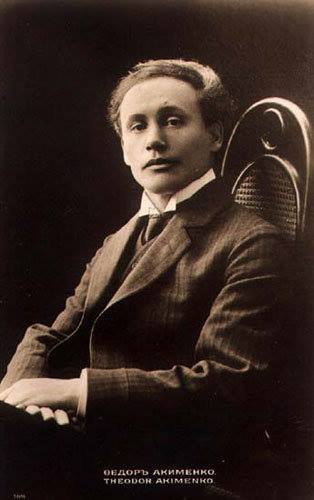
On February 20, 1876, in the village of Peski—which at that time was a village on the outskirts of Kharkiv—Fedir Stepanovych Yakymenko was born.
At the age of 10, he was sent to the Imperial Chapel in St. Petersburg. He studied under A. K. Lyadov and M. A. Balakirev. At the St. Petersburg Conservatory (1896–1900), Akimenko completed a course in the class of N. A. Rimsky-Korsakov, professor of composition theory.
From 1897, he worked as an instructor in the conducting courses at the Imperial Chapel.
From 1901 to 1903, he was the conductor of a music school in Tiflis in the Caucasus.
From 1903 to 1906, he served as director of the music school in Nice (France), and then, for a short time, as director of the Kharkiv branch of the Imperial Russian Musical Society.
In 1910, in issue No. 12 of the magazine *Apollon* (a Russian illustrated magazine covering the visual arts, music, theater, and literature), he was featured in the article “Young Russian Composers.”
From 1919 to 1923, he was a professor at the Petrograd Conservatory.
In 1923, Fedir Stepanovych emigrated to France.
In 1932, he was elected vice-director of the Russian Normal Conservatory in Paris, where he served as a professor of piano.
Musicologists, for their part, offer the following assessment of this outstanding Kharkiv composer, pianist, and teacher:
Akimenko’s compositions reveal a solid compositional technique, refined taste, a consistent style, poetic quality, and sincere emotion.