Public analysis of architectural projects in the form of publications in the specialized press used to be as common as modern posts with their humiliating criticism in social networks.
One of the striking examples is the project for the development of the northern part of Stalin Avenue (now Heroiv Kharkova Avenue) opposite the Palace of Culture of the Kharkiv Electromechanical Plant, proposed by architects M. Pidhirny and D. Bulakh. In an illustrated supplement to the Budivelnaya Gazeta in August 1940, architect G. Wolfenson subjected the project to severe criticism. It is worth publishing it in full. The project was not implemented, although the arch in one of the buildings could claim the status of the largest in Kharkiv.
Kharkiv is one of the largest centers of our country. Over the past 10-12 years, the city has changed radically.
Views of Soviet Kharkiv with its extraordinary silhouettes of the Derzhprom, the House of Projects and other buildings have graced the pages of Soviet and foreign magazines, and the screens of cinemas. These buildings remain in memory as symbols of the first years of the great construction of socialism. Despite their clearly expressed constructivist character, they are full of a kind of pathos.
The following years, unfortunately, did not bring anything significant to the architecture of the city. The originality and wide scope of the first large ensembles gave way to stereotyped reminiscences of constructivist style and, later, timid attempts to master the classics.
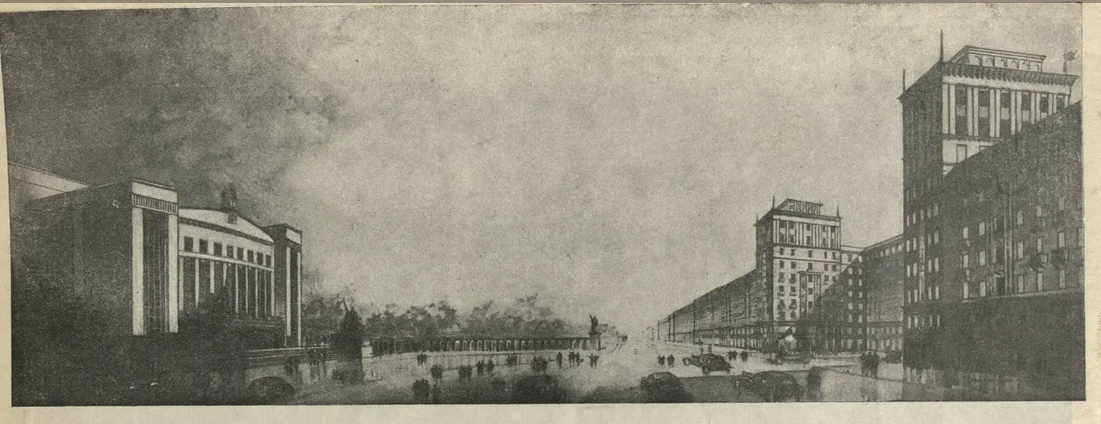
One of the last major works of Kharkiv architects – the project for the reconstruction of Stalin Avenue is also not distinguished by the freshness of the idea and corresponds to the significance of this thoroughfare. On the opposite side of the theater, the project involves the construction of a number of residential buildings with a height of 6 to 8 floors. The development is mainly perimeter, with buildings arranged along the red line and partial arrangement of kurdoners (opposite the theater and near the buildings of the Comintern factory).
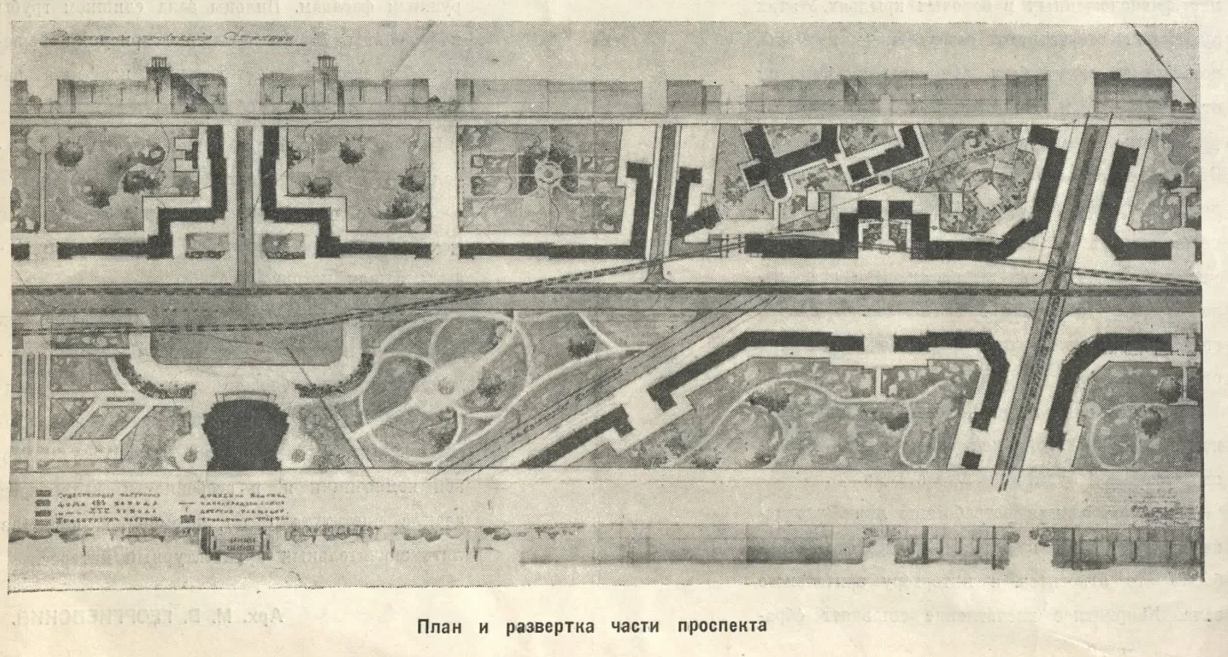
The buildings are designed on the basis of typical 4-apartment sections with bathrooms, elevators and garbage chutes. However, it is impossible to recognize the successful placement of one half of the section at the end of building “A”. This is due to the need to service only two apartments with a special elevator. Such a decision is uneconomical.
Residential buildings are built only on one side of the highway segment. The juxtaposition of the long wall of residential buildings to the volume of the theater, located in the greenery of the park, corresponds to the nature of a large city highway leading from the city center to its periphery.
The theater building is set back from the red line. The open area formed here somewhat violates the uniform length of the 16-kilometer highway. The volume of the theater on the square closes the perspective of one of the cross streets.
In front of the theater on the opposite side of the square are two elevated volumes of buildings – the buildings of the Kharkiv Tractor Plant. Unfortunately, these compositional features limit everything that could be considered acceptable in this project. A more detailed analysis of the development raises a number of serious objections. The decoration of the facades is elementary, there is no regularity in the template division of the walls horizontally, there is no desire to give the wall a clear architectural and constructive expression.
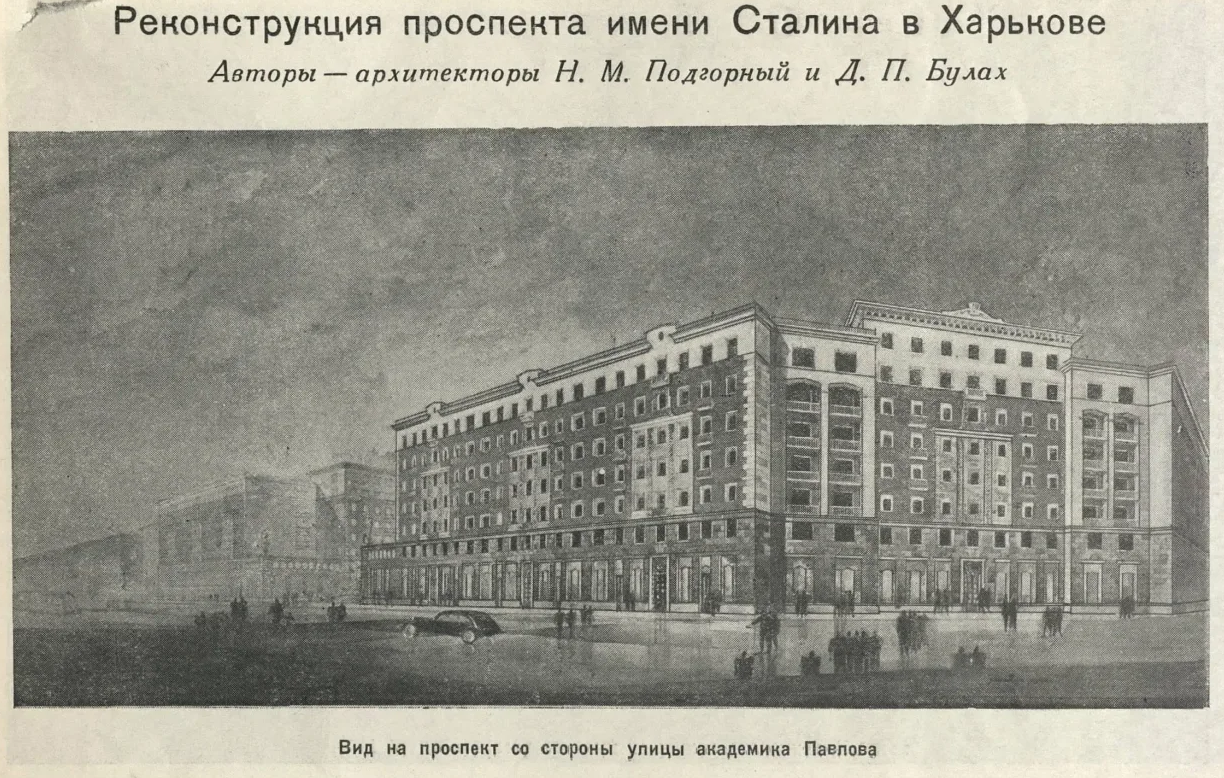
In building “A”, the decoration of the upper division, covering the 7th floor, is too simplified and corresponds to the nature of the decoration of courtyards rather than main facades. This impression is enhanced by small, too primitive pediments above the entrances. The cornice is also primitive and does not correspond to the height of the building.
The middle division is decorated with light flat bay windows of rough proportions. The bay windows are not connected to the wall in any way and seem artificially glued. The beveled corner part of the building is very poorly resolved.
The adopted system of stepped recessing is at odds with the silhouette of the corner. It would seem more logical to push the raised part forward, rather than deepen it.
I would like to see the middle part, which forms the courdoner (building “B”), less schematic and more elegant. The mechanical repetition in the middle part of the horizontal divisions of the side buildings introduces monotony into the composition, which is not eliminated by the giant arch of the passage 5 floors high.
The arch, inscribed in a rectangular prefix, is not read as an opening in the wall, structurally connected to this wall.
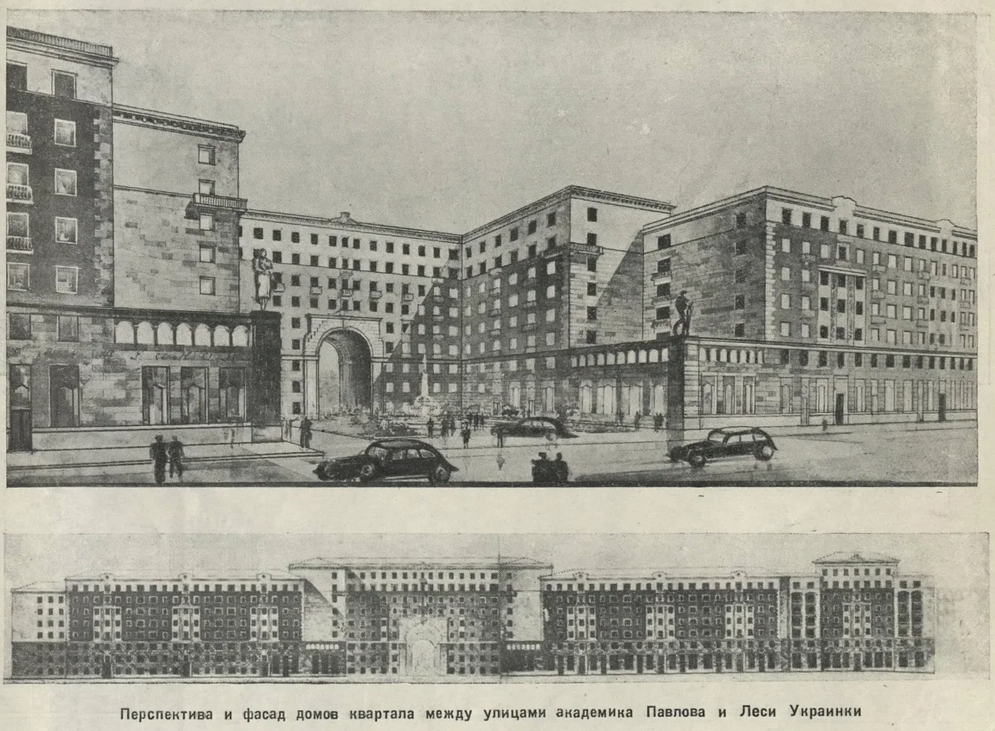
The exaggerated height of the arch and the dimensions of its span are hardly justified in this particular place. The view of the quarter, which opens through the arch from the street side into the courtyard, will not be of interest, since it is limited here by the inner building, which is accidentally placed at an angle. The inner-quarter space, visible through the arched span, is not organized.
The area in front of the theater is formed by two symmetrical buildings located on both sides of Tsyrkunovska Street.
The height of these 7 buildings is 6-8 floors. At some corners it increases to 10 floors.
Both buildings “A” and “B” are designed in an emphasized monumental manner, but their composition is devoid of balance. This is caused by the different heights of the volumes, which have the same length of the facades from the avenue side.
Architectural forms, individual details of the facades are schematic, rough, and poorly proportioned. The repetition of the same motifs in under various conditions deprives the architecture of integrity and logic. I mean, for example, the vertical divisions in the middle floors. In the 6-story part, they essentially represent blades covered with a frieze. In the elevated part, the same blades end only with a tiny balcony. The eight-story part has no cornice. The tower is primitively designed. Its forms are rough, the consoles supporting the cornice seem to be sawn from wood.
All this indicates that the work on the reconstruction of Stalin Avenue is not yet at a sufficiently high quality level.
The significance of the task requires the manifestation of the highest skill, the highest architectural culture.
Architect G. Y. Wolfenson