The Derzhprom building has deservedly become a true symbol of Kharkiv not only for many generations of Kharkiv residents, but also for guests of the city from all over the world. Its current address is Svobody Square, 5.

Derzhprom, which means “State Industrial”, located on the largest square in the city and all of Ukraine, became the main element of the “new center” of Kharkiv, founded in the 1920s on a wasteland behind the University Garden (Shevchenko Garden).
The planning of Dzerzhinsky Square (as Svobody or Freedom Square was originally called) and the new district to the north and west of it was developed by architect Viktor Trotsenko in 1924.
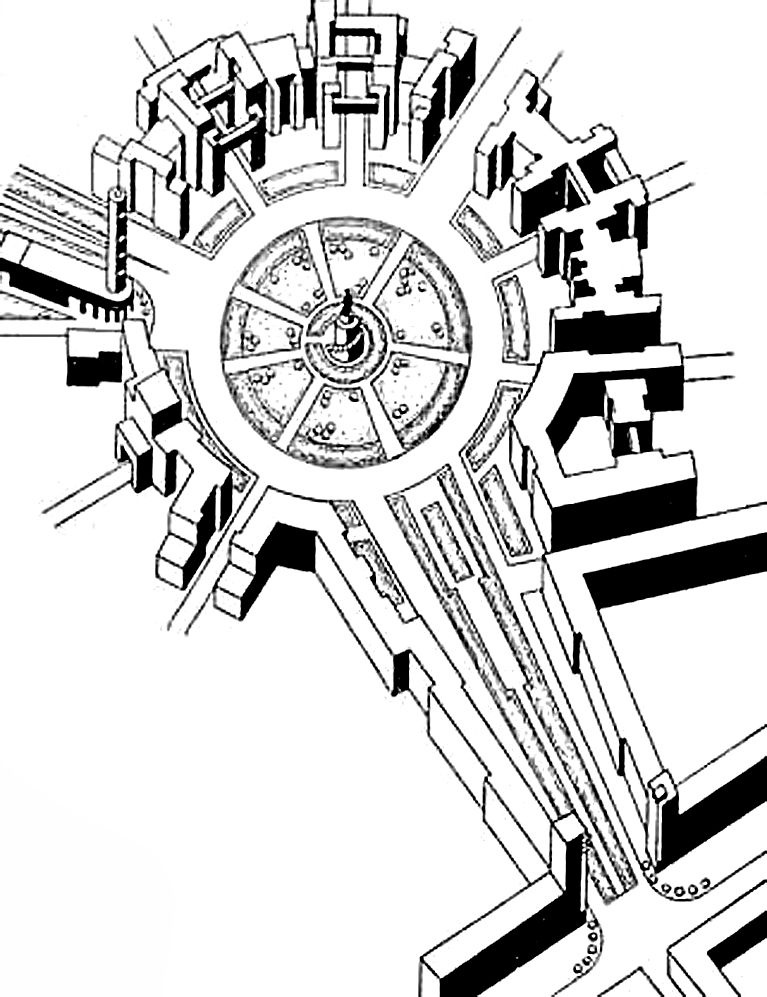
According to it, the streets were to converge towards the square from radial directions. The square was to house large administrative and government buildings – they had previously been huddled in old structures throughout the city and no longer met the needs of the rapidly growing capital of Soviet Ukraine.

The large building was also needed by the numerous state trusts that managed the country’s industry during the era of the NEP (New Economic Policy). It can be said that the liberal-market spirit of the NEP was reflected in the “airy” forms of the new building, with its bridges flowing from street to street and open courtyards where it was intended to hold exhibitions of the national economy.

The competition for the building of the State Industry, which was organized in 1925, was won by the work “Uninvited Guest” by architects Sergei Serafymov, Samuel Kravets and Mark Felger (Leningrad). The project was executed in the then popular constructivist architecture style, where functionalism prevailed over decorations. However, the Derzhprom was not 100% devoid of decorations – for example, some balconies practically did not carry a functional load.

Excavation work began in 1925, and the central building was laid in 1926. The work was supervised by the talented and experienced engineer Pavlo Rotert, who had previously worked at the Southern Railways (construction of the Southern Railway Department building). Thousands of workers and engineers under the leadership of Pavlo Rotert and Samuel Kravets gained experience in working with reinforced concrete structures, which they later applied in the construction of the Dnipro Hydroelectric Power Plant and the Moscow Metro.

The first buildings of Derzhprom were built manually, but construction was completed at a record pace using mechanized methods.
The building was officially put into operation on November 7, 1928. The 13-story Derzhprom became the tallest “skyscraper” in Soviet Ukraine – its height (68 m) exceeded the height of Ginzburg’s Kyiv “skyscraper” by 50 cm. From 1928 to 1934, the Derzhprom housed the Council of People’s Commissars of the Ukrainian SSR, which performed the functions of a modern cabinet of ministers.

Derzhprom did not become the tallest “skyscraper” in Europe – in Germany in the mid-1920s, buildings were built even higher, but its scale and volume of 347 thousand m³ were truly impressive. Theodore Dreiser, who visited Kharkiv in late 1927, compared Derzhprom to a part of New York moved to the snowy steppes, and in the city development plans the writer saw the “future Ukrainian Chicago”. Many architectural researchers call Derzhprom one of the most outstanding examples of early modernist architecture of the 1920s, especially emphasizing its unusual volumetric and spatial concept.

Initially, it was planned to make recreation areas and sports grounds on the roofs of Derzhprom, but these plans were not implemented. “Air” 26-meter transitions were used only in the first years. After the abolition of the NEP, the liquidation of trusts and the transfer of the government of the Ukrainian SSR from Kharkiv to Kyiv in 1934, the need for frequent communication between various organizations located in 9 sections disappeared.

Derzhprom suffered during World War II. It lost its glazing due to nearby explosions, and the facade of the 6th section was partially destroyed by a bomb. By 1947, the building was restored.

In 1955, a television tower was installed on the roof of Derzhprom, increasing the height of the building to 108 m.

In 2000, a memorial sign to the victims of Nazi persecution – residents of the Kharkiv region – was installed on the back side of Derzhprom.

And in 2011, a commemorative sign of a “lucky coin” with a face value of 3,333 kopecks appeared near Derzhprom.

In 2000-2018, work was carried out to repair the facades, communications and passages (architect V. Novgorodov), during which, in particular, the cement coating of the walls, windows and stained glass were replaced. Despite the established stereotype, energy-efficient wooden windows were installed in the State Industrial Complex, not plastic ones. In the original windows, the glass was attached to the frames with putty, which had to be changed every year. No one did this, which is why the building suffered from large heat losses. Derzhprom was not 100% reinforced concrete, in some places brick, shell rock and even construction waste were used. During the repair, copper fittings and some old elevators (which require an elevator operator inside) were preserved.

Since 2017, Derzhprom has been on the Tentative List of UNESCO World Heritage Sites.

At the end of the 2010s, Derzhprom housed 120 different organizations (mostly budget-funded), among which it is worth noting the “Art of Sloboda Ukraine” gallery, the Museum of Local Self-Government, and even a climbing wall.

In 2021, an observation deck was installed on the roof of Derzhprom (architect V. Lopatko).

The building’s glazing was damaged during the Russian shelling of Kharkiv in 2022-2024. Due to hostilities, since 2023, Derzhprom has received additional status as a site under enhanced UNESCO protection.

On October 28, 2024, a Russian bomb hit Derzhprom, it also lost a significant part of glazing and stained-glass windows.


On November 7, 2024, as a result of a repeated bombing on Freedom Square, the glazing of the main facade of Derzhprom was also damaged.


- Danylevs’koho Street, 19 - 13.10.2026
- Debunking the myth about one of the most famous Kharkiv photos - 12.10.2026
- The Architectural Evolution of the Kharkiv Theater - 26.09.2026