Many sports fans are familiar with the sculpture of the Discobolus on the roof of the rotunda at the ticket booth of the “Metalist” Stadium. But who created the sculpture of the athlete?
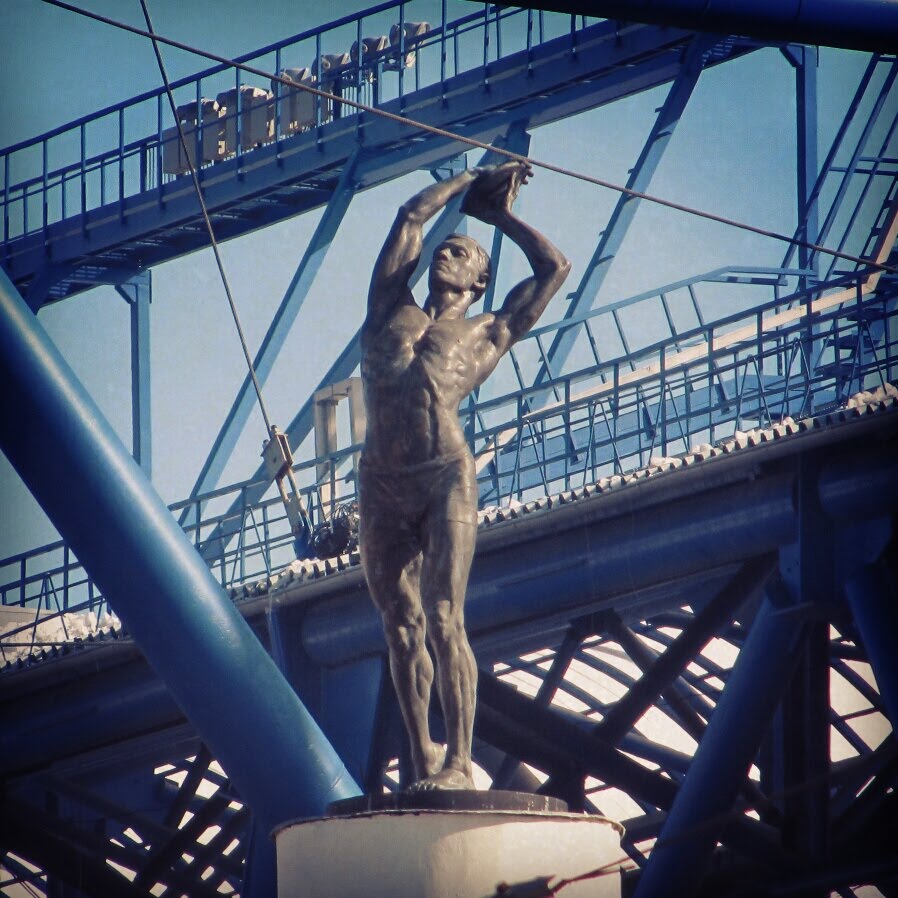
It is a well-established fact that the ticket booth, like the original stadium, was designed by Z. Permilovsky, a student at the architecture department of the Kharkiv Art College. The booth, which is now a designated architectural landmark, was built in 1926 (incidentally, the stadium was built on the site of the Holy Spirit Cemetery, which had existed there since 1772). But the creator of the discus thrower was, of course, not him… but Matvey Manizer, an outstanding sculptor better known to Kharkiv residents as the creator of the Shevchenko monument!
Here is what can be found in Manizer’s own book, *A Sculptor on His Work*, published in 1940:
In 1926, together with sculptors E. A. Janson-Manizer and T. S. Kirpichnikova, I created a series of sculptures on the theme of physical education… These relatively small pieces were later reproduced in bronze and zinc castings by the “Krasny Vyborgets” foundry, intended as prizes. One of these figurines, having found its way to Kharkiv, served as the impetus for a commission for a large sculpture titled “Discobolus,” which I completed in 1927. Bronze casts of it are located in Kharkiv and in the Parks of Culture and Recreation in Leningrad and Moscow.
The model for the sculpture was gymnast Donat Anatolyevich Kalabin, a Master of Sports who possessed a perfectly sculpted athletic physique. In the 1920s and 1930s, pseudo-classical sculptures celebrating the beauty of the human body became widespread in Europe, and this trend did not bypass us either. To this day, in some abandoned and overgrown parks in Kharkiv, one can still see half-ruined white concrete sculptures of athletes.
After World War II, the stadium had to be practically rebuilt from scratch; only a few sections survived. Manizer’s sculpture “Discobolus,” however, has survived.

- The Architectural Evolution of the Kharkiv Theater - 26.09.2026
- 1st Kharkiv Gymnasium - 17.09.2026
- The Oldest Movie Theater in Ukraine - 24.08.2026