Kharkiv is a city of mystery and a city of legend. Yet, its amazing stories and facts are not merely found on the surface or buried within thousands of documents; much of the enchanting unknown lies—quite literally—beneath our feet. The Kharkiv underground… What do we know about it? Where does truth end and fiction begin? But let us take things in order.
It is crucial to recognize that the first scholarly study dedicated to the underground passages of Kharkiv was prompted by preparations for the 12th Archaeological Congress, held in the city in 1902. This study took the form of a letter from Professor I.P. Shchelkov—former Rector of the Imperial University of Kharkiv—to D.I. Bahalii, Chairman of the Preliminary Committee for the 12th Archaeological Congress; the letter was published in the Committee’s Proceedings alongside an article by M. Levakovsky titled “On the Underground Passages of the City of Kharkiv.” Levakovsky’s article had previously appeared in the Kharkovskie Vedomosti newspaper and was, in essence, a direct response to D.I. Bahalii’s appeal to the residents of Kharkiv, asking them to share any information they possessed regarding the city’s underground passages with the Preliminary Committee.
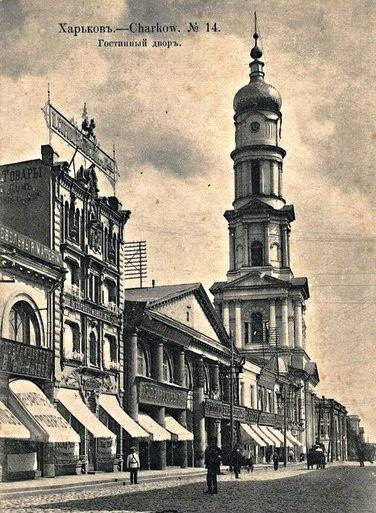
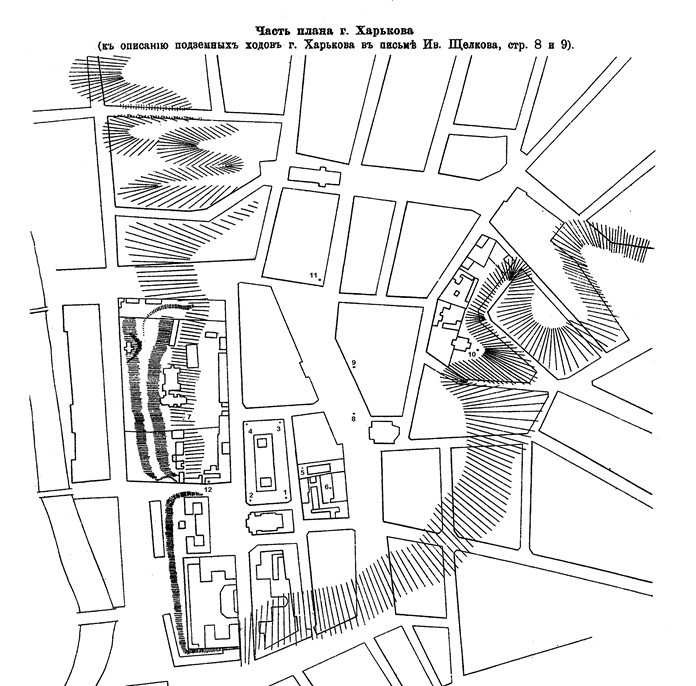
It is from this letter by I.P. Shchelkov that we first learn of the existence of several large underground structures beneath the Gostiny Dvor complex. Of particular value to us is the plan of Kharkiv accompanying the letter, which marks the locations where these ancient underground chambers were discovered. However, as the saying goes, seeing is believing. Therefore, for your reference, we are publishing in this article a portion of the aforementioned letter by I.P. Shchelkov, along with the plan itself, both taken from the book Proceedings of the Kharkiv Preparatory Committee for Organizing the Archaeological Congress (Vol. 1, Kharkiv, 1902).
Appendices to the minutes of the third meeting
(Letter from Iv. Shchelkov to the Chairman of the Committee).Dear Dmitry Ivanovich,
I learned from journals that the preparatory committee for the 12th Archaeological Congress—scheduled to take place in Kharkiv in August 1902—met in Moscow in early January, and that you are a member of it. As a native of Kharkiv who has lived there almost my entire life, I have taken an interest in historical antiquities and gathered some information, which I have decided to share with you. It is quite possible that my report contains nothing new to you, but that is of little consequence. The points below outline the matters to which I would like to draw your attention.
As you know, the original settlement of Kharkiv occupied a sharp, elevated promontory forming the tip of the watershed between the Lopan and Kharkiv rivers. To the west, this promontory dropped in a steep cliff toward the Lopan valley, while to the east, the slope was gentler, descending into the Kharkiv valley. The valleys of both rivers consisted of broad, marshy terrain filled with numerous small river channels and lakes; while such channels and lakes still exist today (stagnant backwaters and ponds in the districts beyond the Lopan and Kharkiv rivers), there were far more of them in the past. I even knew people who used to hunt ducks on the lakes in the area where the Bavaria Garden is now located. This entire elevated promontory is honeycombed with cave passages. Most have since collapsed, though some remain intact because property owners put them to use—primarily for storing wine. The best-preserved passages are those connected to the Zheverzheev cellars, located at the southwestern and southeastern corners of the Gostiny Dvor building (Nos. 1 and 2). They run both eastward—passing beneath Goryainovsky Lane—and westward, beneath the Square of Government Offices. There is also a small cellar (No. 3) beneath the southwestern corner; however, the passage beneath the northwestern corner (No. 4) is particularly interesting: it runs across Universitetskaya Street, descending steeply toward the monastery courtyard. It was here—right near the prosvirnya (bakery for liturgical bread)—that a cave-in occurred some 10 or 12 years ago (No. 7).
I inspected the site together with Professor Morozov. I believe it was a continuation of the aforementioned passage (No. 4), which likely opened out somewhere on the steep slope now occupied by the Bishop’s House garden. To the east of Gostiny Dvor, there is a passage leading from the cellar of the Pitra house to the house that once belonged to Matuzkov (Nos. 5 and 6). That house no longer exists; a municipal building has been erected on the site, and the passage appears to have been partially filled in. I have seen all the aforementioned passages personally; I visited them in the company of Professor Morozov and the land surveyor Pervukhin. In addition to these passages known to me personally, I have information about others that undoubtedly formed part of the same network: until recently, there was such a passage beneath the Kulikov house (No. 9) on Nikolaevskaya Square; Prof. V.Ya. Danilevsky told me about it, having visited it during his childhood. From there, passages ran across Nemetskaya Street toward the site where the Jewish synagogue now stands. Below, there is a cellar (No. 10) from which, according to accounts, it was possible—not so long ago—to venture deeper inside. This is likely an exit point from the cave passages into the Kharkiv River valley. Evidence that passages existed beneath Nemetskaya Street lies in the fact that, some 50 or 60 years ago, a cow fell in there (near the house of the former architect Ton) and perished. I also heard that there was an entrance to the caves from the former Medvedev house (No. 11, at the corner of Sumskaya Street and Nikolaevskaya Square; now the Schasny house). The manager of the Pashchenko-Tryapkin properties mentioned that there is a passage in their cellar as well (No. 12).
To help you get your bearings, I am enclosing a plan of central Kharkiv that I have on hand, with the locations of the described cave passages marked by red dots and numbers. Should you wish to examine them yourself, please contact Nikolai Alekseevich Zheverzheev (Director of the City Bank) or his son, Sergei Nikolaevich; They are very fine people, and I have no doubt they will gladly show you the caves at their disposal…
Please forgive me for troubling you with this letter, and accept the assurance of my sincere respect.
Yours faithfully, Ivan Shchelkov.
