On Sunday, April 23, 1867, at 2:00 p.m., the grand opening of the first ethnographic exhibition took place in Moscow at the Exerzergauz—the riding hall.
In attendance were professors from the universities of Moscow, St. Petersburg, Kazan, Dorpat, and Kharkiv, as well as numerous officials and members of scientific societies. The exhibition was organized by scholars affiliated with the Society of Lovers of Natural Science, Anthropology, and Ethnography at Moscow University.
They held 30 preparatory meetings, which took place from December 29, 1864, to August 31, 1866.
At the seventh meeting on August 25, 1865, I. Ya. Kovalevsky, who was present on behalf of Kharkiv,
“He presented a list of items he had brought from the Kharkiv Governorate and was donating to the exhibition. He stated that many people in the Kharkiv Governorate had expressed a desire to support the exhibition. For example, the Provincial Head of the Nobility, Prince Trubetskoy; the Administrator of the Chamber of State Property, Potulov; and Mayor Skrynnik had expressed their willingness to provide costumes; photographer Danilevsky had promised to send photographs; Mr. Disky had agreed to send some models; and I. I. Karazin, a landowner from the Bogodukhovsky District, to donate a very interesting Tatar statue. The committee thanked I. Ya. Kovalevsky for his assistance and donations and decided to notify the individuals he had named that it expects their cooperation and would be very grateful for whatever assistance they choose to provide.”
However, for reasons that are entirely unclear to us, Danilevsky’s photographs were not included in the exhibition. It’s a shame, because these photographs could have significantly enriched our understanding of the ethnography of Sloboda Ukraine.
The exhibition itself, which opened on April 23, 1867, consisted of three sections.
The first section featured life-size scenes, each of which included a number of mannequins accurately representing anthropological types, dressed in traditional costumes and surrounded by authentic objects of folk life. Renowned Russian sculptors were commissioned to create the mannequins. The scenes included various structures, landscapes, and vegetation typical of specific regions.
The second section featured photographs, albums, and drawings commissioned by the organizers, depicting specific individuals—peasants and townspeople; Costumes, items of clothing, tools, tableware, furniture, musical instruments, children’s toys, folk prints, and models of buildings were also on display.
The third section contained anthropological and archaeological materials.
In total, the exhibition featured about 300 mannequins, 450 outfits and clothing items, 1,100 household items, and 1,600 photographs.
But, as the saying goes, it’s better to see something once than to hear about it a hundred times.
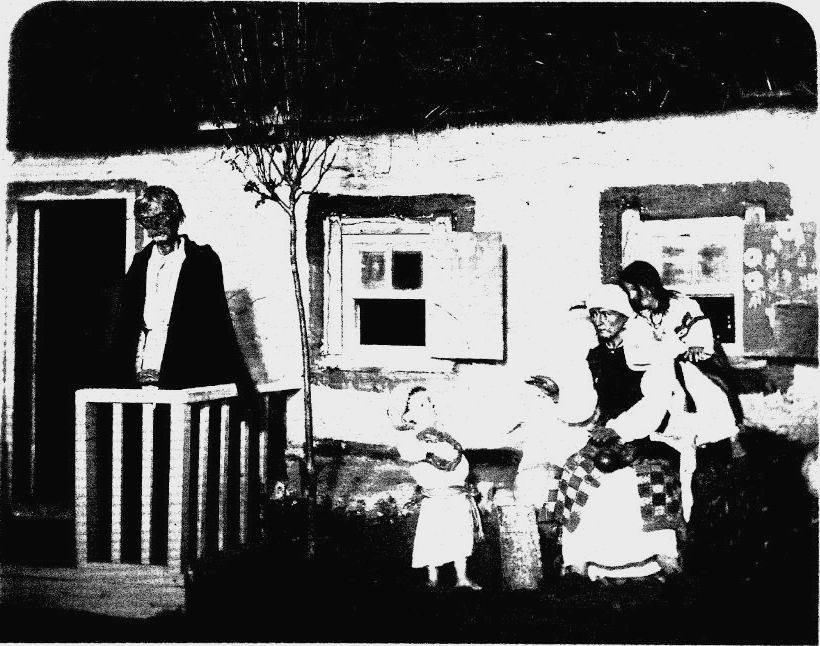
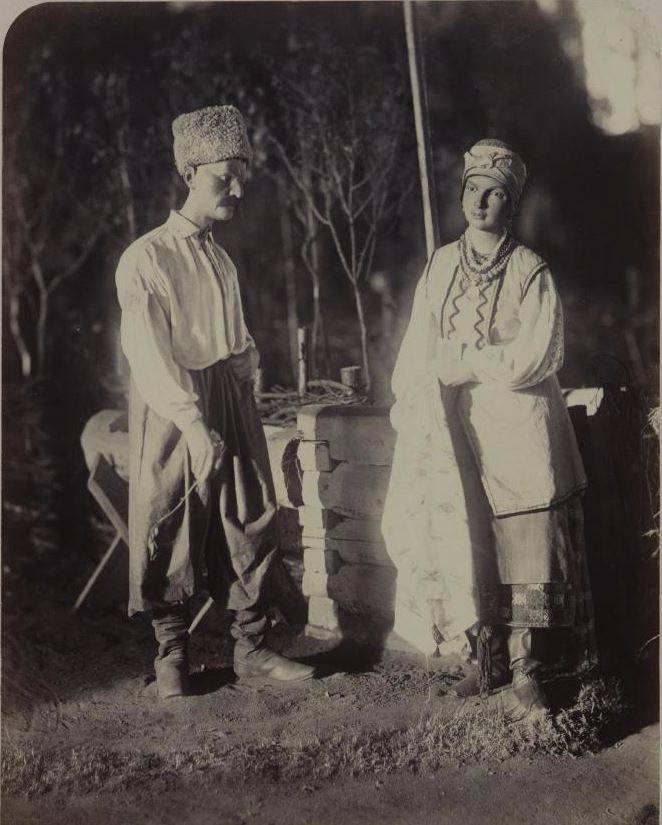
For this reason, we invite you to enjoy two extremely rare photographs from 1867, which depict the aforementioned diorama and mannequins portraying a scene of everyday life among Ukrainians in the Kharkiv region.
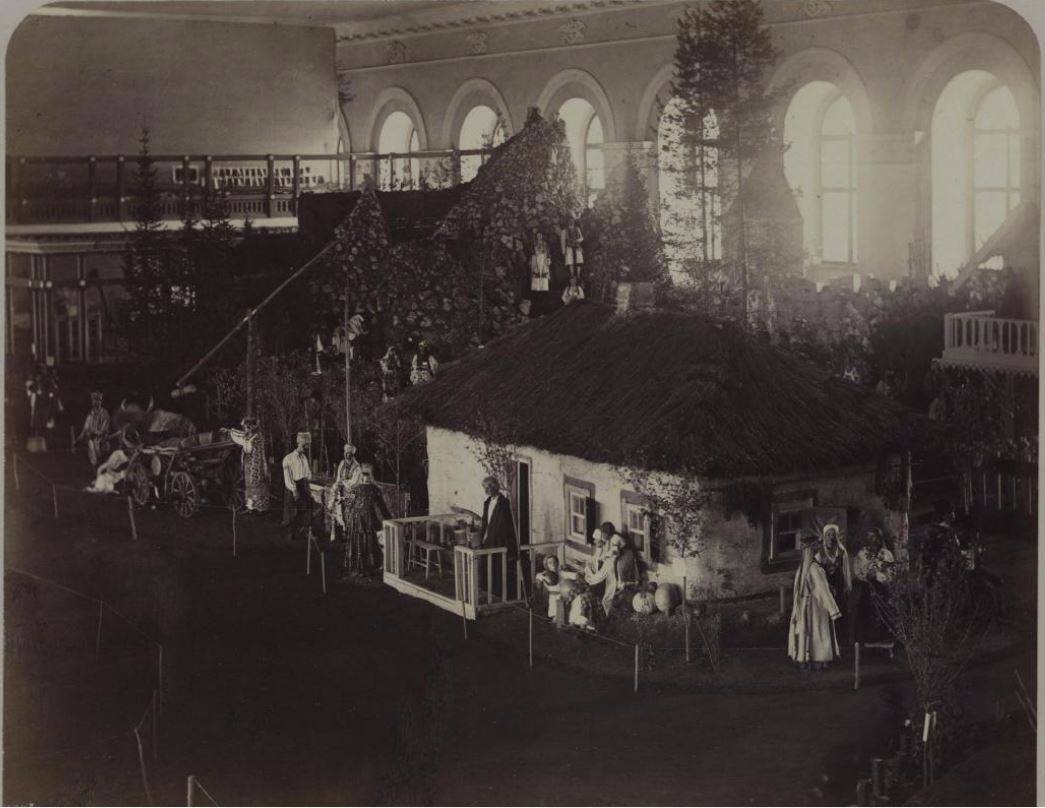
The Ukrainian section of the exhibition drew considerable public interest.
At its center stood a life-size cottage with an adjoining yard and garden enclosed by a wattle fence, as well as a field of rye, wheat, and barley. Arranged in various poses around it were sixteen figures: a grandmother with her grandchildren, a chumak with a pair of oxen and a cart, and several groups of men and women in traditional costumes from the provinces of Kyiv, Poltava, Voronezh, Podolia, and Kharkiv.
In the book *The Ethnographic Exhibition of 1867*, published in 1878, we find a detailed description of the exhibits from Sloboda Ukraine:
— A Little Russian from the Kharkiv Governorate, Izyum District. His attire consists of the following items: a shirt with meretchka (embroidery) and pants with oчкуры (drawstrings); he wears a hat on his head.
— A woman from Little Russia, Kharkiv Governorate, Izyum County. Her attire consists of the following items: a blouse with lace and a front panel (red paper), a checkered skirt, an apron, a woolen jacket (kersetka) made of yellow paper fabric with velvet trim. On her head she wears a brocade headdress tied with a silk scarf; in her hands she holds a towel; on her feet are red boots, around her neck is a necklace (several strands of large beads) and a ducat. She wears earrings. Gift of S. D. Levshin.
— An elderly woman from Little Russia, Kharkiv Governorate, Zmiiv County. She was sitting on a bench, with a girl and a boy standing beside her. Her attire consists of the following items: a shirt, a variegated woolen skirt, a red woolen sash, and a green baize skirt. She is wearing shoes on her feet. On her head was an ochipok tied with a namitka (muslin headscarf). She held a rushnyk in her hands. A gift from I. Ya. Kovalevsky.”
In addition, the Kharkiv Statistical Committee presented models of buildings from the Kharkiv Governorate as a gift to the exhibition, among other items: a traditional house with outbuildings and a windmill.
List of Sources and References:
- All-Russian Ethnographic Exhibition (1867; Moscow)
- The Slavic World: An Ethnographic Exhibition, 1867–2000

- About the military pilot school and the airfield in Kharkiv… - 04.11.2020
- Nikanor Savich—A Political Career by Mistake - 13.07.2020
- And once again, about the Cavalry Guards… - 21.01.2020