The South Railway Administration building is located right in the center of Privokzalnaya Square. It was built in the Neoclassical style by architects A. Dmitriev and D. Rakitin, and engineers P. Rottort and V. Glazyrin, between 1912 and 1914.
“Well, there it stands. They needed it, so they built it,” many might think. However, it’s not quite that simple. The main motivation behind the building’s construction was sheer idiocy, and here’s why.

The entire staff of the Kharkiv Railway Central Administration, numbering 2,300 people, was housed in 19 rented buildings scattered throughout the city at considerable distances from one another. It got to the point of absurdity—when a single department might be located in three different houses in different parts of the city. All of this, of course, greatly hindered the smooth operation of the Southern Railway. However, somehow people put up with it and endured.
However, one day a miracle suddenly happened! The Southern Railway Administration calculated that renting 19 premises cost 147,000 rubles a year. And with the costs of maintaining city telephones, watchmen, messengers, and payments to the city for electricity, the total amounted to 157,000 rubles a year.
Obviously, they didn’t want to waste that much money, so they decided to build one large building…
The Southern Railways Administration Building in Kharkiv.
The Southern State Railways, formed by the merger of the Kursk–Kharkiv–Sevastopol and Kharkiv–Mykolaiv lines, serve a broad swath of southern Russia stretching up to a thousand versts (1,066 km) and an average width of up to 400 versts (426 km). This extremely rich territory encompasses both the mining regions of the Donets Basin and vast areas of agricultural production, with a number of major cities and six ports along its lines: Mykolaiv, Kherson, Sevastopol, Feodosia, Kerch, and Henichesk.

The Southern Railways, stretching approximately 3,000 versts (3,200 km) in length, transport up to 1.2 billion poods (19.6 million tons) of freight and twelve million passengers annually, with a turnover of 62 million rubles. These railways are operated by a staff of 50,000 employees, 2,300 of whom are assigned to the central administration located in Kharkiv.

Until now, the central administration of the Southern Railways had occupied 19 rented buildings in Kharkiv, scattered throughout the city at a distance of three versts from one another, which, of course, caused considerable inconvenience, greatly complicated communication between the various departments, and resulted in unnecessary expenses for messengers, especially since some departments were forced to be housed in several buildings located far apart from one another.

The road administration spent over 147,000 rubles on renting premises, and when adding the costs of maintaining city telephones, watchmen, and messengers, as well as increased payments to the city for electric lighting, the total annual cost of renting premises exceeded 157,000 rubles. Despite such substantial expenses, the privately rented premises did not serve their intended purpose.
Under these circumstances, it was clearly advantageous to construct a building of their own, especially since the department had a suitable plot of land at its disposal. The request for the necessary funds was approved, and the road administration began construction of its own building this year.
The following standards were used as a basis for drafting this proposal.
The interior floor space, calculated at an average of 2.46 square sazhens (11.2 square meters) per employee, is distributed as follows:
- Approximately 50% is allocated for office space, where several people work, with at least 1.25 square feet (5.7 square meters) per person occupying such space;
- about 7% for offices, based on an average of 5 square yards (22.7 square meters) per person;
- about 16% for the council and meeting rooms, common areas (restrooms, break rooms, the library, etc.), and other spaces (courier stations, temporary archives, storage rooms, etc.);
- about 27% for hallways and stairwells.
The area of the lower ground floor, which houses changing rooms, dining rooms, central heating equipment, the central archive, etc., is not included in the specified area of 2.46 square sazhens (11.2 square meters) per person.
The total usable floor area is estimated at 5,764.67 square sazhens (26,242 square meters), excluding the mezzanine, which has an area of 1,028.85 square sazhens (4,683 square meters).
The building is a five-story structure with a high basement; the layout features one-sided, well-lit corridors. The ceiling height of the rooms on the central floor is 2 sazhens (4.26 m), and on the other floors, 1.8 sazhens (3.84 m).
The building is being constructed in the immediate vicinity of the train station. The main facade faces a large square, currently occupied by a haphazardly growing garden. Finally, the rear of the building faces a narrow alley, across which stands a railway technical school.
Consequently, with its nearly square floor plan, the building faces the street and the square on all sides, which necessitated paying special attention to its exterior appearance.

More than 15 million bricks will be needed to complete the wall construction; the total cost of the work will amount to 1.5 million rubles, not including the cost of the rails for the foundation slabs or the free delivery of materials.
By early September of this year, the foundations had been poured, a significant portion of the tall granite base with iron grilles near the basement level had been completed, and part of the brickwork on the walls had been laid.
The attached plans do not show a detailed breakdown of the rooms, as this will be finalized somewhat later, when the building’s total usable floor area—nearly three hundred square meters (32,775 sq. m.)—is allocated in detail among the departments and staff. The two-story hall, occupying the center of the third and fourth floors, has a relatively small area but can be expanded by incorporating the adjacent reception areas.
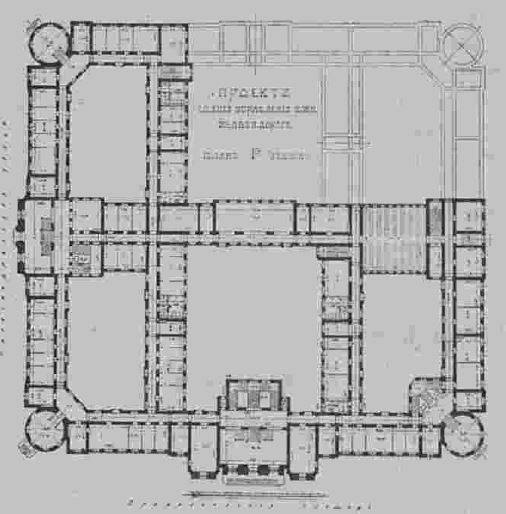
The basement is primarily occupied by the mobilization department, the archives, and the staff locker room. The main railway archive, as can be seen on the floor plan, is housed in a separate building enclosed by stone firewall walls; it consists of 11 floors, modeled after American library and archive storage facilities.
The Engineering Council has made minor changes to the attached plans, replacing the rounded corner towers with a more gradual transition. Construction will likely be completed no earlier than the end of 1913 or in 1914.
A. Dmitriev. D. Rakitin.
Source: *Zodchiy* magazine, 1912.

- About the military pilot school and the airfield in Kharkiv… - 04.11.2020
- Nikanor Savich—A Political Career by Mistake - 13.07.2020
- And once again, about the Cavalry Guards… - 21.01.2020