Today, the Sharivka Estate and Park are arguably one of the most visited tourist attractions in Sloboda Ukraine. Local historians write articles about them, photographers never tire of taking pictures, and tour guides bring tourists there practically year-round.
Thanks to this, both factual and less-than-factual information about this place prior to 1917 has become more or less widely known. However, the history of Sharivka in the postwar period is no less interesting. Although it lacks fictional barons and legendary sugar mounds, it answers the question of why what we see today has survived to the present day—and what efforts were made to ensure that.
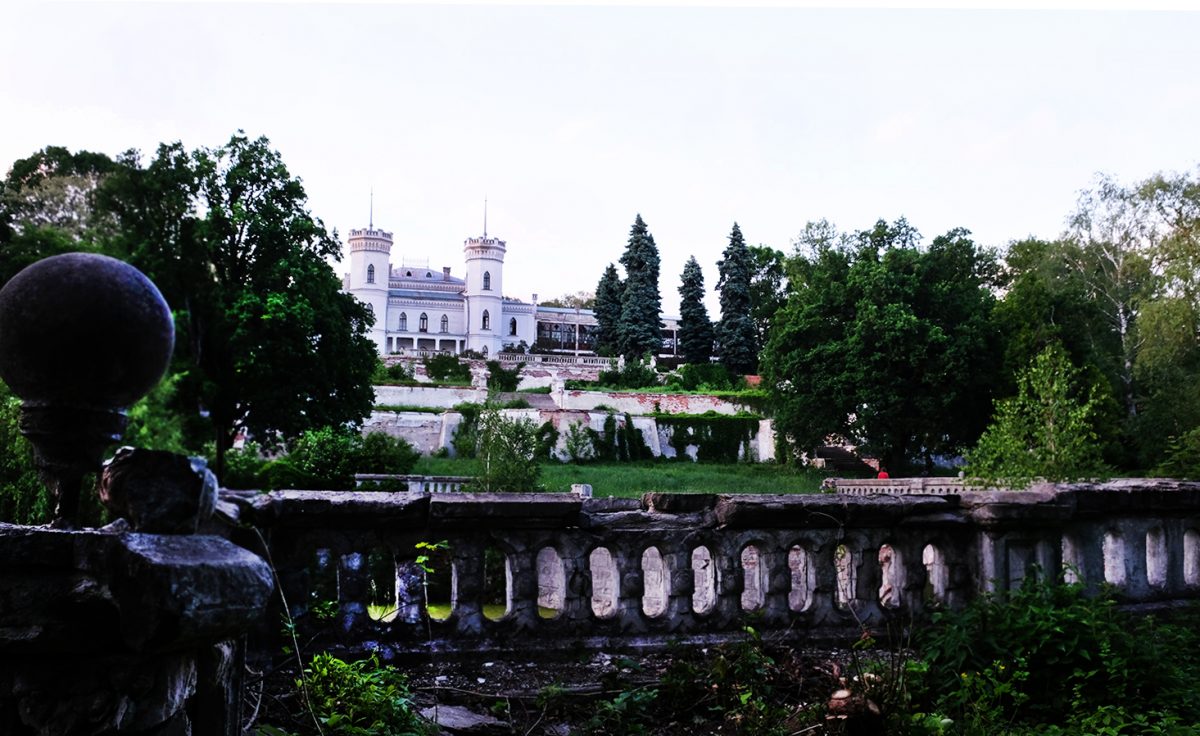
To begin with, the first references to the Sharivka estate and park appear in documents from the Kharkiv Regional Department of Architecture only in 1953, in the “list of monuments in the city of Kharkiv and the Kharkiv region subject to inspection.”
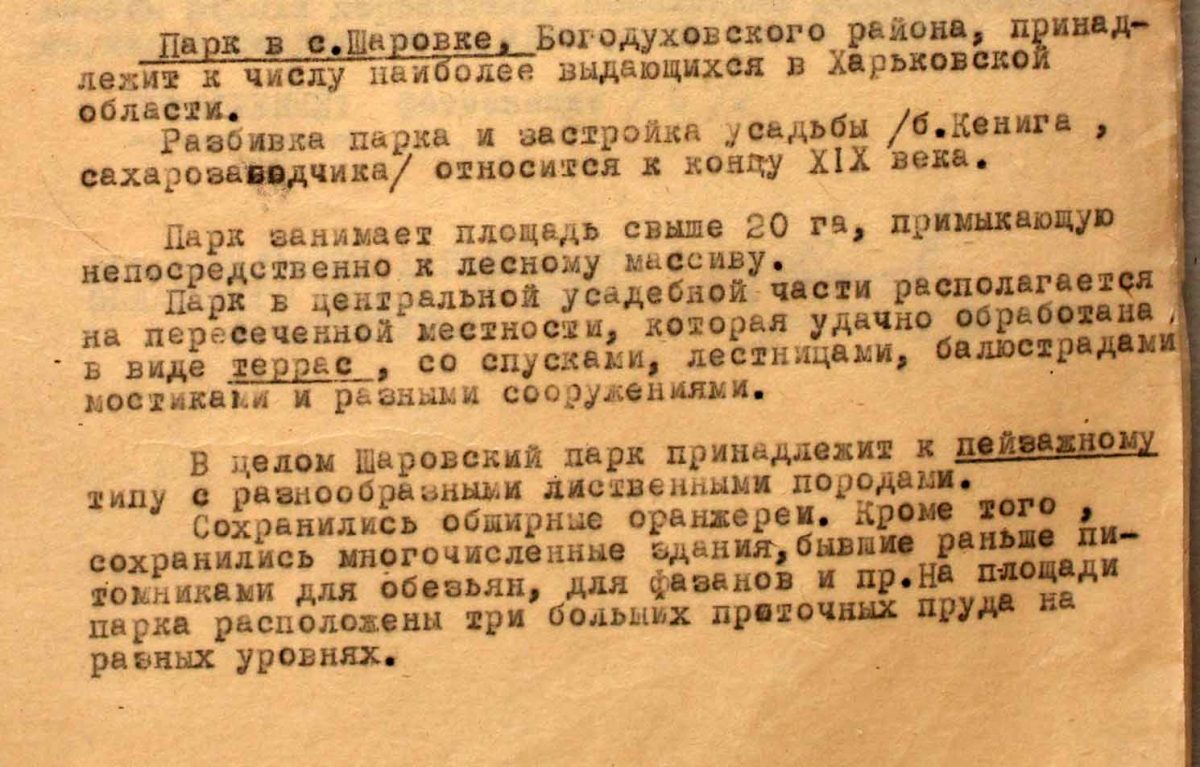
Unfortunately, before that, Sharivka had simply been neglected—all efforts and funds in Kharkiv and the region, which were recovering from two German occupations, were directed toward the preservation and restoration of more significant architectural sites (I will write about them in future articles). But it was not until 1955 that Frolov, deputy head of the Kharkiv Regional Department of Architecture, found an opportunity to write the following to the deputy head of the Department of Architecture under the Council of Ministers of the Ukrainian SSR:
In response to your request, we are providing the following information about parks in the Kharkiv Oblast that may be included in the registry…
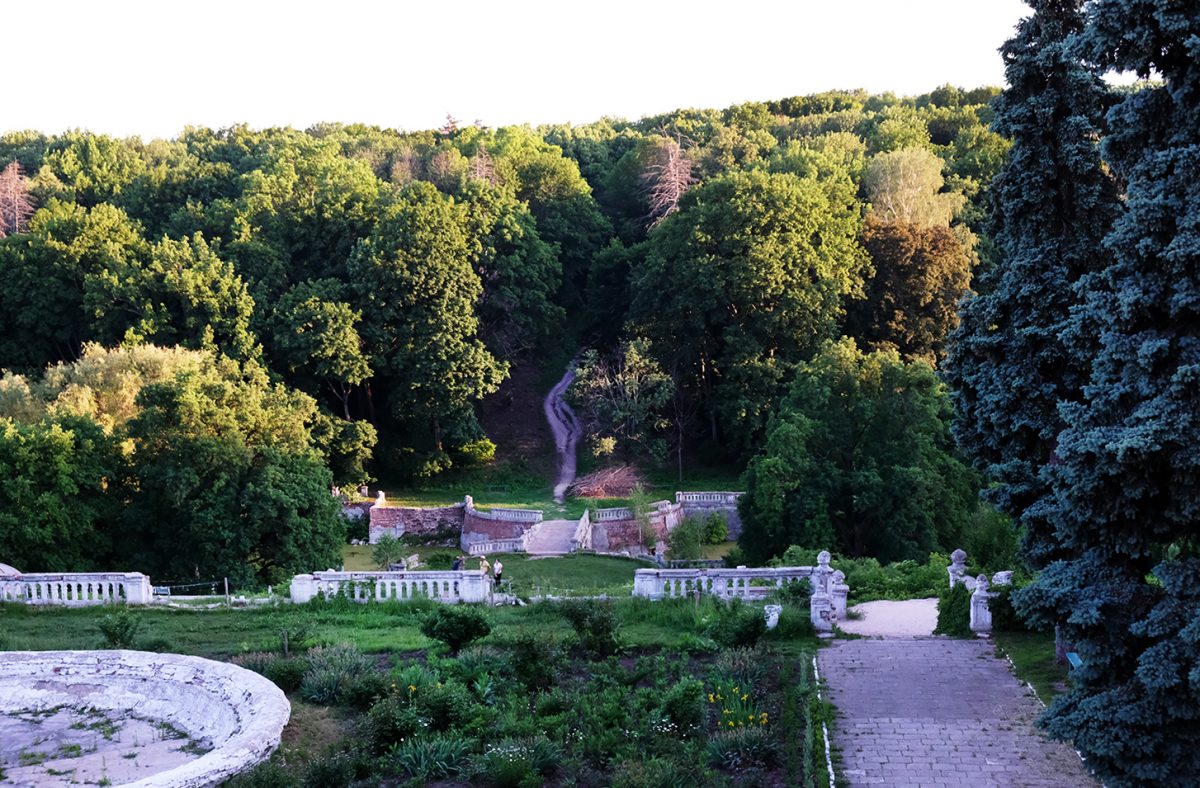
The park in the village of Sharivka, Bohodukhiv District, is among the most outstanding in the Kharkiv Oblast. The park’s layout and the estate’s buildings (formerly owned by Koenig, a sugar manufacturer) date back to the late 19th century. The park covers an area of over 20 hectares, directly adjacent to a forest. The park in the central part of the estate is situated on rugged terrain, which has been skillfully landscaped into terraces featuring slopes, staircases, balustrades, bridges, and various structures. Overall, Sharivka Park is a landscape-style park featuring a variety of deciduous tree species. Extensive greenhouses have been preserved. In addition, numerous buildings that formerly served as enclosures for monkeys, pheasants, and other animals have been preserved. The park grounds feature three large flowing ponds at different levels.
The park and estate undoubtedly deserve attention and should be designated as an architectural monument.
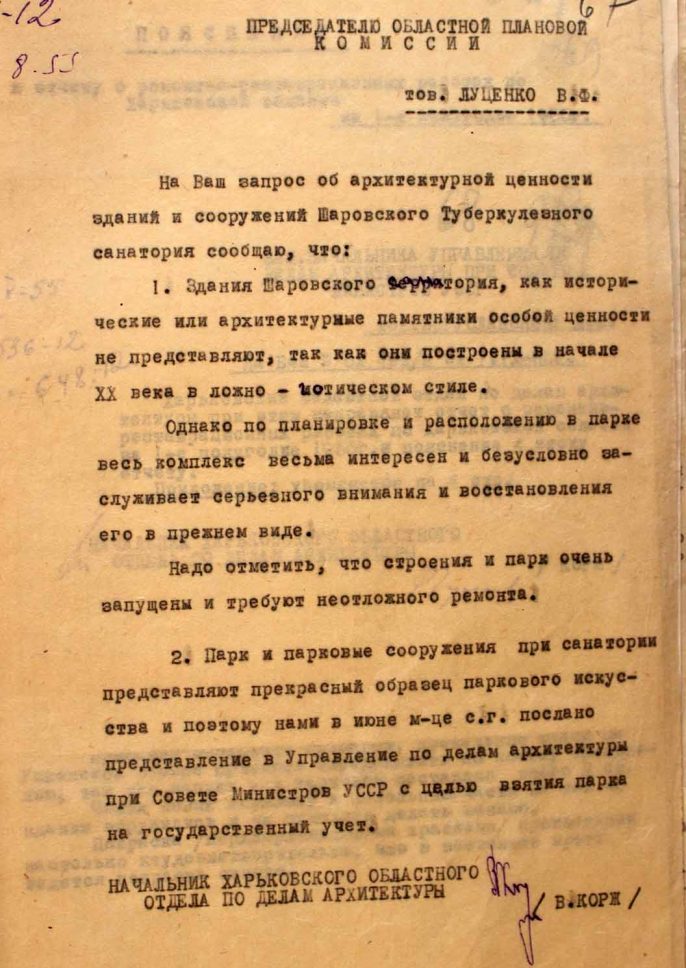
In addition, V. Korzh, head of the Kharkiv Regional Department of Architecture, wrote to V. F. Lutsenko, chairman of the regional planning commission:
In response to your inquiry regarding the architectural value of the buildings and structures at the Sharivka Tuberculosis Sanatorium, I would like to inform you that:
1. The buildings of the Sharivka Sanatorium do not represent historical or architectural monuments of particular value, as they were built in the early 20th century in the pseudo-Gothic style.
However, in terms of its layout and location within the park, the entire complex is quite interesting and undoubtedly deserves serious attention and restoration to its original state.
It should be noted that the buildings and the park are in a state of serious disrepair and require urgent repairs.
2. The park and its structures at the sanatorium represent a fine example of landscape architecture; therefore, in June of this year, we submitted a proposal to the Department of Architectural Affairs under the Council of Ministers of the Ukrainian SSR with the aim of having the park placed on the state register
As a result, after some time, due to its historical and cultural value, only the late 19th-century terraced Sharivka Park was included on the list of architectural monuments. The estate, however, was not.
However, it was not until 1959, at the suggestion of the head of the Main State Inspection and Construction Control of the Ukrainian SSR, that the first detailed postwar survey of Sharivka Park was conducted.
The following is reported regarding the technical condition of the green spaces and the dendrological composition:
The park at the “Sharivka” Tuberculosis Sanatorium is designed in a landscape style. Plantings are arranged in clumps. Coniferous clumps predominate, although conifers account for only 10–12% of the total plant population. There are also tree-lined avenues. The total number of species and cultivars is 123, comprising 12 conifers, 111 deciduous trees, and 46 species of shrubs.
The average age of the plantings is 50–60 years. About 20 individual oak trees are 250–300 years old. There is one oak tree estimated to be 500 years old.

Despite some maintenance, the plantings are in a neglected state and require thinning. Due to elm trees damaged by Dutch elm disease, a significant amount of deadwood has accumulated, which must be removed.
From the document titled “Historical Information,” compiled at the same time regarding the estate and the park, we learn that the park itself was established in 1903 on the site of a forested area and an old orchard. Its total area is 30 hectares. In the years following the park’s establishment, the species composition included about 300 species and varieties of trees and shrubs. However, during the Civil War, this number declined to 160 species. Until 1917, Sharivka belonged to König. Then, from 1917 to 1924, it housed a plant breeding station, a vacation home, a hospital, and a children’s camp.
From 1924 to the present, the park has been managed by the “Sharivka” Tuberculosis Sanatorium.
The storm drainage system is nearly destroyed. And the irrigation system that had previously existed had fallen into complete disrepair by 1959.
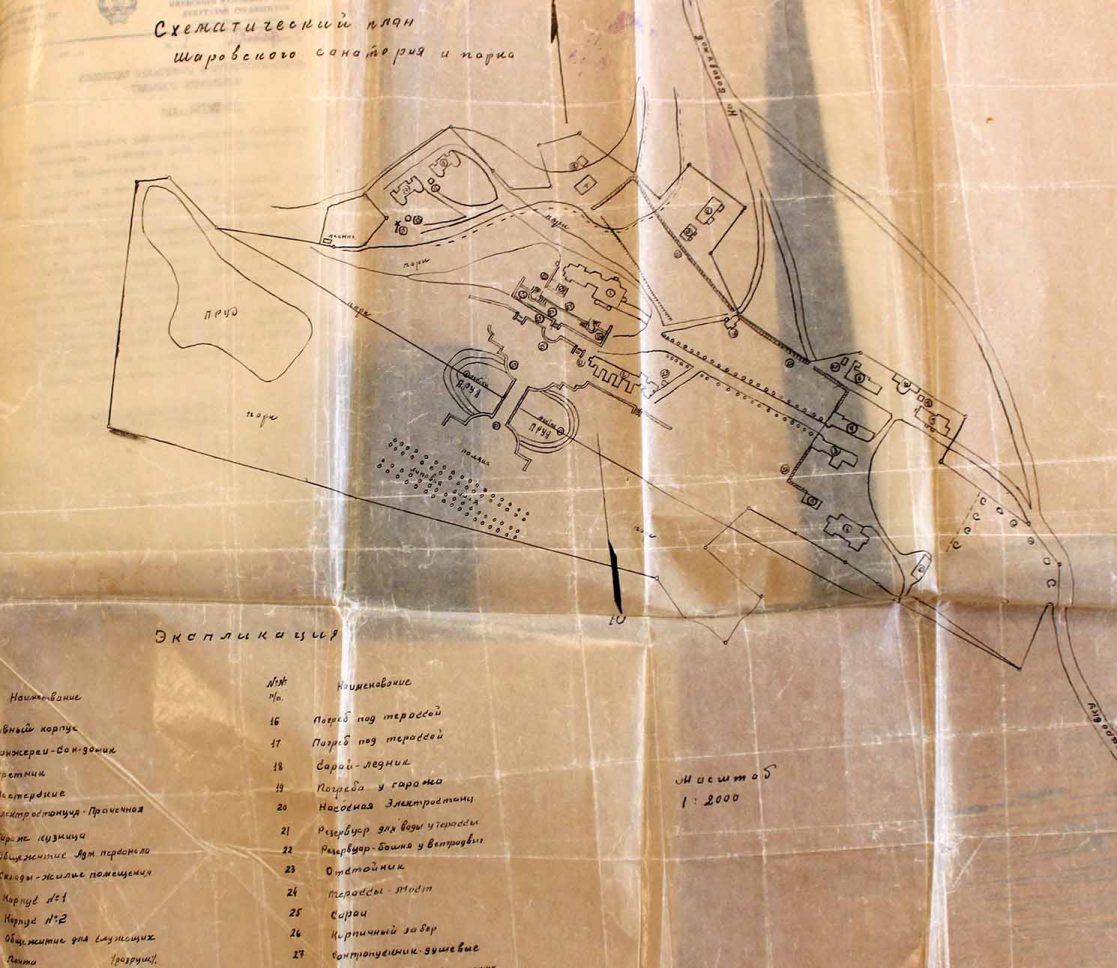
A detailed inventory was compiled of all 123 trees and shrubs remaining in Sharivka Park.
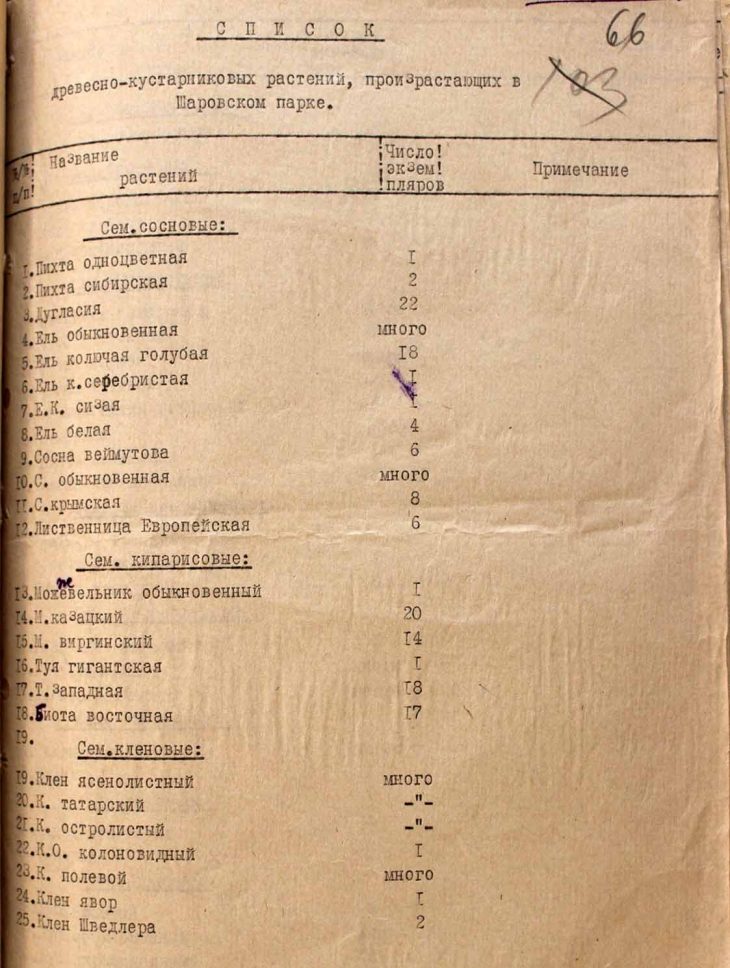
And also—a site plan.
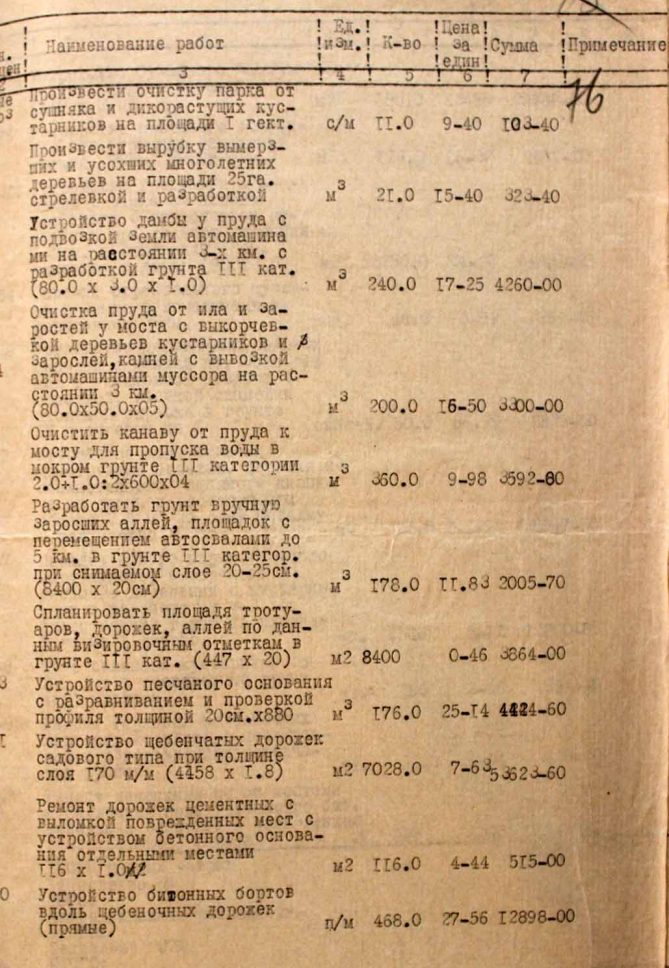
A cost estimate totaling 233,008 rubles was prepared for the improvement and restoration of the “Sharivka” park and architectural monuments. Among the 21 items listed in the work specifications were, for example:
— Clearing the park of deadwood and wild shrubs over an area of 1 hectare;
— Constructing a dam by the pond and dredging it of silt;
— Laying garden-style gravel paths;
— Constructing sidewalks and open areas near the castle;
— Removal of construction debris and soil;
— Installation of wooden garden benches;
— Planting new trees in the park to replace those that were cut down, frozen, or withered;
— Repair of the inlets of storm drains.
Naturally, the full amount was not allocated at that time. However, according to Kharkiv architects, in 1966 the condition of Sharivka Park was assessed as satisfactory.
The following year (1967), the estate itself was finally included on the list of architectural monuments. However, the documents described it as follows:
In our view, the main building of the estate in the village of Sharivka has no architectural value, as it was built at the very end of the 19th century in the pseudo-Gothic style. In terms of its form and construction, it is of no interest as an architectural monument. The building is in satisfactory condition and is used as the main building of a tuberculosis sanatorium…
No technical inspection of the estate’s buildings was conducted that year.
But in 1968–1969, a full-blown scandal erupted over the issue of Sharivka. The Council of Ministers of the Ukrainian SSR noted the extremely unsatisfactory condition of the monuments of garden and park architecture in the Kharkiv region, as well as the lack of proper oversight regarding their preservation. A special decree was even issued to strengthen oversight of their operation, as well as a complete ban on making changes to their grounds and allocating land for development without the permission of the Council of Ministers of the Ukrainian SSR. Among these sites was Sharivka, whose park, according to the documents, was in a state of neglect, and the condition of the estate was assessed as hazardous.
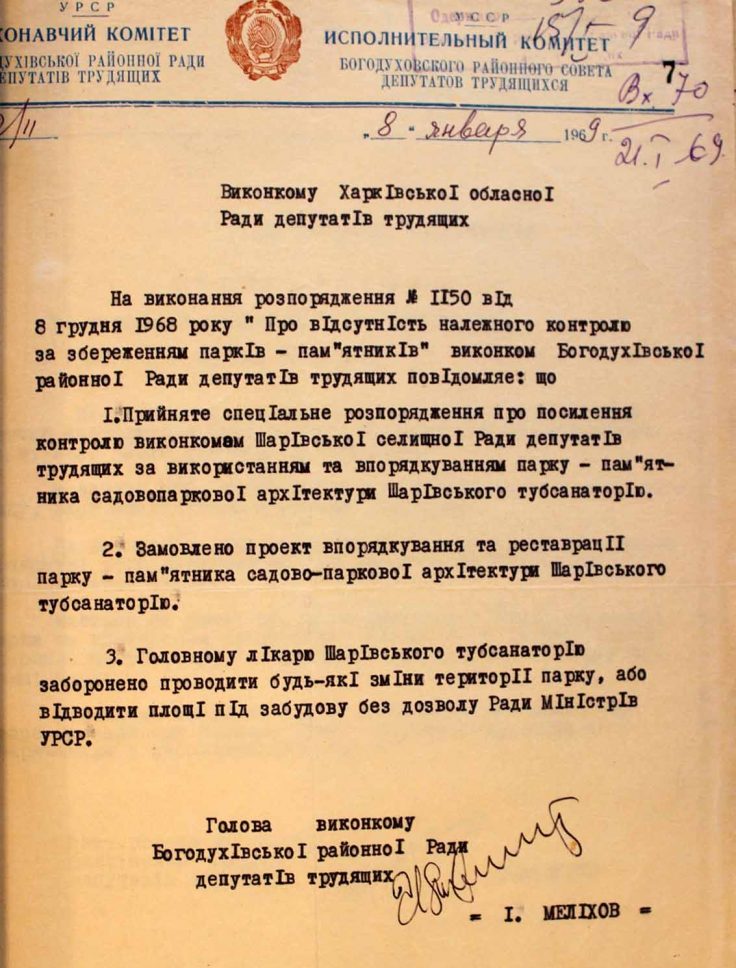
In his defense, the chairman of the Executive Committee of the Bohodukhiv District Council wrote:
“In 1969, the republican specialized scientific and restoration workshops of the State Construction Committee of the Ukrainian SSR were unable to carry out major repairs due to being overloaded…”
He also requested that 72,000 rubles be allocated for the major renovation of the main building in 1970. This request was approved, and in September 1969, the chief physician of the “Sharivka” tuberculosis sanatorium was informed that the necessary 72,000 rubles would, after all, be provided for the renovation of the park and estate in 1970.
I have not yet been able to find any reports on the repair work carried out in the park and on the estate during 1970–1971. However, documents dated January 28, 1972, indicate that emergency repairs to the Blue Hall were planned to be carried out by the third quarter of that year.
In 1973, the situation regarding repair and restoration work in Sharivka was as follows:
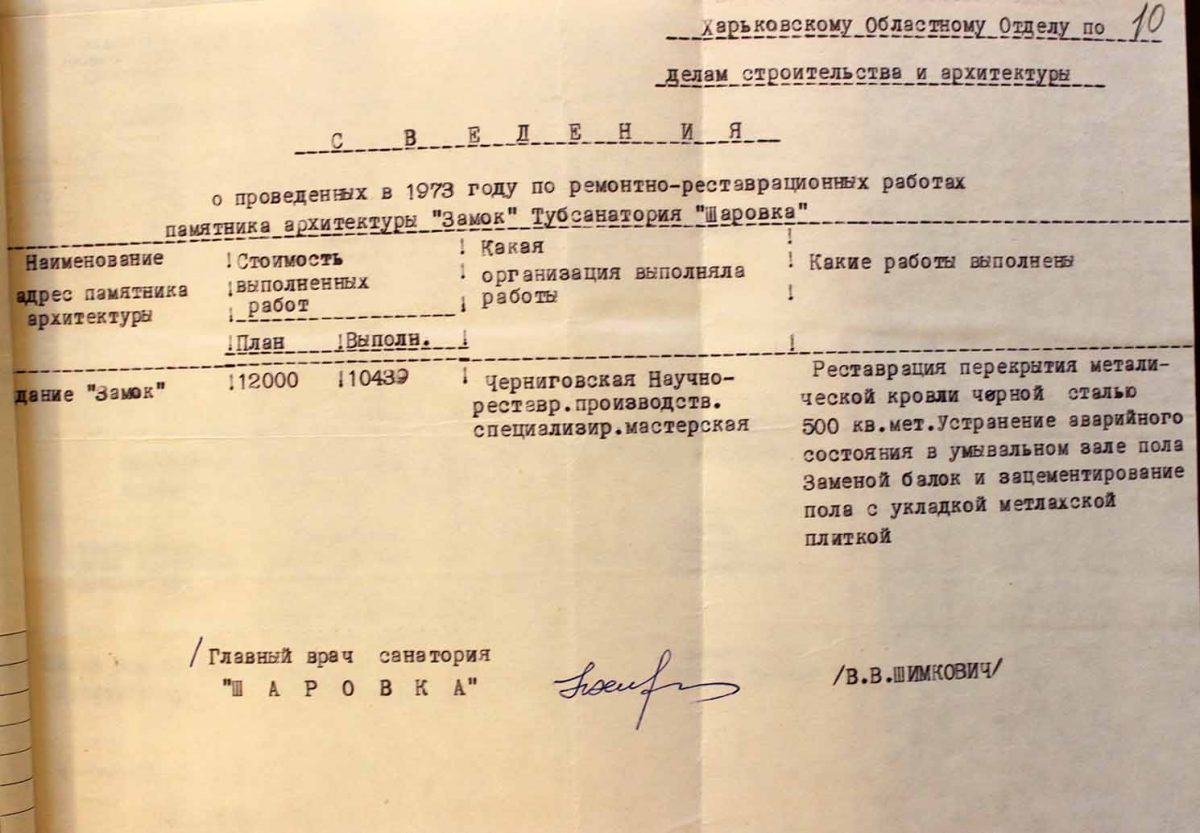
However, all the funds that could not always be secured for the restoration of the park and the estate simply slipped through our fingers like water through sand. This is likely why, in 1980, V. G. Stepanov, head of the regional department of construction and architecture, wrote in his report on the technical condition of architectural monuments in the Kharkiv region words that remain relevant to this estate—beloved by many—to this very day. I would call them prophetic:
In 1975, the Sharivka Tuberculosis Sanatorium was allocated 70,000 rubles specifically for the restoration of the park. The funds were spent, but the condition of the park has not changed to this day.

- About the military pilot school and the airfield in Kharkiv… - 04.11.2020
- Nikanor Savich—A Political Career by Mistake - 13.07.2020
- And once again, about the Cavalry Guards… - 21.01.2020