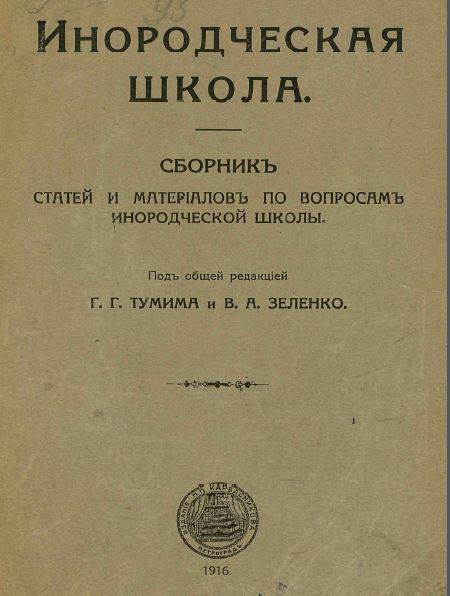
In 1916, the Empire was still intact. However, pressing issues were becoming increasingly evident. That same year saw the publication of a book titled *The Foreign School*, which was highly relevant at the time.
In the chapter titled “The Foreign School and Its Needs,” we find an interesting fact about our city…
Although, as usual, everything is as it always has been. Kharkiv, as always, is ahead of the rest of the world.)
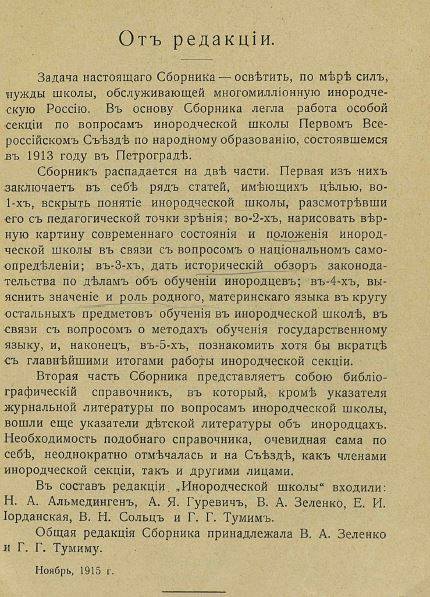
The purpose of this Collection is to shed light, to the best of our ability, on the needs of schools serving the multimillion-strong non-Russian population of Russia. This Collection is based on the work of a special section on issues related to non-Russian schools at the First All-Russian Congress on Public Education, held in Petrograd in 1913.
This collection is divided into two parts. The first part contains a series of articles aimed, first, at elucidating the concept of a non-native school by examining it from a pedagogical perspective, second, to paint an accurate picture of the current state and status of foreign-language schools in relation to the issue of national self-determination; third, to provide an overview of legislation governing the education of foreign nationals; fourth, to clarify the significance and role of the native language among other subjects taught in schools for non-native students, in connection with the issue of methods for teaching the official language; and, finally, fifth, to provide at least a brief overview of the main findings of the work of the section on non-native students.
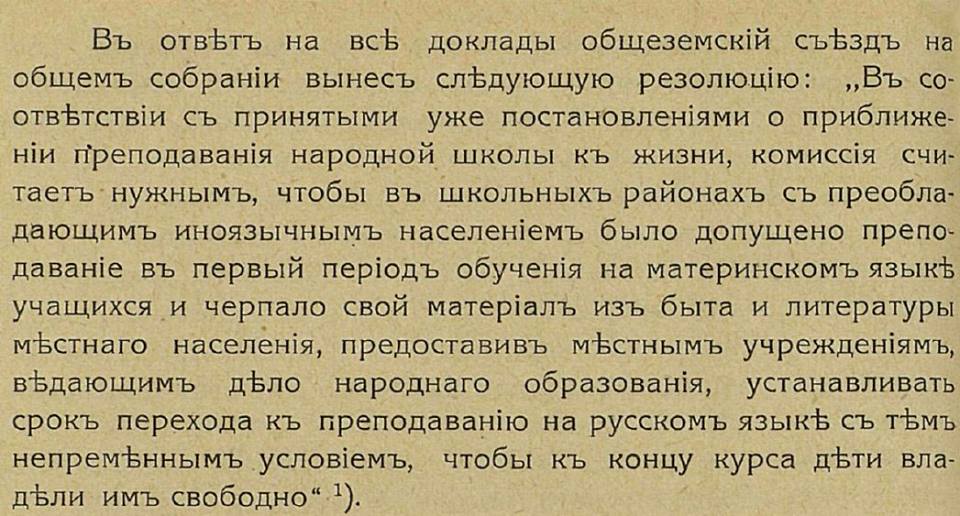
In response to all the reports, the convention adopted the following resolution at its general assembly.
In accordance with the resolutions already adopted regarding the alignment of public school instruction with real life, the commission deems it necessary that, in school districts with a predominantly non-Russian-speaking population, instruction during the initial period of schooling be conducted in the students’ native language and draw its material from the daily life and literature of the local population, while granting local authorities,
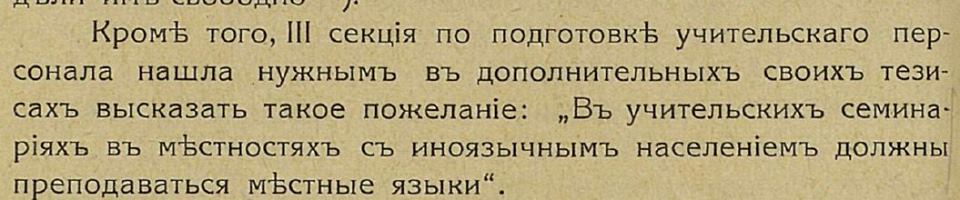
responsible for public education, to determine the timeline for the transition to instruction in Russian, with the indispensable condition that by the end of the course, the children have a fluent command of the language.In addition, the third section on teacher training deemed it necessary to include the following recommendation in its supplementary proposals: “Local languages should be taught at teacher training colleges in areas with a non-Russian-speaking population.”
All the resolutions of the various congresses remained mere words, sometimes serving only to bring persecution upon the speakers. Only the Kharkiv zemstvo compiled a list of Ukrainian books and included them in the catalogs of its public libraries, and this “bold step” did not turn anything upside down or disrupt anything in the life of the zemstvo. And this is one of the rare, bright examples of a thoughtful attitude toward the education of non-Russians. But in general—all around—there is a kind of oppressive ring: neither educational societies nor private initiatives are permitted in either school-based or extracurricular national education for ethnic minorities, and within this ring, their finest creative energies wither away.


- About the military pilot school and the airfield in Kharkiv… - 04.11.2020
- Nikanor Savich—A Political Career by Mistake - 13.07.2020
- And once again, about the Cavalry Guards… - 21.01.2020