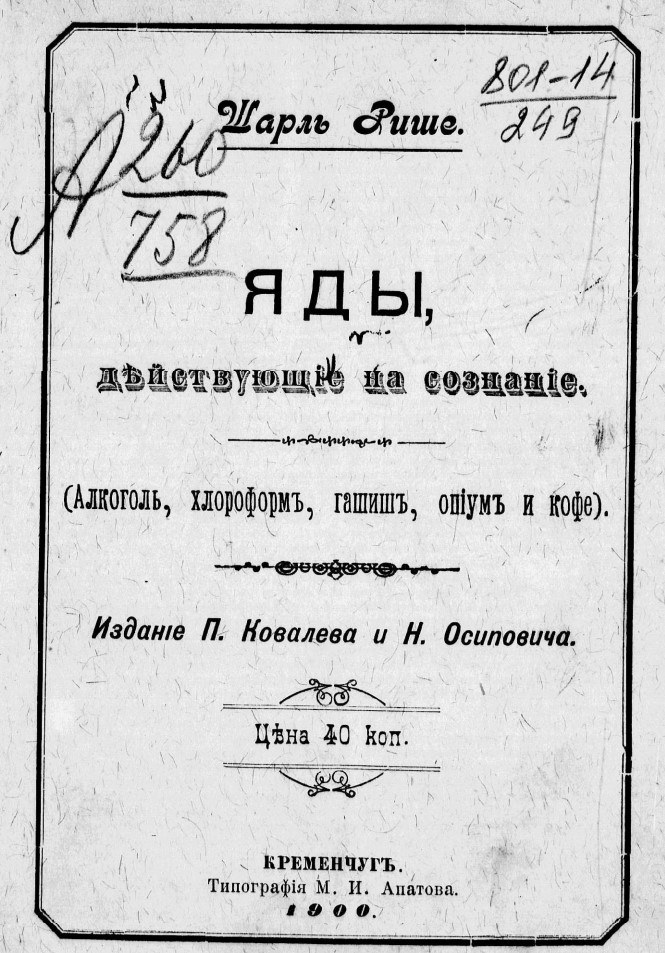
Today, in our book column, we invite you to learn about the harmful effects of poisons on the mind—a category that, in 1900, included not only alcohol, chloroform, hashish, and opium, but also… coffee! This book was published in Kremenchug by P. Kovalev and N. Osipovich. The research itself was conducted by French physiologist Charles Richet, winner of the 1913 Nobel Prize in Physiology or Medicine.
…but the main active ingredients in these plants—atropine and nicotine—act primarily on muscle fibers, and their effect on mental functions is secondary, following their effect on the spinal cord. By studying the effects of alcohol, chloroform, hashish, opium, and coffee separately, we can easily summarize the patterns of disturbances these substances cause in mental functions. Just as the study of disturbances in spinal cord function under the influence of strychnine, potassium bromide, or atropine provides us with valuable insights into the normal functions of that organ, so too can the analysis of functional disturbances in consciousness caused by substances that distort it provide us with irrefutable data regarding the mechanism of healthy consciousness.

- Danylevs’koho Street, 19 - 13.10.2026
- Debunking the myth about one of the most famous Kharkiv photos - 12.10.2026
- The Architectural Evolution of the Kharkiv Theater - 26.09.2026