On September 29, 1914, the governors and mayors of the Russian Empire (including those of Kharkiv) received a very interesting circular marked “Confidential” from the Police Department of the Ministry of the Interior.
The gist of the document, which bore the signature of Comrade Vladimir Fyodorovich Dzhunkovsky, Minister of Internal Affairs (a position equivalent in authority to that of a deputy minister—author’s note), was as follows:
“In order to ensure consistency and uniformity in the registration of criminals by the Criminal Investigation Departments and the Central Bureau, I have deemed it necessary, in amendment to the rules previously issued on this matter, to issue the following instructions:
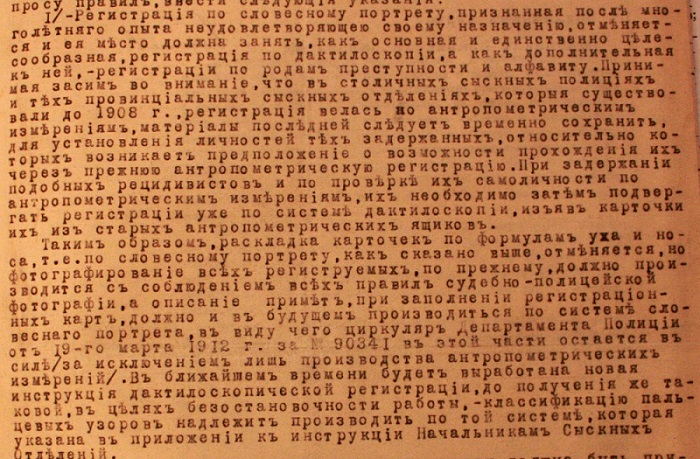
The second point of this reform was no less important. After all, a newly created classification system was introduced for recording crimes by type. It was strictly required that the relatively limited number of case files held by the detective departments be reorganized according to the new table no later than January 1 of the coming year.
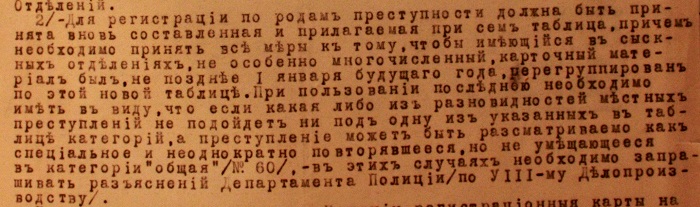
Of course, the points mentioned above were only part of Vladimir Fyodorovich Dzhunkovsky’s reform, a description of which would take quite a few pages.
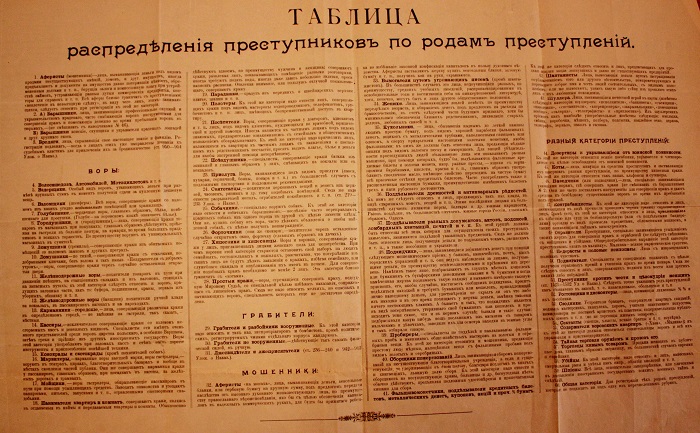
Be that as it may, the Kharkiv Police Chief and the district magistrates received the above table, and it was precisely according to this table that criminals in our city were classified by type of crime a little over 100 years ago.
Thanks to this document (which, given its considerable size, apparently hung on the walls of police offices in Kharkiv), we can not only find out what various types of criminal professions were called, but also what specifically characterized them.
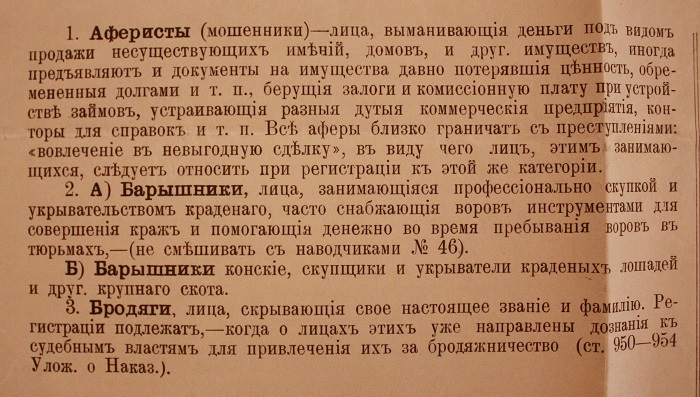
Right at the beginning of the “Table Showing the Distribution of Criminals by Type of Crime,” we learn who swindlers (fraudsters), profiteers (or “horse profiteers”), and vagrants were, how they were defined, and what they did.
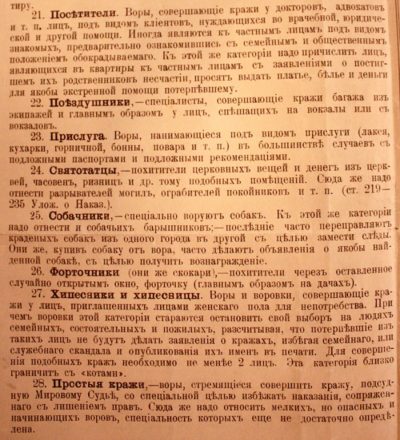
Next, from item No. 4 through No. 28, there is an extensive section titled “Thieves,” which indicates that there are different types of thieves:
— bicycles, cars, motorcycles, etc.
— Change-stealers. A specific type of thief who pockets money when exchanging large sums while receiving change for a cheap purchase.
— Burglars (sniffers). All thieves who commit burglaries in any unoccupied premises or storage facilities.
— “Golubyatniki” — attic thieves, primarily stealing laundry hung out to dry. (“Golubi” means “laundry” in thieves’ cant.).
— City shoplifters (both men and women)—people who steal goods from stores while shopping; they operate mainly when traveling to large cities, fairs, and during major holidays and celebrations. They primarily steal from department stores amid the hustle and bustle.
— “Brute” burglars—those who steal from occupied premises by breaking locks and other barriers.
— “Silent” burglars—those who commit thefts using lock picks or duplicate keys, without breaking in; this category also includes the so-called “Good Morning Greeters”—thieves who carry items out through doors left open by accident.
— Railroad thieves. They steal goods while trains are in transit, from station warehouses, and from cars parked on siding tracks; this category also includes those who steal train car parts, such as: buffers, bearings, valves, mirrors from restrooms, paneling, etc.
— Railroad pickpockets—thieves who steal carry-on luggage at train stations, in passenger cars, and on steamships.
— City pickpockets — individuals who commit various thefts within a specific city without traveling to other locations; so to speak, they are local.
— Cashiers — those who exclusively commit burglaries by breaking into fireproof cash registers and cash boxes. There are a great many such specialists among the thieves of the Kingdom of Poland, especially in Warsaw, followed by Greeks and visitors from other foreign countries. Thieves in this category use very expensive tools and state-of-the-art equipment when breaking into cash registers and walls.
— Horse thieves and cattle thieves (excluding dog thieves).
— Pickpockets—the highest-class pickpockets; traveling thieves—who steal in theaters, circuses, charity bazaars, and generally in places where the public gathers. They also commit pickpocketing against passengers, mainly as they board train cars, on railroads, and on streetcars.
— “Washermen”—traveling thieves who rob passengers en route using sedatives. They strike up a conversation and offer cigarettes, drinks, and snacks laced with sleeping pills.
— Landlords and rooming house operators—commit thefts by entering apartments and rooms that are being rented out or handed over to tenants. They usually operate in pairs—typically a man and a woman—and commit theft by distracting the person showing the property with various conversations; sometimes they ask for a glass of water, and sometimes they even offer small deposits, asking for a receipt to be written. They commit the theft by distracting the person showing the property or taking advantage of their absence.
— Coat check attendants—steal overcoats, hats, and the like from entryways and concierge desks.
— Floor polishers. This category includes individuals who commit theft under the guise of tradespeople—plumbers, telephone repairmen, chimney sweeps—as well as those who have unrestricted access to an apartment.”
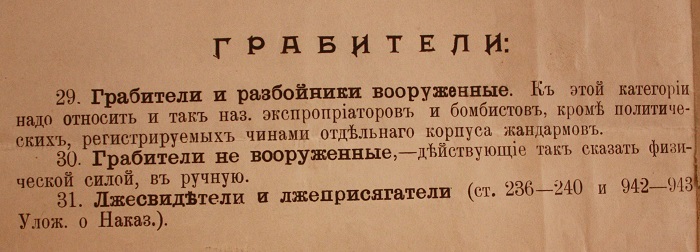
The “Robbers” section is less diverse and has only 3 categories.
The classes taught by the following individuals, however, are much more varied and interesting.
“Scammers:
— “Monk” scammers are individuals who swindle money, blank promissory notes, or stamped paper worth large sums under the pretext of transferring an inheritance from a high-ranking monastic figure, primarily of the Orthodox faith, ostensibly to ensure that funds are placed in reliable commercial hands for a supposedly adopted child, thereby avoiding the lawful confiscation of those funds by the ecclesiastical authorities. The swindlers force the victim to purchase blank promissory notes, deed paper, and the like; once they have received these in hand, they disappear.
— Extortionists who operate through threatening letters (as distinct from blackmailers). In most cases, these are individuals who did not complete their education at various—primarily secondary—educational institutions, which were promoted during the years of emancipation, and who educated themselves through Pinkerton’s literature, although, of course, there may also be individuals from other social backgrounds.
— Suitors. Individuals engaged in the pursuit of brides—predominantly of an advanced age—and in extorting money under the pretext of covering wedding expenses, as a portion of the future dowry, to provide even minimal support for close relatives, to settle old debts, romantic entanglements, and so on.
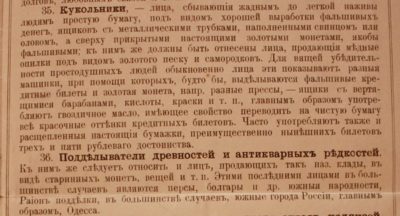
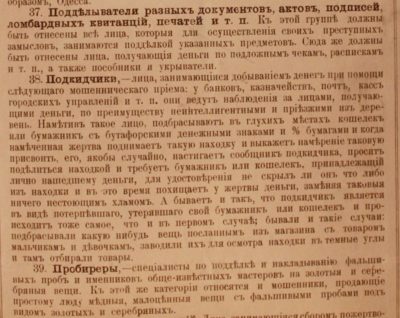
— Fundraisers. Those who collect donations for nonexistent charitable organizations, or—if the organizations do exist—who, through forgeries in ledgers and receipts, pocket the lion’s share of the proceeds for themselves. This category also includes collectors for nonexistent churches, hospitals, and other charitable institutions; they typically operate by presenting forged identification and stamped donation books.
— Counterfeiters of currency, banknotes, coins, coupons, stocks, and other securities. This category also includes individuals offering for sale old stocks of bankrupt and long-defunct companies.
— Blackmailers. Individuals who extort money by threatening to publicize certain circumstances that compromise and discredit the good name and honor of wealthy people in prominent positions. They also extort money after learning some secret from these individuals’ past or about their romantic escapades.
— Card cheats. Those who engage in dishonest card games (the following categories of card cheats are known: “executors,” “bankers,” “collectors,” “spotters,” “organizers,” “entrepreneurs,” “cover-ups,” “assistants in general,” “spectators,” “telegraphers,” and “henchmen”). The following are the most commonly used card-cheating techniques: the swap, the switch, the box, the bag, the selection, the slip, the stuck card, the hold, the telegraph, the mirror, the prick, and the shuffle.”
In the section titled “Various Categories of Crimes,” you could learn who they are and what they do:
— Deserters evading military service
— Thieves— Gunners (or submariners)
— Smugglers
— Poisoners
— Homosexuals and sexual psychopaths
— Arsonists
— Criminals who violate women’s honor and chastity
— Usurers and discounters
— Pimps
— Sectarians
— Keepers of thieves’ dens (“Khaza,” “Malina”).
— Illegal arms trade and smuggling
— Human traffickers
— Murderers
— Spies
— General category
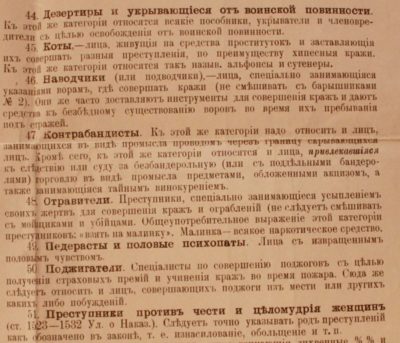
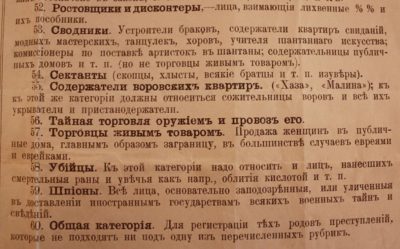
As we can see, many of those terms and definitions are still in use today.
That was a fascinating and informative table. There’s no doubt that the cases from 1914–1917 involving blackmailers, street performers, street cleaners, cashiers, and others—held in the Kharkiv Regional State Archives—are just as interesting. But that’s a whole other story…

- About the military pilot school and the airfield in Kharkiv… - 04.11.2020
- Nikanor Savich—A Political Career by Mistake - 13.07.2020
- And once again, about the Cavalry Guards… - 21.01.2020