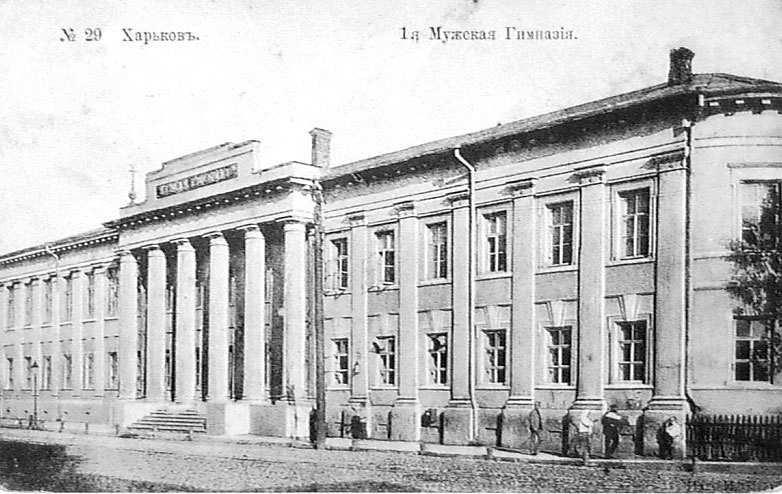
While walking down Universytets’ka Street, you’ll notice numerous commemorative plaques hanging on the buildings of the oldest institution of higher education in Eastern Ukraine. This is hardly surprising, as many illustrious names are associated with Kharkiv Imperial University. Every year, the number of commemorative plaques honoring those who once studied or taught there continues to grow. Few buildings in our city can rival the old university’s buildings in terms of the number of famous figures associated with them, with the possible exception of the building that once housed the 1st Kharkiv Boys’ Gymnasium (now located at: Heroes of Kharkiv Ave., 24).
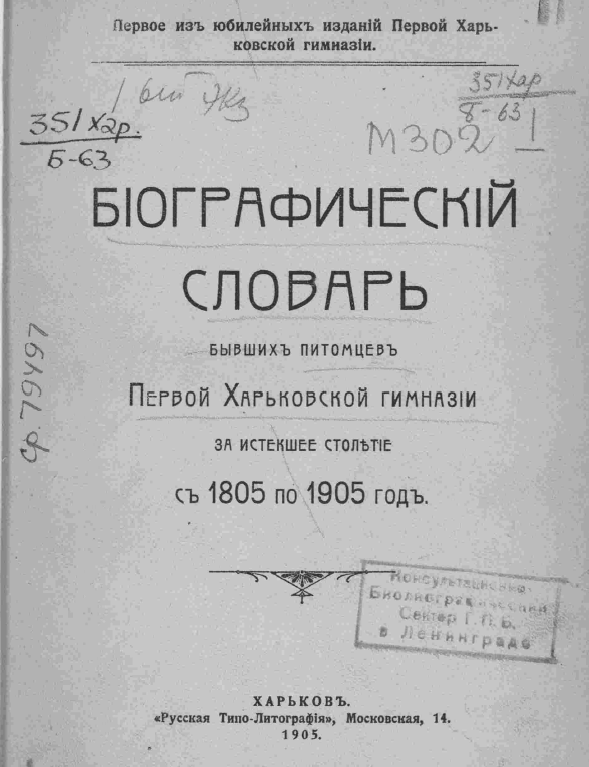
Back in 1905, to mark the centennial of this wonderful educational institution—where many famous people took their “first steps”—a remarkable “Biographical Dictionary of Former Students of the First Kharkiv Gymnasium from 1805 to 1905” was published, totaling 441 pages! It contained such a large number of what we would now call “great” figures that one could talk about them for hours.
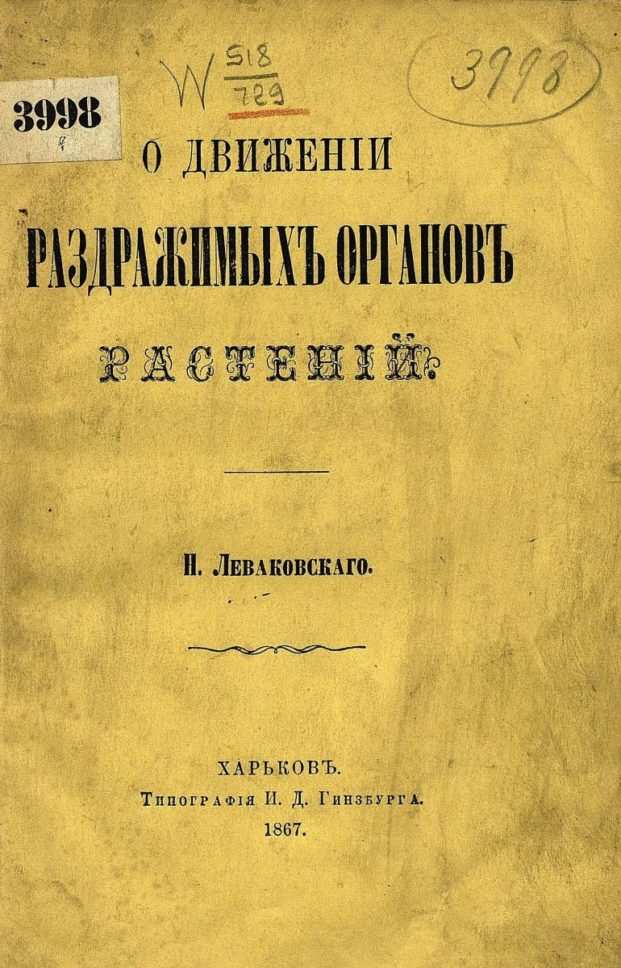
The memoirs of the gymnasium’s former students are also of immense value to us; thanks to them, we can learn many interesting—and at times harrowing—details about the teaching system, the teachers, and the lives of the students at the school. One such historical source is the memoirs of Nikolai Fedorovich Levakovsky, one of the first botanists in the Russian Empire at that time in the field of experimental morphology, who studied there from 1845 to 1852.
Right at the beginning, he candidly admits:
…Many years have passed since I left the walls of the First Kharkiv Gymnasium upon completing my studies, but my memories of my seven years there are so vivid that it feels as if it all happened only a few months ago. Even now, I often find myself, in my dreams, back as a student at the gymnasium, and various events from that time come to mind with striking clarity; and when I wake up, I thank my lucky stars that I experienced all of this only in a dream…
It turns out that all teaching methods at that time boiled down to “rote learning” and “cramming.” As a result, teachers and students at the gymnasium were divided into two hostile camps, “ready at any moment to engage in open combat, which indeed happened more than once.” Among the teachers in particular, Nikolai Fyodorovich singles out one category, which he calls “God’s scourges.” Resisting them was considered unthinkable, “and only fervent prayer” before the arrival of such a teacher was regarded as the only possible way to appease their wrath and the resulting torment of the boys. Naturally, many of these incidents remained etched in Nikolai Levakovsky’s memory for the rest of his life. In his memoirs, written later in life, he recalls with a shudder:
…But then the teacher walks into the classroom. The children cross themselves, make the sign of the cross on their notebooks, and hurriedly draw several crosses on the bench and on the floor to protect themselves from evil spirits. The teacher happens to see this and flies into an indescribable rage; before the prayer at the start of class is even over, he has already grabbed one of the children by the hair with his bony hand, and a tuft of hair flies to the floor!
“What on earth are you doing, you beast? Have you decided to renounce me as if I were the devil himself? Pull him by the ears, you beasts,” he orders his neighbors. “Harder, harder!
” The poor boy cries, but the torture continues until the teacher has had his fill…
Levakovsky and others describe equally horrific forms of torture inflicted on students at the gymnasium. The teacher would call on a student to take roll call and note in the register who was absent. I think that many who are reading these lines did this happily at school as children and would be very surprised to learn that for Kharkiv students in the mid-19th century, this was a terrible form of torture. After the teacher’s frenzied shout—“Now listen, don’t make a mistake—don’t write it down in the wrong column!!”—many of them saw stars and were left speechless. The children grew nervous, made mistakes, and marked the absent student in the wrong column. For such a trifle, the teacher’s anger knew no bounds. After the student who had made the mistake was paraded across the entire classroom by the teacher, who rewarded him with slaps on the back of the head, a new victim was called up, and the whole thing started all over again. This went on until some lucky soul finally managed to take attendance without making a mistake. Then the lesson would begin—and with it, the children’s hell.
“K., go ask B. about the lesson.”
Both of them walk up to the blackboard. K. is the best student.
“What’s the matter with you, you beast? Your pants are practically falling off,” the teacher teases poor K., whose trousers—likely not tailored to fit him—do indeed hang awkwardly. The quiz begins. All it takes is for the student answering to draw a line—while writing a fraction—at an angle rather than horizontally, and a storm breaks out:
“Smear that brute’s face with a sponge!” he orders K., and the latter is obliged to obey without question. Puzzled by such a pedagogical tactic, the student answering, of course, is completely at a loss. What follows is a merciless pounding of the head against the blackboard, a good handful of hair being yanked from his head, and being forced to his knees. Then it’s the turn of the next student, sitting next to him, to whom roughly the same thing is done…
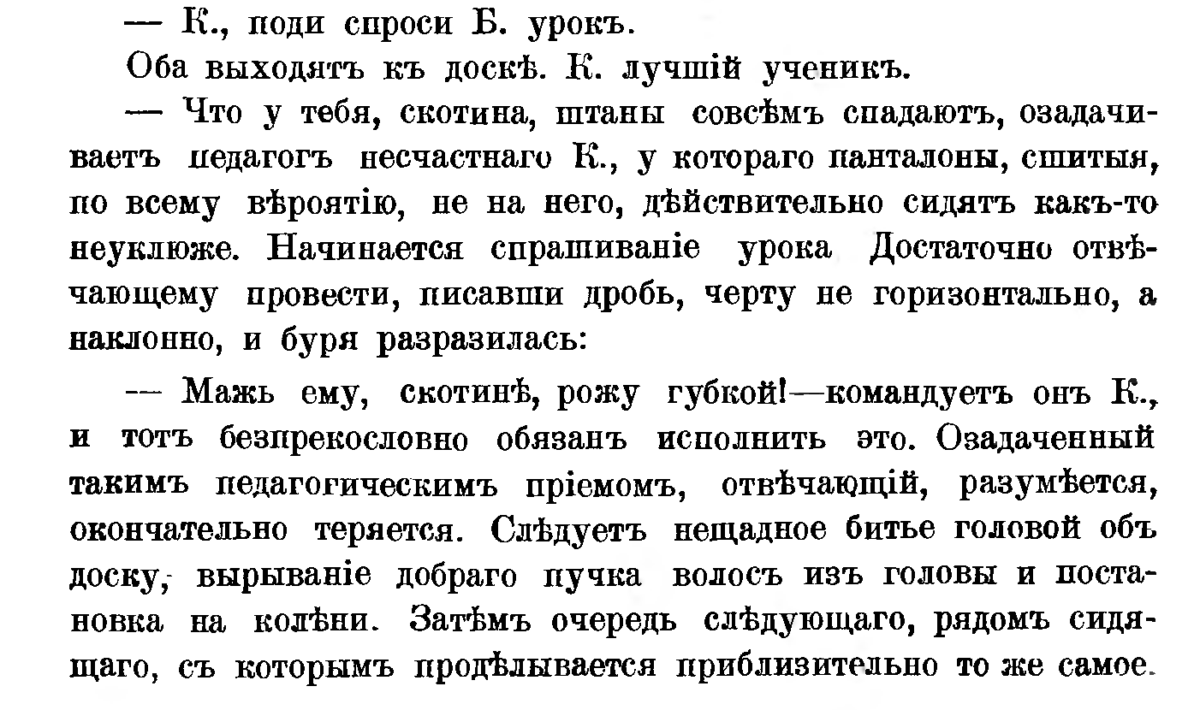
But the abuse didn’t end there. The teacher meticulously wrote down the names of all the students forced to kneel for even the slightest offense on a separate piece of paper, which was then handed over to the inspector for further punishment. The children were flogged with canes. Undoubtedly, it is extremely difficult to believe everything described here—both then and now… Nikolai Fedorovich Levakovsky honestly names the sadistic teacher. It turned out to be Bernhardt, a math teacher at the 1st Kharkiv Gymnasium, who, according to the author, belonged not among teachers but in an insane asylum. And the most frightening thing here is that there were quite a few teachers like him at the gymnasium. True, each had his own methods of punishment.
The overweight German teacher, Haberland, would silently deliver “full-force, loud slaps” to his students. This meant that there was an error in the translation. He never explained why a particular translation was incorrect or exactly how it should be done. Semiganovsky, the penmanship teacher, would hit students on the palms with a ruler to correct their handwriting. Savitsky, the art teacher,’s favorite punishment was to grab students by the temples and yank them upward. Which, according to Nikolai Fedorovich (who apparently experienced this himself), “caused unbearable pain.” And the French teacher, Montenac, simply punched his students wherever he could.
Of course, such treatment was bound to provoke resistance from the students. Levakovsky recalls how, one day during a penmanship class, Semiganovsky—whom we’ve already met—once again tried to punish a student with a ruler. However, the student fought back, and a “full-blown fistfight” broke out between the teacher and the student, during which the student grabbed a stool and began using it to fend off the teacher. The teacher, of course, bolted out of the classroom to complain to the inspector. As a result, Nikolai Fedorovich’s classmate was mercilessly flogged and put in detention. Sometimes, when something like this happened, the entire class would stand up for their injured classmate. However, regardless of whether the students succeeded in achieving justice or not, the outcome of such conflicts was always the same: the expulsion of several students from the gymnasium…
Be that as it may, Nikolai Levakovsky, the son of a nobleman, managed—despite being bullied by his teachers—to complete his studies at the gymnasium and enroll at Kharkiv University in the Department of Natural Sciences of the Faculty of Physics and Mathematics. In 1867, the scientist was awarded a master’s degree in botany. From May 27, 1875, to May 19, 1881, he served as vice rector of Kazan University. In the summer of 1888, the accomplished scientist and educator retired and spent the last 10 years of his life in Kharkiv, where he died in 1898 at the age of 64.
He left behind fond memories; according to his contemporaries, he was “exceptionally modest, always friendly and tactful.” However, it was not until 1915 that Nikolai Fedorovich’s daughter published her father’s memoirs, which recounted the terrible bullying he endured at the 1st Kharkiv Gymnasium…

- About the military pilot school and the airfield in Kharkiv… - 04.11.2020
- Kharkiv Artisans and the 1887 Exhibition - 17.08.2020
- Nikanor Savich—A Political Career by Mistake - 13.07.2020