The topic of murders and assassination attempts targeting prominent politicians, officials, and public figures has always sparked interest. Of course, there were such cases in the history of Kharkiv in the 19th and early 20th centuries. Among them, the most well-known is the assassination attempt on Dmitry Nikolayevich Kropotkin, who served as governor of Kharkiv from July 1870 to February 1879.
Savva (born Ivan Mikhailovich Tikhomirov), who at that time served as Bishop of Kharkiv and Akhtyrka, describes the events in his memoirs in great detail and with vivid clarity.

On the night of the 9th to the 10th, on the Friday of Cheese Week, a shocking event took place in Kharkiv—a vicious attempt on the life of the provincial governor, Prince Dmitry Nikolaevich Kropotkin. Here is how this event was described in the Kharkiv Provincial Gazette (No. 39, February 13):
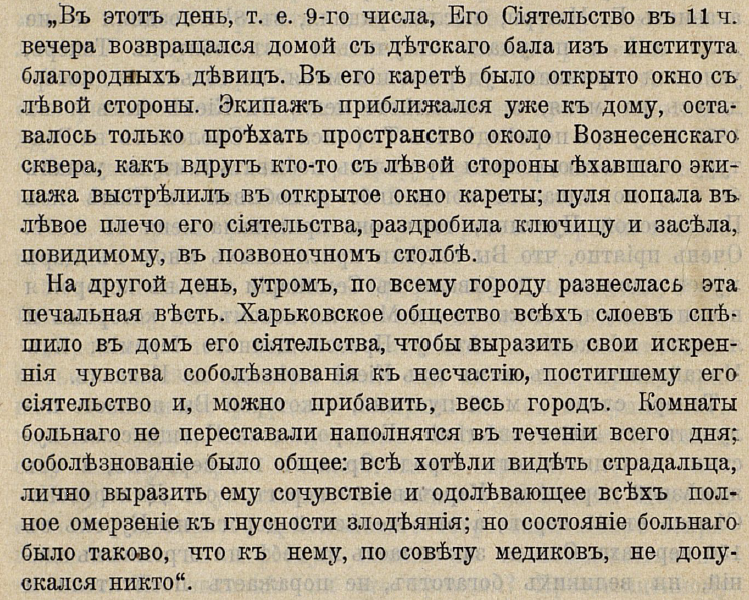
Having learned with horror the next day of this terrible event, I hurried to the home of the man who had been struck by a bullet, but was unable to see him. There, however, I was comforted to learn that Prince Dmitry Nikolaevich, as soon as he was carried into the house, before any medical assistance was provided, requested his confessor and, after confession, received Holy Communion. Here is evidence of the good fruits of the sound family upbringing that the suffering prince received in his childhood.
The prince’s suffering continued until the 15th. On that day, at 7 o’clock in the morning, he passed away at the age of 44. On Saturday the 17th, at 3 o’clock in the afternoon, his body was carried from his home to the Cathedral with all due honors. On the same day, a proclamation from the vile Socialist-Revolutionary Party, titled “The Execution of Prince Kropotkin,” was sent to the governor’s office and posted on city poles that night. In this proclamation, the prince was accused of allegedly cruel treatment of prisoners at the Novoborisoglebsk penal prison, of making a false report regarding the student incident of December 14, 1878, and other matters. On the 18th, a Sunday in the first week of Great Lent, a solemn funeral service was held after the Liturgy in the cathedral over the body of the prince, who had departed to God. On this occasion, at my request, an edifying sermon was delivered by Archpriest V. I. Dobrotvorsky, professor of theology at Kharkiv University and spiritual advisor to the deceased prince. After the funeral service in the cathedral, the coffin containing the prince’s body was carried to the Pokrovsky Monastery and placed in the narthex of the lower church, where it remained until early March, and then transported to Moscow, where he was buried at the Novodevichy Convent on March 8.

Of course, this excerpt from the memoirs of the Bishop of Kharkiv does not allow us to pass judgment on the governor; rather, it reflects a subjective viewpoint. However, the fact remains that the assassination attempt on the head of the Kharkiv Governorate on February 21 (New Style), 1879, caused a major public outcry. Many years later, Prince Alexander Dmitrievich Golitsyn would write in the preface to his memoirs: “Meanwhile, the Kharkiv Governorate was not considered politically stable—during the previous reign, the local governor, Prince Kropotkin, had been assassinated by a terrorist.”
In his book, Alexander Dmitrievich also discusses the assassination attempt in our city on the governor of Kharkiv, Prince Ivan Mikhailovich Obolensky. The most interesting thing here is that it was not the security detail but a brave woman who prevented the assailants from killing the governor of Kharkiv.
In May 1902, at the well-known “Tivoli” amusement park in Kharkiv, the governor of Kharkiv, Prince Obolensky, was the target of an assassination attempt by one of those fanatical youths who had been recruited by this criminal party (referring to the militant wing of the Socialist-Revolutionary Party—author’s note) to carry out terrorist acts. Fortunately, the attempt failed. The assailant’s hand was deftly and boldly deflected by the wife of the chairman of the Kharkiv Provincial Administration, O. N. Gordeenko, who was standing next to the governor. The shot went off into the air, and the assassin was immediately seized and disarmed. O. N. Gordeenko was awarded a gold medal for saving lives.
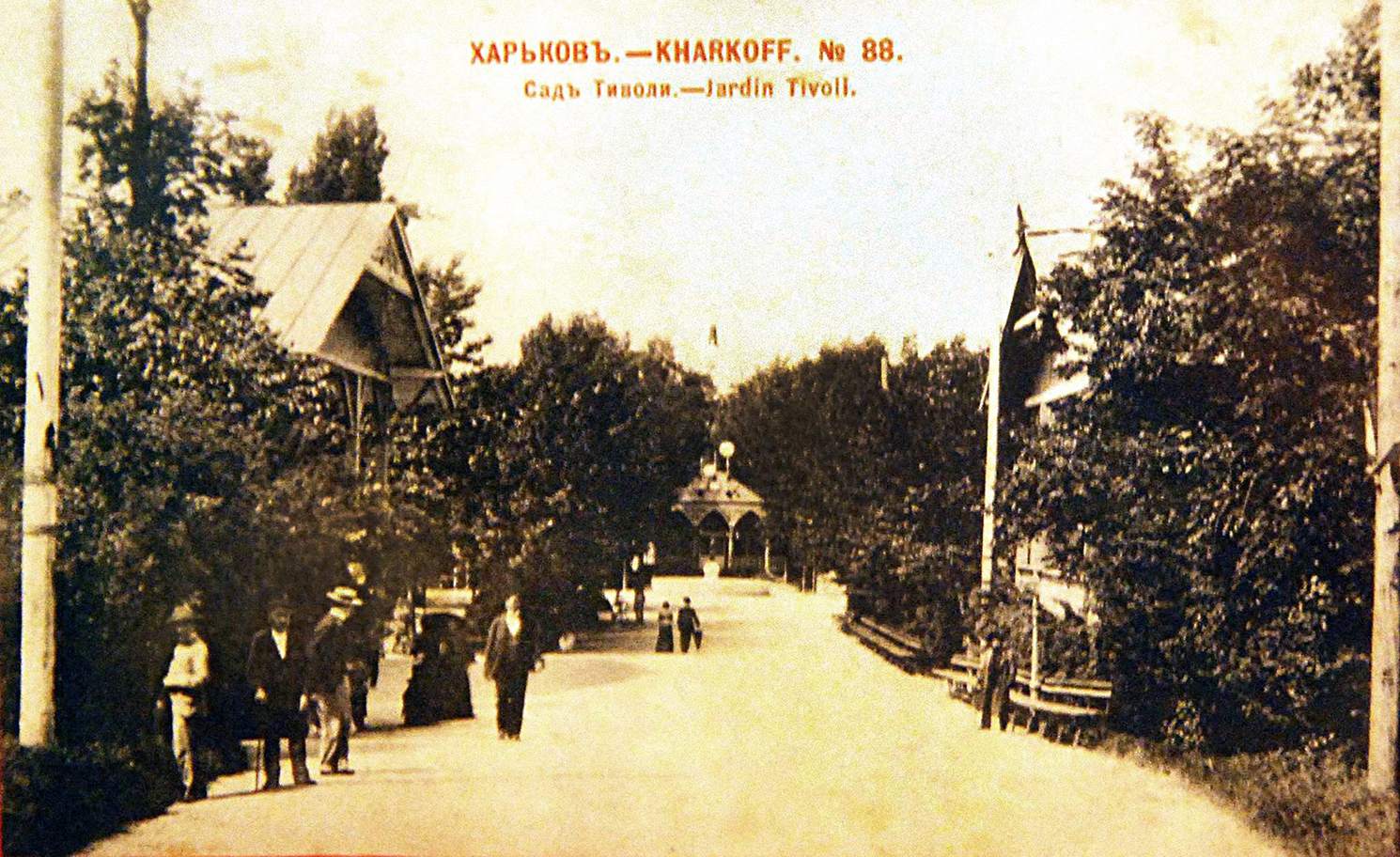
Today, very little remains of Tivoli Park. Most residents of our city know this place as the square in front of the “Pishchevyk” Palace of Culture. However, on April 23, 2014, the Kharkiv City Council decided to restore the square’s original name—Tivoli Garden. Unfortunately, the information board that tells visitors about the garden’s history makes no mention of the assassination attempt, nor of Mikhail Yegorovich Gordeenko’s wife—Olga Nikopolionovna—and her heroic act. What a pity. After all, the actions of this brave woman deserve to be known.

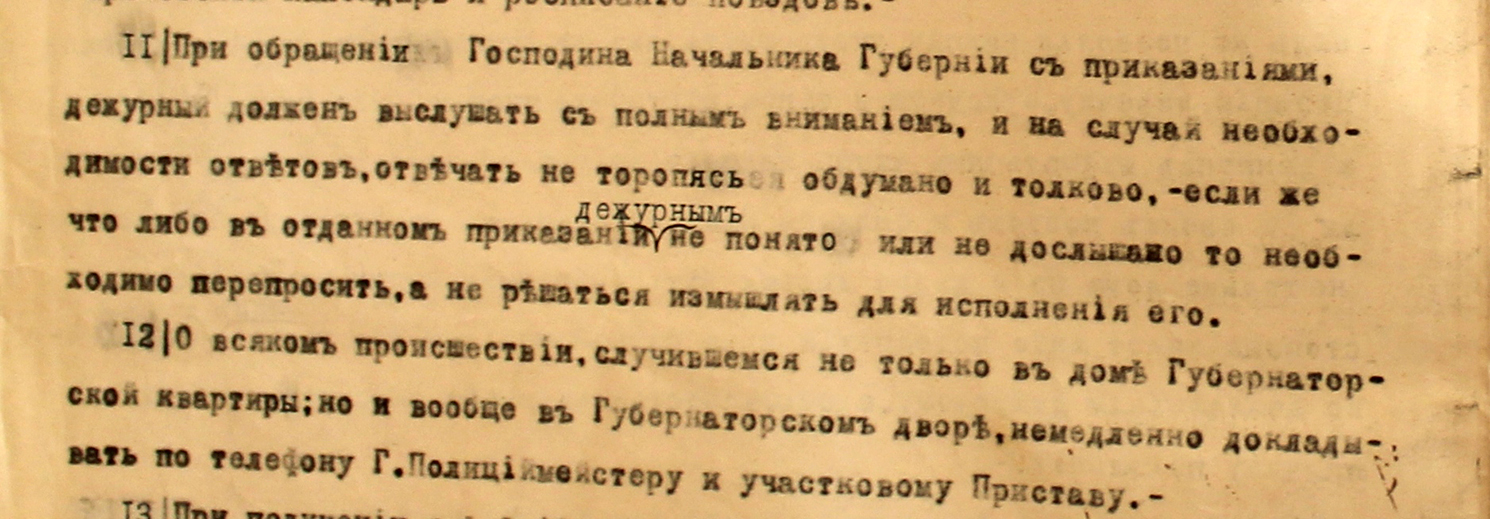
The State Archives of the Kharkiv Region contain a wealth of interesting information about the governor’s security. For example, a 1903 document titled “Instructions for District Supervisors Assigned to Duty at the Residence of the Governor of Kharkiv Province” consists of 19 points.

The officer on duty was required to report to the post without delay, dressed in full dress uniform, by 8:00 a.m. Then, before the outgoing officer was relieved, an inspection of all premises was conducted to ensure there were no unauthorized persons present. It was strictly forbidden to use the police officers on duty as messengers (for example, to the office or the bakery). Those on duty were required to know the days and hours of reception for both the governor and his wife. And the details of all visitors coming to see the governor (position, last name, first name, patronymic, place of residence), as well as the time of the visit, were recorded in a separate book. Paragraph 11 stated: “When the Governor issues orders, the officer on duty must listen to them with full attention, and if a response is required, answer without haste, thoughtfully and intelligently. If, however, anything in the order given is unclear or not heard by the officer on duty, it is necessary to ask for clarification, rather than rushing to invent a way to carry it out.” And No. 12 clearly stated that “Any incident occurring not only in the Governor’s residence: but also generally within the Governor’s compound, must be immediately reported by telephone to the Police Chief and the local Constable.”
And, of course, at night the officer on duty was required to check the sentry posts around the house as often as possible to ensure that the men were at their posts and not sleeping, and that the outer entrances to the house were locked. Be that as it may, after the assassination attempt on Ivan Mikhailovich Obolensky, there were no further attempts to kill governors in pre-revolutionary Kharkiv—and thank God for that!

- About the military pilot school and the airfield in Kharkiv… - 04.11.2020
- Nikanor Savich—A Political Career by Mistake - 13.07.2020
- And once again, about the Cavalry Guards… - 21.01.2020