To this day, the life and work of our fellow Kharkiv native, Prince Alexander Dmitrievich Golitsyn (1874–1957), have received very little attention from historians, which is a shame, since it’s a very interesting topic.
One of the wealthiest landowners in the Kharkiv Governorate, a public figure, and a deputy to the State Duma in 1918, he actively supported Hetman Skoropadsky. However, for a number of reasons, the role of our Kharkiv prince in the creation of the Ukrainian state is glossed over and shamelessly ignored.
In 2011, the Kyiv-based publishing house “Tempora” published a very interesting book titled “Chikalenko, E. Diary (1907–1919).”
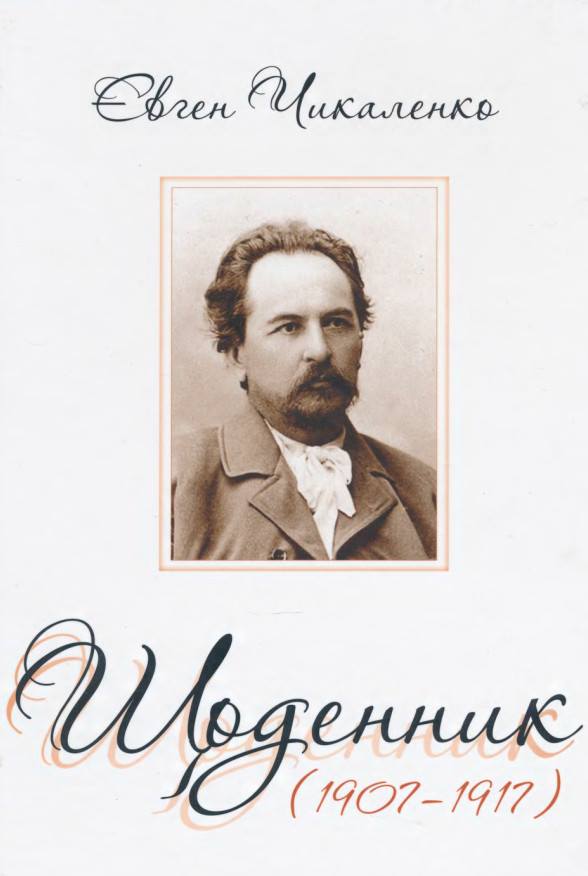
To my great regret, Alexander Dmitrievich is mentioned there only once. However, at the end of this book, I discovered a section titled “Notes.” This section was compiled by historian Tatyana Sergeevna Ostashko in the style of a short biographical dictionary. Tatyana Sergeevna herself, positioning herself as an expert on the events of the Ukrainian Revolution of 1917–1921, found a place in the aforementioned book for our Prince Alexander Dmitrievich Golitsyn.
The biography she wrote about the prince from Kharkiv shocked me with its glaring ignorance of the subject matter and distortion of the facts. In doing so, she seemed to be creating a false image of the prince himself and of Kharkiv, of whose history he is a part. Furthermore, to avoid unnecessary questions, I will simply quote Ms. Ostashko’s most glaring errors, with my own comments in parentheses for clarity:
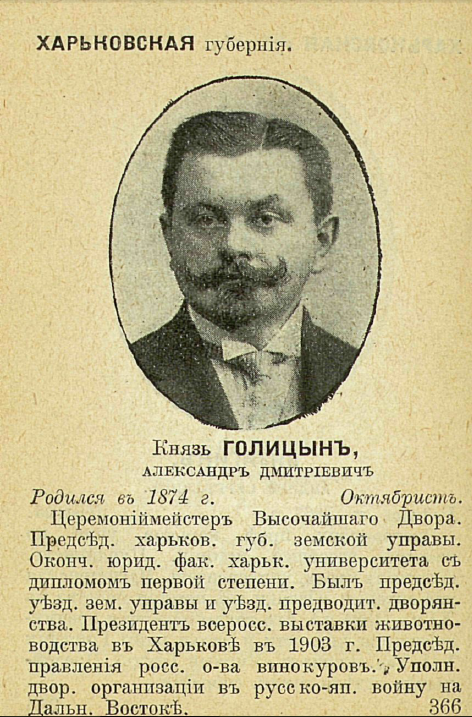
1) Alexander Dmitrievich Golitsyn, Prince—a Russian statesman, politician, and local government official of Ukrainian descent, and a major landowner from the Kharkiv region. Son of the renowned Russian military commander and Governor-General of Moscow, D. V. Golitsyn
Apparently, Tatyana Sergeevna is unaware of this, but A. D. Golitsyn’s father was Prince Dmitry Fedorovich. He served as an Actual State Councilor, district leader of the nobility, and honorary trustee of the Kharkiv Real School. And from April 9, 1889, he also served as chamberlain. Prince Dmitry Fedorovich Golitsyn was never the Governor-General of Moscow. Moreover, no one from the Dolzhikov (or Kharkiv) branch of the Golitsyn princes ever held any leadership positions in the Moscow Governorate!
From the Golitsyn princely family, the following individuals held leadership positions in the Moscow Governorate:
- Sergei Alekseevich Golitsyn. Governor, March 29, 1753 – June 12, 1758;
- Dmitry Vladimirovich Golitsyn. Military Governor-General, Jan. 6, 1820—Mar. 27, 1843;
- Vladimir Mikhailovich Golitsyn. Governor, May 14, 1887 – December 20, 1891;
- Vladimir Mikhailovich Golitsyn. Vice Governor, April 21, 1883 – May 14, 1887.
As we can see, the only person whose initials match is Prince Dmitry Vladimirovich, who passed away peacefully 30 years before the birth of our Prince from Kharkiv. But the oddities don’t end there).
2) …and the brother of M. D. Golitsyn, the last head of the government of Tsarist Russia.
My dear friends, just because people have the same middle names, does that necessarily mean they have the same father? Prince Nikolai Dmitrievich Golitsyn was undoubtedly related to the Dolzhikovsky Golitsyns, but he was not Alexander Dmitrievich’s brother. The aforementioned Prince Dmitry Fedorovich Golitsyn was the father of five children:
- Alexander (1874–1957). Married to Ekaterina Nikolaevna Khvoshchinskaya (1876–1931) since 1896;
- Fedor (1875–1888);
- Sergei (1877–1939);
First wife since 1911, Zoya Nikolaevna O’Rourke (1889–1986);
Second wife since 1926, Nadezhda Antonovna Trunina (1878–1937) - Vera (1887–1889);
- Elizaveta (1892–1982).
Married to Dmitri Alexandrovich Zinoviev (1887–1963) since 1917.
Moreover, Prince Alexander Dmitrievich was a thoroughly self-sufficient and independent figure. Any attempt to imply the existence of some kind of alleged family lobby seems utterly absurd.)
3) Member of the First State Duma
Good heavens! What do you mean, the First Duma? Alexander Dmitrievich served as an elector from Kharkiv to the First and Second State Dumas. But in 1907, he was elected a member of the Third State Duma by the congress of landowners of the Kharkiv Governorate. He was a deputy of the Third Duma, not the First. And this is extremely important, since the Third Duma existed from November 1, 1907, to June 9, 1912, and gave our fellow countrymen the opportunity to accomplish a great deal. The First Duma, on the other hand, existed for an extremely short time: from April 27 (May 10) to July 9 (22), 1906.
I have nothing more to add. I humbly believe that anyone who bears the title of “historian” has no right to make such gross errors.
A people who do not know their past have no future. However, what kind of future do we have with researchers like these?
And finally, remember that a clean Kharkiv isn’t just about the streets—it’s also about the mind.

- About the military pilot school and the airfield in Kharkiv… - 04.11.2020
- Nikanor Savich—A Political Career by Mistake - 13.07.2020
- And once again, about the Cavalry Guards… - 21.01.2020