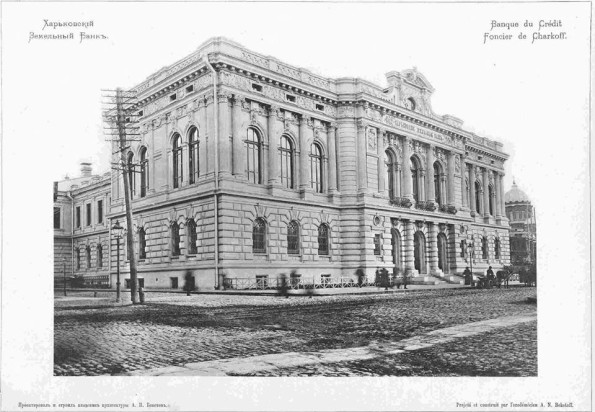
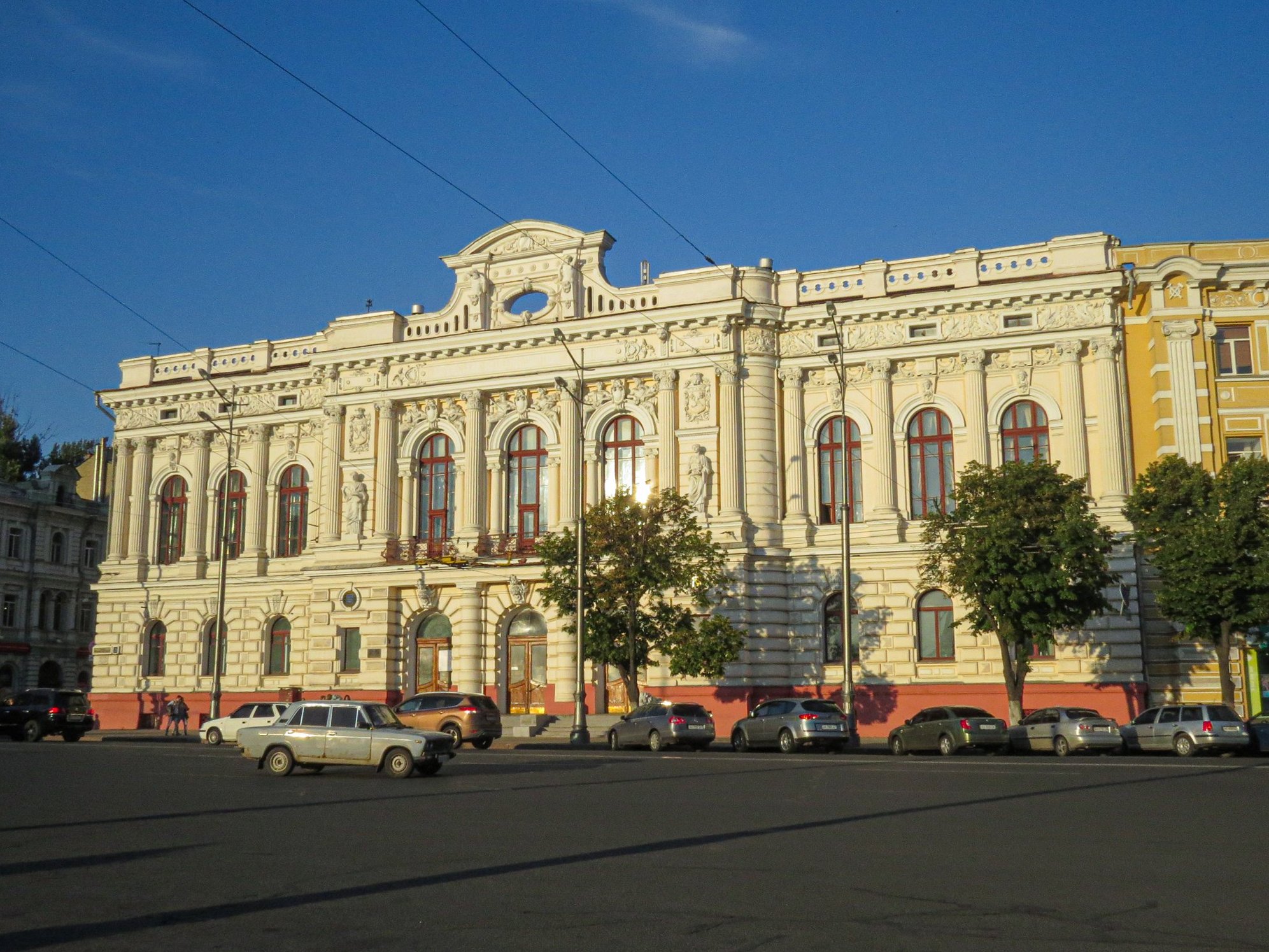
I imagine that few of us have not seen the magnificent building of the Automotive Technical College at Constitution Square, 28 at least once in our lives. Originally, it was the building of the Kharkiv Land Bank.
Incidentally, the Land Bank was considered Russia’s first joint-stock company and operated in eighteen provinces.
The board of this institution, headed by O.K. Alchevsky, commissioned architect Oleksiy Beketov to design the building. They also expressed their desire for the structure to meet all the latest architectural standards for such buildings.
In order to visit the finest European banks in person, Beketov traveled to Germany, Austria-Hungary, France, and Italy. This ultimately led to the construction of the bank building between 1896 and 1898 in the Neo-Renaissance style. Incidentally, it cost the bankers a mere 510,000 rubles.
But what was the bank like before 1917? The 1898 issue of *Zodchiy* magazine will help us answer that question…
One of the oldest private joint-stock banks in Kharkiv is the Land Bank. Founded more than 25 years ago, it previously occupied rented premises that were ill-suited both for the operations of such an institution and in terms of fire safety; consequently, as the Land Bank’s sphere of activity expanded, there arose an urgent need for its own spacious, comfortable, and fire-safe premises. The board of the aforementioned bank, based on a resolution of the general meeting of shareholders, commissioned architect Oleksiy Beketov to draw up a detailed design for the bank building, expressing the desire that it meet all the latest architectural requirements for such structures. To ensure greater success in this endeavor, offered the future architect a trip abroad, together with one of the employees, for the purpose of inspecting the finest European banks on site.
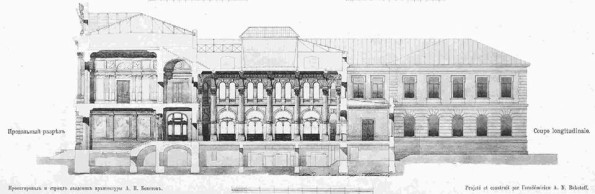
This survey of foreign banks resulted in the building shown in the accompanying illustrations.
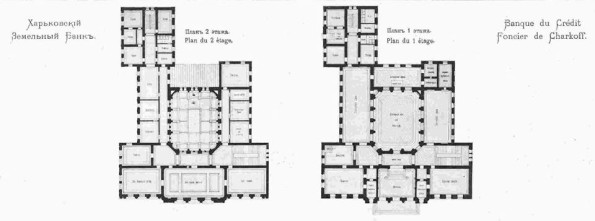
As can be seen from the floor plan, the main area is reserved for the public in the central hall, which is accessed directly from the first-floor lobby. This central, double-height hall (approximately 298 m²), paved with marble tiles and clad in artificial marble, resembles a covered atrium, separated from other rooms by wide arches featuring wrought-iron display cases and counters for all banking operations directly involving the public, such as: the main cashier’s office, the bond department, loan disbursement, loan repayments, the accounting department, and the secretarial and information departments; accordingly, adjoining the central hall are long rooms for: a) the accounting department (approx. 255 m²), b) the secretarial department (approximately 182 m²), c) the bond department and main cashier’s office (approximately 127 m²), with adjacent fireproof, steel-armored storage rooms for cash and bonds. In addition to the aforementioned rooms, the first floor also contains the following rooms, with windows facing the main facade: the management office (approximately 109 m²) and the appraisal committee room (approximately 109 m²), each with a reception area for clients, and further, with windows facing the rear facade and the alley, the staff quarters, such as: a room for on-duty guards, a tea room, and restrooms. Thus, all necessary facilities for the public visiting the bank are concentrated on the first floor.
A large marble staircase (with a flight width about 2.8 meters) leads to the second floor of the building, featuring handrails and balusters made of pink artificial marble and bronze grilles.
On the second floor of the main façade, there are three halls: the central one (approximately 214 m²) is intended for general shareholders’ meetings, while the two side halls (111.5 m² each) are used for the issuance of mortgage certificates and public auctions, respectively. Next are rooms with windows facing the side facades, which house separate offices for the auction secretary, legal advisors, bank agents, a library (approximately 205 m²), and administrative offices.
The entire bank building is heated by a low-pressure central steam heating system installed by the firm “Kerting Brothers.” The boiler room is located beneath the main hall, and the floor level of this room is 2 arshins (approximately 1.42 meters) lower than that of the other basement rooms, which house the bank’s archives and storage areas. The entire basement floor is covered partly by solid vaults and partly by vaults supported by iron beams. The two upper floors also feature fireproof ceilings, partly made of corrugated iron with a concrete coating, and partly constructed using the Monier system.
The bank building is ventilated using a forced-air system powered by electric fans.
The building is equipped with water-flush toilets using the “Unitas” system.
The total cost of the building, as per the final estimate—including plumbing, paving of the courtyard, and sidewalks—is estimated at 510,000 rubles.
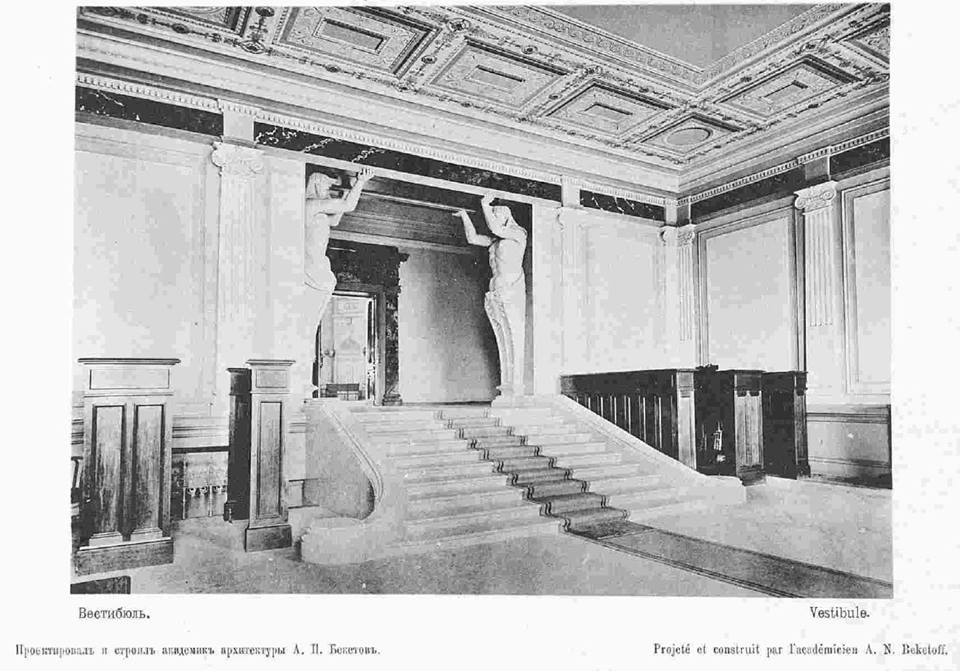
The heating system was installed by the firm “Kerting Brothers.” The toilets were water-flush models using the “Unitas” system. The building also featured fire-resistant ceilings, some of which were made of corrugated iron with a concrete coating.
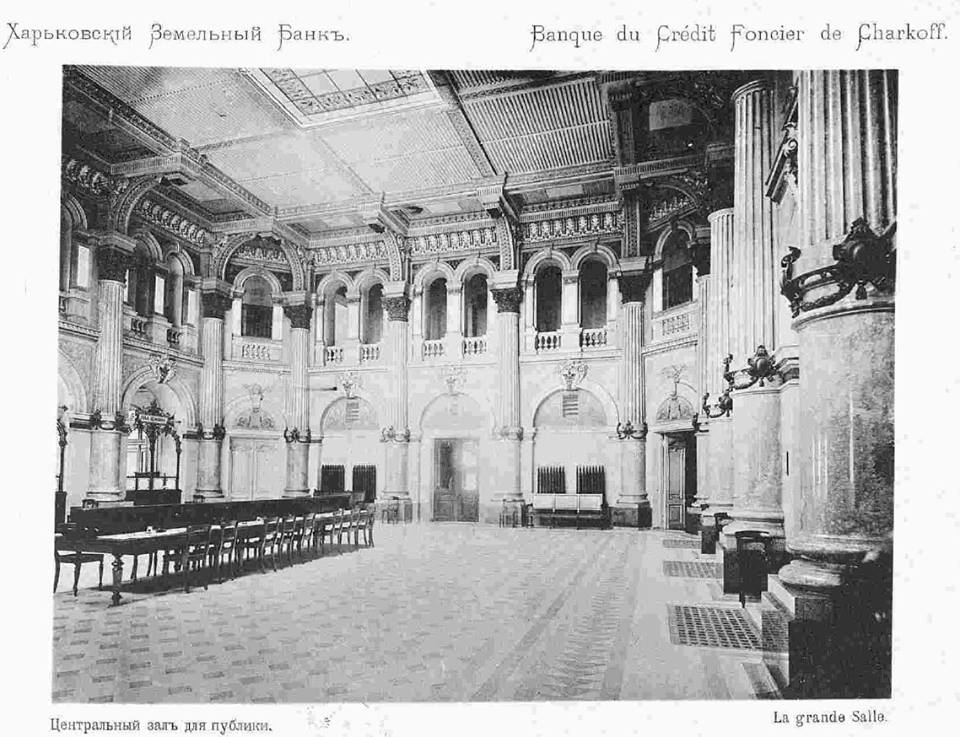
The building sustained heavy damage during the war. Its reconstruction and restoration were carried out under the direction of architects G.V. Sikhuralidze and O.Y. Leibfreid between 1948 and 1953.
The building was damaged during Russian missile strikes on Kharkiv in March 2022 (some of the windows were shattered).

- About the military pilot school and the airfield in Kharkiv… - 04.11.2020
- Nikanor Savich—A Political Career by Mistake - 13.07.2020
- And once again, about the Cavalry Guards… - 21.01.2020