There is absolutely nothing in our city that commemorates this man. There is no street or alley named after him, no commemorative plaque, no scholarship bearing his name, and he isn’t even included in the lists of Kharkiv’s great residents. And yet we’re so proud of our city’s past; we love to talk about its outstanding figures and its potential as a tourist destination. However, if you ask passersby about Andriy Yuryan, you’ll hear them reply, “Who’s that?”
Well then, let’s meet our hero.
He was born into a simple peasant family on September 30, 1856, at the Mengeli estate near Ergli.
He received his early musical education at local parish schools. He then enrolled in the Riga School. After participating in the First All-Latvian Song Festival in 1873, the young Andrejs made the final decision to devote his life to music and, in 1875, enrolled in the St. Petersburg Conservatory. While still a student, he began collecting Latvian folk songs and conducted the choir of the St. Petersburg Latvian Charitable Society. And in 1877, he published his first romances. His “March of the All-Latvian Song Festival” for symphony orchestra, composed in 1880, was a success. A student of Rimsky-Korsakov, he graduated from the conservatory with degrees in three specialties:
1) in 1880—for organ performance;
2) in 1881—for composition;
3) in 1882—for French horn performance. Incidentally, he received a large silver medal.
However, back in his homeland, the talented musician, alas, was unable to find work. In 1882, he arrived in our beloved city and began working at the Kharkiv Music School.
At various times, he taught music theory, choral singing, and the French horn, eventually becoming Isaac Dunaevsky’s teacher.
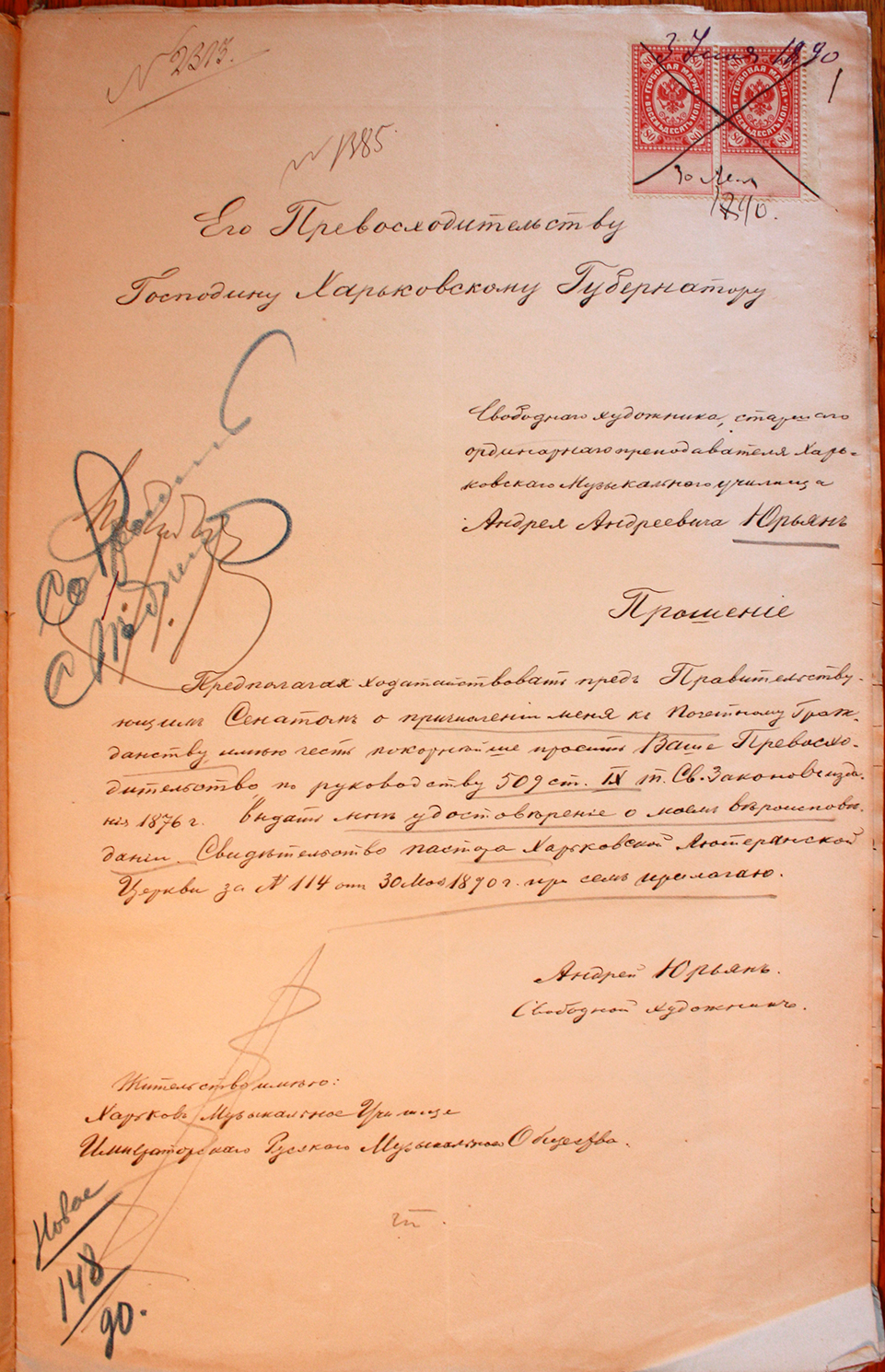
And Jurjāns influence on Yazep Vitols (Joseph Ivanovich Vitol), who later became the founder of Latvian piano music, was so great that in 1891 Vitol dedicated his “Variations on a Latvian Folk Theme” to him. To this day, they remain one of Vitols’ most significant works. In addition to his teaching activities, it was in our city that Yuryan truly realized his potential as a composer: he composed musical works and actively performed in concerts.
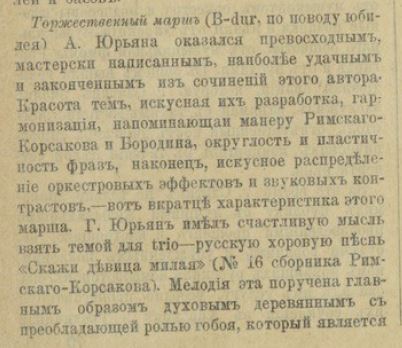
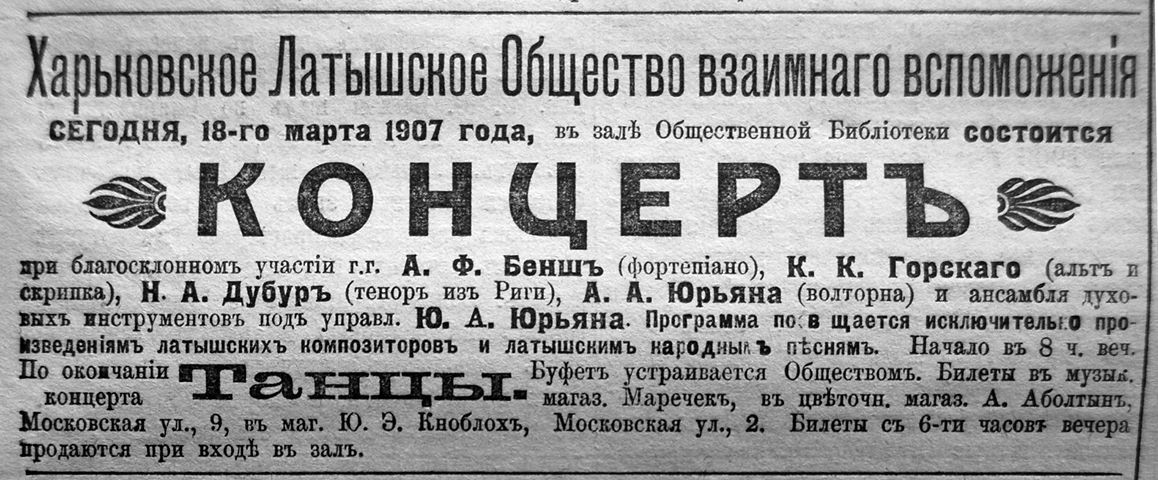
Both local and national newspapers wrote about his performances (in which he appeared as an organist and French horn player), as well as about the Jurjāns brothers’ French horn quartet. He also served on the leadership of Latvian national organizations.

Andrejs Jurjāns devotes all his time outside of teaching and performing to the main focus of his life—namely, Latvian folk music. He collects and researches national song folklore. And in 1884–1885, he published his first collections of arrangements of Latvian folk songs.
He became the conductor of the third (in 1888), fourth (in 1895), and fifth (in 1910) All-Latvian Song Festivals. Starting in 1889, Jurjāns served as the permanent editor of the musical publications of the Riga Latvian Society. It was he who organized extensive musical and ethnographic activities in Latvia.
And beginning in 1894, the musician began publishing the scholarly series *Materials on Latvian Folk Music*. A brilliant musician and patriot of his people, he created:
From 1883 to 1894—the orchestral suite “Latvian Dances.”
In 1886—the cantata “Fatherland.”
In 1891—the symphonic poem “The Liberation of the Latvian People.”
In 1893—the cantata “Rejoice and Be Glad.”
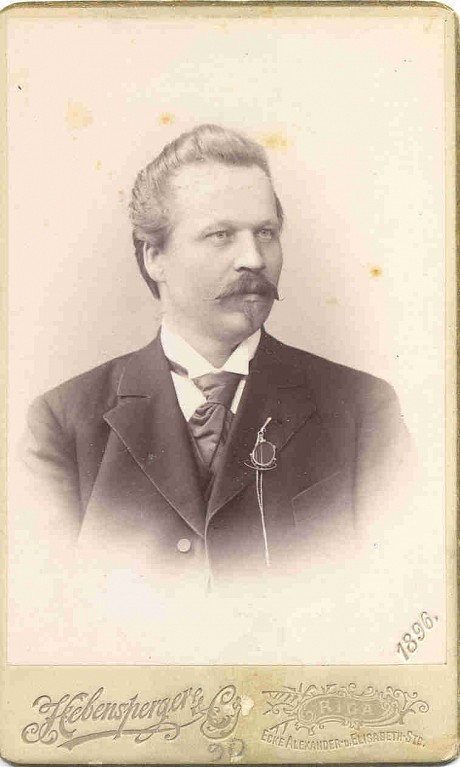
This was followed by a series of choral works and romances set to texts by Latvian poets. As a delegate from Kharkiv, Andrei Yuryan took an active part in the 10th Archaeological Congress in Riga in 1896.
The work of Andrejs Jurjāns, a Latvian from Kharkiv, was highly regarded even during his lifetime. In the 1899 book *Memoirs of Prince S. V. Shakhovsky and Essays on the Baltic States*, we read:
“…Andrejs Jurjāns, a singing teacher in Kharkiv, is currently considered the best Latvian composer.”

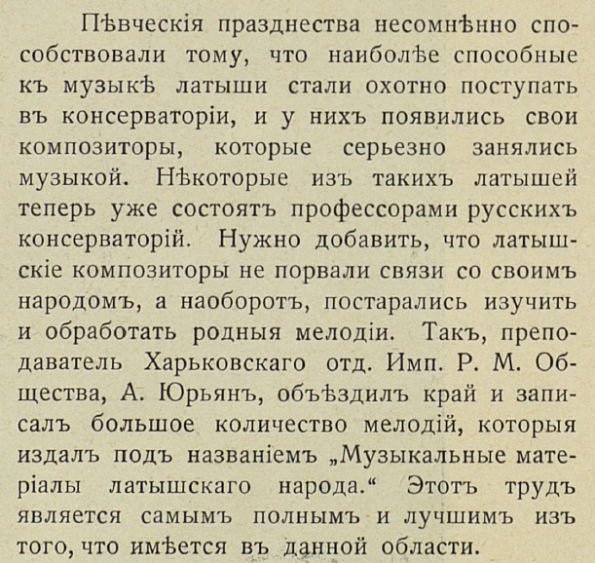
And Yuri Novoselov, in his 1911 work *Essays on the Ethnography and Contemporary Culture of the Latvians*, wrote the following:
These singing festivals undoubtedly encouraged the Latvians most gifted in music to enroll in conservatories, and they began to produce their own composers who took music seriously. Some of these Latvians are now professors at Russian conservatories. It should be added that Latvian composers did not sever ties with their people; on the contrary, they sought to study and adapt their native melodies. For example, Andrejs Jurjāns, a lecturer at the Kharkiv branch of the Imperial Russian Musical Society, traveled throughout the region and recorded a large number of melodies, which he published under the title “Musical Materials of the Latvian People.” This work is the most comprehensive and best of its kind available in this field.
In 1916, due to the complete loss of his hearing, Jurjāns left his position at the Kharkiv Music School. And on July 25, 1918, his beloved son Olgerd died. Devastated by grief, the composer decided to return to his homeland and left Kharkiv in 1919.
In December 1920, Yuryan moved to Riga, where in 1921 he published a collection of Latvian folk songs he had harmonized, as well as the fifth issue of *Materials on Latvian Folk Music*.
The sixth volume was published posthumously—the great composer died in Riga on September 28, 1922.
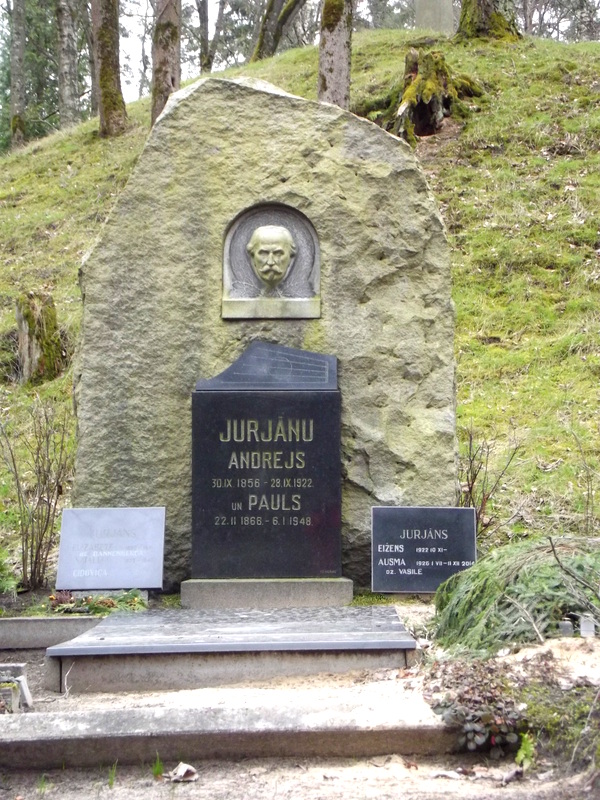
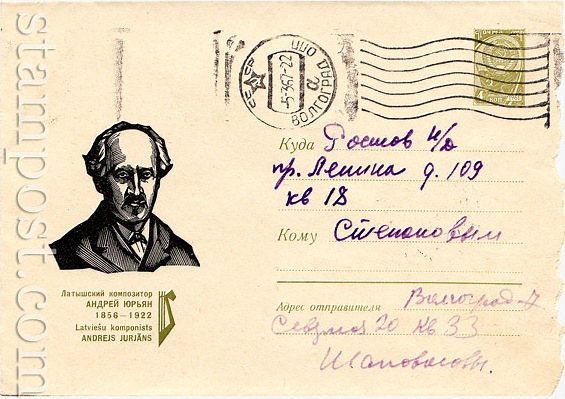
The name of the founder of Latvian musical folklore studies and the composer of the first national vocal-instrumental and symphonic works is still honored in Latvia to this day. Various concerts and festivals are held in his honor. After all, it was his choral arrangements of folk songs that became the foundation of Latvian classical music. Even during the Soviet era, a number of books, commemorative envelopes, and other items were dedicated to studying his life.
But in the city where one of Latvia’s greatest composers lived for about 36 years—and which has every right to consider him one of its own—there is absolutely nothing. As I pieced together documents related to the life of Andrei Yuryan bit by bit at the Kharkiv Regional Archives, I sometimes asked myself: “Does today’s Kharkiv even need him?” The answer to that question remains to be seen. But I dream that one day this illustrious name will finally return to the city that was his home for more than three decades, and that, together with tourists from Latvia, we’ll stroll through Kharkiv’s historic sites or listen to the wonderful works of the Latvian composer at the Kharkiv Philharmonic.

- About the military pilot school and the airfield in Kharkiv… - 04.11.2020
- Kharkiv Artisans and the 1887 Exhibition - 17.08.2020
- Nikanor Savich—A Political Career by Mistake - 13.07.2020