In the mid-19th and early 20th centuries, a considerable number of magazines and newspapers were published both in Sloboda Ukraine and in other regions. It goes without saying that journalists from various publications, then as now, went on work trips and shared their impressions of them with readers.
Thanks to this, today we can see our beloved city through the eyes of a visiting journalist—Alexander Grigoryevich Bezgin.
While working for the daily newspaper *Krymsky Vestnik*, the author wrote about what he saw in a rather caustic tone. Bezgin’s observations on the cities along his route proved so insightful and witty that, after being published in issues 111, 113, 123, and 130 of the “Krymsky Vestnik” in 1909, they were released as a separate booklet.
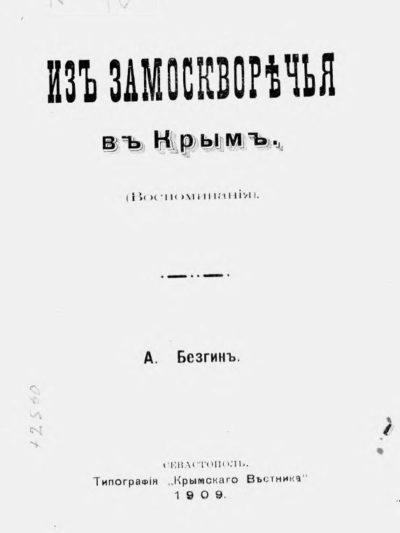
Before we get to how this Sevastopol journalist saw our beloved city, what caught his eye, and what stuck with him, let’s start… with the city of Kursk. It is his description of Kursk that will answer our questions about “civilization in Kharkiv” and about who the “big fat Mongol” really is.
Kursk—even though it has an electric tram—looks like a city that has not yet fully recovered from the devastation of the Tatar invasion in the thirteenth century: the dust, the mud, the lack of fences and barriers where they are needed, and their presence where they are not, rob the city of its cheerful appearance…
…The station buffet in Kursk is far better than the one in Orel; it has been run since time immemorial by the descendants of Tamerlane, who hail from Kasimov. After the overthrow of the Tatar yoke, they were left with numerous buffets; and to tell the truth, theirs are both better and cleaner…
The author then goes on to describe Kharkiv.
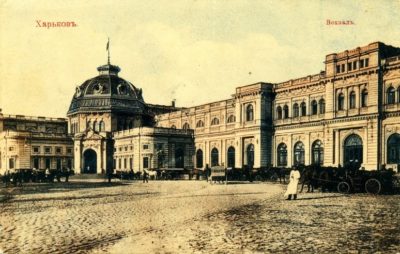
In Kharkiv, “civilization” is more evident: here, the top bigwig can speak both French and German, sprinkled with English phrases.
“Where on earth did you learn that?”
”I picked it up from passing foreigners.”
There are many recollections of the legendary Kharkiv “vankos” (cabs), but the writings of a witty contributor to the *Krymsky Vestnik* have significantly expanded our knowledge of them.
Forty-five years ago, when Russia was just emerging from a nomadic way of life, amid vast steppe herds numbering in the millions—comprising “shlenoks,” “shpanoks,” and ordinary sheep—and when Kharkiv was not yet surrounded by a ring of smokestacks, it seemed far more interesting, simpler, and cleaner than it is today.
Back then, there were no two-horse carriages, neither for cabs nor for trams; there were only “vankos.” “Vanko”—a diminutive of Ivan—has its own verb. When asked, “What does your husband do?” a cook looking for work would reply, “He’s vanking.” I recommend that anyone visiting Kharkiv for the first time never call a one-horse cart a “cab”—it’s an insult for which a vanko might take you to court—“there are no cab drivers here, only vankos.” Recently, the horse-drawn cab drivers (with two horses) have given their horses to the vankas (single-horse drivers), and the vankas have generously given them their own nag. So now the “vankas” drive faster, charge half the fare, and are even smoother than the horse-drawn cabs, given that the wheelbase matches the tram tracks, along which they typically travel crisscrossing Kharkiv’s main thoroughfares—Ekaterinoslavska, Sumskaya, Moskovskaya, and Staromoskovskaya Streets, crossing the imaginary rivers: Lopan, Kharkiv, Netech, and Nemyshlyu, which lose their names and their last drops of water in the sands of the expropriated outskirts of Kharkiv—Moskalevka
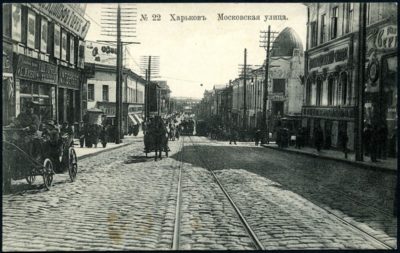
Many people say that “Kharkiv is a student city.” Bezgin also notes this, citing a number of interesting facts.
The crowds of students milling about on Sumskaya Street certainly have an impact on the life of modern Kharkiv; when the weather is bad—whether it’s stormy or simply gloomy—they gather on the theater’s steps and in the university garden.
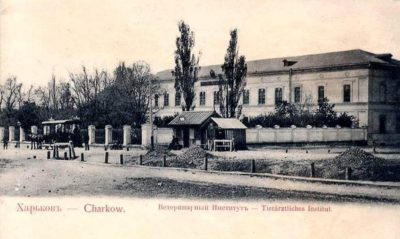
Exactly ten years ago, in the spring of 1899, there was a student “blockade” of the university and all its institutes in Kharkiv; and since four-legged creatures are considered friends of two-legged ones, the striking students of the veterinary institute felt it was their duty to invite the animals—they simply drove the sick or vivisected animals out of the institute’s infirmary. And many had to witness a procession never seen before or since, as sick cats, dogs, horses, cows, chickens, pigs, and turkeys—driven down Sumskaya Street with the wails characteristic of each animal—were herded along by veterinary students wielding whips
More than 100 years have passed, yet journalists from various publications still come to this city, where “civilization is more clearly evident,” and continue to write travel essays about it…

- About the military pilot school and the airfield in Kharkiv… - 04.11.2020
- Nikanor Savich—A Political Career by Mistake - 13.07.2020
- And once again, about the Cavalry Guards… - 21.01.2020