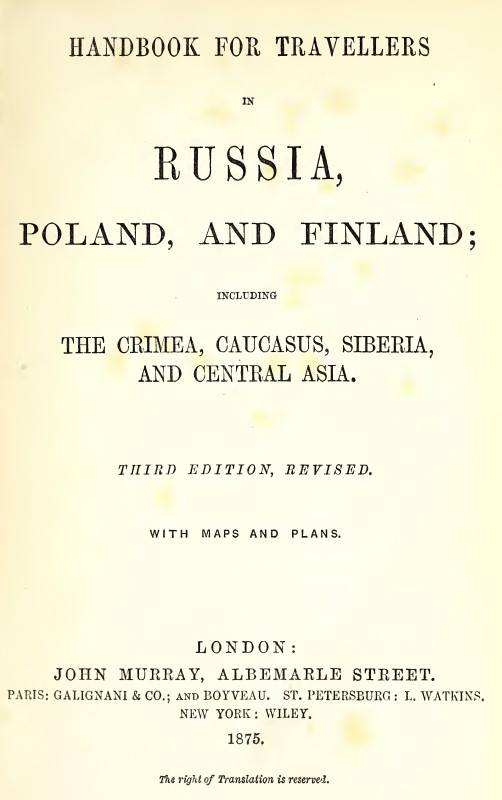
We have already discussed Kharkiv as seen through the eyes of foreigners in a 1917 book by a British commercial representative. Foreigners often notice interesting things that escape the attention of the city’s residents, so their perspective on the city is often quite valuable. In 1875, John Murray in London published a travel guide titled “Russia, Poland, and Finland,” which mentions our city. It particularly emphasizes the fact that the development of railroads greatly spurred the growth of tourism. As is well known, the railroad had arrived in Kharkiv six years earlier, making it easier for tourists to reach the city. So what did the 1875 British guidebook have to say?
Kharkiv, elevation 153 m, population 91,000
Hotels:
- Grand Hotel de l’Europe, of which the landlord is a Frenchman. Very good apartments, table, and attendance. An omnibus will be found at the stat.
- There are also some very good rooms at the rly. stat. Bellevue, good table and attendance;
- Dagmar, handsome, not dear.
History. The town of Kharkof, now the seat of government of a province of the same name, was founded about 1650 by a band of Cossacks, of whom the chief, Khariton, is popularly supposed to have given it its present appellation, although the anterior existence of a rivulet in the vicinity bearing the same name is by others cited in refutation of that theory.
Trade and prosperity have since established the importance of Kharkof, now one of the principal centres of commerce in Russia. It has an immense trade in wool, and four fairs are annually held there—the “Krestchenskaya,” or Epiphany fair, opened on the 6th (18th) January, being one of the most important in Russia. The wool sales take place exclusively at the Trinity fair, in June. Bazaars or markets are moreover held on Sundays, Wednesdays, and Fridays. They are particularly active immediately before Christmas and Easter.
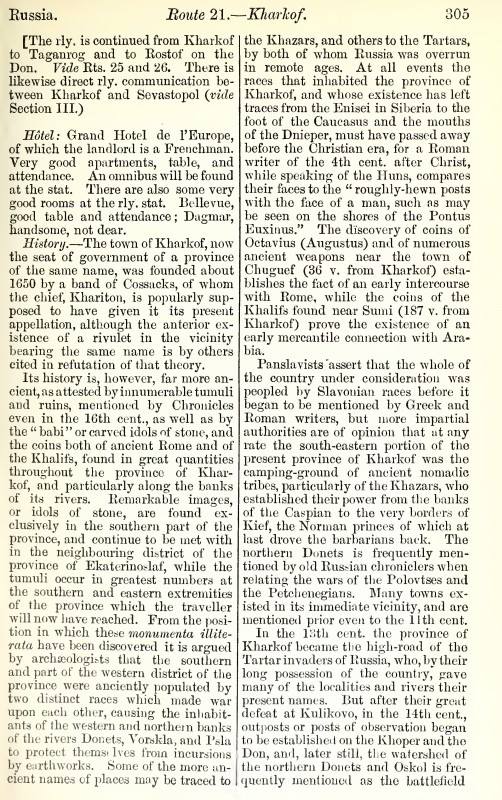
Kharkof is likewise a seat of learning, as it possesses a University, founded in 1805, and frequented by 600 students. It is situated in the centre of the town, the principal building being a former palace of the Empress Catherine II. The scientific collections are kept in that building, but the library, containing 55,000 vols., is on the other side of the street. The Zoological Cabinet contains a valuable collection of the birds of S. Russia and of the fishes of the Black Sea.
In the north part of the town is a Veterinary College, conducted on a very liberal scale and well worthy of a visit, as is also the Government Model Farm, about a mile out of Kharkof, established 1847. The environs of the town are very picturesque, and the view from the “Cold Mountains,” or still better from the lower part of Ekaterinoslaf-street, is one of the most striking that can possibly be imagined. There is also a large public garden, the Chinese pagoda in which was erected at an expense of 30,000 rubles.
Banks: Branch of State Bank, Municipal, Commercial, Volga-Kama Banks, Mutual Credit Land Bank, and several private bankers.
Thus, even foreigners went out of their way to emphasize the fact that our city was a center of trade and education. However, we haven’t yet been able to find any photos of the Chinese pagoda in the public garden that cost 30,000 rubles…

- The Architectural Evolution of the Kharkiv Theater - 26.09.2026
- 1st Kharkiv Gymnasium - 17.09.2026
- The Oldest Movie Theater in Ukraine - 24.08.2026