In an effort to stabilize the political situation amid widespread unrest and revolutionary protests, on October 17, 1905, Russian Emperor Nicholas II issued the Imperial Manifesto on the Improvement of the State Order (the so-called October Manifesto), drafted primarily by Minister of the Interior A. G. Bulygin. The historical significance of this manifesto lay in the fact that, in conjunction with the manifesto of August 6, 1905, “On the Establishment of the State Duma,” it made it possible to publish the election law on December 11, 1905. A total of 135 electoral districts were established, in which elections were held, for the most part, in February and March 1906.
In 1906, the “Vozrozhdenie” publishing house in Moscow published the book *The State Duma of the First Convocation: Portraits, Brief Biographies, and Profiles of Deputies*, priced at 1 ruble and 25 kopecks. Thanks to this unique book, we can now learn and see exactly who represented our beloved Kharkiv in the Russian Duma. So please pay attention—meet the first deputies from Kharkiv!
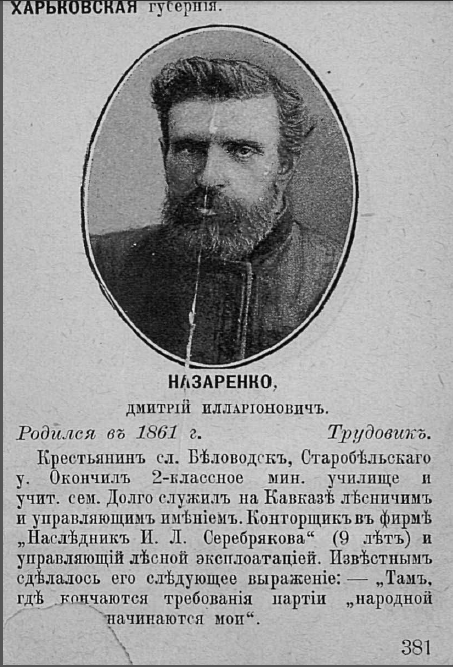
Dmitry Illarionovich Nazarenko.
Born in 1861. A member of the Trudovik movement.
A peasant from the village of Belovodsk, Starobil’s’k District. He graduated from a two-year mining school and attended a private school. He served for many years in the Caucasus as a forester and estate manager. He worked as a clerk at the firm “Heir of I.L. Serebryakov” (for 9 years) and as a forestry manager. He became known for the following statement: “Where the demands of the ‘People’s Freedom’ party end, mine begin.”
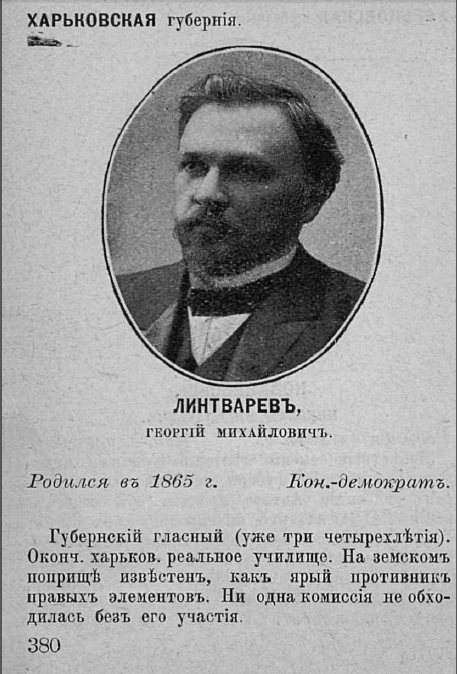
Georgy Mikhailovich Lintvarev.
Born in 1865. A Constitutional Democrat.
Provincial councilor (for three four-year terms). A graduate of the Kharkiv Real School. In local government circles, he is known as a staunch opponent of right-wing elements. No commission was formed without his participation.
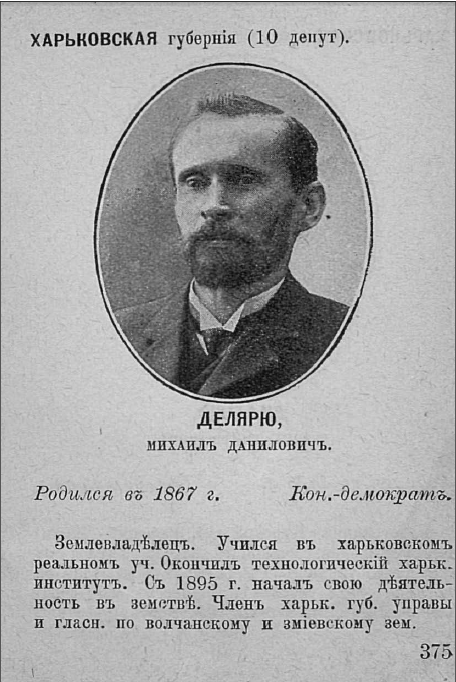
Mikhail Danilovich Delyar.
Born in 1867. Constitutional Democrat.
Landowner. He studied at the Kharkiv Real School. He graduated from the Kharkiv Technological Institute. In 1895, he began his work in the zemstvo. He was a member of the Kharkiv Provincial Administration and a representative for the Vovchansky and Zmiivsky zemstvos.
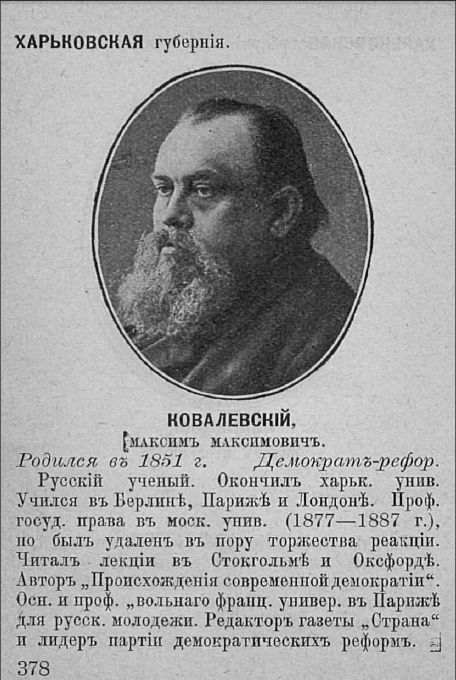
Maksim Maksimovich Kovalevsky.
Born in 1851. Reformist Democrat.
A Russian scholar. He graduated from Kharkiv University. He studied in Berlin, Paris, and London. He was a professor of constitutional law at Moscow University (1877–1887), but was dismissed during the height of the reactionary era. He lectured in Stockholm and Oxford. Author of *The Origins of Modern Democracy*. Founder and professor at the “Free French University in Paris for Russian Youth.” Editor of the newspaper *Strana* and leader of the Party of Democratic Reforms.
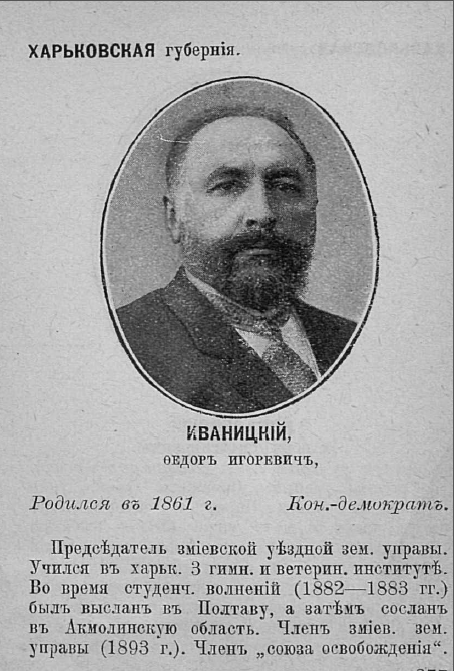
Fedor Igorevich Ivanitsky.
Born in 1861. Constitutional Democrat.
Chairman of the Zmiiv County Zemstvo Council. He studied at Kharkiv Gymnasium No. 3 and the Veterinary Institute. During the student unrest (1882–1883), he was exiled to Poltava and then banished to the Akmolinsk Region. Member of the Zmiiv Zemstvo Council (1893). Member of the “Union of Liberation.”
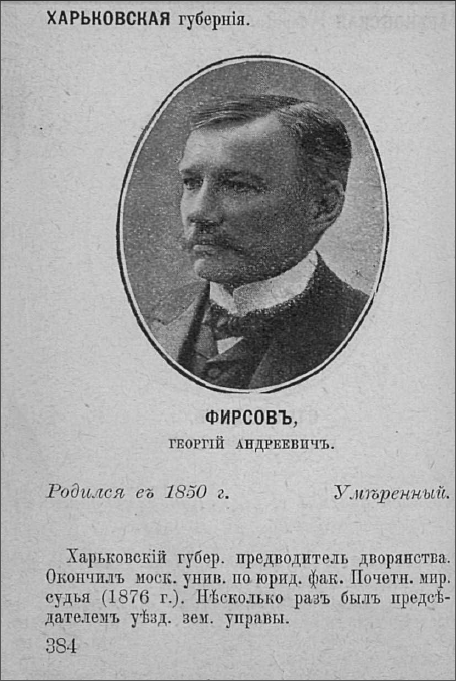
Georgy Andreevich Firsov.
Born in 1850. Moderate.
Head of the Nobility of the Kharkiv Province. He graduated from the Faculty of Law at Moscow University. Honorary Just of the Peace (1876). He served as chairman of the district zemstvo council on several occasions.
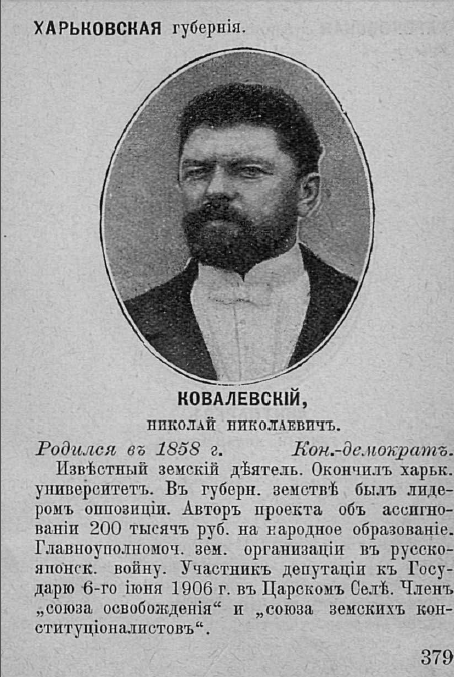
Nikolai Nikolaevich Kovalevsky.
Born in 1858. Constitutional Democrat.
A well-known zemstvo activist. He graduated from Kharkiv University. He was the leader of the opposition in the provincial zemstvo. He authored a proposal to allocate 200,000 rubles for public education. Chief representative of the zemstvo organization during the Russo-Japanese War. Member of the delegation that met with the Tsar on June 6, 1906, in Tsarskoye Selo. Member of the “Union of Liberation” and the “Union of Zemstvo Constitutionalists.”
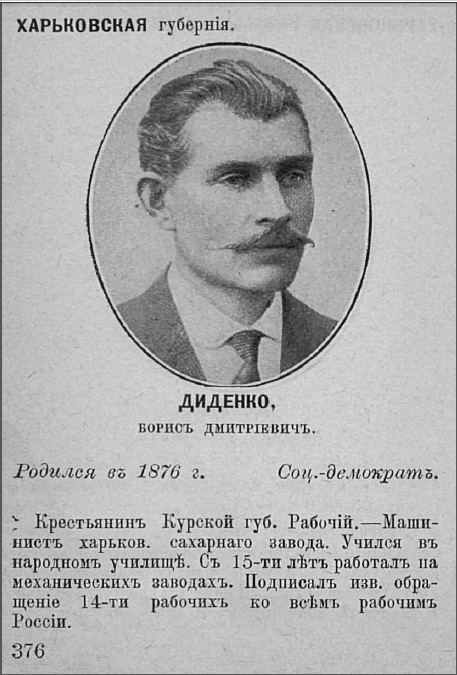
Boris Dmitrievich Didenko.
Born in 1876. A Social Democrat.
A peasant from the Kursk Governorate. A worker. A machine operator at the Kharkiv sugar factory. He attended a public school. He worked in machine shops starting at age 15. He signed the famous appeal by 14 workers to all workers in Russia.

Nikolai Andreevich Gredeskul.
Born in 1864. Constitutional Democrat.
Professor at Kharkiv University. Dean of the Law School. He graduated from high school and the Law School at Kharkiv University. He was imprisoned on the orders of Minister Durnovo and, just before the elections, exiled to the Arkhangelsk Governorate, but was released after the election. Editor of the newspaper *Mir* (which was shut down). Second Deputy Chairman of the State Duma.
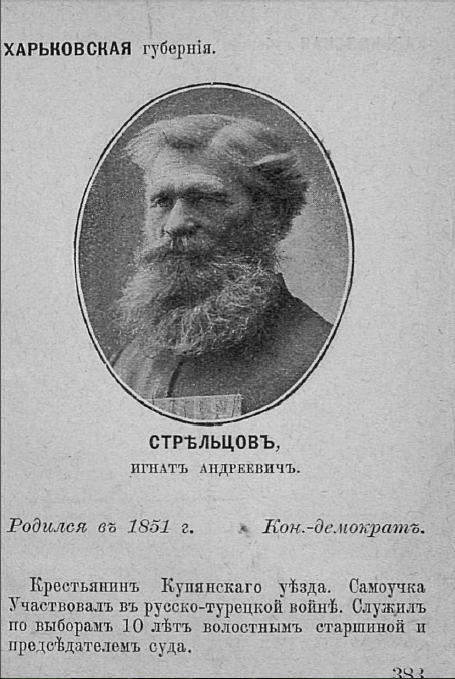
Ignat Andreevich Streltsov.
Born in 1851. A Constitutional Democrat.
A peasant from Kupyansk County. Self-taught. He fought in the Russo-Turkish War. He served for 10 years, by popular election, as a volost elder and court chairman.
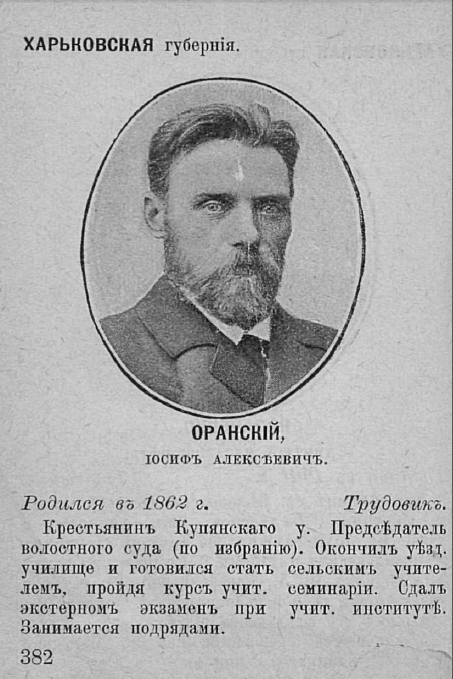
Joseph Alekseyevich Oransky.
Trudovik was born in 1862.
A peasant from the Kup’yans’k District. Chairman of the volost court (elected). He graduated from the district school and was preparing to become a rural teacher after completing a teacher-training course at a seminary. He passed the exam as an external student at the teachers’ college. He is engaged in contracting work.
The First State Duma existed for 72 days and held only one session.
On July 8, 1906, Emperor Nicholas II issued a manifesto dissolving the State Duma.
Elected by the people, instead of carrying out their legislative duties, they have strayed into a realm that does not belong to them and have turned to investigating the actions of local authorities appointed by Us, to pointing out to Us imperfections in the Fundamental Laws—amendments to which can be made only by Our Royal Will—and to actions that are clearly unlawful, such as the Duma’s appeal to the people on its own behalf.
Disturbed by such disorder, the peasantry—without waiting for a lawful improvement in their situation—resorted in a number of provinces to open looting, theft of others’ property, and disobedience to the law and lawful authorities.
But let Our subjects remember that a lasting improvement in the people’s standard of living is possible only when there is complete order and tranquility. Let it be known that We will not tolerate any arbitrariness or lawlessness, and We will use the full force of state power to bring those who disobey the law into submission to Our Imperial will. We call upon all right-thinking Russian people to unite in support of the lawful government and the restoration of peace in Our beloved Fatherland.
The manifesto also announced that new elections would be held under the same rules as those for the First State Duma. So, on July 9, when the deputies arrived for the session, they found the doors to the Tauride Palace locked and the manifesto announcing the dissolution of the Duma nailed to a post nearby.

- About the military pilot school and the airfield in Kharkiv… - 04.11.2020
- Nikanor Savich—A Political Career by Mistake - 13.07.2020
- And once again, about the Cavalry Guards… - 21.01.2020