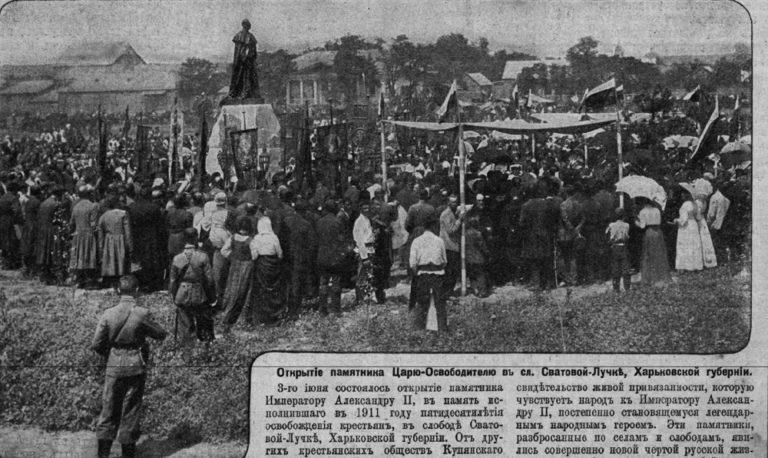
Back in June 1911, in the settlement of Svatova-Luchka (now the city of Svatovo in Luhansk Oblast) in the Kup’yans’k District of the Kharkiv Governorate, a monument to Emperor Alexander II was ceremoniously unveiled amid the sincere jubilation of the people. For a town with a population of 14,877, this was undoubtedly an extremely important and momentous event. Reports on the monument’s unveiling appeared not only in the local provincial press but also in national publications, such as the magazine *Ogonyok*.
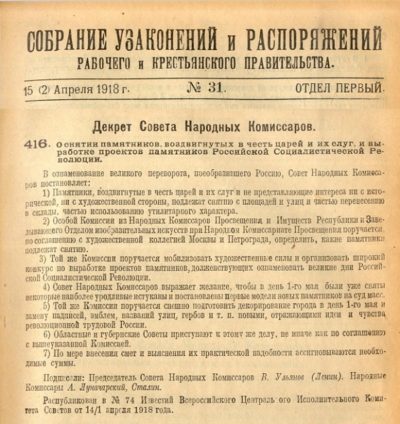
However, things move on, and everything changes. As everyone knows, on November 7, 1917, the Bolsheviks came to power. In early April 1918, the Council of People’s Commissars adopted a decree “On the Removal of Monuments Erected in Honor of the Tsars and Their Servants, and on the Development of Designs for Monuments to the Russian Socialist Revolution.”
It read:
To commemorate the great revolution that transformed Russia, the Council of People’s Commissars resolves:
- Monuments erected in honor of tsars and their servants that are of no historical or artistic interest are to be removed from public squares and streets and either stored in warehouses or put to practical use.
- The Special Commission consisting of the People’s Commissars of Education and Property of the Republic and the Head of the Department of Fine Arts at the People’s Commissariat of Education is tasked with in consultation with the art committees of Moscow and Petrograd, to determine which monuments are to be removed.
- That same Commission is tasked with mobilizing artistic talent and organizing a broad competition to develop designs for monuments intended to commemorate the great days of the Russian Socialist Revolution.
- The Council of People’s Commissars expresses its desire that, by May 1, some of the ugliest statues be removed and the first models of the new monuments be erected for the public to judge.
- The same Commission is tasked with urgently preparing the city’s decorations for May 1 and replacing inscriptions, emblems, street names, coats of arms, and the like with new ones that reflect the ideas and sentiments of revolutionary working-class Russia.
- Regional and provincial councils may undertake this task only in agreement with the aforementioned Commission.
- As budgets are submitted and their practical necessity is determined, the necessary funds are allocated.
Signed: V. Ulyanov (Lenin), Chairman of the Council of People’s Commissars; People’s Commissars A. Lunacharsky and I. Stalin.
The revolutionary mob had destroyed monuments to the old regime before. That very monument to Emperor Alexander II was not completely demolished until 1928. Obviously, no one paid any attention to its historical or artistic value.
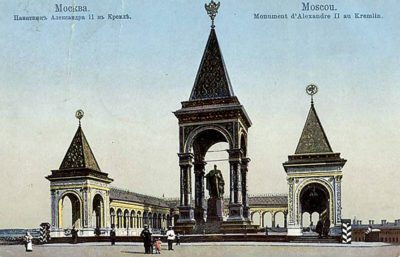
However, I find it extremely hard to imagine that, when they were dismantled, there weren’t any expressions of discontent from the local population along the lines of: “Well, let it stand—it’s part of our history,” “It’s so beautiful and has enormous cultural significance for our city,” “Our monument to Emperor Alexander II is one of the most beautiful in the world—we must preserve it for future generations!”
After all, the truth is that absolutely any new government does everything in its power to erase the memory of the previous government from the nation.
The emperors stepped down from their pedestals, and their places were taken by leaders—Lenin and Stalin. However, in my view, there was one small but extremely important difference in all of this, namely, the cult of personality. Strange as it may seem, the Bolsheviks—who had fought so zealously against religion—were, in fact, very similar to the ancient Romans in their imposition of the veneration of their leaders, Lenin and Stalin, upon the people. Their emperors, too, were proclaimed gods either during their lifetimes or after their deaths, and grandiose monuments and mausoleums were erected en masse in their honor.
On the night of September 28–29, 2014, the Lenin monument in our city was torn down.
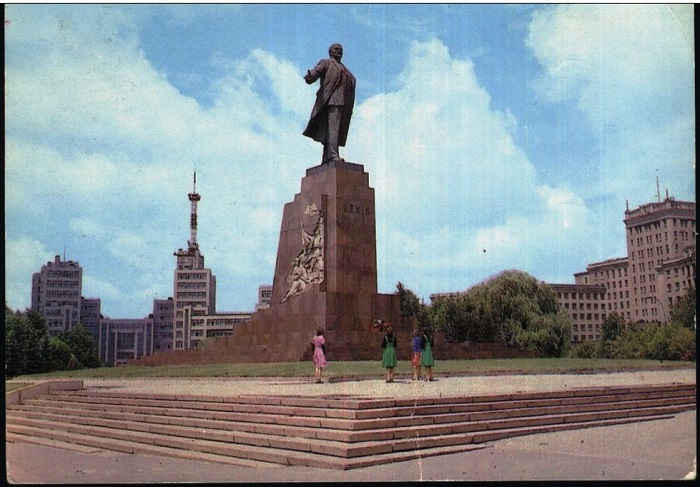
The townspeople’s reactions to this varied.
However, few people remember anymore that, for the leader of the world proletariat himself, our Kharkiv was a completely foreign, unfamiliar place—and even… “abroad”!
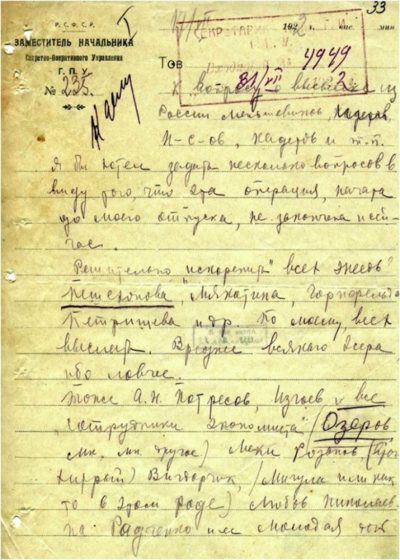
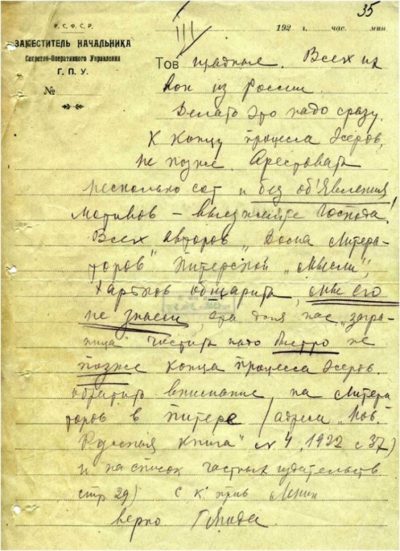
On July 16, 1922, Vladimir Ulyanov wrote a letter to Joseph Stalin. The subject matter of this letter was, for that time and those people, quite ordinary and predictable. It concerned the development and implementation of a decision by the Soviet leadership to expel members of the intelligentsia who were part of the political opposition to the Soviet government. And everything about this letter would have been standard, were it not for one big “but.”
Toward the end of the text, Lenin, addressing Stalin, makes a candid and downright sensational admission about our beloved city. Here is the quote:
We need to search Kharkiv—we don’t know the place; it’s like “abroad” to us. We have to clear it out quickly, no later than the end of the SRs’ operation.
It is also very interesting that in G. G. Yagoda’s handwritten copy of this letter, the phrases “we don’t know him” and “quickly” are underlined several times.
For clarity, I am providing the full text below:
Comrade Stalin!
Regarding the expulsion from Russia of the Mensheviks, the [People’s] Socialists, Kadets, and the like from Russia, I would like to ask a few questions, given that this operation, which began before my leave, has not yet been completed.Should we resolutely “eradicate” all the ESRs? Peshekhonova, Myakotina, Gornfeld? Petrishchev and others. In my opinion, we should expel them all. They’re more harmful than any SR, because they’re more cunning.
The same A. N. Potresov, Izgoev, and all the staff of *The Economist* (Ozerov and m[any], m[any] others). The [Mensheviks]: Rozanov (a doctor, cunning), Vigdorchik (Migulo or something like that), Lyubov Nikolaevna Radchenko and her young daughter (rumored to be the worst enemies of Bolshevism); N. A. Rozhkov (he must be deported; he is incorrigible); S. L. Frank (author of “Methodology”). A commission under the supervision of Mantsev, Messing, and others must submit lists, and several hundred such gentlemen should be ruthlessly deported abroad. Let’s cleanse Russia for good.
As for Lezhnev (formerly of *Den*), it’s worth giving serious thought to whether we should deport him. He’ll always be the most devious, as far as I can tell from the articles of his I’ve read.
Ozerov, like all the staff at *The Economist*, is one of our most ruthless enemies. All of them—get them out of Russia.
This must be done immediately. By the end of the SRs’ trial, no later. Arrest several hundred people without giving any reasons—get going, gentlemen!
All the authors of *Dom Literatov* and St. Petersburg’s *Mysl*; we need to comb through Kharkiv—we don’t know it; for us, it’s “abroad.” We need to clean it up quickly, no later than the end of the SRs’ purge.
Please note the writers in St. Petersburg (listed in *Nov[aya] Russkaya Kniga*, No. 4, 1922, p. 37) and the list of private publishers (p. 29).
With [communist] greetings, Lenin.
Many years have passed since then. But just as before, for many people, our beloved and unique city remains “unknown” and “abroad.” However, for two years now, the bloodstained idol—to which human sacrifices were offered for many years—has not been gazing down on Kharkiv from the heights of its pedestal. And thank God…
P.S. The full text of the letter is included in the book *V. I. Lenin: Unknown Documents, 1891–1922 (2000)*. A copy of the letter, handwritten by G. G. Yagoda, was taken from the website.

- About the military pilot school and the airfield in Kharkiv… - 04.11.2020
- Nikanor Savich—A Political Career by Mistake - 13.07.2020
- And once again, about the Cavalry Guards… - 21.01.2020