Few people realize that skydiving—an extreme spectacle—was often performed right in the heart of urban areas in the 19th century. Among the most famous aerialists who toured with this form of entertainment for the public were Józef and Olga Drevnicka.
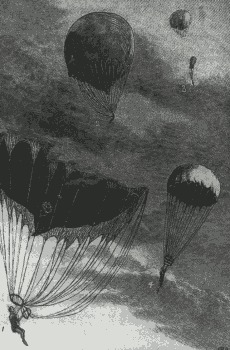
The Poles Stanisław and his brother Józef were well-known pioneers of parachuting. At that time, they jumped from hot-air balloons, and the brothers selected the designs for both the balloons and the parachutes through trial and error and manufactured them themselves. Due to the imperfection and unpredictability of both the parachutes and, especially, the balloons, these jumps were a very risky and dangerous form of public entertainment. Most accidents occurred during balloon ascents at low altitudes—gusts of wind would push the balloons into houses or trees, where they would catch fire, and the parachutists would fall from a low but fatal height at which the parachute was still useless. This is how Stanislav Drevnitsky died in Vitebsk. Józef’s partner became the wife of his other brother—Olga Mikhailovna Drevnitskaya. Her husband was an industrialist and strongly opposed his young wife’s dangerous hobby but was forced to give in.
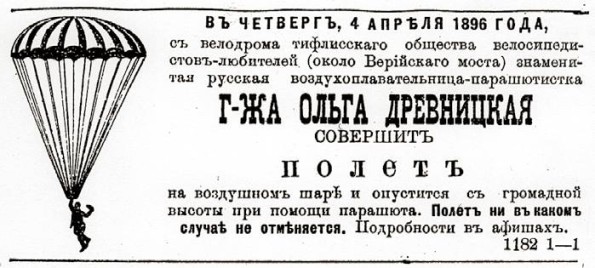
In mid-May 1895, four flights were made in Kharkiv, two by each balloonist. They jumped over the Tivoli Garden, located behind the current Musical Comedy Theater on Blagovischenska Street. We discussed the history of this garden during our tour based on the 1915 Guidebook, and we will definitely return to this topic. They had to land on trees, rooftops, and tram and telegraph wires, so the parachutists faced serious risks. Nevertheless, as the newspaper Yuzhny Krai reported, the jumps went off easily.
Olga—a cheerful and pretty young woman—was completely calm. Without the slightest hesitation, she hung from the ring beneath the rapidly rising balloon. And just as boldly, after unfastening her parachute at a height of half a verst (0,53 km), she plunged downward. The parachute gently lowered the girl to the ground. Twenty minutes later, she was back at “Tivoli,” greeted by the sounds of the orchestra and the ovations of the audience. “She received a lot of applause,” the newspaper wrote, “especially from the ladies: after all, she represented, to some extent, the entire fairer sex.”
Often, after taking off, the balloons would land outside the city, and the balloonists didn’t always manage to reach them first—there were instances when peasants, upon spotting a balloon, would tear its envelope to shreds “for household use.” Balloons cost up to 1,000 rubles, so losing one resulted in serious financial losses. Even the city’s more “civilized” residents often didn’t believe that a living person had jumped and began stabbing the unfortunate parachutists who had landed with pins to make sure they hadn’t dropped a doll… After all, they’d paid for the spectacle! In 1896, Olga suffered serious injuries during a balloon ascent and decided not to risk extreme jumps anymore. Józef, however, continued to entertain the public right up until the start of World War I and made over 400 jumps from balloons!
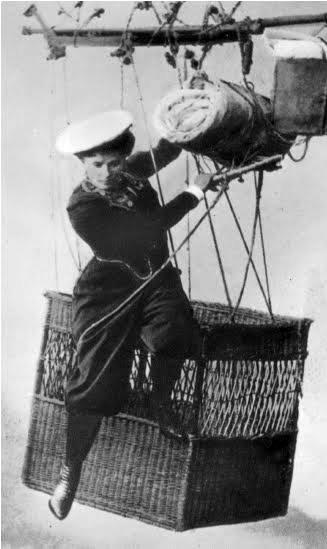
History has not preserved any images of Olga Drevnitskaya, but there are photographs of another female parachutist from the same era, the German Katarina Paulus, which give us an idea of what a packed parachute and basket looked like in hot-air balloons. At that time, both parachutes placed on the basket and those attached beneath the balloon were used; in the latter case, the balloon did not have a basket, and the parachutist hung beneath it on ropes.
There are also surviving newspaper clippings from other cities; admission to the event cost 50 kopecks. Although it was quite possible to watch the parachutists jump “from behind the fence”—outside the specially equipped areas with designated spectator seating.

- "Noah's Ark" - 21.10.2026
- Blackie’s House on Maksymilianivska St - 19.10.2026
- Danylevs’koho Street, 19 - 13.10.2026