After Mykola Lysenko’s death on November 1, 1912, a simple cross was placed on his grave.
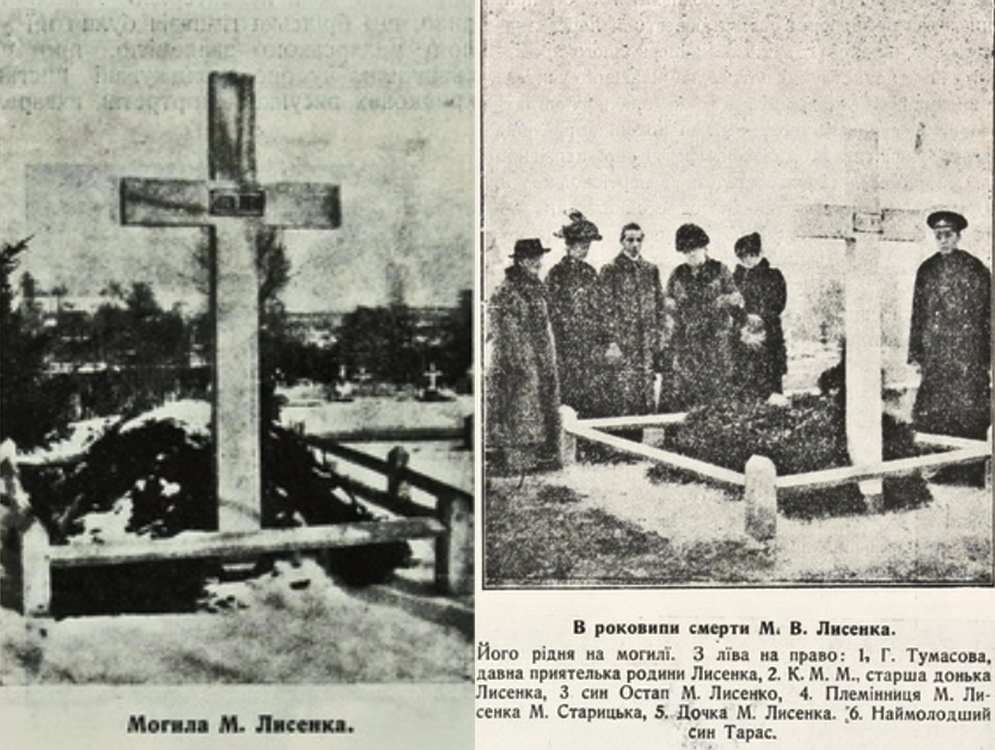
There’s no doubt that the great Ukrainian composer deserved better. Once again, it fell to our city’s Ukrainian intellectuals to tackle this issue (yeah, as if they didn’t have enough on their plate with the first monument).
In early January, the Ukrainian Artistic Section of the Kharkiv Literary and Artistic Circle, wishing to honor the memory of the late composer Mykola Lysenko, resolved at its meeting to do everything in its power to assist those who had decided to erect a monument at his grave.
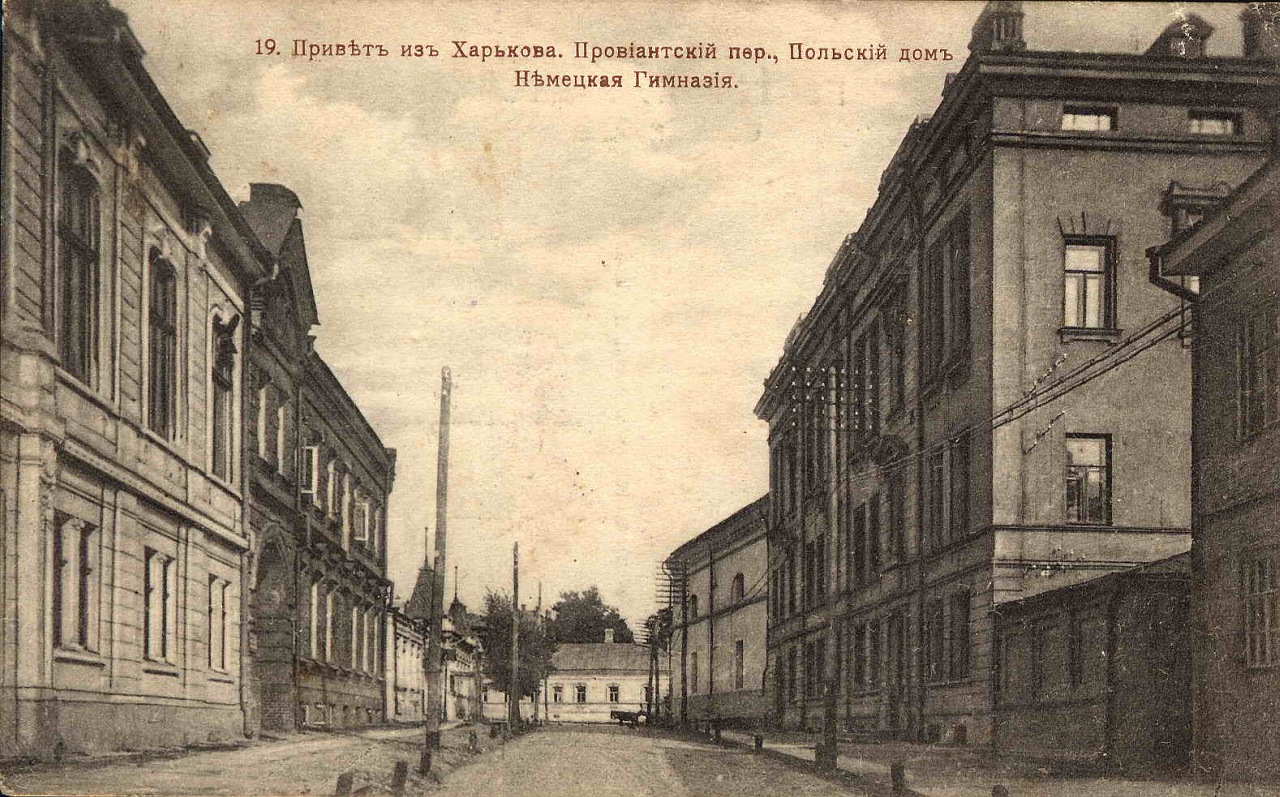
A competition was announced in our city to design a preliminary sketch for a memorial to Mykola Lysenko at the Baikove Cemetery in Kyiv. The organizers noted that, for a monument honoring a man who had devoted his entire life to Ukraine and Ukrainian art, a Ukrainian style would be most appropriate. Three prizes were to be awarded for the best designs. Designs were to be submitted by March 31, 1913. Anyone interested could review the detailed contest rules at the Kharkiv Literary and Artistic Circle itself, located at Hoholya Street, 4, Polish House.
The jury included such prominent figures as S. I. Vasylkivsky, V. V. Velichko, A. M. Varyanitsyn, N. M. Uvarov, and M. A. Berkos. A total of 9 architectural designs, 2 drawings, and 1 sculpture were submitted to the competition from St. Petersburg, Moscow, Kyiv, Kharkiv, and Galicia.
The awards ceremony took place on April 8. Incidentally, the guests from Kyiv who had been invited to this event—which was of utmost importance to Ukraine—did not show up. From April 9 to 10, the projects were on display for public viewing at 34 Yekaterinoslavska Street from 11 a.m. to 3 p.m.
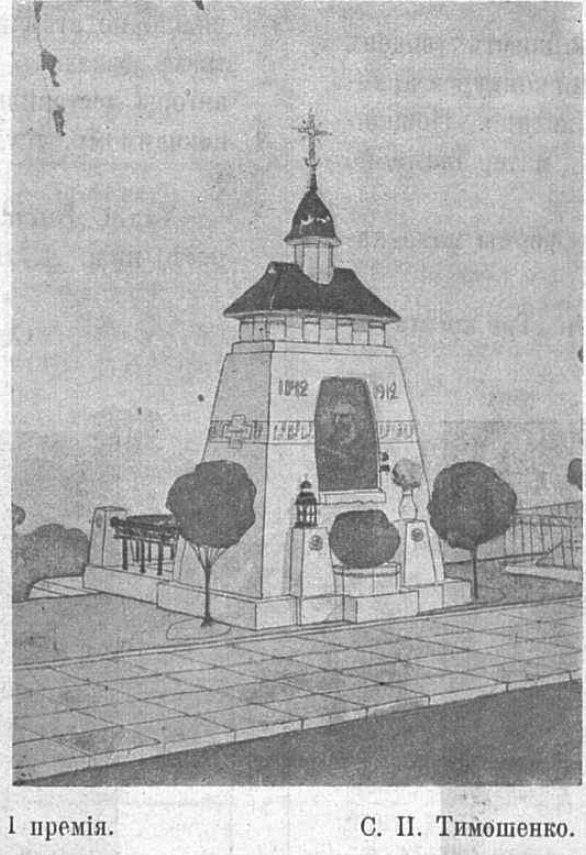
First prize (100 rubles) was awarded to the entry titled “The Eye,” created by civil engineer S. P. Tymoshenko. The monument was designed as a small, well-proportioned chapel with an interesting shape. Its upper part was decorated on one side with a plaque bearing an inscription, and on the other with a bronze bas-relief portrait of the late composer. It was also noted that “the design shows some—albeit very moderate—modernization of the Ukrainian style.”
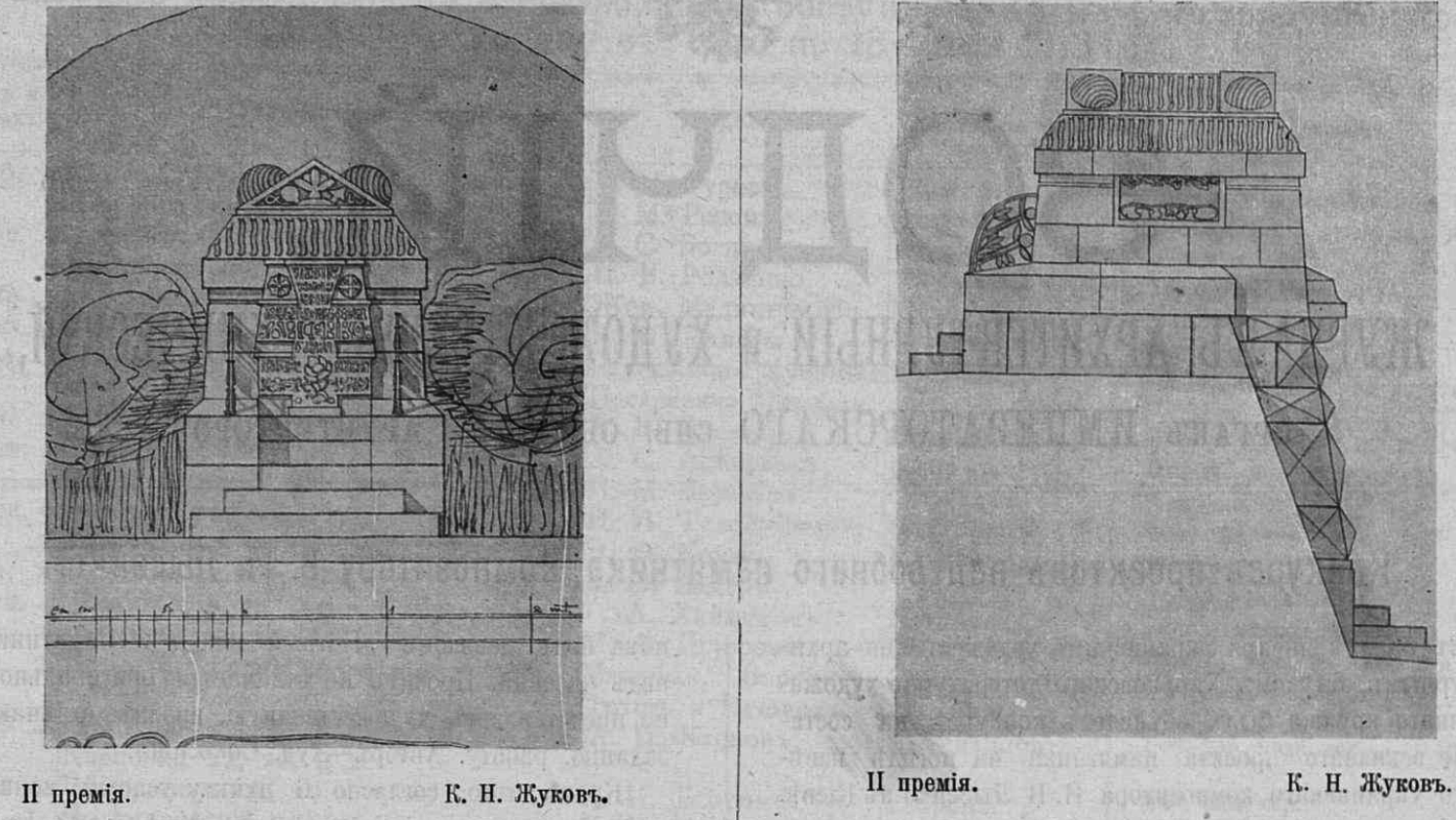
The second prize (75 rubles) was awarded to the project titled “Slaven Yest.” According to artist K. N. Zhukov’s design, the tombstone consisted of a stone sarcophagus richly decorated with ornamentation and massive bronze elements. The jury rated this project quite highly, noting that “The project is well-composed, but less distinctive than the previous one. Its author, artist Zhukov, made a commendable attempt to incorporate features of the Ukrainian style into works of hewn stone.”
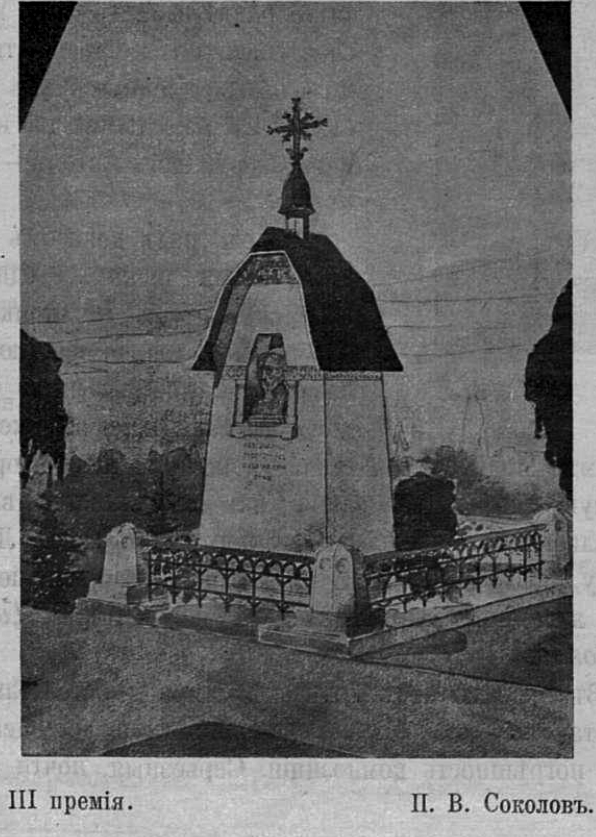
Third prize (50 rubles) went to the project “Treble Clef” by artist P. V. Sokolov.
The project itself wasn’t particularly original, but it certainly met the artistic requirements.
In addition to these projects, the commission recommended accepting two others. The first, titled “He Is Not Dead” by Viktor Karpovich Trotsenko, was highly original in its concept. A stone cross, elegantly crafted, stood beneath a canopy whose roof was designed in the Ukrainian style. However, this project had a number of shortcomings, which is why it was not awarded a prize. In the jury’s opinion, the four stone columns supporting the canopy were completely out of character with the Ukrainian style. Additionally, the project was lavishly illuminated with bright and cheerful colors, which were entirely inappropriate for a memorial structure.

The second entry—with the motto “Our thoughts and songs will never die, will never perish”—was the only sculpture in the competition. It was an irregularly shaped stone block, on one of whose surfaces, at the top, there was a medallion with a bas-relief portrait of Lysenko, while below the portrait there was a relief image of a weeping woman. Its creators were two inseparable friends who became renowned sculptors during the Soviet era—Vasily Vasilyevich Kozlov and Leopold Avgustovich Dietrich.
The reasons why the other designs were not awarded prizes were particularly intriguing. The
well-conceived and meticulously executed design, titled “Vira,” resembled the bell tower of the Sutkovets Church with its austere forms. However, all the solemn dignity of the monument’s design was undermined by the realistically rendered human figures integrated into it.

The project titled “Golden Cross” showed the work of a skilled craftsman. However, it completely lacked the architectural character required by the competition guidelines. “Apparently, the author did not use any materials on Ukrainian architecture at all,” the commission members sadly noted. Two projects, titled “Bayan” and “Three Crosses,” on the other hand, were complete copies of ancient Ukrainian churches without any adaptation. And the authors of the two projects from Galicia not only signed their works not with mottos but with their full names, but also managed to submit only one drawing each instead of the plans for three facades and a sectional view (as required by the competition rules).
None of these extremely interesting and remarkable projects ever came to fruition. First came World War I, then the Civil War. In short, in keeping with the oldest Ukrainian tradition, everyone had “other things on their minds.” It wasn’t until 1939 that an extremely “original” tombstone, designed by Yefim Isaevich Belostotsky, was erected on Mykola Lysenko’s grave.
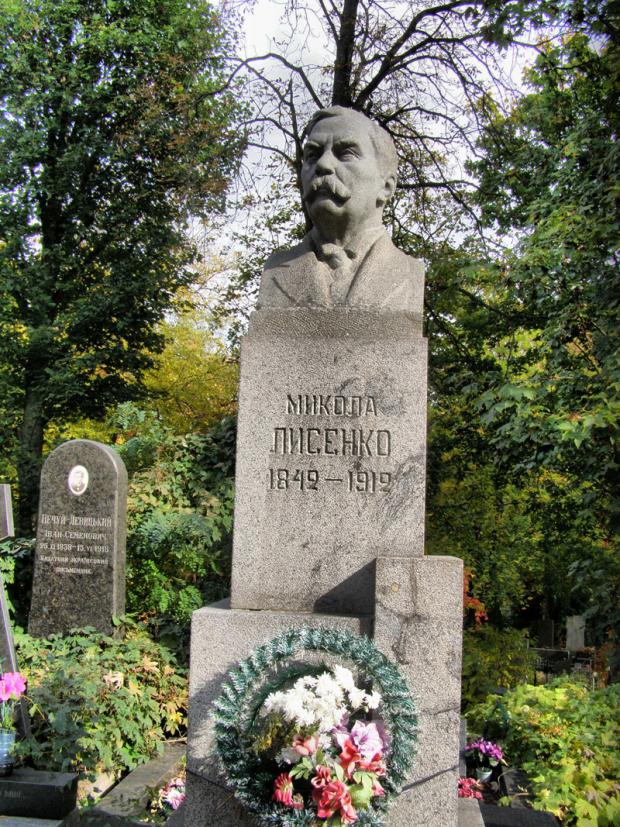
It is a great pity that the efforts of the architects and sculptors, as well as the Kharkiv jury’s strict scrutiny of whether the projects reflected the “Ukrainian style,” were in vain…

- About the military pilot school and the airfield in Kharkiv… - 04.11.2020
- Nikanor Savich—A Political Career by Mistake - 13.07.2020
- And once again, about the Cavalry Guards… - 21.01.2020