As is well known, there are many glorious chapters in the history of our beloved city that are linked to the Polish community and its prominent figures.
In 2011, as part of a joint project between the Consulate General of the Republic of Poland in Kharkiv and the Central Scientific Library of Kharkiv National University, an extremely informative booklet titled “Poles on the Map of Kharkiv” was published based on the results of the symposium “Famous Poles of the Kharkiv Region.” It contained information about places associated with Poles and brief biographical notes on notable figures.

However, many of us, as we walk down the beautiful Gogol Street, have no idea that hidden within it is a magnificent monument created by the Donetsk sculptor Alexander Porazhnyuk.
In 2009, to mark the 150th anniversary of his birth and the 85th anniversary of his death, a marble bust of Konstantin Gorsky was ceremonially unveiled at the entrance to the Cathedral of the Assumption of the Blessed Virgin Mary.
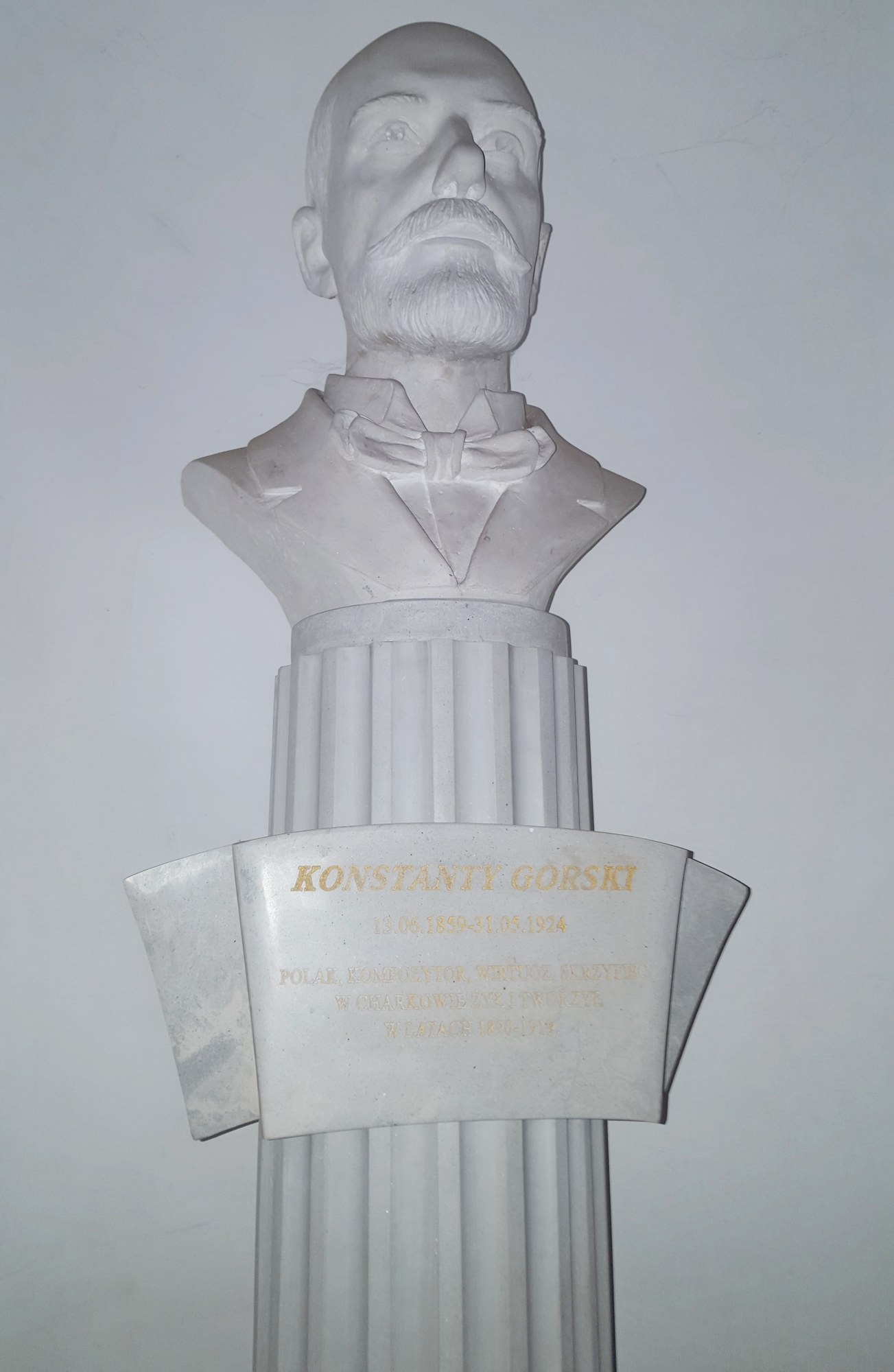
The Poles had more than enough reasons to commemorate this man, especially in a place like this.
Born on June 13, 1859, in the city of Lida, Konstantin Kiprianovich Gorsky (Konstanty Antoni Gorski) lived and worked in Kharkiv for 29 years. He is known as a talented composer, virtuoso violinist, teacher, conductor, public figure, and author of romances, operas, and numerous instrumental works.
Others know him as one of the founders of the “Dom Polski” cultural society in Kharkiv.
Some revere him as the founder and director of the church choir at a Catholic parish, while others respect him as one of the best teachers at the Kharkiv Music School. Pyotr Ilyich Tchaikovsky himself considered Konstantin Gorsky one of the finest performers of his violin concerto.
In 1919, this wonderful composer left our city and returned to Poland, where his name continues to enjoy great respect and popularity to this day. Konstantin Gorsky’s time in Kharkiv, however, was marked by many triumphs. For example, the following lines can be found in newspapers from 1903:
The annual concert by faculty members of the local music school—pianist R. Genik and violinist K. Gorsky—was a great success on October 21.
According to a local music critic, “Mr. Gorsky is a talented violinist and conductor, but an even more talented composer who is currently finishing an opera based on a story from Polish literature; he has not yet been sufficiently recognized in this area of his work. His modest role as a teacher at the music school, which demands a great deal of time and effort, quartet and symphony concerts—including rehearsals and preparing students for them—as well as the customary Polish evenings, in which Gorsky always takes as active a part as he does in all the church’s musical affairs, greatly hinder his creative work. This, however, does not prevent us from hoping that Gorsky will, after all, take his rightful place among Russian composers, commensurate with his talent.”

However, exactly 10 years later, his good name, fame, the recognition of his contemporaries—in short, everything Konstantin Gorsky had achieved—unexpectedly came to nothing. In 1913, Gorsky left the music school, and the people of Kharkiv stopped attending his concerts. What, then, caused the downfall of the career of a man who had been so enthusiastically applauded at his concerts?! For many, this remains a mystery to this day. Those who know the truth are reluctant to speak about the reason for Gorsky’s downfall, so don’t look for an answer online—the story is far too sordid.
While working with one of the most authoritative, popular, and widely read music publications of the time, *The Russian Music Gazette*, I came across a very interesting article in its May 1913 issue.

Kharkiv. We’ve heard about a truly ugly incident that took place in the local music scene.
Karavaychuk, one of the best students in Konstantin Gorsky’s violin class at the local music school, graduated from the school three years ago and has since established himself as a capable conductor. He formed an amateur orchestra and has repeatedly organized highly successful symphonic concerts, both in terms of program and performance. Following the death of Fr. Kucher, who was well-known in Kharkiv, he took over as head of the student orchestra at the Technological Institute and performed his duties admirably, receiving very good and well-deserved reviews from his former professors, including the school’s director, I. I. Slatin, and his professor, K. Gorsky.
Last summer, the latter recommended Karavaychuk (stage name: Karavaev) to his brother Ivan Gorsky in Tiflis, where Karavaychuk was to serve as his assistant, the second conductor. A conflict arose out of jealousy among the conductors. Ivan Gorsky (as reported by our correspondent P. Bebutov) was not successful, whereas the young Karavaychuk, on the contrary, captured the public’s attention. The matter ended in a rift—Karavaychuk was forced to leave. For the upcoming summer season, the Sevastopol City Council invited Karavaychuk to serve as conductor of the summer orchestra, a position Ivan Gorsky had been eyeing. In an attempt to discredit Karavaychuk, the latter published a letter of an unflattering nature in the *Crimean Herald* and, unfortunately, was supported in this by his brother, who published a review in the same newspaper about his student Karavaychuk, which slandered his good name and his musical abilities, and at the same time demanded that he return his own certificate, issued in 1910! Karavaychuk recounted this entire sad story in the Kharkiv-based *Yuzhny Krai* with the aim of clearing his name. Fortunately, this unsavory incident ended happily. Although the Sevastopol city council summoned Karavaychuk to explain himself (following a letter from Ivan Gorsky that amounted to a denunciation) and sent a request to the school’s director, the young conductor retained his position. In any case, the Gorsky brothers’ attitude toward him will remain an eloquent fact in the annals of our provincial musical life.
Konstantin Gorsky has left the faculty of the Kharkiv Music College

After these events, Konstantin Gorsky continued to pursue a career in music, though newspaper reports often mentioned empty concert halls…
Of course, none of us is perfect, and we all make mistakes. I think it’s also completely irrelevant whether our Kharkiv has forgiven Gorsky or not. What’s far more important to us is that the Kharkiv scandal has gone down in the annals of provincial musical life as an example of the public’s reaction to an unsavory act described in a leading music publication.
After all, our city’s history consists not only of glorious deeds but also of scandals like this one. We have the right to know the truth, no matter how unpleasant it may be.


- About the military pilot school and the airfield in Kharkiv… - 04.11.2020
- Nikanor Savich—A Political Career by Mistake - 13.07.2020
- And once again, about the Cavalry Guards… - 21.01.2020