Today is International Day for Monuments and Sites. It was established in 1982 by the General Assembly of the International Council on Monuments and Sites (ICOMOS) to draw public attention to issues related to the protection and preservation of the world’s cultural heritage. On the eve of this significant date, we set out on our first expedition to explore the landmarks of Sloboda Ukraine.
It goes without saying that our trip in no way claimed to be on par with the professional field trips undertaken by architects, local historians, or, for example, the “Society for the Study of the Russian Estate.”
However, we set a clear goal: to document the current state of these estates through photos and videos and to draw attention to the historic sites that we are losing year after year. After all, as is well known, most of the estates in Sloboda Ukraine were ruthlessly destroyed not during the Civil War or World War II, but during the Soviet era and in our own time. At this rate of deterioration, they may soon simply cease to exist.
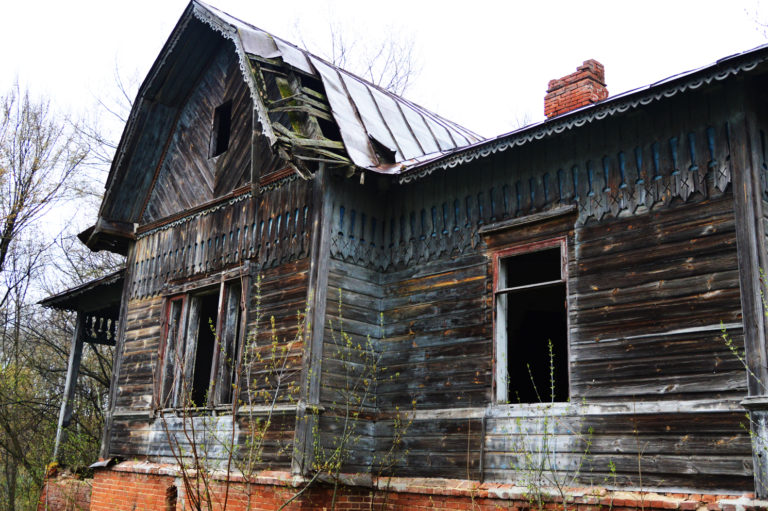
We planned the itinerary for our first trip to visit the estates of the former Bohodukhiv Uyezd. We visited the beautiful Kadnytsya estate of Yegor Stepanovich Gordienko. Out of concern for the children, the estate’s owner opened a zemstvo public school there in 1893. In 1894, the Kadnytsya School was named after its founder, E. S. Gordienko. Today, in the beautiful wooden mansion that survived the fires of war, nothing remains to speak of its former splendor or the glorious name of the patron who loved his homeland. Ruins reign everywhere, surrounded by mountains of trash. The building—which is not a historic landmark but has become a restroom for vacationers—is what Kadnytsya has become today.
During the Soviet era, the former estates of the “wicked bourgeoisie” were converted into clubs, cinemas, and hospitals. This was precisely the fate that befell the home of Court Counselor Karp Alexandrovich Pavlov, built in 1823. To this day, the historic estate houses the Malyzhinsky Psychoneurological Residential Care Facility for Women. Obviously, it’s not possible to gain access there for these reasons. Beyond the fence that separates the world of the healthy from the sick lie the ruins of the Church of the Dormition of the Mother of God…
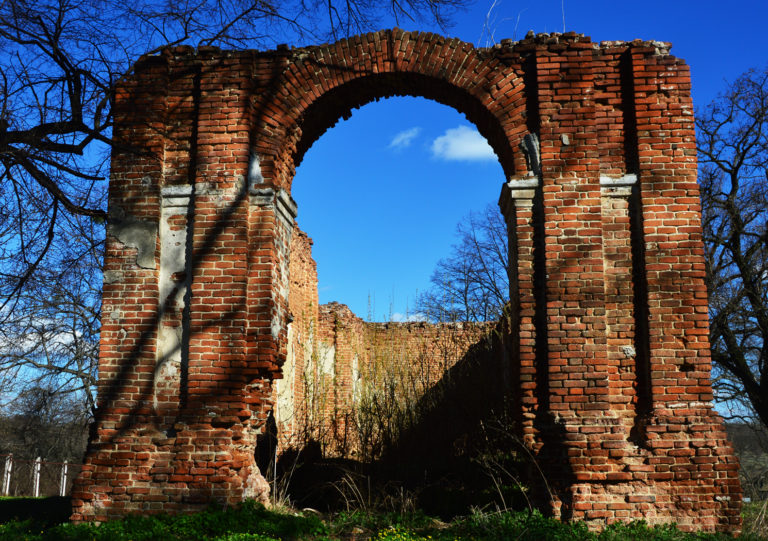
As we drove through the village with the lovely name of Merlo, we came across this interesting building, which dates back either to the early 20th century or to the Soviet era. Whenever it was built, given that the village is small, it is unique and also forms part of our historical heritage. You can learn about the history of Malyzhyne and Merlo from Andrei Paramonov’s excellent book, published in 2009: “Malyzhyne, Merlo of the Bohodukhiv District, Kharkiv Governorate. A Bit of History…”.
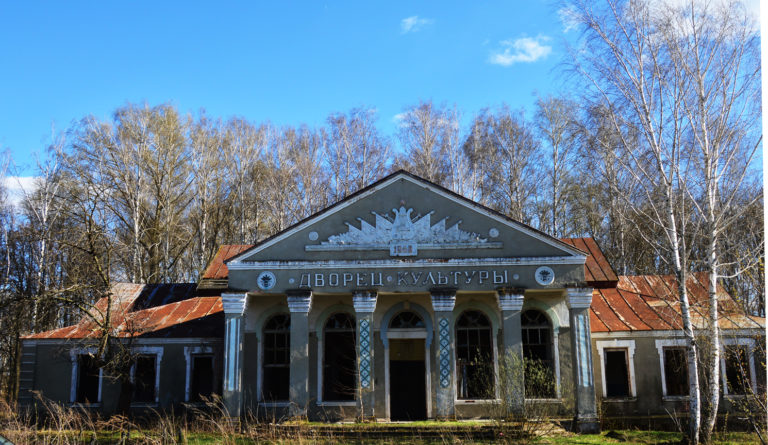
Inna Romenskaya wrote in detail about our impressions of our visit to Lisove; she selflessly photographed all the sites, and an interview with the director of the Psyarivskyi Open-Air Ethnographic Museum “Ukrainian Sloboda” will be published shortly.
I wanted to tell you a little about the main destination of our trip—the estate in the village of Lyutovka. The place itself is extremely interesting and steeped in legend. It’s located at the intersection of what used to be two major highways—the Muravsky and the Sumsky—where bandits used to prey on travelers with robberies and murders. People used to say that this was an ill-fated place—that is, “fierce.” It is believed that this is precisely what gave rise to such a strange name—Lyutivka.
Documents from 1713, published in Volume 4 of “Reports and Rulings of the Governing Senate During the Reign of Peter the Great,” it is stated that the village of Lyutivka (incidentally, like Kadnytsya) belongs to Fyodor Kovalevsky.
However, we can find far more interesting information about the early history of Lyutivka in the document titled “Record of the Lands of the Zolochiv Sotnia of the Kharkiv Regiment, 1749.”
“The village of Lyutivka, located eleven versts from Zolochiv in the Zolochiv summer cottage area, was settled more than forty years ago by Yakov Kovalevsky, a former regimental captain of the Kharkiv Regiment; and after the death of the aforementioned captain, his sons, Fyodor and Grigory Kovalevsky, owned the village of Lyutivka; but now, for reasons unknown, it has come into the possession of landowner Nastasya Bortenova, who owns a considerable amount of granted land in Zolochiv—including hayfields and other plots—and just as in years past, as well as now, the residents of Zolochiv have endured, with no small hardship, numerous acts of plunder and oppression at the hands of Landowner Bortenova.”
In “A List of the Specific Cities and Counties That Make Up the Kharkiv Governorate and the Number of Souls in Each as of 1779,” it is stated that at that time, the settlement of Lyutovka was owned by Lieutenant General Ivan Samoilovich Khorvat and had a population of 750 males.
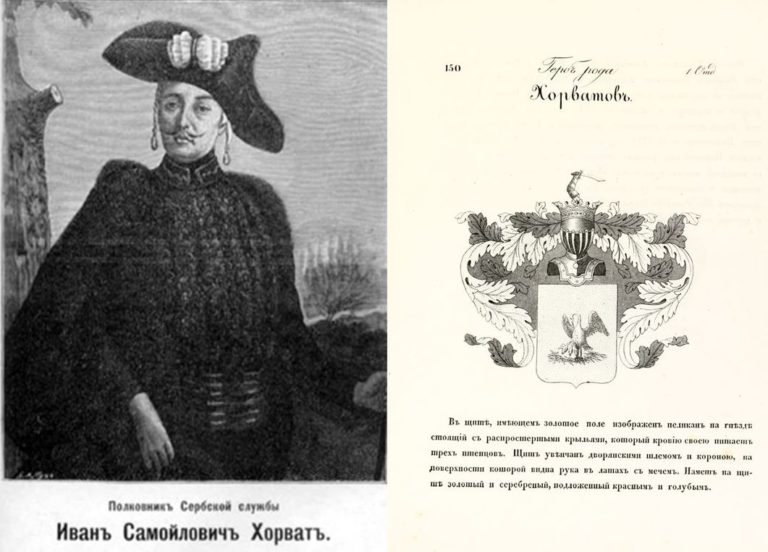
The owner of Lyutivka himself was of Serbian descent; who entered the service of the Russian Empire from Austria in 1751 and was also the initiator of the establishment of Serbian settlements (the so-called “New Serbia”), which were placed under his direct and sole administration. It is believed that it was Ivan Samoilovich Horvat who established an estate in this area; as late as the late 19th and early 20th centuries, farm buildings, a wing, a Doric-style mausoleum in the garden, and a church built in 1765.
By the early 19th century, the Lyutivka estate was already owned by the Zheltukhin family. The growth of the estate’s population during this period is particularly telling. In 1808, the population had already reached 1,491 people of both sexes, and by 1817, it had risen to 1,645. By comparison, according to data from 2001, Lyutovka’s population was as high as 631 people, and now, by all accounts, it is even smaller. The estate developed rapidly; in 1844, the landowner Anton Nikolaevich Zheltukhin built a wooden church dedicated to St. John the Baptist.
Since the mid-19th century, Lyutivka has been owned by the Counts of Kleinmichel. It was thanks to this family that the beautiful estate—which now lies virtually in ruins—was built. For this reason, let’s take a closer look at the estate’s founders. The progenitor of the Kleinmichel family is considered to be the son of a Riga pastor—Andrei Andreevich Kleinmichel (1757 – September 5, 1815). Having enjoyed a fairly successful career in the military, he thereby laid the foundation for his family’s future prosperity. His son, Pyotr Andreevich Kleinmichel, was a protégé of Minister of War Alexei Arakcheyev and an unquestioning executor of Emperor Nicholas I’s will.
Consequently, in 1839, P. A. Kleinmichel was elevated to the rank of count. From that moment on, the Kleinmichel family adopted a coat of arms featuring a beautiful motto written in gold letters on a scarlet ribbon: “Diligence conquers all.”
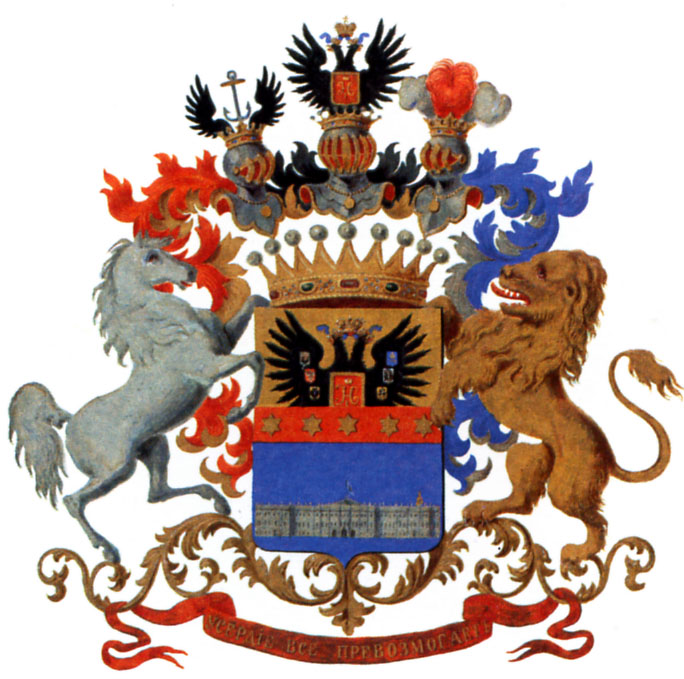
From 1842 to 1855, Pyotr Andreevich served as Chief Administrator (Minister) of Transportation and Public Buildings. As a person, the count had a rather mixed reputation among his contemporaries. It is believed that he was the one who introduced the practice of paying salaries “under the table” (that is, part officially and part not); many considered him an embezzler and a sycophant. His second marriage, which took place in 1832, was both happy and advantageous. Pyotr Andreyevich’s chosen one was the widow of Staff Captain V. O. Horvat—Cleopatra Petrovna Ilyinskaya (October 17, 1811—January 17, 1865).
The new wife had undeniable virtues. She was wealthy (it is believed that she was the one who purchased Lyutivka) and of noble birth. By 1869, Lyutovka already had, in addition to the manor and the church, a school, a hospital, a fair, two distilleries, and two saltpeter factories, as well as a population of about 1,700. In 1851, Cleopatra Petrovna was appointed a lady-in-waiting at court. Gossipmongers in high society claimed that Cleopatra Petrovna and her husband willingly adopted the illegitimate children of Emperor Nicholas I and his mistress, Varvara Nelidova.
It was precisely this circumstance that was credited with P. A. Kleinmichel’s rapid rise through the ranks. As for the couple’s eight children (three daughters and five sons), their detractors referred to them behind their backs not as “Klein-Michaels” (little Michels), but “Klein-Nikolauses” (that is, little Nikolauses). Whether this is true or not, who knows. However, the children of Pyotr Andreevich and Cleopatra Petrovna went on to have successful careers in government and also formed ties with influential and wealthy families. The Klein-Michael estates, acquired through purchase or marriage, were located in many provinces of the empire. The Lyutivka estate, meanwhile, went to Count Vladimir Petrovich Kleinmichel (1839–1882), who participated in the suppression of the Polish uprising, became a hero of the Russo-Turkish War of 1877–1878 (for which he was promoted to major general) and received numerous awards. After his death from pneumonia on January 27, 1882, in St. Petersburg, Princess Ekaterina Petrovna Meshcherskaya took possession of the estate. Under her stewardship, a Freiburg cattle breeding farm was established in Lyutivka in 1887. By 1903, the herd consisted of 90 cows and 3 breeding bulls, and young cattle were sold annually for up to 100 rubles. Her son, Count Nikolai Vladimirovich Kleynimhel, born on July 31, 1877, followed in his ancestors’ footsteps. After graduating from the Alexandrovsky Lyceum, he enlisted in the Cavalry Guard Regiment in 1900. From 1903 to 1916, he served as the Bohodukhiv District Leader of the Nobility and was elected a delegate to the Bohodukhiv District and Kharkiv Provincial Zemstvo Assemblies. Count Kleinmichel also served as Master of Ceremonies at the Imperial Court.

Under Nikolai Vladimirovich Kleinmichel, Lyutivka flourished even more. In 1901, the estate’s total land area was 4.333 desyatinas (4,733 hectares), of which:
— There were 3,426 desyatinas of arable land, on which various grain crops were grown;
— The orchard covered 10 desyatinas (about 11 hectares).
In addition to cattle and pigs, Lyutivka also had its own horse farm, where elite horses were bred for equestrian sports.
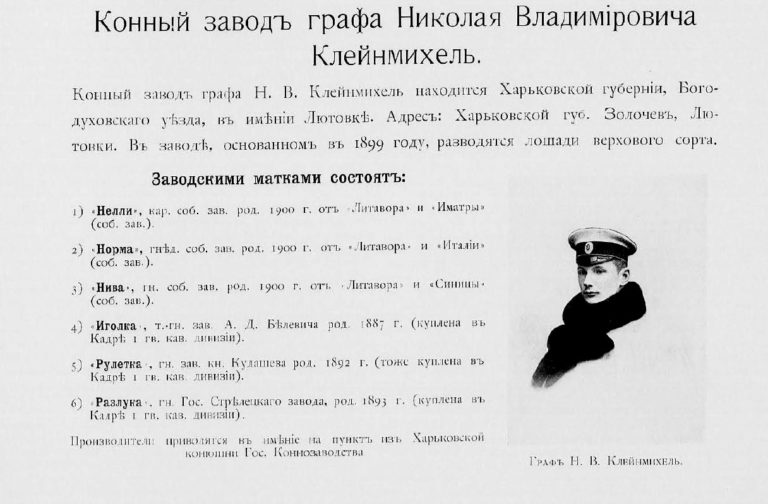
The parish had its own workshop for repairing agricultural machinery and implements used on its own farm. According to the *Reference Book for the Kharkiv Diocese for 1904*, the parishioners in Lyutivka numbered 1,157 men and 1,052 women.
The estate’s owners themselves were passionate about antiques, which is why the estate housed a considerable collection of interesting, antique, and rare items. So the numerous distinguished guests who visited the magnificent and opulent Lyutivka estate had plenty to feast their eyes on.
In the summer of 1914, Count Nikolai Vladimirovich Kleinmichel, accompanied by the renowned art historian Georgy Lukomsky, set out on a journey through the Kharkiv Governorate, armed with cameras and traveling by car. Notes from these trips were periodically published in 1915–1916 in the magazine *Stolitsa i Usadba*.
The war with Germany, which broke out just as they were finishing their tour of the sixth of the eleven counties that made up the Kharkiv Governorate, forced them to interrupt the work they had begun.
And after the Easter Matins service in 1915, within a few hours, the flames mercilessly engulfed the old wooden church and the magnificent iconostasis on Count Kleinmichel’s estate…
However, having seen that public interest in art had not waned despite the long war, Kleinmichel and Lukomsky went ahead and published the first volume of the book “Historic Estates of the Kharkiv Governorate”—now beloved by so many—in 1917. They noted that the proceeds from the sale would go toward the restoration of the burned-down church in Lyutivka. Thanks to this remarkable book—which has been reprinted several times in our time through the efforts of Andrei Paramonov—we can now, 100 years later, see extraordinarily beautiful photographs of historic estates in the Kharkiv region and learn about their history. As the co-author and publisher of this book, Nikolai Vladimirovich writes words that remain relevant and important to this day:
For a long time now, I’ve been thinking about personally exploring and somehow capturing in some form those stately manor houses in my native Kharkiv Governorate—a legacy left to us from years long past. These days, the new owners of these estates—among whom are even ordinary peasants— sometimes do not hesitate to tear down a beautiful old house, pavilion, or monument “for bricks or firewood” in order to erect a farm building or a “Modern-style” residential house in its place; the same thing happens with other kinds of ancient treasures. Therefore, it seemed to me highly desirable that people who love artistic antiquities join forces to undertake the task of comprehensively cataloging and documenting the surviving monuments of antiquity in various fields of art, noting their artistic significance. This might, perhaps, save many of them from destruction.
It was precisely these words of his that inspired us to take this trip. It was thanks to them that we decided to start at the Lyutivka Estate.
From 1916 to 1917, Nikolai Vladimirovich served as Vice Governor of Moscow, effectively becoming the last person to hold that position during the pre-revolutionary period. Due to his staunch monarchist convictions, he found himself out of favor under the new regime and left with his family for his estate in Crimea. Upon learning the details of the tsar’s family’s difficult life in Tobolsk, he began planning a daring trip there to join the detachment of Red Army soldiers guarding the Tsar. However, when his relatives pointed out that his aristocratic appearance might arouse suspicion and cause even greater harm to the royal family, Kleinhendel decided to join the White Army.
On January 23, 1918, in Yevpatoria, Red sailors conducted a search of Kleinmichel’s property. And on January 24, at 10 p.m., they killed him. In his suicide note to his loved ones, the last owner of the Lyutivka estate wrote: “Tell Mom that I am dying for my convictions.”
Back in the Soviet era, there was just about everything at the Lyutivka estate. Incidentally, as recently as the 1990s, two marble lions could be seen flanking the central entrance. However, in 2001, one of them was stolen. The other one, as they say, was hidden “just to be on the safe side” by the residents of Lyutivka themselves—but exactly where it is remains a great mystery.

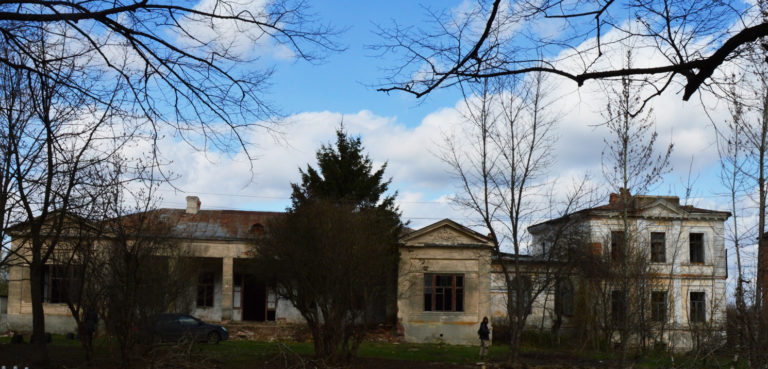
In the early 2000s, Kharkiv-based researcher Andrei Fedorovich Paramonov undertook an unprecedented journey through the estates of the former Kharkiv Governorate with the aim of documenting what remained. This work culminated in the 2008 publication of the unique book *Gardens and Parks of the Kharkiv Governorate*. When we visited Lyutovka nine years later, we saw just how strikingly different the estate’s current condition is from the photographs featured in the book or online.
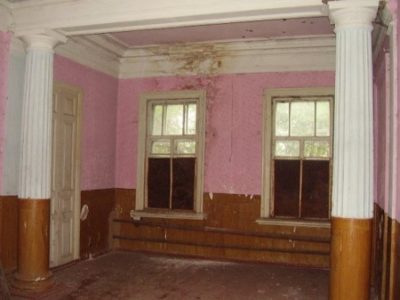
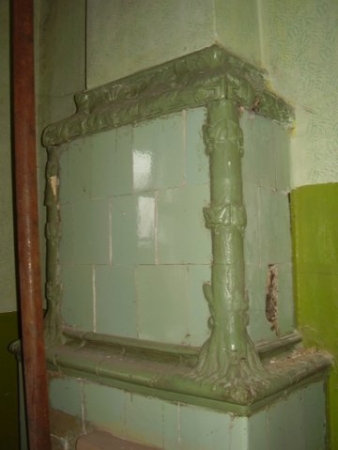
Only the numerous ruins of pre-revolutionary buildings now bear witness to the fact that some 2,000 people once lived in Lyutivka and that life there was bustling…
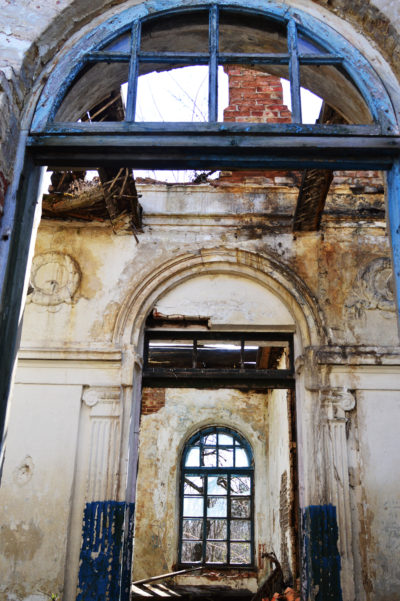
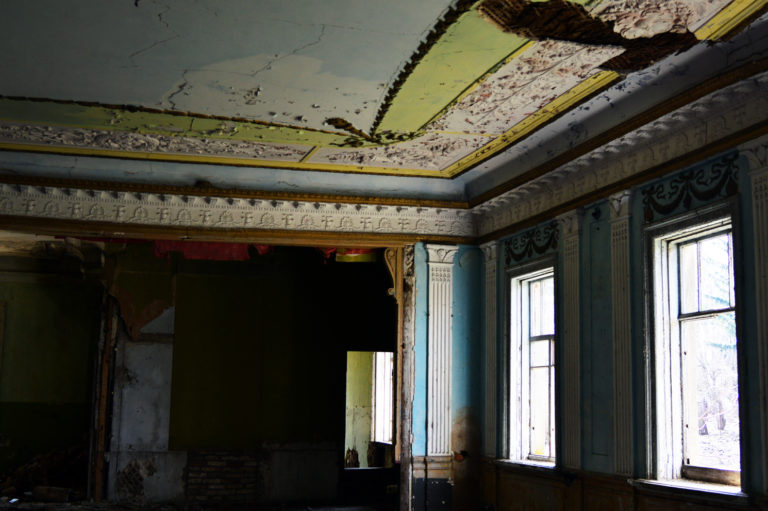
I am sincerely convinced that the book by the last owner of Lyutivka, Count Nikolai Kleinmichel, will continue to be reprinted in 10 to 20 years and will remain in high demand. However, I am by no means certain that his once-magnificent estate, from which he set out in the summer of 1914 to write this book—not being a designated architectural monument and lacking support from the state or patrons—will survive for even another five years… Such is the gratitude of the Slobozhans.
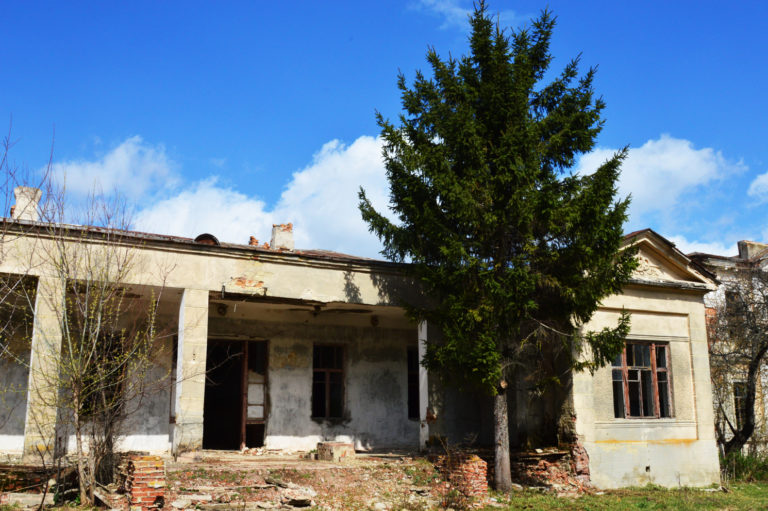
To be continued. We still have many more trips ahead of us to historic estates, which we are losing day by day. For, as the motto of the owners of the Lyutivka Estate stated, “Diligence conquers all.”

- About the military pilot school and the airfield in Kharkiv… - 04.11.2020
- Nikanor Savich—A Political Career by Mistake - 13.07.2020
- And once again, about the Cavalry Guards… - 21.01.2020