The 19th-century foreign press contains many remarkable stories related to Kharkiv, stories that have since been forgotten in Kharkiv itself. Of course, these stories should be taken with a healthy dose of skepticism—one can only imagine how much the “telephone game” might have distorted the news as it traveled halfway around the globe at that time.
For example, a remarkable incident occurred in our city, as reported by *The Roanoke Times* in Roanoke, Virginia. In its May 16, 1891, issue, the newspaper refers to a case described in the *Kharkiv Vedomosti*. An Egyptian mummy was brought to an exhibition in Kharkiv. Customs officials were at a loss as to how to clear this mummy through customs, since the term “mummy” did not appear in their catalog of commodity types. Eventually, they found a commodity with the same name—“mummy” paint. The mummy was then weighed and cleared through customs according to the tariffs for the paint of the same name based on its weight. A similar incident, according to a report in the same *Kharkiv Vedomosti*, occurred in another city of the empire, which was not named. There, a skeleton from Germany was cleared through customs under the category “used goods” in the catalog.
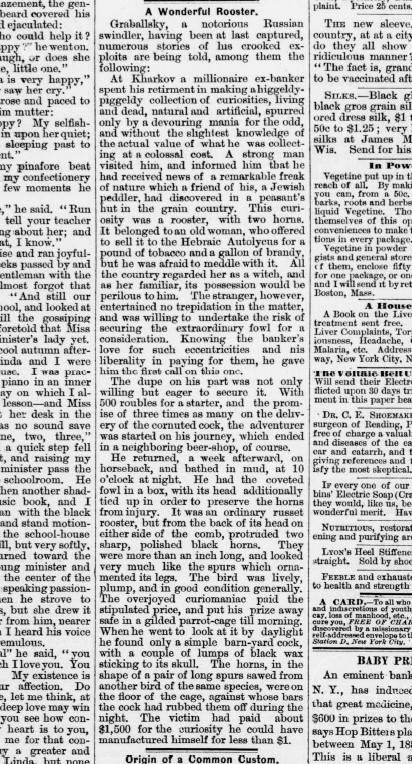
Another equally intriguing story is recounted in the *Watertown Republican* (Wisconsin) of June 2, 1880. Here is a translation:
A Wonderful Rooster.
Graballsky, a notorious Russian swindler, having been at last captured, numerous stories of his crooked exploits are being told, among them the following:
At Kharkiv a millionaire ex-banker spent his retirement in making a higgledy-piggledy collection of curiosities, living and dead, natural and artificial, spurred only by a devouring mania for the odd, and without the slightest knowledge of the actual value of what he was collecting at a colossal cost. A strong man visited him, and informed him that he had received news of a remarkable freak of nature which a friend of his, a Jewish peddler, had discovered in a peasant’s hut in the grain country.
This curiosity was a rooster, with two horns. It belonged to an old woman, who offered to sell it to the Hebraic Autolycus for a pound of tobacco and a gallon of brandy, but he was afraid to meddle with it. All the country regarded her as a witch, and as her familiar, its possession would be perilous to him. The stranger, however, entertained no trepidation in the matter, and was willing to take the risk of securing the extraordinary fowl for a consideration. Knowing the banker’s love for such eccentricities and his liberality in paying for them, he gave him the first call on this one.
The dupe on his part was not only willing but eager to secure it. With 500 roubles for a starter, and the promise of three times as many on the delivery of the cornute cock, the adventurer was started on his journey, which ended in a neighbouring beer-shop, of course.
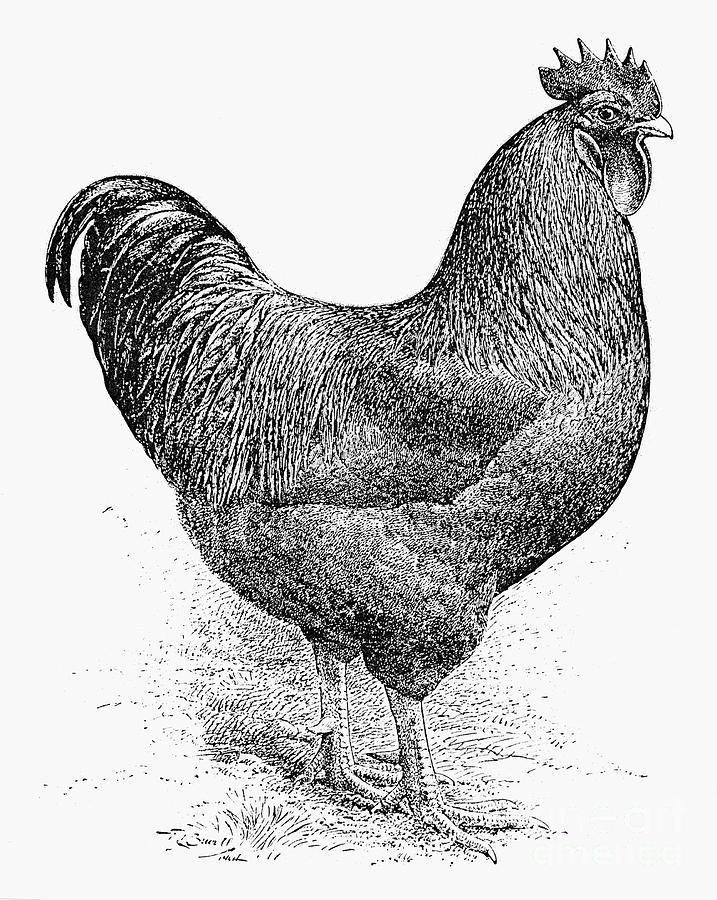
He returned, a week afterward, on horseback, and bathed in mud, at 10 o’clock at night. He had the coveted fowl in a box, with its head additionally tied up in order to preserve the horns from injury. It was an ordinary russet rooster, but from the back of its head on either side of the comb, protruded two sharp, polished black horns. They were more than an inch long, and looked very much like the spurs which ornamented its legs. The bird was lively, plump, and in good condition generally. The overjoyed curiomaniac paid the stipulated price, and put his prize away safe in a gilded parrot-cage till morning. When he went to look at it by daylight he found only a simple barn-yard cock, with a couple of lumps of black wax sticking to its skull. The horns, in the shape of a pair of long spurs sawed from another bird of the same species, were on the floor of the cage, against whose bars the cock had rubbed them off during the night. The victim had paid about $1,500 for the curiosity he could have manufactured himself for less than $1.
It’s worth noting that $1,500 in 1880 is equivalent to more than $49,000 at the 2026 exchange rate. That really is a huge amount of money for a mere rooster.

- The Architectural Evolution of the Kharkiv Theater - 26.09.2026
- 1st Kharkiv Gymnasium - 17.09.2026
- The Oldest Movie Theater in Ukraine - 24.08.2026