My friends in Lviv like to proudly mention from time to time that their Art Gallery houses paintings by the world-renowned artist Henryk Siemiradzki.
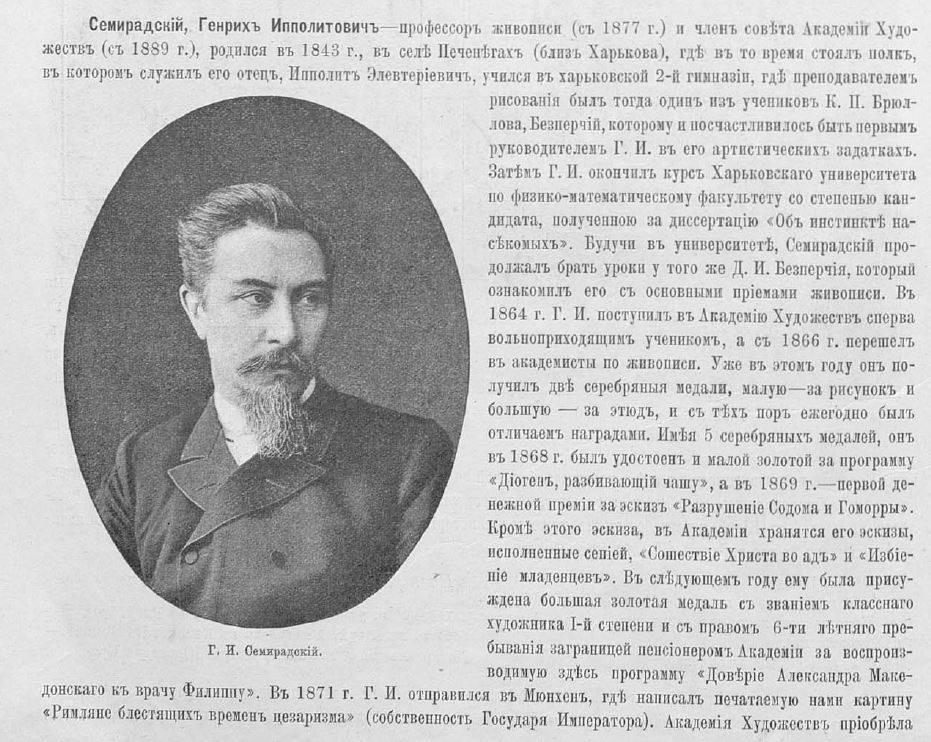
However, the fact that this great artist was born in the Kharkiv Governorate and studied in Kharkiv often comes as a huge shock to them…
But the fact remains that Siemiradzki:
- the godson of Adam Mickiewicz’s full brother;
- a parishioner of a Catholic Church;
- academician and professor at the Imperial Academy of Arts and the academies of painting in Berlin, Stockholm, Rome, and Turin; corresponding member of the French Academy of Fine Arts;
- “the last classic of Russian art,”
…was from Kharkiv.
It is customary to write favorably about a person after their death. Eulogies, hordes of researchers. And quite a few texts have been written about Siemiradzki since his death on August 23, 1902.
But for us, what was written during the Genius’s lifetime is far more valuable. Therefore, we present information about Heinrich Ippolitovich based on the seminal two-volume 1889 edition of F. I. Bulgakov’s *Our Artists*.
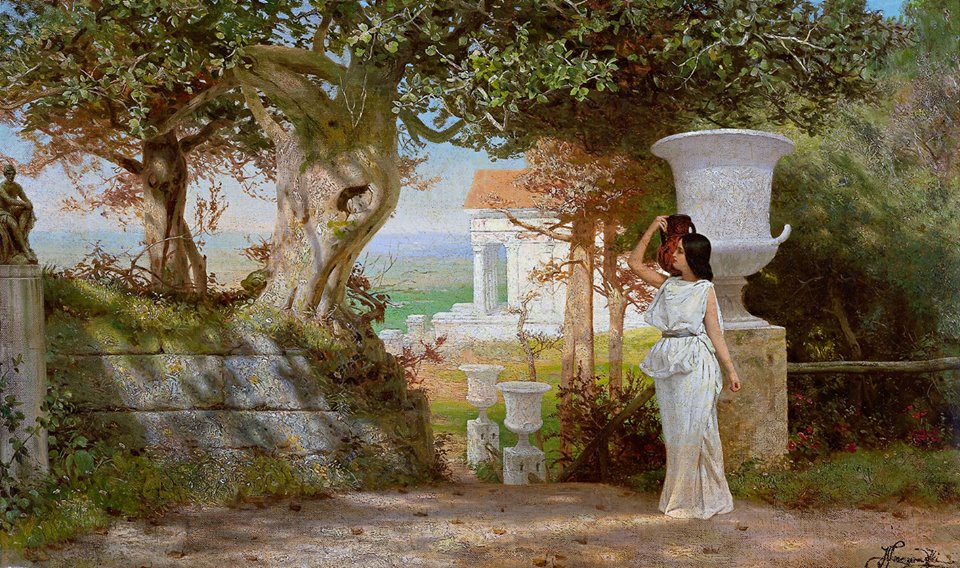
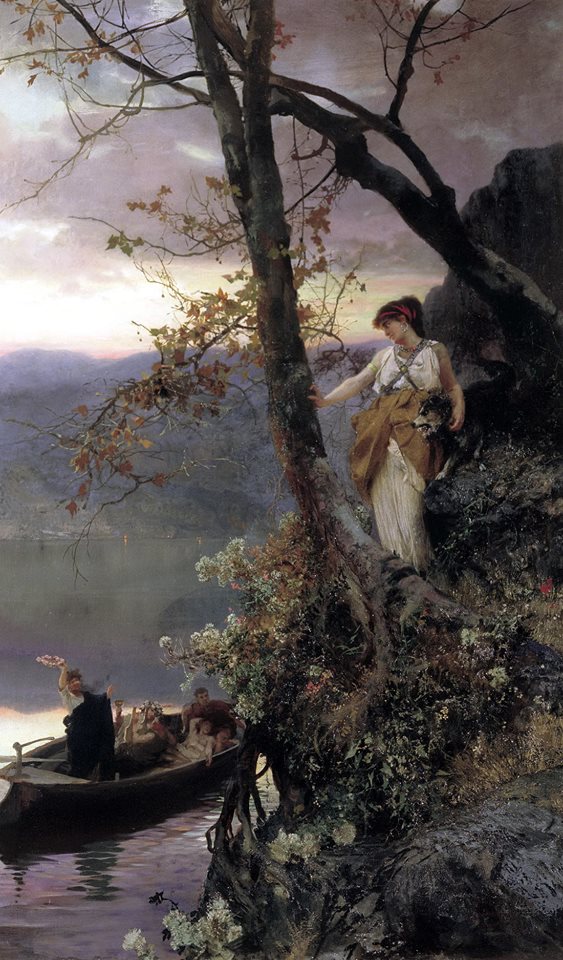
The aforementioned publication contains 18 black-and-white reproductions of his paintings. For this reason, and in order to fully appreciate the beauty of the works, color images have been included from various contemporary albums and catalogs.
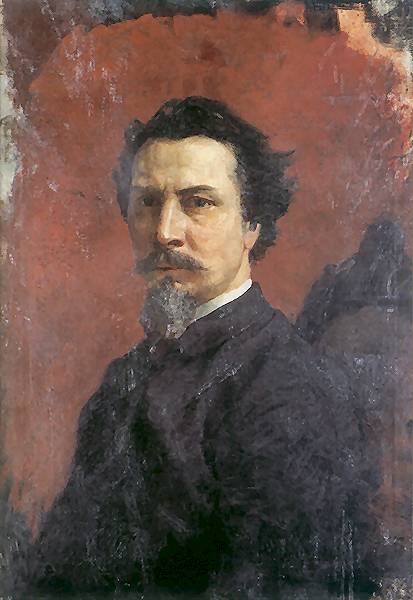
Siemiradzki, Henryk Ippolitovich—professor of painting (from 1877) and member of the Council of the Academy of Arts (from 1889)—was born in 1843, in the village of Pechenihy (near Kharkiv), where a regiment in which his father, Ippolit Eleuterievich, served was stationed at the time; he studied at Kharkiv’s 2nd Gymnasium, where the art teacher at the time was one of K. Brullov, Bezperchiy, who had the good fortune to be G. I.’s first mentor in developing his artistic talents.
G. I. then graduated from Kharkiv University’s Faculty of Physics and Mathematics with a candidate’s degree, awarded for his dissertation “On the Instinct of Insects.” While at the university, Siemiradzki continued to take lessons from the same D. I. Bezperchy, who introduced him to the basic techniques of painting.
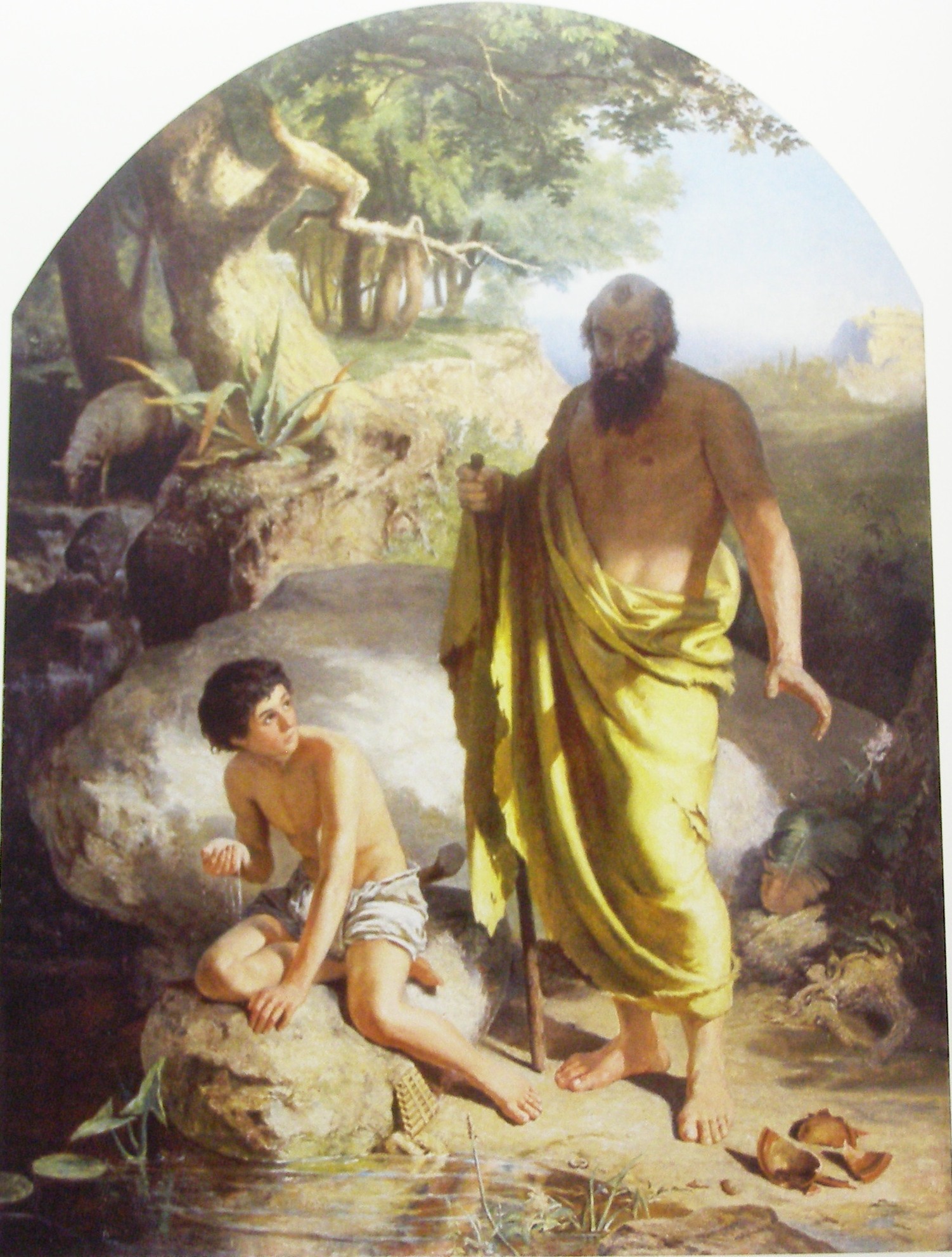
In 1864, G. I. enrolled at the Academy of Arts, initially as a non-matriculated student, and in 1866 he became a full-time student in the painting department. That very year, he received two silver medals—a small one for a drawing and a large one for a sketch—and from then on was awarded prizes every year. Having earned five silver medals, he was awarded a small gold medal in 1868 for the composition “Diogenes Smashing the Bowl,” and in 1869 —the first cash prize for his sketch “The Destruction of Sodom and Gomorrah.” In addition to this sketch, the Academy holds his sepia sketches “Christ’s Descent into Hell” and “The Massacre of the Innocents.”
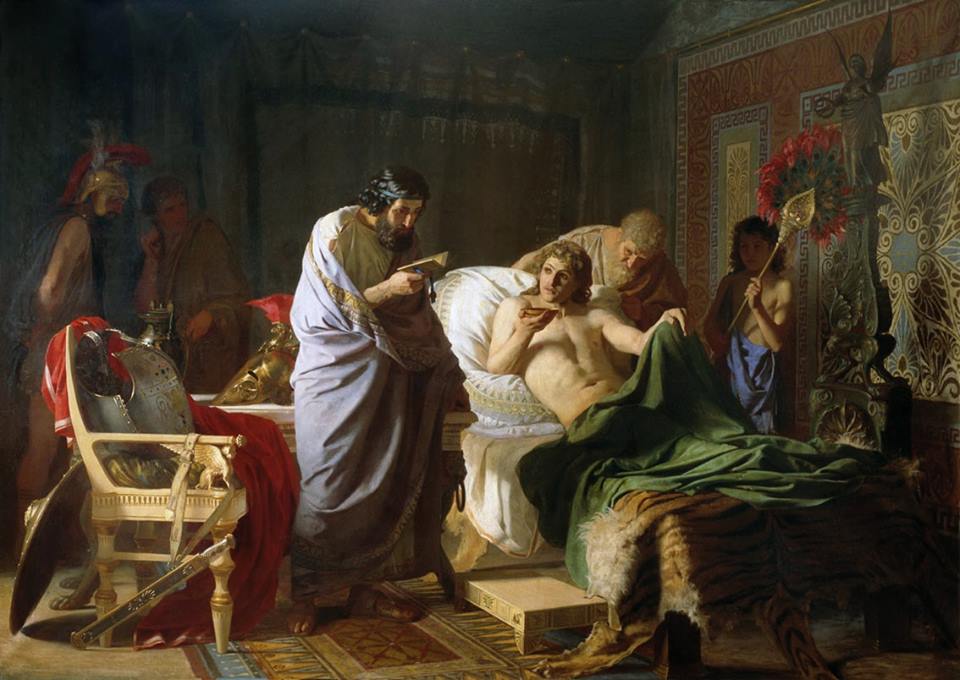
The following year, he was awarded a large gold medal, along with the title of First-Class Artist and the right to spend six years abroad as a pensioner of the Academy to carry out the program described here “Alexander the Great’s Trust in the Physician Philip.”
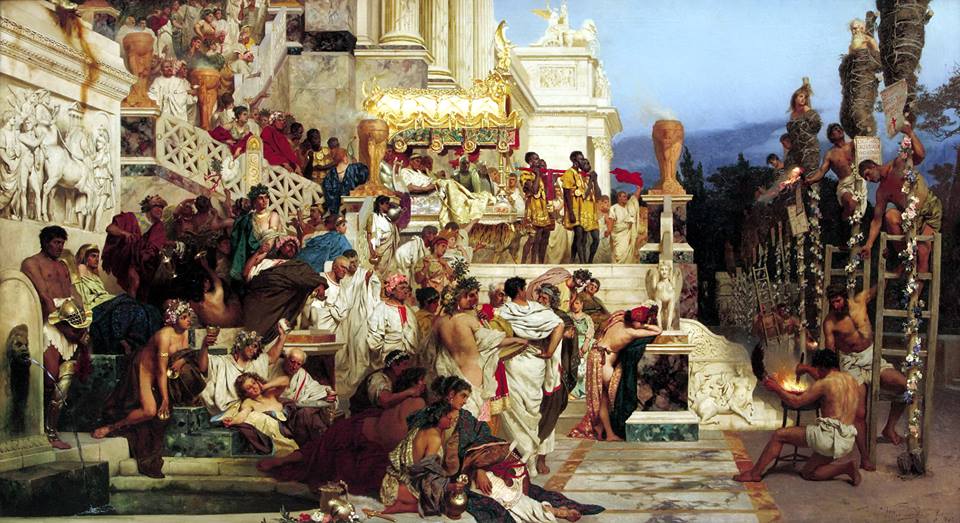
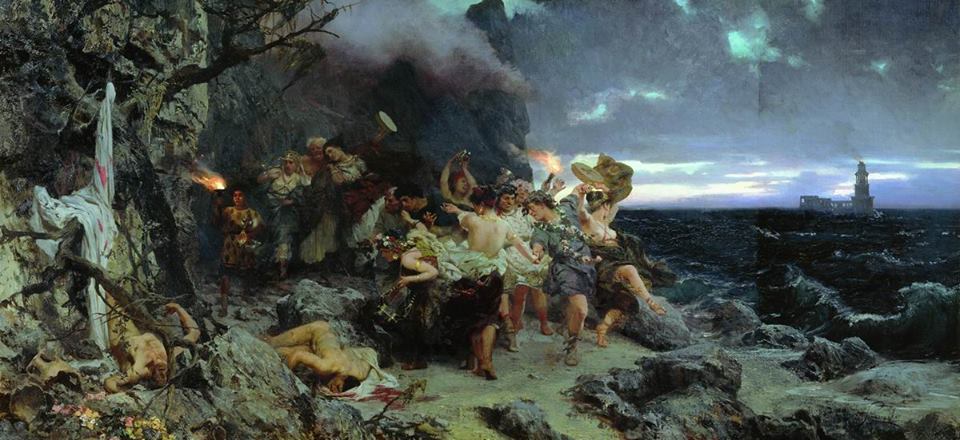
In 1871, G. I. traveled to Munich, where he painted the work we are reproducing here, *The Romans in the Glorious Days of Caesarism* (property of His Imperial Majesty). The Academy of Arts later acquired G. I.’s drawing based on this painting.
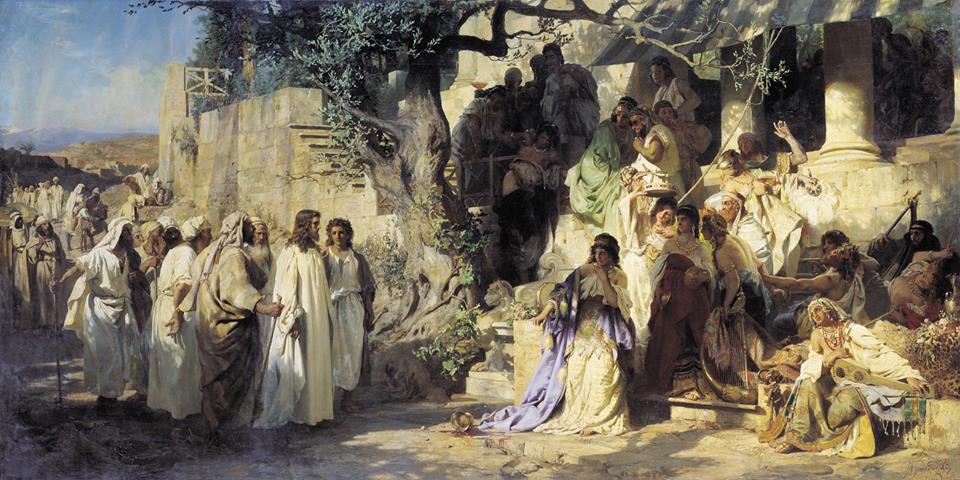
From Munich, he moved in 1872 first to Florence and then to Rome, where he painted his famous *The Sinner*, commissioned by Grand Duke Vladimir Alexandrovich, based on a scene from a poem by Count A. K. Tolstoy. This painting, which we are also reprinting, was acquired by the heir apparent, the Tsarevich—now the reigning Emperor—and a sepia reproduction of it was acquired by Grand Duke Vladimir Alexandrovich. For this work, the Academy conferred upon G. I. the title of academician (1873). In 1874, he painted *The Persecutors of Christians at the Entrance to the Catacombs* (which was acquired by Mr. Ivashov), and in 1876 he submitted sketches of sacred images—commissioned for him to execute in the Cathedral of Christ the Savior in Moscow—for Imperial approval.
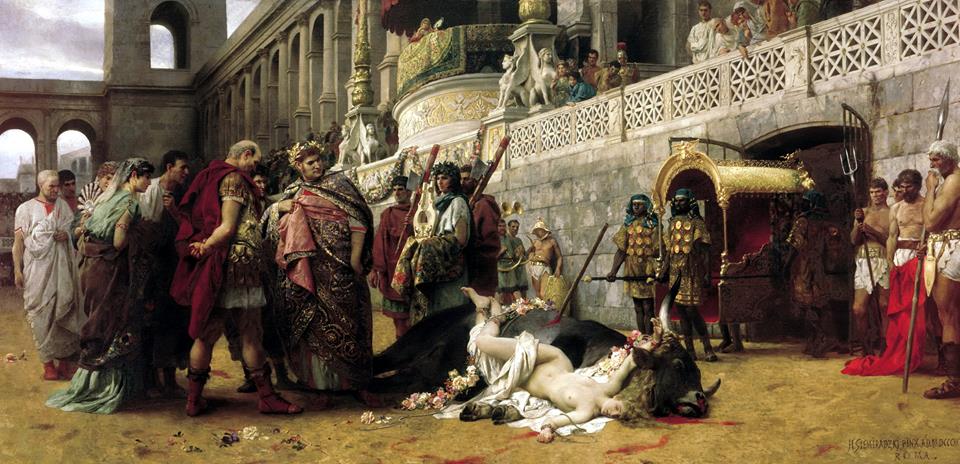
In 1877, G. I.’s pension-funded stay abroad came to an end, and the artist concluded it by creating a remarkable work that brought him worldwide fame: *The Lamps of Christianity*. For this painting, which depicts the persecution of Christians under Nero, the Academy awarded him the title of professor (1877), and on March 9, 1877, its council resolved to inform G. I. that all his “artistic work brings honor to the Academy and to Russian art.” For literary and musical works featuring Nero as their subject, this painting served as an inexhaustible source of inspiration. The plots of some foreign novels about Nero were drawn from this painting, and the set designs for plays on the same theme were also inspired by G. I.’s work. For *The Lamps of Christianity*, along with the painting *La femme ou la coupe?* (A Difficult Choice) at the 1878 World’s Fair in Paris, it was awarded the Grand Prix d’Honneur, and the artist received the Legion of Honor from the French government. At the same time, the Academies of Fine Arts in Berlin, Stockholm, and Rome (San Luca) elected G. I. as a member, and the Uffizi Gallery in Florence invited him to paint his own portrait for its historical collection of portraits by famous masters of all times and nations. The painting “Beacons” was donated by its author to the Kraków Museum; a copy of it is housed in the D. Botkin Gallery in Moscow.
G. I.’s artistic output was not limited to these major works, which brought him both fame and honors in Russia and abroad, as well as the highest awards. Among his major works, in addition to those that were featured in academic exhibitions and are listed below, the following are also worth mentioning:
1) “The Sale of Amulets”;
2) “Elegy” (from ancient life);
3) “The Roman Beggar” (Le naufrage);
4) “Dance Among Swords” (repeated twice);
5) “In the Time of Tiberius on Capri” (by K. T. Soldatenkov);
6) “The Resurrection of Christ” (in one of Warsaw’s Catholic churches);
7) “Christ Calming the Storm” (in a Protestant church in Kraków);
8) “The Wandering Priest of Isis”;
9) “The Glowing Worm”;
10) “The Chase After a Moth”;
11) “The Pirates’ Hideout”;
12) Ibid. (repetition with modifications);
13) “He and She”;
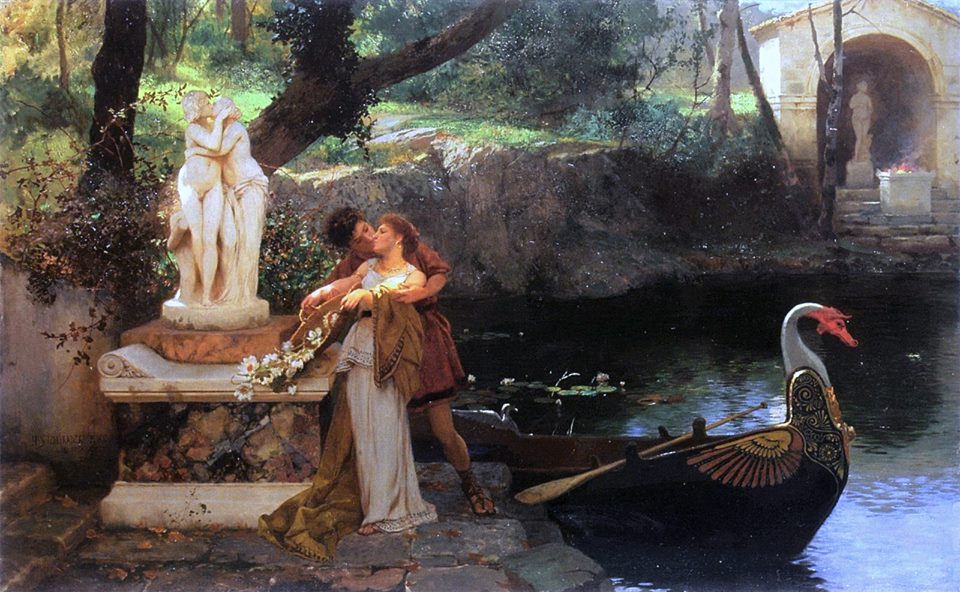
14) “Family Happiness” (from ancient life);
15–18) Four scenes from the life of St. Alexander Nevsky in the Cathedral of Christ the Savior in Moscow;
19) “The Baptism of Christ” (ibid.);
20) “Christ’s Entry into Jerusalem” (ibid.);
21) “The Last Supper”—an altarpiece (ibid.);
22) “Light and Darkness” (ceiling painting at Count Zawisza’s residence in Warsaw);
23) “Aurora” (ceiling painting in the home of Mr. Nechaev-Maltsev in Siberia);
24) “The Temptation” (owned by Grand Duke Konstantin Konstantinovich);
25) “Girls Listening to a Flute”;
26) “Song of a Slave Girl”;
27) “Classical Landscape”;
28) “A Patrician’s Rest”;
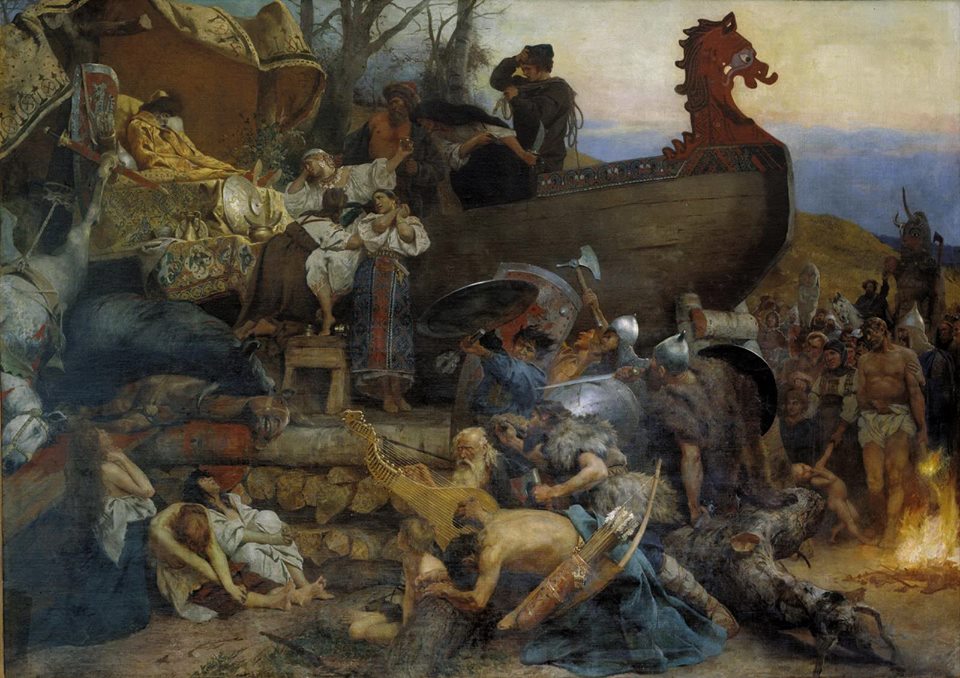
29) “The Funeral Feast of Svyatoslav’s Warriors” (at the Moscow Historical Museum);
30) “The Burning of the Rus’” (ibid.);
31) “The Martyrdom of St. Timothy and St. Maura”;
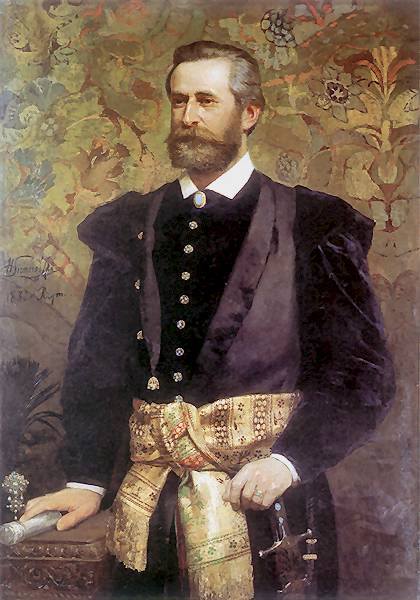
32) Portrait of Count Wadziecki;
33) Portrait of Prince Lubomirski;
34) Portrait of Countess Tyszkiewicz;
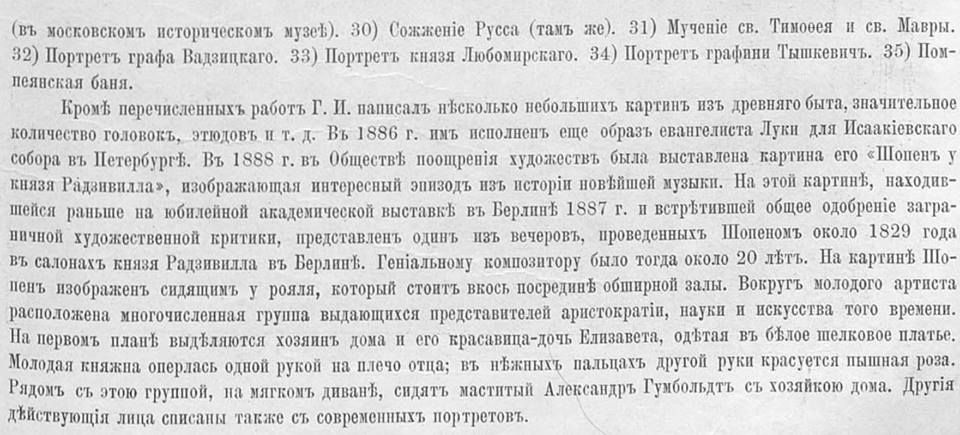
35) “The Baths of Pompeii.”In addition to the works listed above, G. I. painted several small scenes depicting ancient daily life, as well as a significant number of heads, sketches, etc. In 1886, he also painted a portrait of the Evangelist Luke for St. Isaac’s Cathedral in St. Petersburg. In 1888, his painting “Chopin at Prince Radziwill’s,” depicting an interesting episode from the history of modern music, was exhibited at the Society for the Encouragement of the Arts.
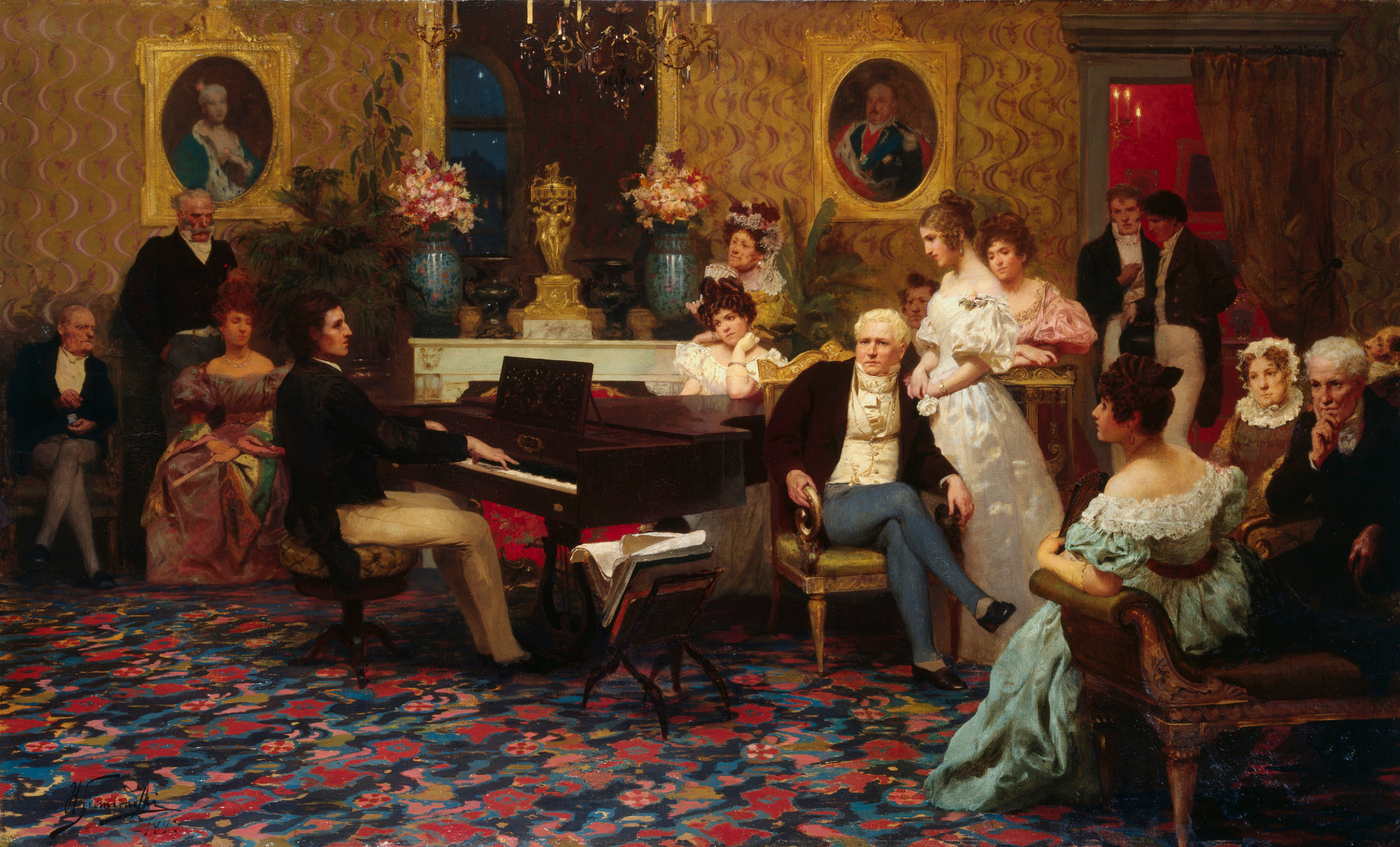
This painting, which was previously on display at the 1887 anniversary academic exhibition in Berlin and which met with widespread acclaim from foreign art critics, depicts one of the evenings Chopin spent around 1829 in Prince Radziwill’s salons in Berlin. The brilliant composer was about 20 years old at the time. In the painting, Chopin is depicted sitting at a grand piano, which stands diagonally in the center of a spacious hall. Surrounding the young artist is a large group of prominent figures from the aristocracy, academia, and the arts of that time. In the foreground are the host and his beautiful daughter, Elizabeth, dressed in a white silk gown. The young princess rests one hand on her father’s shoulder; a lush rose adorns the delicate fingers of her other hand. Next to this group, on a soft sofa, sit the venerable Alexander von Humboldt and the lady of the house. The other figures are also modeled after contemporary portraits.
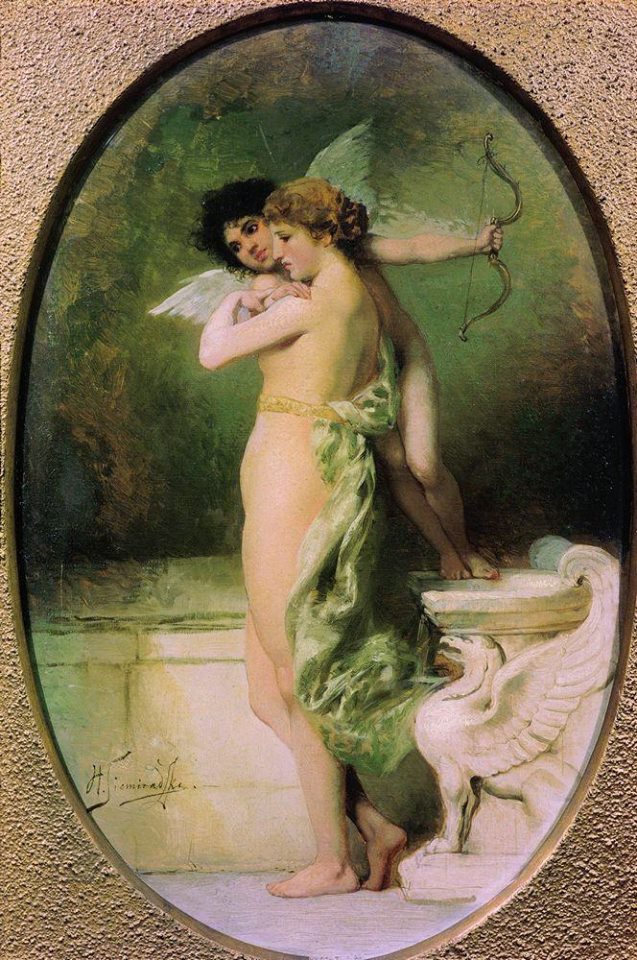
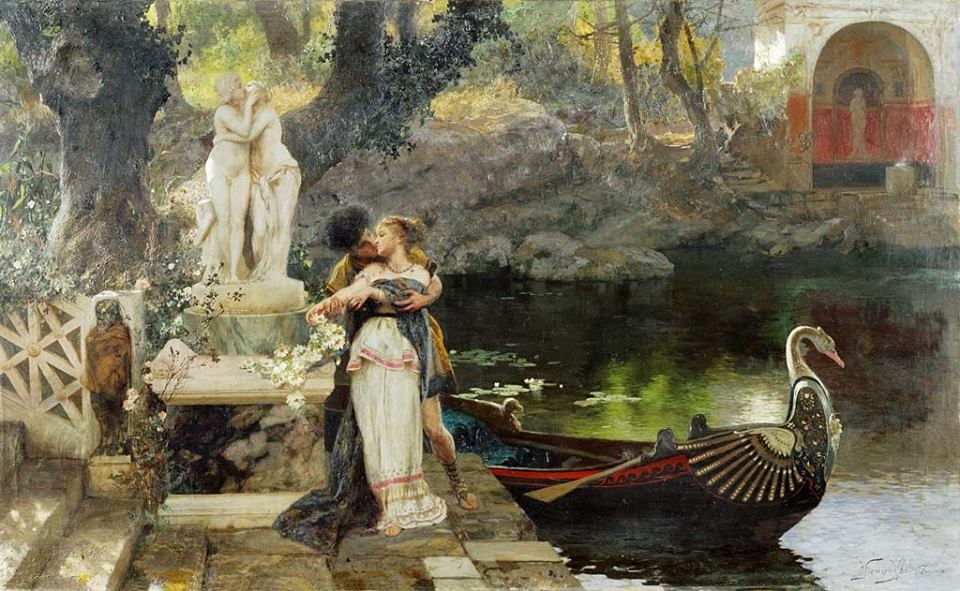
In 1889, G. I. Ustrayld organized a solo exhibition of five paintings in the halls of the Academy of Arts: “Before Bathing,” “At the Fountain,” “Following the Example of the Gods” (property of His Imperial Majesty). With the exception of “The Temptation of St. Jerome,” all of these paintings are reproduced in this edition. “Phryne” deserves special attention. The artist himself explains the subject matter as follows.
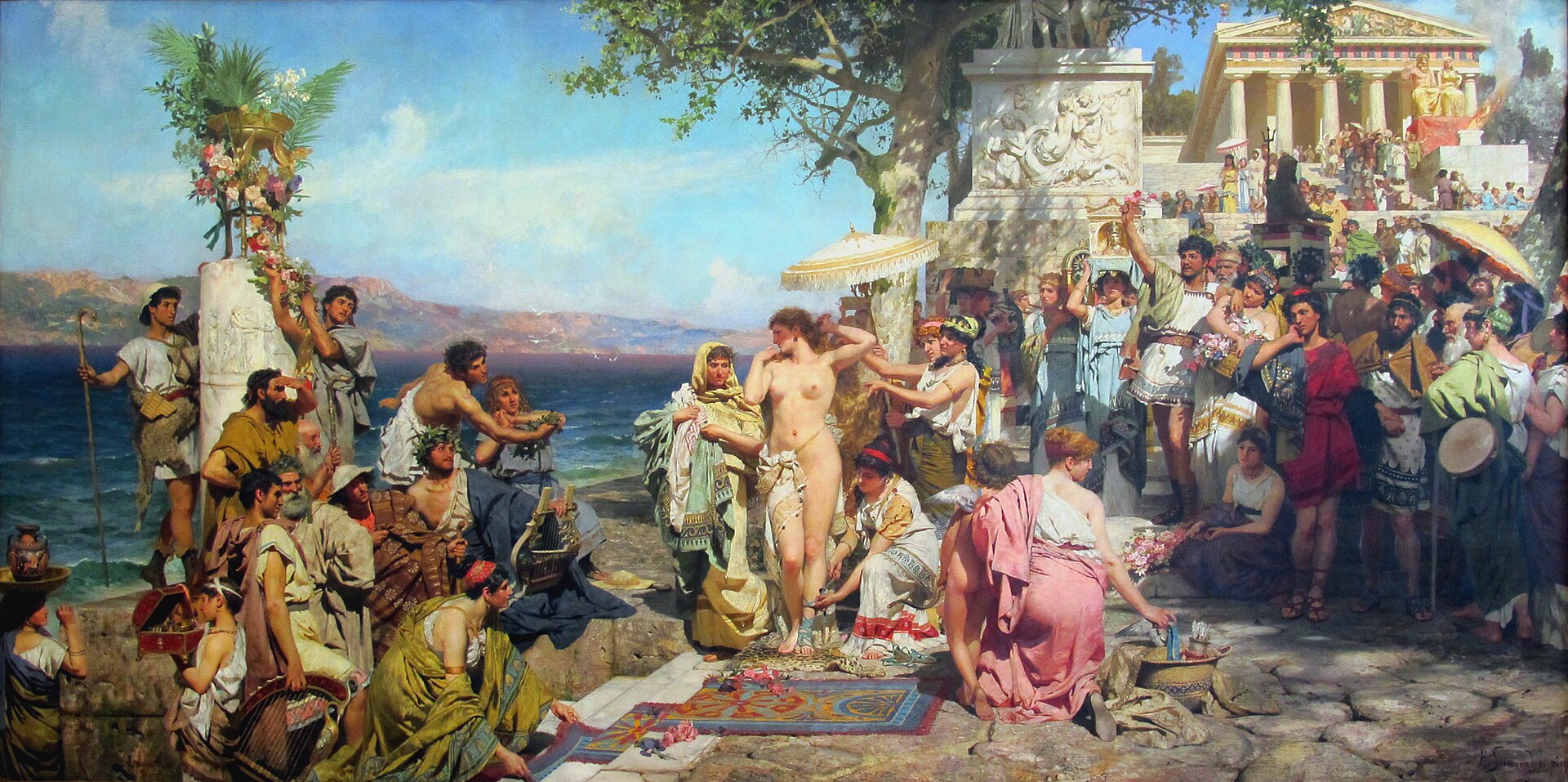
In the 4th century B.C., the beautiful hetaera Phryne was famous in Athens and throughout Greece; according to legend, as reported by the Greek compiler Athenaios of Naucratis, the sculptor Praxiteles, her lover, sculpted the statue of Aphrodite of Cnidus, and the painter Apelles painted Aphrodite Anadoimene. According to the same writer (“The Banquet of the Sophists,” XIII), “at the Eleusinian Festival and the Festival of Poseidon, Phryne, in full view of the assembled Greeks, removed her clothes, let down her hair, and entered the sea,” undoubtedly portraying herself as the goddess of love born from the waves and seeking thereby to perform an act of piety. The painting depicts this episode from the life of the famous hetaera. The hetaera and her companions are placed at the center of the painting. Phryne, in all her naked beauty, stands before a huge crowd, scattered in small groups, about to plunge into the waves. One of the maids, holding an umbrella in one hand and the beauty’s golden hair in the other, is about to shield her from the rays of the scorching sun, another holds her clothes, and a third spreads a rug across the marble steps down which Phryne is about to descend toward the sea. Since Aphrodite never appears without Cupid, one of Phryne’s attendants is busily adorning the child with the attributes of the god of love, tying wings to his back. To the left of this central group, which captures the viewer’s attention, a magnificent view of a sun-drenched landscape unfolds. This is the Gulf of Thessaloniki, with the mountains of the island of Salamis visible in the background. A poet, crowned with laurels, leans against a column. The face of this bard of the goddess of love shows rapture. He is likely delighted by the goddess’s victory. On the column with bas-reliefs stands a tripod bearing flowers gathered in honor of the deity. The people are so captivated by the beauty before them that they snatch the sacred flowers from the tripod and throw them at her feet. To the right, numerous groups are arranged in a colorful chain. In the distance, the Temple of Poseidon is visible. A religious procession moves in front of the temple. Priests carry images of deities on their heads. Young men crowned with flowers carry a bronze statue of Poseidon. Among the groups of people gathered, one draws particular attention for its lifelike realism and bold execution. A dashing young man, captivated by the hetaera’s perfect beauty, has fixed his dark eyes—burning with the heat of passion—upon her. As if intoxicated by his passion, he scatters flowers at Phryne’s feet, grabbing handfuls from the basket of the flower girl standing beside him. This girl is evidently his beloved. She is unable to hide her jealousy and timidity.
The Albertina Academy in Turin elected the author of *Phryne* as a full member, while the Paris Academy of Fine Arts elected him as a corresponding member.
The following works by G. I. are published here: “Christ and the Sinner,” “Lights of Christianity in the Time of Nero,” “The Orgy of the Glorious Days of Caesarism,” “An Ancient Dance Amid Swords,” “Alexander the Great’s Trust in His Physician Philip During His Illness,” “The Priest of Isis,” “The Amulet Seller,” “The Slave Girl’s Song,” “Summer Twilight in Pompeii,” “The Burning of the Rus,” “The Funeral Feast of Svyatoslav’s Warriors,” “Following the Example of the Gods,” “Isaurian Pirates Selling Their Booty,” “Before Bathing,” “By the Fountain” (two paintings), “Family Happiness,” and “Phryne in Eleusis.”
1867: “Divination with Molten Wax: Louis XI After Signing the Death Warrants”;
1868: “Diogenes Smashing a Bowl”;
1869: “The Savior’s Descent into Hell” (sepia). “The Destruction of Sodom” (sepia);
1870: “Alexander the Great’s Trust in His Physician Philip During His Illness”;
1872: “The Romans in the Glorious Days of Caesarism”;
1873 “The Sinner” (property of His Imperial Majesty the Emperor);
1874 “The Sinner.” — “The Sinner” (sepia) (property of Grand Duke Vladimir Alexandrovich);
1875: “The Amulet Seller”;
1881: “The Massacre of the Innocents” (sketch) (owned by the Academy of Arts). – “The Destruction of Sodom” (sketch). – “The Sinner.” “Alexander the Great’s Trust in the Physician Philip”;
1883 “Idyll”;
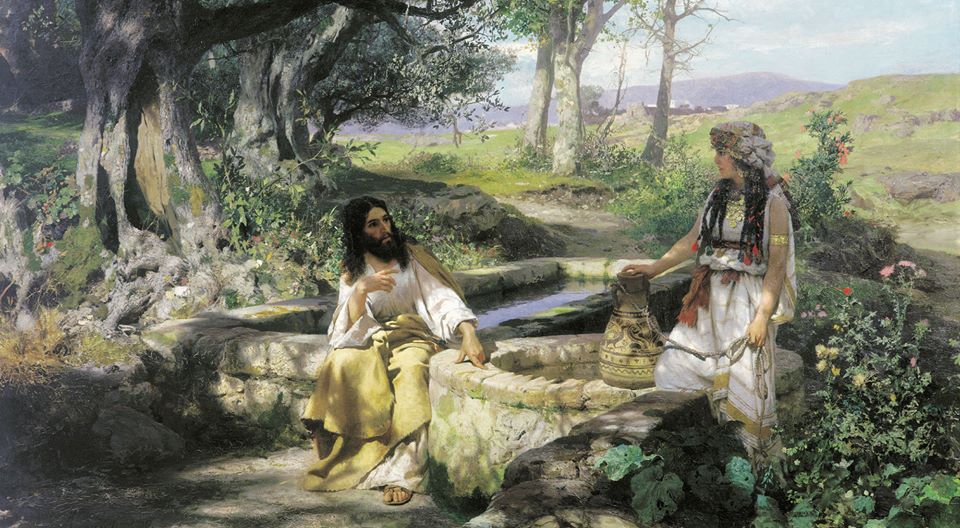
1887 “Christ at the Home of Martha and Mary” (property of the Academy of Arts). – “Scene from Ancient Life.
” 1889. Isaverian pirates selling their spoils (a scene from ancient life).At world’s fairs:
- 1873, Vienna. “The Sinner”;
- 1876, Philadelphia. “The Amulet Seller” (the artist was awarded a gold medal for this painting);
- 1878 in Paris. “The Lamps of Christianity.” “Woman or Cup?” “Shipwrecked”;
- 1882, at the All-Russian Exhibition in Moscow. “Alexander the Great’s Trust in the Physician Philip.” “Christ and the Sinner.” “An Ancient Dance Amid Swords” (owned by K. T. Soldatenkov). “Lights of Christianity” (owned by D. Botkin). “An Orgy in the Time of Tiberius on Capri” (owned by K. T. Soldatenkov).
At traveling academic exhibitions:
- 1887 in Yekaterinburg and Odessa;
- 1888 in Riga;
- 1888–1889 in Kyiv;
- 1889, Kazan: “Christ at the Home of Martha and Mary.”






- About the military pilot school and the airfield in Kharkiv… - 04.11.2020
- Nikanor Savich—A Political Career by Mistake - 13.07.2020
- And once again, about the Cavalry Guards… - 21.01.2020