To this day, Moisey Dikansky remains one of the most enigmatic figures in Kharkiv’s architectural history.
He is credited with designing more than a dozen mansions in our beloved city. However, there is not a single document to confirm this.
However, it can be said with certainty that Moisey Gershovich Dikansky was a brilliant architectural theorist.
His works, which have been reprinted numerous times, are considered among the first scholarly works in the Russian Empire to analyze various ways in which the state could encourage private initiative in addressing urban problems, as well as in the development and improvement of cities.
In January 1907, he gave his first presentation to the St. Petersburg Society of Architects and Artists, delivering a lecture titled “The Housing Crisis,” which was later published in the journal *Zodchiy*.

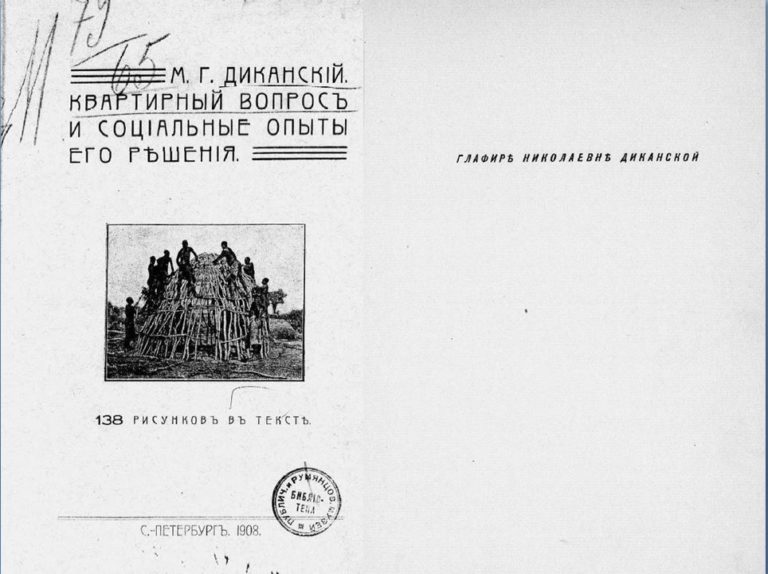
In 1908, Dikansky wrote the book *The Housing Problem and Social Experiments in Solving It*. The issues addressed by the author were so relevant and pressing that the book was reprinted. Dikansky began it with the following words:
It hardly needs to be proven that the housing issue is one of the most pressing issues of our time and one of the most important social problems of the “turn of the century.” The large-scale industry of our time, which generates immense national wealth and, for this purpose, out of economic necessity sharply divides society into classes—those who own everything and those who have almost nothing—naturally subjects the latter to incredibly harsh living conditions. Such glaring housing poverty among the urban masses is but one of the main conditions of the generally harsh existence of the “stepchildren of our culture,” which P. J. Proudhon once fiercely denounced with these words: “There is no fact more shameful for our celebrated culture than the complete homelessness of the vast majority of the population in large cities. And this concerns the most vital aspect of our moral and family life! In this respect, we are worse off than savages: the troglodyte has his cave, the Australian his tent, the Indian his hut, while the modern proletarian is, in effect, suspended in midair…”
At the International Construction and Art Exhibition held in St. Petersburg in 1908, it was for this very book that Moisey Dikansky received a certificate of commendation from the Ministry of Trade and Industry.
This outstanding architectural theorist of the early 20th century never forgot our beloved city.
Dissatisfied with the draft of mandatory regulations regarding construction for Kharkiv residents, Dikansky delivered a comprehensive presentation at a general meeting of members of the Kharkiv branch of the Russian Technical Society titled “The Draft of Mandatory Regulations and Urban Development in Kharkiv.” Many of the issues raised by Dikansky remain relevant to our city to this day.
In the Kharkiv newspaper *Utro*, dated May 21, 1913, we read:
Yesterday, under the leadership of V. I. Ryumin, a general meeting of the members of the Kharkiv branch of the Russian Technical Society was held.
Engineer M. G. Dikansky delivered an extensive and interesting presentation on a highly topical subject:
“Draft Mandatory Regulations and Urban Development in Kharkiv.” The main point of the report is that there is currently an urgent and pressing need to redevelop the city of Kharkiv and establish special residential districts within it. The draft mandatory regulations on construction for Kharkiv residents, developed by the city administration, remains silent on this crucial issue: it does not provide for density standards—either for individual land plots or for the total urban area—based on building height; it lacks a master plan and offers no broad vision for the future development of the city’s territory. Citing a number of examples of urban development in foreign cities, the speaker points out that the portion of territory allocated for the first central district—which contains the tallest buildings—ranges in different cities from 1/5 to 1/10 or less of the city’s total area.
To illustrate this relationship specifically using Kharkiv as an example, the central district with the tallest buildings would be bordered to the north by Basseynaya Street, to the south by Voskresenskaya Street, to the east by Konnaya Square, and to the west by Aleksandrovskaya Street. With the establishment of this new type of residential district, Paragraph 28 of the mandatory regulations—which sets the minimum street width at 10 sazhens—must be repealed. The rapporteur then addressed the question of how the introduction of the proposed building height restrictions would affect the financial interests of landowners: such a restriction would significantly curb the rise in land prices in those areas where it is implemented. The speaker then noted that the regulations impose a number of prohibitions and restrictions that limit private owners’ right to use their property, as this infringes upon the public interest. In conclusion, the speaker stated: “Every improvement is brought about first and foremost by the force of public opinion. Everything that has already been achieved in Kharkiv in terms of urban development—such as the tram system, sewerage, and so on—came about after these issues had taken root and matured in the public consciousness. The same applies to the future of Kharkiv—the crucial issue of its revitalization and beauty (and beautiful cities are, after all, wealthy cities) depends to a large extent on that same force of public opinion. The time has come to raise awareness of this issue and promote it in public forums, at meetings, and in the press. The future of Kharkiv in the not-too-distant future depends on this: whether it will be a haphazard mass of crammed barracks with cramped, unhealthy courtyards, or whether it will be a picturesque urban landscape with well-planned streets, hygienic homes, and beautiful outskirts; whether there will be, in the city of Kharkiv—spread over an area of 10 million square sazhens—even a small corner where one could breathe clean air and enjoy the proximity of fields, where, in the poet’s words, “instead of black masses of rectangular boxes, there are cheerful little houses, gardens, and trees gilded by the sun’s rays.” The presentation was accompanied by a slide show. The speaker was thanked.”
And on May 28, 1913, the full text of the aforementioned report by Moisey Dikansky “The Future of Kharkiv Regarding the Draft Mandatory Regulations on Construction” was published in the newspaper *Utro*, where all residents of our city could read it.
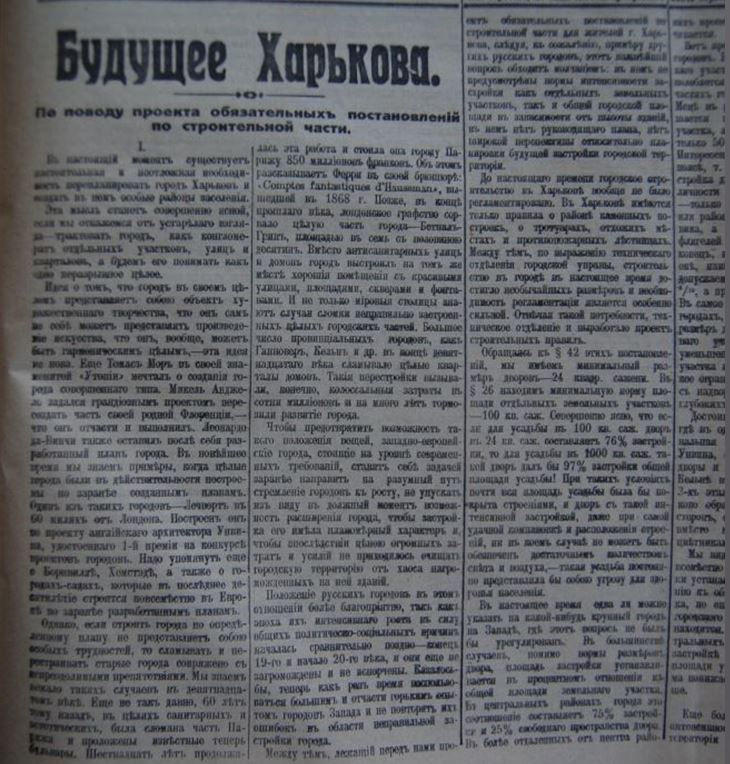
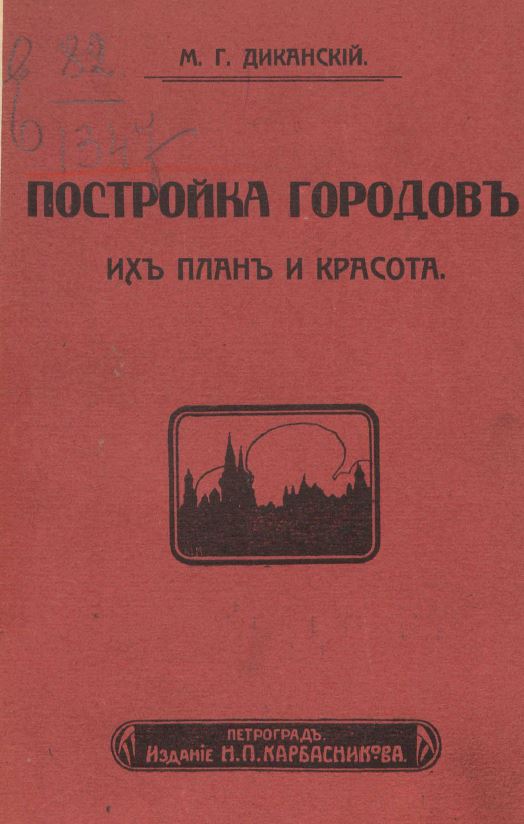
Based on this work, Dikan later wrote papers on urban improvement and planning, and in 1915, his book *The Construction of Cities, Their Planning, and Beauty* was published.
Years have passed. The name and works of this outstanding urban planner in our city have been forgotten and are unknown. Yet, the question he raised in his 1913 report remains: “What will Kharkiv be like in the not-too-distant future: Will it be a haphazard mass of crammed barracks with cramped, unsanitary courtyards, or will it be a picturesque urban landscape with well-planned streets, hygienic homes, and beautiful outskirts?!” and remains extremely relevant to this day.
Unfortunately, there is no answer to that question yet.

- About the military pilot school and the airfield in Kharkiv… - 04.11.2020
- Nikanor Savich—A Political Career by Mistake - 13.07.2020
- And once again, about the Cavalry Guards… - 21.01.2020