Some events that were extremely important for Ukraine—which took place in our most beloved city in 1912–1913—are either not written about at all, mentioned only in passing and without detail, or simply attributed to Kyiv.

Of course—after all, just one week after Nikolai Lysenko’s death on November 1 (October 24, Old Style) 1912, Mykola Mikhnovsky, a member of the Kharkiv Duma, submitted a petition to Nikolai Evdokimovich Dorofeev, the acting mayor, calling for the preservation of the memory of composer Nikolai Lysenko in our city.
In his statement, Mikhnovsky writes, in part, as follows:
On October 24, 1912, the renowned Ukrainian composer Mykola Lysenko passed away in Kyiv. His contributions to our people are truly immeasurable…
…The late composer was educated at the Second Kharkiv Gymnasium and attended lectures at Kharkiv University. It was also in Kharkiv that N. Lysenko began his musical education. Thus, Kharkiv can take pride in the fact that the first seeds of the great composer’s sensibilities and inspiration were sown in his soul by the atmosphere of Kharkiv, which at that time was called the “Ukrainian Athens.” It is only fitting that Kharkiv honor its great son and immortalize his memory.
Further on, at the very end—after listing the proposals to establish scholarships named in honor of Lysenko—Mykola Mikhnovsky also proposes allocating 3,000 rubles for the construction, specifically in Kharkiv, of a bust commemorating the late composer.
That is how the story began of the construction in Kharkiv of the world’s first monument to Mykola Lysenko. After all, there were no such initiatives in other cities of the Russian Empire at that time. Of course, it’s impossible to describe all the twists and turns and events that spanned at least a year and a half in a single article. I’m also confident that I’ll find answers to a number of questions through painstaking research in the archives. However, on the whole, the key points related to the erection of a monument to the greatest Ukrainian composer in our city are already clear to me. It is precisely these points that I am publishing for the first time.

Thus, at the Kharkiv City Duma session on November 16, the deputies honored the memory of Mykola Lysenko and officially tasked a special commission with exploring the possibility of erecting a monument to him in Kharkiv. In early February 1913, the Kharkiv City Duma adopted a resolution:
- To establish a scholarship in his name at the Kharkiv Music School in the amount of 100 rubles per year, to be awarded to one of the school’s students (a Ukrainian).
- Name one of the city’s existing scholarships at the art school after him.
- The Historical and Philological Society of Kharkiv University shall establish an annual award of 100 rubles for the best student essays on Ukrainian ethnography related to folk songs and music.
- Display a portrait of Lysenko at the city drama theater.
The report by Duma members N. F. Sumtsov, V. M. Ponomarenko, I. V. Kulynich, and N. I. Mikhnovsky on the issue of erecting monuments to prominent Ukrainian figures. The rapporteurs noted that these monuments should be erected in a specific sequence. First, to Taras Shevchenko; then to Kvitka-Osnovyanenko; and finally, to Mykola Lysenko. The Parks Commission, having taken into account all architectural and artistic considerations, proposed the following locations for the monuments:
— a site in the northern part of Mykolaiv Square for a monument to T. G. Shevchenko;
— in Myronosytska Square, on a site facing Sumska Street—a monument to Kvitka-Osnovyanenko;
— in the center of the site located next to the Veterinary Institute (now the Kharkiv Regional Palace of Children’s and Youth Creativity), across from the building of the provincial zemstvo administration (the regional administration is now located on this site).

On June 11, the City Administration submitted a comprehensive report to the City Council on the construction of monuments to Shevchenko, Kvitka-Osnovyanenko, and Lysenko, and proposed allocating 3,000 rubles to the fund for the construction of a monument to Mykola Vitalievich. The contributions were to be divided into three equal installments of 1,000 rubles each per year, beginning in 1913. It was also proposed to authorize, in accordance with established procedures, the collection of donations for these monuments within Kharkiv and the province. According to a preliminary estimate, the total cost amounted to 100,000 rubles (50,000 for the Shevchenko monument and 25,000 each for the monuments to Osnovyanenko and Lysenko). On June 15, despite a series of debates, the special commission’s report was adopted by the Kharkiv Duma. In October 1913, newspapers throughout the empire were focused solely on the scandalous Beilis case, while in Kharkiv, local issues were the main topic of discussion.

On October 9, 1913, the city council received a statement intended for the Duma from Nikolai von Ditmar, a member of the State Council who was extremely influential both in Kharkiv and throughout the empire. In it, he wrote the following:
At upcoming City Council meetings, members of the commission on the monuments to Shevchenko, Kvitka-Osnovyanenko, and Lysenko are to be elected. The work of the recently deceased Lysenko falls within the realm of music, and it seems to me that the question of a monument to him should be postponed until the significance of his musical work has been more thoroughly clarified. No detailed report on this matter has been submitted to the City Council. Therefore, both for me personally and for many council members (as I have ascertained through inquiries), Lysenko’s significance in the field of local music and the scope of his musical output—for example, in comparison with Glinka, Tchaikovsky, Dargomyzhsky, Serov, Rimsky-Korsakov, Borodin, Cui, and others; in other words, Lysenko’s place in the Russian pantheon of music and theater has not been clarified. Only leading experts in the field of music can determine his place in that pantheon. On the other hand, perhaps the time has not yet come for a proper assessment of the late composer. Therefore, I propose that the question of a monument to Lysenko be postponed. But it seems to me that this commission should be tasked with the question of a monument to Lermontov. The Duma passed a corresponding resolution long ago and allocated funds, but many years have passed and nothing has been done. And the significance of Lermontov’s brilliant works for our culture goes without saying.

This statement had such an impact on newspaper readers that on October 11, for example, the newspaper *Utro* published a scathing piece by A. Smolyanov in its “Untitled” column. In it, the author, quoting von Ditmar, suggests the following in a highly ironic tone:
…No wonder, then, that Councilman von Ditmar, having crossed out Lysenko, suggests:
“But a monument to Lermontov should have been erected long ago.”
Lermontov’s significance for local poetry has obviously already been established. But is that really true? Or perhaps it hasn’t been established either? Let Councilman von Ditmar have a chat with those very same council members with whom he spoke about Lysenko. What if it turns out that:
“It hasn’t been established.”
Then what? We don’t need monuments to either Lermontov or Lysenko. Better yet, let’s erect a monument to the “vocalist” von Ditmar. With the inscription: “For his efforts to clarify Lysenko’s identity.” And on the reverse side, in Slavic letters: “Good are those who think firmly. I say so.”

The controversy surrounding the monument to Mykola Lysenko continued to escalate. The October 15 session of the Kharkiv City Duma was quite scandalous. Once again stating his position on the monument, Councilman von Ditmar emphasized that October 14, 1914, marked the 100th anniversary of Lermontov’s death, and, given Lysenko’s unclear significance in the world of music, he proposed rejecting the monument’s installation. In response, Nikolai Mikhnovsky said the following:
On my own behalf and on behalf of the Ukrainian council members, I express my deep satisfaction with the proposal to erect a monument to Lermontov. Of course, monuments are necessary for Lermontov, Turgenev, and many other great figures. But I strongly protest against forcing great deceased figures of different nationalities to compete with one another, as Councilman von Ditmar is doing, for he proposes postponing the monument to Lysenko and erecting one to Lermontov instead. I, however, would say: both deserve a monument; there is plenty of space not only in the world but also in Kharkiv, while great people are very few.
We should not foster rivalry among the great departed, especially since the living—who cherish the spirit of the departed—will follow in their footsteps. And this leads to a futile national struggle. Ukrainians wish to live peacefully alongside their Russian brothers, and Mr. von Ditmar is sowing unwanted discord.
Nikolai Mikhnovsky then stated that von Ditmar, by proposing to postpone the Lysenko monument, actually—judging by his arguments—wants to cancel the decision to raise funds for it altogether, and continued:
Councilman von Dietmar demands that “leading experts” determine what place Lysenko might occupy in the Russian pantheon. We Ukrainians are too modest to dream of places in the Russian pantheon: our dreams are limited to the Ukrainian pantheon, in which Shevchenko and Lysenko will occupy the top spots.
Mikhnovsky then quotes von Ditmar’s opinion of Pyotr Ilyich Tchaikovsky’s Lysenko and highlights Nikolai Vitalyevich’s immense significance for the entire Ukrainian people. “That is why we, the Ukrainians, are submitting a request to the Duma to erect a monument to Lysenko!”
It’s simply impossible not to quote the exchange that ensued:
Von Dietmar:
“Apparently, Council Member Mikhnovsky did not understand my statement. If I had considered Lysenko unworthy of a monument, I would not have hesitated in the least to say so. I maintain that there was no such report on Lysenko’s significance. Councilman Mikhnovsky emphasizes Lysenko’s significance, saying that the monument is being erected by Ukrainians, but I thought the Russian people were erecting a monument to Lysenko, not some other people…
“The Ukrainian people!!!” Mykola Mikhnovsky shouted in response.

Von Dietmar:
“Find out exactly what Lysenko stands for, and erect a monument to him in accordance with that.”
Mykola Mikhnovsky:
“We live in Ukraine, and there are 27 million Ukrainians living in Russia—and Mr. von Ditmar, a member of the State Council, doesn’t know that?!”
von Dietmar:
“I live in Russia and know only the Russian people.”

Council Member Poddubny:
“I move that we reaffirm the Duma’s previous resolution and recommend that Representative von Ditmar familiarize himself with the significance of Lysenko.”
As a result, the Kharkiv Duma unanimously reaffirmed its previous resolution to erect a monument to Lysenko and allocate 3,000 rubles for it. A special commission was also established to oversee the construction of monuments to T. G. Shevchenko, G. F. Kvitka-Osnovyanenko, and N. V. Lysenko. Its members included Duma councilors V. M. Ponomarenko, V. E. Morokhovets, V. G. Korenev, S. A. Raevsky, D. I. Bagaley, V. V. Velichko, and N. I. Mikhnovsky.
There is no doubt that Nikolai von Ditmar’s particularly harsh remarks in the city council stirred up the local Ukrainian intelligentsia. As early as October 22, an article by Konstantin Bich-Lubensky titled “Composer N. V. Lysenko and His Significance in Music” was published in the press. In it, the author notes that the fundamental issue raised by von Ditmar demands an answer. Pointing out Lysenko’s immense significance for Ukraine, Bich-Lubensky concludes his piece with the following words:
Just look what national intolerance can lead to! Is it any wonder, then, that on these grounds, there’s no need to erect a monument to our own Lysenko in his homeland! But God, who sees all, is alive.

At its meeting on October 21, the Kvitka-Osnovyanenko Society expressed its gratitude to Nikolai Mikhnovsky for his great efforts and initiative in organizing the erection of a monument to N. Lysenko by the Kharkiv City Council.
In late November, a local Kharkiv sculptor, Mr. Richa, presented a model of a monument to Mykola Lysenko to the city council. It was an obelisk on a wide pedestal, featuring a bust of the composer with his arms crossed over his chest. At the base, with one knee bent on one of the steps, a Ukrainian boy was writing the composer’s last name on the obelisk.

However, the world’s first monument to Mykola Lysenko was never destined to grace our city. In 1914, World War I broke out, and then the Bolsheviks plunged the country into bloody chaos… No one had time for such things. In a city where so much is connected to the famous Ukrainian composer, nothing—except for the sculptural composition “Lysenko’s Music” on the facade of the KHATOB building (created by sculptor S. Yastrebov), serves as a reminder of Lysenko.
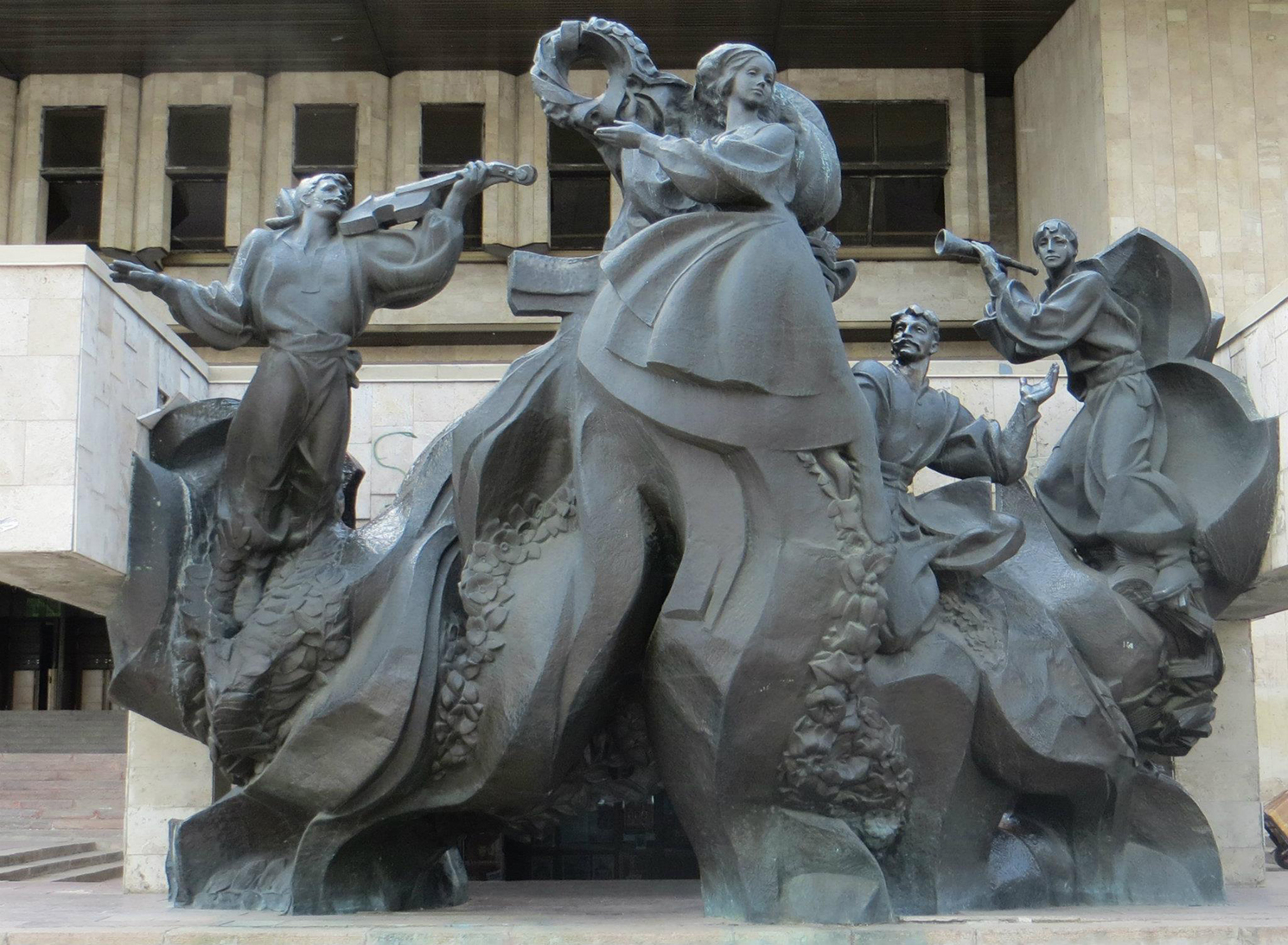
However, I am confident that one day we will take a walk together through Lysenko’s haunts in Kharkiv, and that we will honor the debt we owe to our ancestors, who sacrificed their savings to build the monument in the early 20th century.
At this point, I would sincerely like to say, “The end of the story.” Alas, I cannot. After all, the design competition for a tombstone for Mykola Lysenko took place in 1913, right here in Kharkiv.

- About the military pilot school and the airfield in Kharkiv… - 04.11.2020
- Kharkiv Artisans and the 1887 Exhibition - 17.08.2020
- Nikanor Savich—A Political Career by Mistake - 13.07.2020