So, dear readers, let’s continue our exploration of Kharkiv’s legendary yet little-known underground passages! You can read the previous part here.
On July 24, 1913, one of the first meetings of the Commission on the Investigation of Underground Passages in the City of Kharkiv took place.
They were subsequently published in the *Bulletin of the Kharkiv City Duma*, No. 8, 1913, and Nos. 6–7, 1914.
We invite you to take a look at them as well.
Meeting on July 24, 1913
In attendance were: Z.Yu. Kharmanksy, A.I. Linnik, G.P. Pavlovsky, B.A. Kustersky, and N.S. Stepanov, a junior engineer with the Kharkiv Provincial Administration.
A proposal from the Governor of Kharkiv, dated July 2 of this year and numbered 2199, was submitted regarding the conduct of a detailed study of the underground passages discovered in the city of Kharkiv in order to prevent potential accidents during urban construction.
The chair asked for comments on the methods of the proposed study, noting that, while the issue was being discussed from the perspective of a broad investigation of the mountain’s underground passages Kharkiv—which is highly desirable from an archaeological standpoint—the Commission nevertheless unanimously decided to refrain from new excavations, both because the passages are located primarily on private property and because of the high cost of such work. It was then decided by a majority vote to conduct a study of the passages that had already been discovered, based on the available documentation on the subject; to this end, the secretary of the Technical Department was instructed to compile all relevant material by the Commission’s next meeting, including Professor Morozov’s well-known work on the underground passages of Kharkiv.
In conclusion, the Commission decided to mark both existing and proposed structures on a map of the city of Kharkiv, in order to inform property owners and builders—in the event of structural collapse—of the necessary precautions to take when erecting foundations and walls.
Meeting on July 31, 1913.
Those present were: Z.Yu. Kharmanksy, G.P. Pavlovsky, B.A. Kustersky, V.N. Matrosov, and N.S. Stepanov, a junior engineer with the Construction Department of the Kharkiv Provincial Administration.
The Commission, upon reviewing the materials submitted for the meeting regarding the investigation of underground passages, noted that such information should be supplemented with archaeological findings and data undoubtedly available to the local archaeological commission. In light of this, at the suggestion of Engineer V.N. Matrosov, it was decided to invite a representative of the Archaeological Society to join the Commission as a member, and to request that the Society provide all available materials on the matter under consideration.
In order to subsequently present specific data from the investigation to the Commission, it was decided that the full membership of the Commission would conduct an inspection of the sites where underground tunnels and sinkholes in the pavement had previously been discovered.
It has been decided that all relevant data will be presented for discussion at the Commission’s meeting on Wednesday, August 7, at 12:00 p.m.
Meeting on August 9, 1913.
In attendance were: Council member Z.Yu. Kharmanksy; members: N.S. Stepanov, junior engineer of the Construction Department of the Kharkiv Provincial Administration; city architects G.P. Pavlovsky and A.I. Linnik; City Engineer B.A. Kustersky; Secretary M.M. Yevseyenko.
The following were heard: A report from the chairman stating that on Friday, August 2, the full Commission inspected the underground structures discovered on the grounds of Freiman’s and the Commercial Club, a report by Engineer Kustersky on the excavations he had begun in the specified area, the vent he had discovered, and the approximate estimate he had prepared in the amount of 1,711 rubles and 9 kopecks for conducting surveys in the area of Rymarskaya Street. The Commission, noting that the underground structures discovered in the area of Rymarskaya Street pose no danger to either traffic or construction, and bearing in mind the high cost of the excavations, resolved to temporarily suspend such excavations in the area of Rymarskaya Street, and reported this to the City Council; Engineer Kustersky requests that a plan of the underground structures in the specified area be drawn up; that an inspection be conducted of the site of the pavement collapse on Soborny Lane and of the underground passages discovered in the courtyard of the Azov-Don Bank and on Nikolaevskaya Square.
In its inspection report on the aforementioned underground structures, the commission noted the following:
1. On the grounds of the Azov-Don Bank, at No. 2 on Nikolayevskaya Square—where the Commission conducted an inspection—according to a note from the Construction Department of the Provincial Administration dated August 5 of this year, No. 2552, two old brick arches were observed in the excavations dug for the new building under construction, apparently covering underground galleries. No other traces of any underground structures were found, and it was not possible to conduct further investigations due to the ongoing construction work.
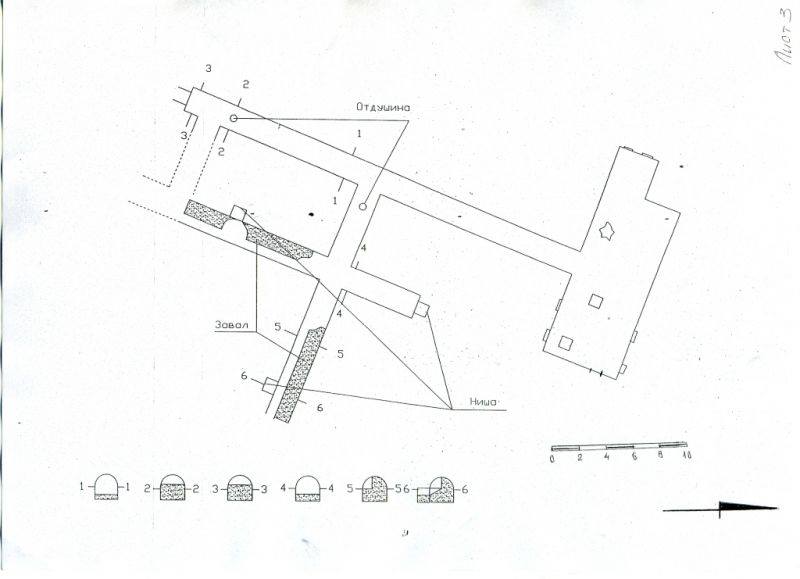
2. In light of the collapse of the pavement on Soborny Lane in 1910, the basements of Zheverzheev’s store, located at the corner of Soborny and Goryainovsky Lanes, were inspected. It was discovered that an entire system of underground corridors with ancient brick vaults adjoins these basements. The corridors are large enough for a person to move around freely; the floors of some of them are sloped. The corridors are located partly beneath Sobornaya and Goryainovsky Lanes and have branches in the form of dead ends. These structures were found to pose no danger to street traffic; the collapse that occurred in 1910 can be attributed to construction work taking place at that time and a heavy rainstorm. It was deemed advisable to draw up a map of all the inspected passages.
3. Pursuant to instructions from store manager Zheverzheev, the underground passages on the courtyard property of Ruf’s heirs on Goryainovsky Lane, No. 7, were inspected; these consist of two corridors: one leads to the city hall on Nikolayevskaya Square, and the other to the Severny Hotel. It was also determined that they are safe and that it would be advisable to draw up a plan.

- The Cellars of the Holy Intercession Monastery - 18.01.2016
- The Mysteries of Kharkiv's Underground. Part 5 - 09.01.2016
- The Mysteries of Kharkiv's Underground. Part 4 - 29.12.2015