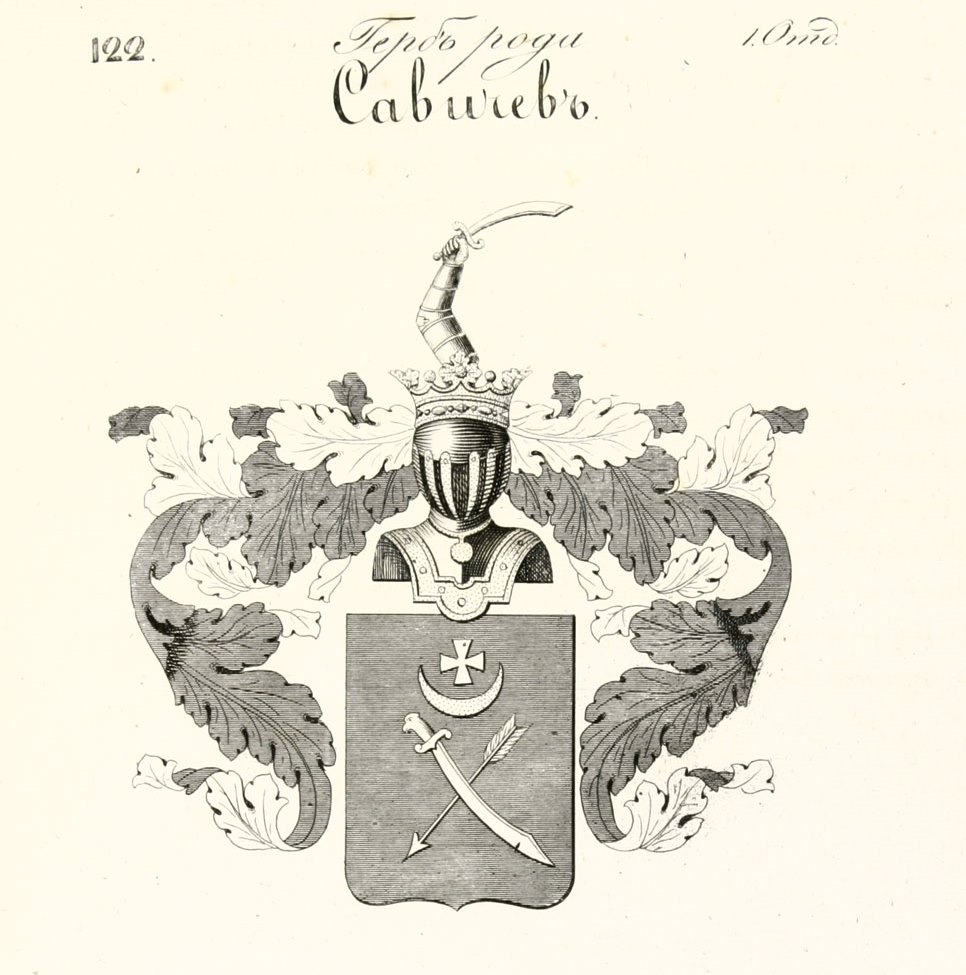
These days, the topic of family dynasties is quite popular in popular culture. Various TV series and books (both fiction and non-fiction) that recount the rises and falls of famous families (such as the Borgias, the Medici, the Rockefellers) are quite in demand. It’s a shame that we know so little about the Sloboda Ukraine dynasties, whose members may not have been emperors, bankers, or Popes. Yet there are many such families in the lands of Sloboda Ukraine. Take, for example, the Savich family. I can’t say anything about intrigues, the poisoning of enemies, or conspiracies, but the history of this noble family and the achievements of its members, as well as their role in the history of our region, in my opinion, fully deserves a book or a film adaptation. In the book *General Armorial*, we read the following about one of the oldest families of Sloboda Ukraine:
“The shield, which has a blue field, depicts a silver cross with a golden moon beneath it, its horns pointing upward; at the bottom, a silver saber and an arrow, point down, are placed in a cross-like formation. The shield is surmounted by a nobleman’s helmet and crown, on the surface of which a hand in armor holding a saber is visible. The mantling on the shield is blue, lined with silver.
Their ancestors served in the Little Russian ranks in 1690 and 1718; by letters of grant from the sovereigns, Tsars and Grand Dukes Ivan Alekseevich and Peter Alekseevich, they were granted estates…”
Over time, the Savich family grew so large that the distinguished historian, heraldist, and genealogist Vadim Lvovich Modzalevsky, in the fourth volume of his seminal work *The Genealogy of Little Russia* (1914), devoted pages 433 through 476 to describing this family. He also noted that this surname encompasses many families of various origins, but he included in the book only the four oldest families, tracing their lineage back to the following founders:
1) The descendants of Savva Prokopovich, a centurion in Voronezh in 1669 and, from 1672, chief clerk of the military court.
2) The descendants of Savva Kirillovich-Lubensky, a regimental centurion (March 1671–February 1672, January 1695) and a regimental judge.
3) The descendants of Savva Grigorievich, a centurion in Voronezh from 1672 to 1687.
4) The descendants of Savva Fedosenko, a townsman of Chernihiv who lived in the late 17th century.
Of these families, the descendants of Savva Prokopovich are most closely associated with Sloboda Ukraine; their numbers were so great that Vadim Lvovich Modzalevsky mentions more than 160 of his descendants alone in his book. It is difficult to know where to begin when writing about a family that owned numerous settlements in the Sumy and Lebedyn districts (according to documents from 1860, which listed the noble estates of the Kharkiv Governorate “with 100 souls or more”).
In the 19th and early 20th centuries, the Savich family played an active role in the life of their hometown, Sumy, and the entire district. In the “Minutes of the Sumy County Zemstvo Assembly” from the 60s to the 80s of the 19th century, one often encounters the names of Nikolai Nikolaevich, Konstantin Alexandrovich, and Andrei Andreevich. In 1879, Nikolai Nikolaevich, Vladimir Nikonorovich, Mikhail Alekseevich, and Veniamin Andreevich Savich were elected magistrates for the Sumy County. This family was also no stranger to philanthropy and patronage of education. After all, the Savichs were also trustees of various schools. For example, in 1879, we read the following on this subject:
Konstantin Alexandrovich Savich, a landowner in the Sumy Uyezd (who, in 1863, established a school in the settlement of Belovodye using timber from his own forest), wishing to provide peasant children in the village of Zhuravki with the opportunity to learn to read and write, took it upon himself to oversee the construction of a building for the Zhuravki School and deposited 700 rubles in the Zemsky Bank in perpetuity in the name of the Zhuravki Zemsky School, so that the interest on this capital would be used to support the school in addition to the funds provided by the society; furthermore, he personally allocated provisions for a teacher who could also teach the Word of God: 24 poods of flour, 1 ½ chetverti of coarse grain, and one pood of butter. For its part, the society has raised 750 rubles for this construction, and the same amount is to be provided by the zemstvo. Thus, thanks to the efforts and dedication of Konstantin Alexandrovich Savich, the building’s rough frame was completed by March 12 and is now nearing completion.
K. A. Savich’s dedication and his love for the cause of public education fully deserve the gratitude of the Sumy Zemstvo.
The lists of “Sumy County Leaders of the Nobility” also include many members of the family.
— 1780–1782. Savich, Alexei Andreevich
— 1804–1806. Savich, Alexei Danilovich, titular counselor.
— 1813–1821. Savich, Nikolai Ilyich, major.
— 1828–1836. Savich, Andrei Alekseevich, Guard lieutenant.
— 1855–1866. Savich, Veniamin Andreevich, Navy Lieutenant.
— 1879–1884. Savich, Veniamin Andreevich, Navy Lieutenant.
But, as is often the case, most of Savva Prokopovich’s descendants made their names in the field traditional for many noble families—namely, military service. In the 19th century, many members of the Savich family held high ranks in the active army, participated in combat operations, and were decorated with military honors. In the first half of the 20th century, three brothers from this family became the most famous. However, they are recorded everywhere as Savvichs. The eldest of them, Pavel Sergeyevich, took part in the Russo-Turkish War of 1877–1878 and the Battle of Plevna. Having received numerous decorations, on December 12, 1900, he was promoted to major general for distinguished service and appointed general for special assignments under the commander of the Kyiv Military District. From 1903 to 1906, he served as governor of Kyiv.
The middle brother, Sergei, served as commander of the Separate Gendarmerie Corps from 1905 to 1907. During World War I, he served as commander of an army corps, then as chief of staff of the Southwestern Front, and so on. General of the Infantry Sergei Savvich was present at the abdication of Emperor Nicholas II on March 2, 1917.
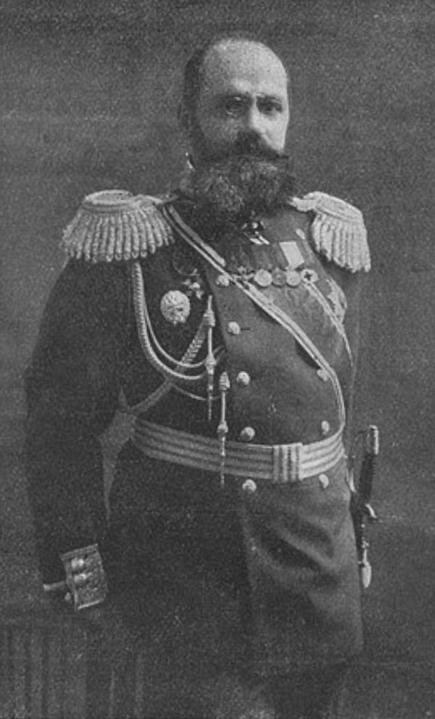
The youngest, Alexander, achieved no less military fame than his older brothers. He took part in the Russo-Japanese War, where he was wounded. On August 1, 1906, he became commander of the 123rd Kozlovsky Infantry Regiment, with which he went to the front in 1914. He then commanded the 81st Infantry Division and was wounded several times. In March 1920, along with other White Army officers, he was evacuated from Novorossiysk to Egypt, where he died in 1951.
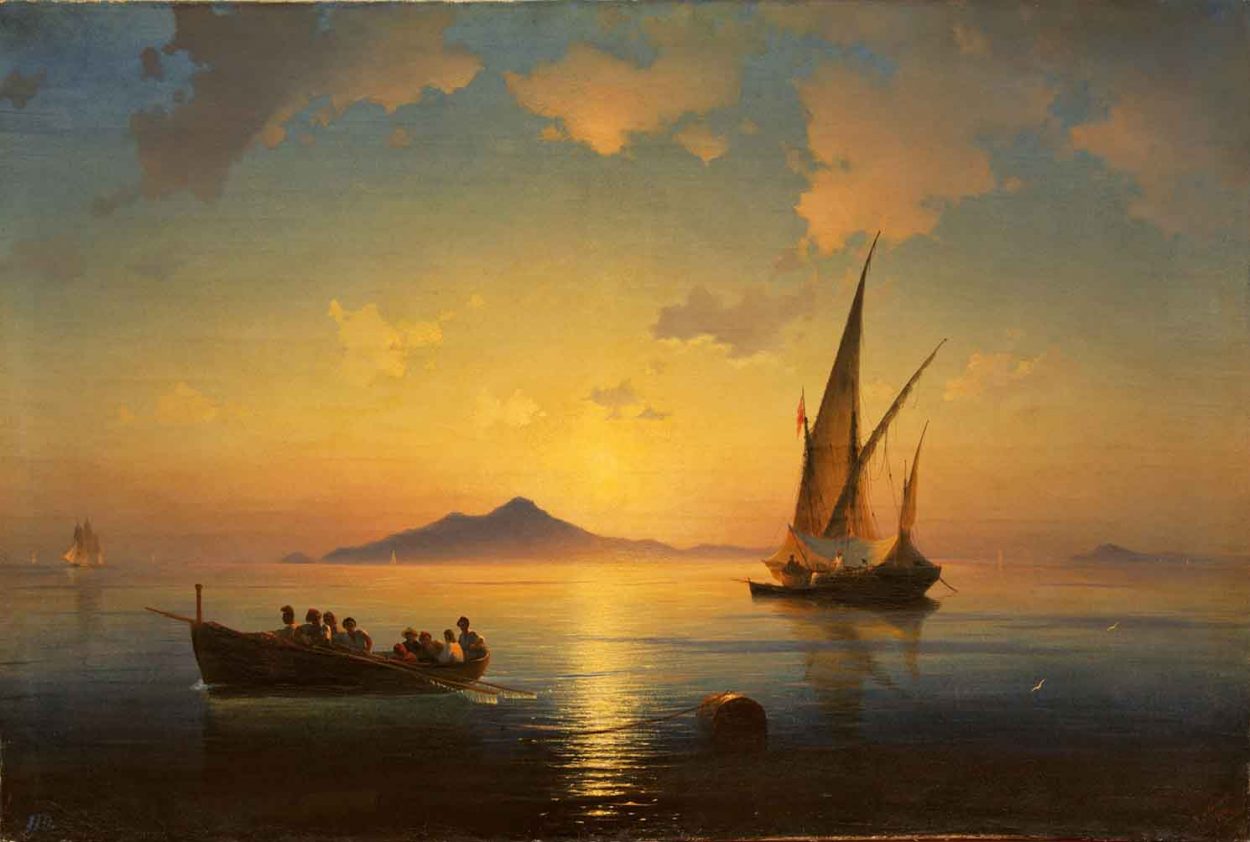
Quite a few members of the Savich family also distinguished themselves in naval service. For example, in 1821, Alexei Petrovich served as a midshipman on ships of the Black Sea Fleet. He sailed to ports on the Azov and Black Seas. In 1823, he was transferred to the Baltic Fleet. From 1828 to 1830, aboard the brig “Telemachus,” he sailed from Kronstadt to Malta and participated in the blockade of the Dardanelles. He retired on January 4, 1832, with the rank of lieutenant commander. Another Savich, Nikanor Nikanorovich, left his family estate in Belovody (now a village in the Sumy region) in 1840 and enrolled in the Naval Academy as a cadet. From 1843 to 1845, he cruised in the Baltic Sea aboard the frigates *Maria* and *Pallada* and the ship *Vladimir*. He subsequently served on various ships, and on December 6, 1852–1853, already holding the rank of lieutenant on the frigate “Pallada,” he sailed from Kronstadt to the shores of Japan. He ended his naval career in 1859 with the rank of lieutenant commander. Although the most famous figure in this regard was Veniamin Andreevich Savich, a native of the village of Pysarivka in the Sumy District, who, after retiring with the rank of lieutenant in the navy, became the district leader of the nobility and took an active part in the zemstvo assemblies.
And, of course, the Savichs also found themselves in scandalous situations. For example, on October 14, 1866, Mikhail Nikolaevich, then a cadet in the 125th Kursk Infantry Regiment, was stripped of his nobility and expelled from service for resisting a sentry and other offenses.
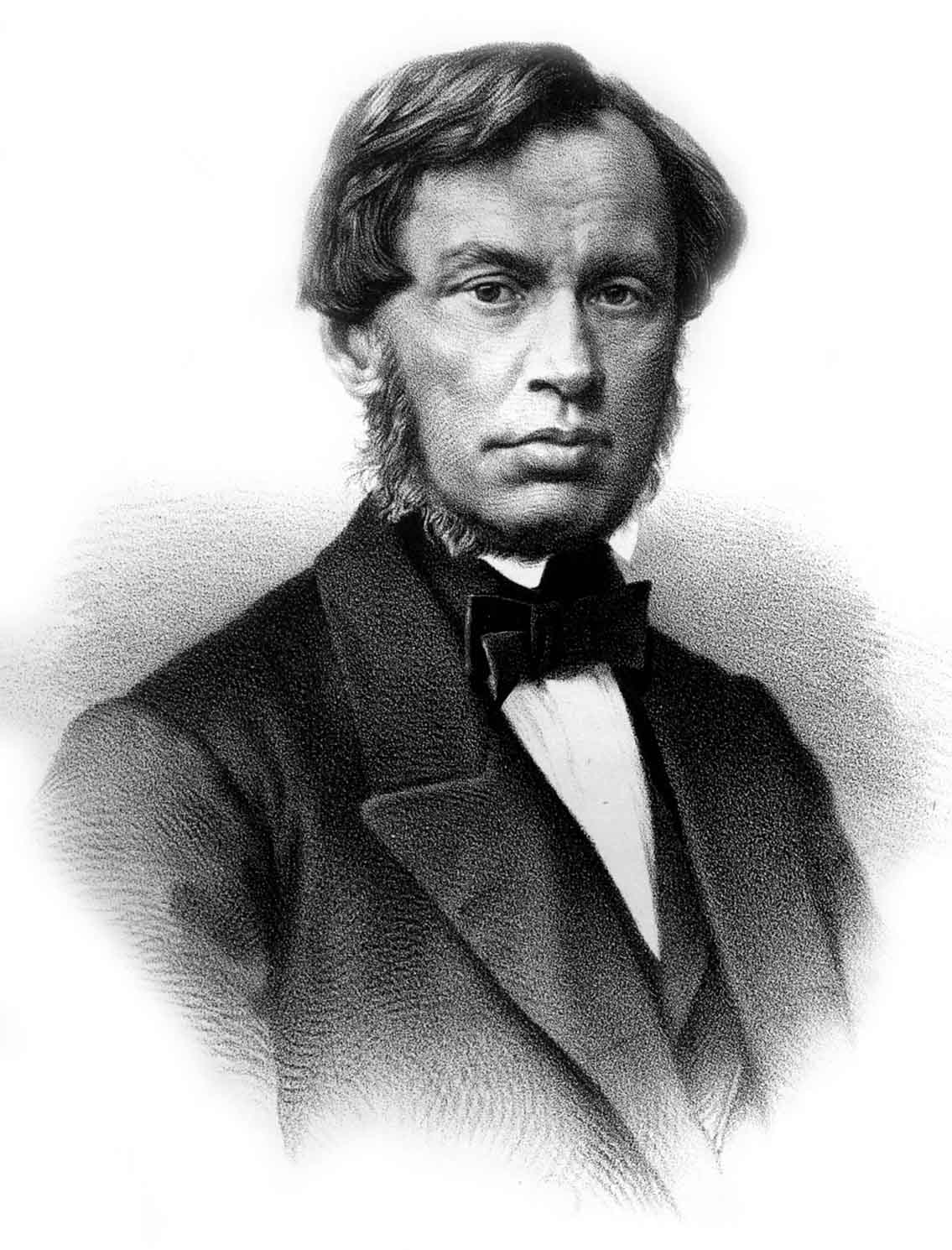
Of course, the Savichs did more than just fight in wars. Many members of this family taught at universities and served as lawyers and judges. Alexei Nikolaevich Pushkarevka, born in 1810 in the village of Pushkarevka in the Kharkiv Governorate, became a member of the Imperial Academy of Sciences and a renowned astronomer; he authored more than a hundred scientific works (some of which were translated into foreign languages) and took one of the most honored places among the astronomers of the Russian Empire in the second half of the 19th century.
One of the last members of the Savich family, Nikanor Vasilyevich, achieved success in politics, serving as a deputy from the Kharkiv Governorate in the Third and Fourth State Dumas from 1907 to 1917. He was regarded there as an expert on maritime affairs, and we know the reason for this. Nikanor did not accept Soviet rule, and in November 1920, together with the White Army, he evacuated to Constantinople, where he became deputy head of the financial department under the commander-in-chief, Baron Pyotr Nikolaevich Wrangel. While living in exile in Paris, he wrote excellent memoirs, which were published in 1993.
One of my favorite sayings goes, “Loving what is yours doesn’t mean hating what belongs to others,” but here’s the problem: we don’t really know what is ours. And that’s a real shame because there were indeed many distinguished and powerful dynasties in the history of our region—such as the Savichs—who played a significant role not only in the Kharkiv Governorate but throughout the entire country.

- About the military pilot school and the airfield in Kharkiv… - 04.11.2020
- Kharkiv Artisans and the 1887 Exhibition - 17.08.2020
- Nikanor Savich—A Political Career by Mistake - 13.07.2020